



Will Iraqi-Saudi Rapprochement Undermine Iran’s Role in Iraq?
Posted on 05 November 2017 .
By Mustafa Saadoun for Al Monitor. Any opinions expressed here are those of the author and do not necessarily reflect the views of Iraq Business News.
Iraqi-Saudi relations have witnessed significant improvement after years of boycott that had worsened during Nouri al-Maliki’s rule between 2006 and 2014. On Oct. 22, the establishment of a Coordination Council between the two countries was announced.
Iran, which is seeking to expand its influence in Iraq, might not like this rapprochement, especially following the latest meeting between Iraqi Prime Minister Haider al-Abadi and Saudi King Salman bin Abdul-Aziz Al Saud that took place with US blessing when US Secretary of State Rex Tillerson attended the launching of the Coordination Council.
Former Iraqi Ambassador to the US Lukman Faily told Al-Monitor, “Over the past years, the US attempted to take serious steps to mend ties between Iraq and Saudi Arabia. With this development, the region’s geopolitics will change.”
Saudi newspaper Asharq al-Awsat reported that the Iraqi-Saudi rapprochement will “curb the appetite of the parties that cause stability,” in a clear reference to Iran, which Saudi Arabia always accuses of “destabilizing the situation in the region.”
The results of the US-brokered Iraqi-Saudi rapprochement started appearing when Tillerson asked Iranian militias to leave Iraq, saying that the Iraqi-Saudi rapprochement will "counter some of the unproductive influences of Iran inside of Iraq.”
Hashem al-Haboubi, the deputy secretary general of the Iraqi National Accord movement spearheaded by Iraqi Vice President Ayad Allawi, told Asharq al-Awsat that the Iraqi-Saudi rapprochement might help Iraq break free from Iranian control.
The Iraqi-Saudi rapprochement does not include the Iraqi state in its explicit form only, but also expands to political parties that are at odds with Iran such as the Sadrist movement led by Muqtada al-Sadr, who visited Saudi Arabia and the United Arab Emirates two months ago and headed to Jordan recently to visit King Abdullah.
Posted in Iraq Oil & Gas News, Politics, Security Comments Off on Will Iraqi-Saudi Rapprochement Undermine Iran’s Role in Iraq?
Saudi Arabia, Iraq to Reopen Border Crossing
Posted on 02 November 2017 .
By John Lee.
Saudi Arabia and Iraq are to discuss the opening a border crossing between the countries for the first time in 27 years.
On Tuesday, the Saudi Council of Ministers authorised the minister of finance to work with Iraq to draft an agreement on the re-opening of the Arar border post, which has been closed since Saddam Hussein invaded Kuwait in 1990, apart from its use for the Hajj and Umrah pilgrimages.
In a further sign of increasing cooperation between the neighbouring countries, state-owned Saudi Arabian Airlines (Saudia) has just resumed flights to Iraq after 27 years, following a similar announcement recently from Saudi budget airline Flynas.
(Source: Gulf Business, Saudi Gazette)
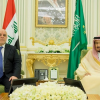
(Picture: King Salman bin Abdulaziz Al Saud in talks with Iraqi Prime Minister Dr. Haider Al-Abadi, 22nd October 2017)
Posted in Iraq Transportation News, Politics, Security Comments Off on Saudi Arabia, Iraq to Reopen Border Crossing

Saudia Resumes Flights to Baghdad after 27 years
Posted on 01 November 2017 .
Saudi Arabian Airlines (SAUDIA), the national carrier of Saudi Arabia, began operating nonstop flights between the airline’s hub in Jeddah and the Iraqi capital city of Baghdad on Monday.
The route will commence as a daily service until November 15, with double-daily frequency thereafter.
A single-class Airbus A330 will be deployed on the route, featuring 300 Guest Class (Economy) seats.
Linking the port city of Jeddah and Baghdad will provide a new air bridge and flexible connectivity for new business ties and growing economic development between the two nations.
The convenient schedule times departing at 12:35hrs from Jeddah, arriving into Baghdad at 15:00 hrs.
The second daily flight commencing November 16, will have a departure time from Jeddah at 03:50 hrs arriving at 06:15 hrs.
The total flying time between Jeddah and Baghdad is 2 hours 25 minutes (2 hours 50 minutes from Baghdad to Jeddah).
The route resumes after a 27 year interruption dating to 1990.
(Source: Saudia)
Posted in Iraq Transportation News Comments Off on Saudia Resumes Flights to Baghdad after 27 years

October Market Review: Changed Oil Dynamics & Liquidity
Posted on 30 October 2017 .
By Ahmed Tabaqchali (pictured), CIO of Asia Frontier Capital (AFC) Iraq Fund.
Any opinions expressed are those of the author, and do not necessarily reflect the views of Iraq Business News.
October was mostly a replay of the dog days of the summer as far as the market was concerned.
However, two developments are worth noting:
- the changed dynamics of oil prices with significant implications for local liquidity; and,
- emerging details of the Saudi led refinancing of the reconstruction of liberated territories.
Please click here to download Ahmed Tabaqchali’s full report.
Mr Tabaqchali is the CIO of the AFC Iraq Fund, and is an experienced capital markets professional with over 25 years’ experience in US and MENA markets.
His comments, opinions and analyses are personal views and are intended to be for informational purposes and general interest only and should not be construed as individual investment advice or a recommendation or solicitation to buy, sell or hold any fund or security or to adopt any investment strategy. It does not constitute legal or tax or investment advice. The information provided in this material is compiled from sources that are believed to be reliable, but no guarantee is made of its correctness, is rendered as at publication date and may change without notice and it is not intended as a complete analysis of every material fact regarding Iraq, the region, market or investment.
Posted in Ahmed Tabaqchali, Investment Comments Off on October Market Review: Changed Oil Dynamics & Liquidity

Iraqi PM Abadi Due in Tehran Wednesday
Posted on 25 October 2017 .
Iraqi Prime Minister Haider al-Abadi is scheduled to pay an official visit to Iran on Wednesday as part of a regional tour.
Leading a high-ranking politico-economic delegation, the Iraqi primer will arrive in the Iranian capital on Wednesday.
During his stay, he is planned to meet with Leader of the Islamic Revolution Ayatollah Seyed Ali Khamenei and Iranian President Hassan Rouhani.
Arriving from Egypt, Abadi met Jordanian King Abdullah II during his several-hour visit to Amman late Sunday.
Abadi began his regional tour, which will later take him to Kuwait, with a visit to Saudi Arabia on Saturday.
(Source: Tasnim, under Creative Commons licence)
Posted in Investment, Iraq Industry & Trade News, Politics, Security Comments Off on Iraqi PM Abadi Due in Tehran Wednesday

First Saudi-Iraq Air Route in 27 years
Posted on 12 October 2017 .
By John Lee.
Saudi Arabian budget airline Flynas is reported to be planning to start services to several Iraqi cities in the coming weeks.
If the plan goes ahead, it would be the first service between the two countries since Saddam Hussein invaded Kuwait in 1990.
(Source: Middle East Eye)
Posted in Iraq Transportation News Comments Off on First Saudi-Iraq Air Route in 27 years
Anbar Locals Warn Against Re-Opening Border Crossing
Posted on 08 October 2017 .
This article was originally published by Niqash. Any opinions expressed are those of the author, and do not necessarily reflect the views of Iraq Business News.
Locals in Anbar celebrated when an important Iraqi-Jordanian border crossing was recently reopened. But the drivers who use it say many areas are still too dangerous to pass through.
When it was announced at the end of August that the Turaibil [Terbil] border crossing between Jordan and Iraq would reopen, there were celebrations. The border point, which facilitates trade between the two countries, was closed in late 2014 because the extremist group known as the Islamic State, or IS, had taken control of the areas in Anbar province leading toward the crossing.
“Opening the Turaibil crossing is urgently needed,” Faleh al-Issawi, the deputy head of Anbar's provincial council, told NIQASH. “Other provinces are slowly becoming more stable and secure again and we too are working to restore our economy and our commercial facilities. The time has come for Anbar to go back to what it was before.”
Anbar sits between three countries – Syria, Jordan and Saudi Arabia – and between four Iraqi provinces. Traders must cross Anbar and locals know they could be exploiting that business. The re-opening of Turaibil has them hoping they will be able to.
On the Jordanian side of the border, everything was apparently ready for Turaibil to re-open. But the Iraqis haven’t been so fast. Most bridges and rest stops on the way there have been destroyed in recent fighting in the province and some areas that the road passes through are still dangerous.
Al-Issawi explains that they have a plan for this. Trucks will be escorted by security forces once they cross into Iraq, right up until they reach another completely secure area. The truck drivers won’t pass through the cities of Ramadi or Fallujah, both of which had been under control of the IS group, before heading to Baghdad or southern and northern provinces directly.
Posted in Iraq Industry & Trade News, Iraq Transportation News, Security Comments Off on Anbar Locals Warn Against Re-Opening Border Crossing

Iraqi Sentiment may be Softening toward Israel
Posted on 29 September 2017 .
By Adnan Abu Zeed for Al Monitor. Any opinions expressed here are those of the author and do not necessarily reflect the views of Iraq Business News.
Iraqi Citizens' Sentiment may be Softening toward Israel
Some Iraqis are calling for closer relations with Israel, feeling a common bond of past persecution and a desire for peace and stability. Many people might find two factors cited in this change quite surprising: Iraqis' guilt, and some resentment of Palestinians.
"There is a dramatic shift that has changed [Iraqi] public opinion [toward Israel] as a result of the Palestinians' involvement in supporting the [late Iraqi] dictator Saddam Hussein and thus getting involved in terrorist operations," writer and political analyst Ali Mared al-Asadi told Al-Monitor recently by phone.
"Most Shiites in Iraq have a sense of guilt because they did not support the peaceful Jewish community with whom they lived for hundreds of years in peace and harmony in one homeland, but who were persecuted and displaced during the monarchy [1958-1963] and the Baathist regime [1968-2003] eras.”
Much of the fanaticism and hostility toward Israel appears to have declined in central and southern Baghdad, where the majority of people are Shiite.
On Sept. 9, Asadi wrote, “It is not in the interest of Shiites to antagonize Israel. Shiites and Jews ought to reach understandings based on common humanitarian grounds that guarantee peaceful coexistence in the Middle East.”
Asadi told Al-Monitor by phone, “If we put the influence of Iran and the remnants of the Baathist culture aside, Iraq would have no excuse to keep officially antagonizing Israel, especially since the majority of the Arab states, [even] the Palestinian state itself, hold relations with Tel Aviv.” Asadi apparently was referring to Arab states having contacts or other ties with Tel Aviv, because most Arab states do not formally recognize Israel..
Many Sunnis also seem to favor closer ties. Political analyst Maher Abed Jawdah told Al-Monitor, “Even Iraqi Sunnis are in tune with Sunnis in Saudi Arabia, Jordan and the Gulf countries in establishing good relations with Israel, mainly because they are driven by the same hate toward Iranian Shiites, who are very hostile against Israel.”
Much of the favorable sentiment in Iraq is coming from Kurds. Israeli Prime Minister Benjamin Netanyahu (pictured) supports the Kurdish quest for an independent state in northern Iraq. This has pushed some Kurds to promote the idea of openness to Israel and to call for turning their relationship into an official one. Some media outlets even showed Kurdish cities raising the Israeli flag next to the Kurdish flag as they prepared for a Sept. 25 vote on a nonbinding independence referendum, which passed overwhelmingly.
Posted in Politics, Security Comments Off on Iraqi Sentiment may be Softening toward Israel

Iraqi Farmers fight against Imported Goods, Corruption
Posted on 19 September 2017 .
By Adnan Abu Zeed for Al Monitor. Any opinions expressed here are those of the author and do not necessarily reflect the views of Iraq Business News.
The Tureibil crossing, or more commonly known as the Karameh border crossing, between Jordan and Iraq reopened in early September in tandem with the opening of another border crossing with Saudi Arabia. This means that more foreign goods are likely to flow into the Iraqi market, which already lacks national products, especially food and agricultural goods.
The prospects for increased imports, which is not good news for the local production industry in Iraq, prompted parliament’s Agriculture, Water and Marshlands Committee on Aug. 14 to accuse the Ministry of Agriculture of mismanagement and confusion in supporting these foreign goods, which caused the local market to become flooded with imported products.
Mohammed Mansouri, an expert on local livestock, warns against “a catastrophe in the sector of livestock and agriculture in Iraq,” urging the government to work “on achieving food security.”
However, the failure of agricultural projects in Iraq is not only the result of poor planning and management, but also a “corrupt agenda seeking to keep this sector lagging so as to continue relying on imports,” said Ali al-Badiri, a member of the Agriculture, Water and Marshlands Committee, in a media statement Aug. 24. “Impeding the cultivation of wheat crops is a conspiracy, as this cultivation has become a threat to the investments of the corrupted,” he said.
In the same vein, Suhaila Abbas, the head of the Agriculture Committee of the Babil Governorate Council, told Al-Monitor, “Linking food security to importation is not due to technical problems such as drought or the rudimentary irrigation and land treatments techniques, as these can be addressed through development plans. This is, however, due to political reasons. Many of Iraq’s neighbors have an interest in keeping Iraq unable to become self-sufficient in terms of food, so it continues importing food products.”
Posted in Agriculture Comments Off on Iraqi Farmers fight against Imported Goods, Corruption
Iraq sends Envoy back to Iran with Little to Show
Posted on 17 September 2017 .
By Ali Mamouri for Al-Monitor. Any opinions expressed are those of the author, and do not necessarily reflect the views of Iraq Business News.
Ayatollah Mahmoud Hashemi Shahroudi, the newly appointed chairman of Iran’s Expediency Council, visited Iraq recently, fueling speculation about his political agenda. His meetings indicate that he most likely was seeking to unify Shiites ahead of the 2018 elections, although he doesn't appear to have succeeded.
Shahroudi, who is a dual Iranian-Iraqi citizen and was a senior leader in the Islamic Dawa Party and the Islamic Supreme Council of Iraq before he became involved in Iranian politics, was warmly welcomed by those two groups, but later in his weeklong visit, he found himself snubbed by others.
Sheikh Humam Hamoudi, a leader of the Islamic Supreme Council and the first deputy parliament speaker, greeted Shahroudi at the airport on Aug. 31. Later, Shahroudi met with Iraqi Prime Minister Haider al-Abadi and with Nouri al-Maliki, the leader of the Islamic Dawa Party and a vice president of Iraq.
In Najaf, however, Shahroudi was not welcomed at all. He did not meet with any of the four leading religious authorities there, even though he is one of the most prominent graduates of the Hawza (Shiite seminary) in Najaf and most likely knows all four clerics from the years he studied there.
Sadrist movement leader Muqtada al-Sadr also refused to meet with him.
Sources close to Grand Ayatollah Ali al-Sistani in Najaf said religious authorities there refused to receive Shahroudi — even though they knew in advance about his visit — because they resent some aspects of Iran's policies regarding Iraq. It seems the rejection was a source of embarrassment to Shahroudi when he returned home, where he issued a statement that his visit was not an official one but merely a religious trip “to the holy sites and shrines of holy Imams.”
Posted in Politics, Security Comments Off on Iraq sends Envoy back to Iran with Little to Show