



Video: Civil War Fears Rising
Posted on 11 June 2013 .
From Jewish News One. Any opinions expressed are those of the authors, and do not necessarily reflect the views of Iraq Business News.
A wave of car bombings in central and northern Iraq has killed at least 57 people, heightening fears that the country may be returning to sectarian civil war.
No group has claimed responsibility for the series of attacks, but officials blame most of the violence that has killed nearly 2,000 people since April on Sunni Islamist insurgents linked to al Qaeda's local wing, known as the Islamic State of Iraq.
Iraq civil war fears: PM Maliki vows action against extremists as sectarian violence spirals.
Iraqi Prime Minister Nouri al-Maliki has vowed to confront sectarian militants following a recent spate of car bombings in Baghdad that have left over 75 people dead.
Al-Maliki, a Shia Muslim, was flanked by four ministers at the news conference, including two senior Sunni politicians, in an apparent display of unity:
Posted in Security0 Comments

Video: Attacks on Sunni Mosques
Posted on 18 May 2013.
From Jewish News One. Any opinions expressed are those of the authors, and do not necessarily reflect the views of Iraq Business News.
There has been a sharp rise in attacks on Sunni holy sites in Iraq, causing a fear that the country could face more sectarian violence reminiscent of the bloodshed that the country experienced back in 2006 to 2007.
Posted in Security0 Comments

Video: Iraq – ‘Disciplining’ the media
Posted on 06 May 2013.
From Jewish News One. Any opinions expressed are those of the authors, and do not necessarily reflect the views of Iraq Business News.
In Iraq, tensions have again flared up in a new wave of deadly attacks against political and sectarian targets. Iraqi media, especially outlets that speak to the Sunni minority, called it a crisis out of the government’s control.
Then, when government forces loyal to Prime Minister Nouri al-Maliki killed 27 Sunni protesters, Iraq’s private media erupted with rage. Anger on the privately-owned airwaves spelled trouble for the government and Maliki’s response was to shut down 10 satellite TV stations — including Al Jazeera’s Arabic language channel — for propagating an “undisciplined media message”.
All but one of the channels are aligned with Sunni financial backers, and the government’s move is being seen as a crackdown on dissent by Maliki’s majority Shia government.
In Iraq’s factionalised media landscape, who you are largely determines who you listen to. So for Maliki, silencing Sunni TV was nothing less than removing a weapon from the hands of his rivals. For the Sunni minority, Maliki’s move was just one more sign that their rights and interests are under attack.
This week’s News Divide looks at both sides of the struggle. Speaking for the government is Ali Al-Shalah, the president of the Iraq Culture and Media Committee; assessing the government’s actions are Dahr Jamail, a producer for Al Jazeera English, Arab media analyst Nehad Ismail and Ammar Shahbander from the Institute of War and Peace Reporting:
(Source: Al Jazeera)
Posted in Communications, Security0 Comments

Video: Media Regulator Muzzles TV Networks
Posted on 01 May 2013.
From Jewish News One. Any opinions expressed are those of the authors, and do not necessarily reflect the views of Iraq Business News.
In a blow to freedom of the press in Iraq, the country’s media regulator has announced it has suspended the licences of ten satellite news networks, including Qatar-based Al Jazeera.
The Communication and Media Commission (CMC) regulator took the action after accusing the networks of inciting violence through their coverage of deadly clashes triggered by a security force raid on a Sunni Muslim protest camp last week:
(Source: Jewish News One)
Posted in Communications, Security0 Comments

Video: Maliki Calls for Talks to End Violence
Posted on 30 April 2013.
From Jewish News One. Any opinions expressed are those of the authors, and do not necessarily reflect the views of Iraq Business News.
Iraqi Prime Minister Nuri al-Maliki has called for talks to end the violence that has entered a third day in the country’s north where Sunni Muslims are angry over a raid on an anti-government protest camp.
Security forces had stormed a protest camp igniting a gun battle between troops and protesters killing some 50 people, the worst clashes in the country since the US pulled out its forces in 2011:
(Source: Jewish News One)
Posted in Security0 Comments

Video: Landmark Iraq Provincial Councils Vote
Posted on 22 April 2013.
From Jewish News One. Any opinions expressed are those of the authors, and do not necessarily reflect the views of Iraq Business News.
Polls have closed in Iraq in the first elections since the US troop withdrawal. Iraqis were voting to elect members of provincial councils in 12 of the country’s 18 provinces:
(Source: Jewish News One)
Posted in Politics0 Comments

Video: Iraq on Terror Alert
Posted on 15 April 2013.
From Jewish News One. Any opinions expressed are those of the authors, and do not necessarily reflect the views of Iraq Business News.
With the Iraqi provincial elections now just days away, members of the police force and army have cast their votes ahead of time, with lines developing outside polling stations across the country, including in Baghdad and Basra:
(Source: Jewish News One)
Posted in Security0 Comments

Video: Jihadis in Iraq and Syria Joining Forces
Posted on 06 April 2013.
From Jewish News One. Any opinions expressed are those of the authors, and do not necessarily reflect the views of Iraq Business News.
Iraqi intelligence officials have said a cross-border alliance is growing between the Islamic extremist groups al-Qaeda in Iraq, and the al-Nusra Front in Syria.
(Source: Jewish News One)
Posted in Security0 Comments


Posted in Security Comments Off on Video: Civil War Fears Rising

Why I Still Like North Bank
Posted on 17 May 2013 .
By Mark DeWeaver.
I thought Sansar Capital’s recent report on the Iraqi banks was excellent. But I was surprised by its somewhat negative take on North Bank (BNOR). In particular, I found myself not entirely convinced by the following three points, which form the basis for their bearish case:
- Insufficient collateral for overdraft lending is a significant risk. Actually, this is only true if the bank has no ability to assess the cashflow situation of its customers. This is unlikely to be true of BNOR’s corporate overdraft clients, which include large cash-rich companies such as Asiacell.
- The new Central Bank of Iraq (CBI) auction rules threaten the growth of BNOR’s forex business. This will only be true if the bank’s customers are unable to find a way around the rules. But in fact they have in the past displayed considerable ingenuity in adapting to the CBI’s ever-changing forex policies. It’s not clear why this time should be different.
- The absence of auditors’ qualifications in the English translation of the 2011 annual report implies an effort to mislead foreign investors. Maybe. But in the bank’s favor, it’s worth pointing out that (1) these qualifications did not appear in the Arabic version of the 2012 annual report, (2) unlike most of the other banks, BNOR has at least gone to the trouble of having its annual report translated, and (3) when meeting with the bank’s management in person I have always found them to be extraordinarily candid.
In addition to this, the bank is one of Iraq’s best capitalized, being one of only three to have reached the CBI’s IQD 250 bn share capital target. It has also been one of the top performing names in the Iraqi market. Adjusted for capital increases, the shares have risen by over 250% since 2009.
What’s not to like?
Posted in Investment, Iraq Banking & Finance News, Mark DeWeaver on Investments and Finance 2 Comments

North Bank Under the Spotlight
Posted on 16 May 2013 .
By Padraig O'Hannelly.
At Iraq Business News we've always been clear that Iraq is a land of both opportunities and risks. The challenge for any investor or businessperson has always been to decide what risks are worth taking, and at what price.
In the investment arena, real out-performance can only come from having a different view from that of the market -- what hedge fund veteran Michael Steinhardt dubbed a 'variant perception'.
This means, for example, that if you want to beat the market by picking shares to buy, you must believe that the market has undervalued them.
But scanning through the excellent report from Sansar Capital on the banking sector in Iraq, which we made available to readers last week, one bank share stood out as possibly overvalued.
While being generally very positive on the sector as a whole, the analysis of North Bank (BNOR) raised a number of concerns, including: dependency on foreign-exchange activities that "are likely to shrink significantly"; risk of significant losses from over-draft facilities; a high level of off-balance sheet leverage; and "selective mistranslation" from Arabic to English.
The report goes into more detail on these issues, and says the bank's auditors point out that many off-balance-sheet credit facilities are given out in a concentrated manner and with insufficient collateral. If that's the case, potential investors, and indeed depositors, must be asking themselves if this is evidence of poor risk management, or perhaps something worse.
Yet, despite these possible warning signs, shares in North Bank were trading on valuations similar to those of their peers. Whether Mr Market is right or wrong remains to be seen.
Please click here to read Mark DeWeaver's article, "Why I Still Like North Bank".
Posted in Blog, Investment, Iraq Banking & Finance News Comments Off on North Bank Under the Spotlight
ISX Clarifies Custody Situation
Posted on 13 March 2013 .
By Mark DeWeaver.
On March 3, the ISX posted the following notification on its website:
“No institution or competent body has requested a license to act as custodian pursuant to Decree No. 17 of 2012.
“Therefore, the Depository Centre remains the sole body conducting the transfer of securities from the account of the investor [registered] with the Centre to the account of the investor [registered] with the broker and vice versa in accordance with the procedures and applications of electronic trading on the Iraqi Stock Exchange.
“Please be advised of the above and [of the fact that] the Board of Governors has a plan to encourage Iraqi and non-Iraqi financial and banking institutions who wish to provide this service.”
(The original Arabic version is available here. Hat tip Ali Albazzaz for this excellent translation.)
This took me a bit by surprise. As I wrote in my last post, National Bank of Kuwait (NBK) seems to be all set to start custodying Iraqi shares. Fellow Iraq fund manager Ali Albazzaz and I also coauthored two articles that mentioned NBK’s custody breakthrough--one for the Financial Times “Beyond Brics” blog, the other for the Emirates leading English-language paper, the National.
Has the ISX contradicted our story? Well, not really. We were wrong about NBK’s subsidiary Credit Bank of Iraq (BROI) having a custody license. They actually have a letter of authorization from the ISX Board of Governors. Thus, BROI’s authorization comes from the ISX rather than the Iraq Securities Commission, which issues licenses.
But does this make any difference to the foreign investor?
Given that custodians do not usually take over the functions of depository centers, it is also unclear what the second point in the notification signifies. Presumably the Iraq Depository Center (IDC) would transfer shares among depository center accounts in any case. Is the ISX simply making sure everyone understands that NBK will not be replacing the IDC?
Finally, what is the Board of Governors' plan to encourage those who wish to provide this service? Will the ISX be using Letters of Authorization as a means to do this, as the case of NBK might suggest?
Given the importance of the custody issue to foreign investors, it would be helpful to have a bit more clarity on what the ISX is trying to tell us.
Posted in Investment, Mark DeWeaver on Investments and Finance 2 Comments
NBK Makes Custody Breakthrough
Posted on 22 February 2013 .
By Mark DeWeaver.
In a move that is likely to mark the start of a new era for the Iraq Stock Exchange (ISX), National Bank of Kuwait (NBK) has begun offering custody support services for ISX-listed shares through its 80%-held subsidiary Credit Bank of Iraq. This is arguably the most important step forward for the ISX since the implementation of electronic trading in 2009. At last the door is open for large institutional investors to enter the Iraqi market. (See this post for more on the significance of the custody issue.)
Credit Bank of Iraq received a letter of authorization to offer custody support services at the end of last year and just “went live” in January. So far the business has focused on custodying shares from the Asiacell IPO but they are now set up to custody all the existing names as well.
NBK will be an acceptable counterparty both for institutional investors and (as a subcustodian) for global custodians. With about US$ 58 billion in assets, it is Kuwait’s largest bank and also one of the largest in the Middle East. It has also been on Global Finance magazine’s list of the world’s fifty safest banks for the past six years and is the top rated bank in the region. In addition, NBK’s custody services now cover not only Iraq but also the GCC and Egyptian markets—an important consideration for institutions looking for a “one-stop shop.”
With a custodian of this caliber on board, the ISX is now in a position to mobilize significant amounts of foreign capital. This is important not only because the listed companies will have greater access to financing but also because increased participation by international investors will incentivize the introduction of best practices at local financial institutions. NBK’s custody breakthrough is thus a breakthrough not only for the Kuwaiti bank and its clients but for Iraq’s capital markets as well.
Posted in Investment, Mark DeWeaver on Investments and Finance 5 Comments

A Big Week For the Iraqi Stock Market
Posted on 07 February 2013 .
The long-awaited first IPO of an Iraqi mobile phone provider has finally come to pass, with the commencement of trading in the shares of Asiacell on the Baghdad stock exchange this week.
The fundraising -- described by our Expert Blogger Mark DeWeaver as "a Nobel prize-winning IPO" -- was a major achievement, effectively doubling the market capitalisation of the stock market overnight, and has succeeded in confounding the sceptics.
Look out for similar floatations to come from Asiacell's rivals, Zain Iraq and Korek.
Meanwhile, this week at Iraq Business News, we are delighted to welcome a new Expert Blogger: Tom Walker is Director of Assaye Risk, and will give us a weekly update on security developments in Iraq, as well as additional views and analysis in his blog.
You can read his first security update here, and we look forward to getting more of his perspectives on security in Iraq.
Whether you're in telecommunications, security, or any other sector of the Iraqi economy, Upper Quartile and AAIB are here to help you. For more information please contact Gavin Jones or Adrian Shaw.
Posted in Blog Comments Off on A Big Week For the Iraqi Stock Market
A Nobel Prize Winning IPO
Posted on 06 February 2013 .
By Mark DeWeaver.
I've often thought there should be a Nobel prize for corporate finance. It would go to the broker or investment bank that managed to place the largest IPO under the most unpromising circumstances. If there were such an award, I think Rabee Securities and its affiliate Melak Iraq would easily win this year after single handedly placing over US$ 1.25 billion worth of Asiacell shares. (There's more on the Asiacell IPO here and here.)
This IPO presented a number of extraordinary challenges. Consider the enormous size of the offering, which was equivalent to almost a quarter of the entire ISX market cap. It never seemed possible that a block of shares this large could be entirely absorbed by local investors. Yet foreign investment banks decided to pass on the deal, which also made it seem unlikely that the shares could be placed abroad.
In the absence of a securities law, the IPO also had to be done without an underwriter. There was no guarantee that the entire offer would be taken up, nor could a single price be set for the shares based on investors’ bids. Instead, a minimum price was set (IQD 22) and the bids were simply fed into the exchange’s normal order-matching system. Investors had relatively little assurance that the price they paid would turn out to be a real market clearing price.
Yet despite these difficulties, Rabee and Melak have managed to pull off the largest IPO in the MENA region in the last five years. Congratulations to both for a job well done!
Posted in Investment, Mark DeWeaver on Investments and Finance Comments Off on A Nobel Prize Winning IPO
ISX Cracks Down on Speculators
Posted on 08 January 2013 .
By Mark DeWeaver.
On December 13 the ISX amended the Iraq Depository Center (IDC) bylaws to prohibit investors from owning the same names in accounts at different brokers. The new rule, which went into effect on January 7, requires anyone holding stocks in the same company through different brokerage accounts to transfer all of their shares to just one of them. The ISX may penalize those who don’t comply by barring them from trading.
This change is evidently intended to crack down on share price manipulation. Ramping share prices is easy to do if you can sell shares back and forth between two accounts. You simply sell the shares to yourself multiple times at higher and higher prices. Then, once ordinary investors start to jump on the bandwagon, you gradually sell off your holding to them and get out at a profit.
It’s easy to see why the ISX should be cracking down on such behavior at this point. With the Asiacell IPO starting this month, ISX officias are understandably focused on maintaining an orderly market. There were also a few names that had been limit up for several days prior to the announcement and fell sharply immediately afterward. In hindsight, these cases look more than a little suspicious.
This rule change won’t end share price manipulation for long, however. In the very short term, speculators may have been caught off balance because they will no longer be able to use some of their brokerage accounts. But it won’t take them long to set up new accounts in different names. Then they will quickly get back to business as usual.
Posted in Investment, Mark DeWeaver on Investments and Finance 8 Comments

Energy Companies no Proxy for ISX
Posted on 13 December 2012 .
The latest article from our Expert Blogger Mark DeWeaver gives a concise overview of the fall and rise of the Iraqi Stock Market (ISX) over the past 15 months, and of some of the factors driving (and not driving) it.
For the average non-Iraqi retail investor, however, it is difficult to participate in this market, and for reasons discussed in the article that may remain the case for some time.
Exposure to companies whose fortunes depend on business in Iraq is the nearest most individuals can get to exposure to the ISX, but the two approaches should not be confused. The Iraq-focussed companies that are traded on the international stock exchanges are predominantly in the energy sector, and their share prices will be driven more by oil price forecasts and the expected quality of their real estate than by Iraqi business in general.
Oil companies are not a proxy for the Iraqi stock market.
Posted in Blog, Investment, Iraq Oil & Gas News Comments Off on Energy Companies no Proxy for ISX
A Home-grown Rally
Posted on 12 December 2012 .
By Mark DeWeaver.
Another roller coaster year for the ISX is drawing to a close. By the middle of May, the Rabee Securities RSISX index had fallen 24% from its early October 2011 peak. Since then, the market has staged a dramatic rebound. As of December 8, the index was down just 3% from the October high and up 8% for the year.
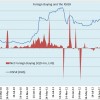
This rebound is all the more remarkable because it has occurred in the absence of any pick up in foreign participation. In 2011 foreigners were net buyers in 97% of the trading weeks with a share of monthly volume that exceeded 10% in all but three months. This year, foreign net buying has fallen sharply. (See chart.) Foreigners have been net sellers in about 40% of the trading weeks so far. Their monthly-volume share has exceeded 6% in only two months. (See the latest Rabee Securities Weekly for a nice chart of the foreign share of monthly volume.)
There is also no obvious catalyst for fresh inflows of foreign money at this point. While the regulators have finally decided to offer custodian bank licenses, HSBC has apparently lost interest in providing share custody in Iraq and no one else has stepped up to take its place. (See this post for more on the custody issue.) EFG-Hermes also seems to have suspended its swaps program, shutting down another potential channel through which institutional investors might have accessed the market. (There’s more on the EFG swaps here.) Even the much-vaunted Asiacell IPO, which I once thought might at last put the ISX on foreign fund managers’ radars, now appears to be targeted mainly at local individuals.
This failure to attract outside money is not the end of the world, however. When the right economic fundamentals are in place, emerging markets can easily go up without foreigner investors. Think of the largely closed Chinese and Saudi markets for example. Or Kuwait’s infamous Souk al Manakh, which rose to such dizzy heights in 1982 that it was briefly the third largest market in the world after the US and Japan.
For the ISX to keep going up, problems like share custody don’t really need to be solved. The important thing is for the Iraqi economy to stay on its current high-growth trajectory. As long as the listed companies' earnings are growing at double digit rates and local investors are flush with cash there’s really no reason why this year’s home-grown rally shouldn't continue into 2013.
Posted in Investment, Mark DeWeaver on Investments and Finance 2 Comments