


Why Two Exchange Rates?
Posted on 02 April 2014 .
By Mark DeWeaver.
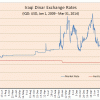
Since the Central Bank of Iraq (CBI) began changing the rules for its USD auctions in 2012, Iraq has been operating a de facto dual exchange rate system. (There’s a summary of some of the CBI’s recent rule changes on pages 12-14 of this report from Sansar Capital.) For those with access to the CBI auction—mainly banks and (as of March, 2013) importers using letters of credit—the rate has been fixed at IQD 1,166: USD 1.00. For the rest of us, the dinar has ranged from 1,194 to 1,292, with two major episodes of depreciation in mid-2012 and mid-2013 (see chart).
The ostensible purpose for this arrangement is to limit illicit outflows of foreign exchange to Iran and Syria. In practice, it serves mainly as a subsidy to banks, large importers, and anyone in a position to generate phony trade documents. The losers include everyone from foreign investors in Iraqi stocks to the government itself, which gets the CBI rate on its oil-export revenues.
Iraq is unusual in this regard. Dual (or even multiple) exchange rates are usually only found in countries suffering from chronic trade deficits and foreign exchange shortages. Typically the objective is to make foreign exchange available for “essential” imports or to control inflation by lowering import prices. Examples include Hitler’s Germany, China in the 1980’s and early ‘90’s, Burma prior to 2012, and Venezuela today. (See this note from the Asian Development Bank for an excellent introduction to this topic.)
It’s hard to see why Iraq belongs on this list. The country has a trade surplus, inflation is low, and the central bank has ample foreign exchange reserves. Even USD outflows to Iran are presumably no longer a major issue.
One exchange rate should be enough.
Posted in Investment, Mark DeWeaver on Investments and Finance 11 Comments
Another Look at Corporate Actions
Posted on 25 March 2014 .
By Mark DeWeaver.
In this old post from 2010, I considered the possibility that ISX share prices might fail to adjust completely for corporate actions. There didn’t seem to be much evidence for this but it was a bit hard to be sure. In those days, stocks would generally be suspended for a number of months following rights and bonus issues. Discrepancies between theoretical and actual ex rights prices might as easily be due to developments during the long intervals between cum rights and ex rights trading dates as to a failure to reflect changes in the number of shares in issue.
In September, 2011, the ISX changed the rules on stock suspensions to allow trading to resume within four weeks of shareholders’ meetings (see this post). Following this dramatic reduction in suspension periods it should be now easier to identify departures from theoretical ex-rights prices. Given the importance of corporate actions to ISX investors, I thought it would therefore be worth revisiting this question with some more recent data.
Since the end of 2012, the “Corporate Actions” table in the Rabee Securities monthly gives 78 examples of rights, bonus, and dividend issues. Taking out cases where the cum rights price was below IQD 1.00 (in which case minority shareholders would be unlikely to subscribe) and a few others where I thought the stocks were too thinly traded for the prices to be meaningful, I ended up with a sample of 49 observations.
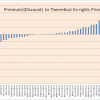
The chart shows the premium/(discount) of actual to theoretical ex-rights prices, where the theoretical price is the last traded cum-rights price adjusted for rights, bonuses, and dividends. For example, if the cum-rights price were IQD 2.00, following a 50% rights issue, a 30% bonus issue, and a IQD 0.25 dividend, the theoretical ex-rights price would be: (2.0+0.5-0.25)/(1.0+0.5+0.3)=1.25. (Note that the dates following the ticker symbols on the x axis are for the start of ex-rights trading.)
In half of the cases actual prices deviated by no more than 5% from the theoretical prices; two thirds of the time the difference was no more than 10%. Extreme examples of over- or under-adjustment were relatively rare.
Once again there doesn’t seem to be much reason to expect outsized gains or losses following corporate actions.
Posted in Investment, Mark DeWeaver on Investments and Finance Comments Off on Another Look at Corporate Actions

Does 'Mental Accounting' Matter?
Posted on 19 March 2014 .
By Mark DeWeaver.
ISX observers sometimes blame share price declines on people selling their recently listed bonus or rights issue shares. Such behavior would be interesting to document because it seems to imply a departure from perfect rationality. From the point of view of conventional finance theory, there just isn’t any reason to differentiate between different lots of the same name.
If you’re holding twelve shares of company X and today’s market price is IQD 2.00, for example, the only thing that should matter to you is that your position is now worth IQD 24.00. And the only thing that should matter for your sell decision is what you think the shares will be worth tomorrow. What you originally paid for them shouldn’t make any difference.
Yet it seems that some investors tend not only to sell winners more readily than losers (see this article) but also to keep track of rights and bonus shares in separate “mental accounts.” The person with twelves shares worth IQD 2.00 each might think of herself as holding three positions. Perhaps she imagines one 10-share position, originally acquired at IQD 2.50, on which she has lost IQD 5.00; a rights share position on which she has made a IQD 1.00 profit; and a bonus share position with a IQD 2.00 profit.
If this kind of thinking is common, listing dates for new rights and bonus shares would take on a special significance. They would generally be occasions on which large numbers of people suddenly found themselves in a position to close mental accounts at a profit. There might then be a tendency for these to be times when the shares in question significantly underperformed the market.
To test this hypothesis, I looked up all the rights and bonus issues since the end of 2012 and identified 31 for which I could find the listing dates for the new shares. (Perhaps the most user-friendly source for this information is the “Corporate Actions” table in the Rabee Securities’ monthly.) And indeed there was some underperformance. In the average case, I found that the shares underperformed Rabee’s RSISX index by 1.05 percentage points on the initial day of rights and bonus share trading.
But it turns out that 1.05 percentage points isn’t statistically significant. The trouble is that the variation of the listing-date relative returns is quite high. While there were 20 cases of underperformance—by as much as 9 percentage points—there were also 11 cases of outperformance—by as much as 7 percentage points. Unfortunately for anyone hoping to base a trading strategy around mental accounting (or, as in my own case, write a behavioral finance article on the subject), the null hypothesis of no underperformance cannot be rejected.
This isn’t to say that Iraqi investors never assign bonus and rights shares to separate mental accounts from the rest of their holdings. If they do, however, it remains unclear whether or not this has any systematic effects on the market as a whole.
Posted in Investment, Mark DeWeaver on Investments and Finance 6 Comments
In State Banks We Trust
Posted on 13 March 2014 .
By Mark DeWeaver.
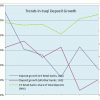
2013 was another strong year for deposit growth at the ISX-listed banks. Deposits at the 19 names that have so far reported year-end financials were up 17% year-on-year as of December 31. (Only BDFD and BELF, which together accounted for 8% of 2012 listed-bank deposits, have yet to report.)
While their deposit growth slowed from 32% in 2012, these 19 banks nonetheless continued to outpace the rest of the sector, where deposits rose by only 10%. As a result, their share in the deposits component of Iraq’s M2 money supply rose for a second year to reach 13%. (Click here for full-sized chart.)
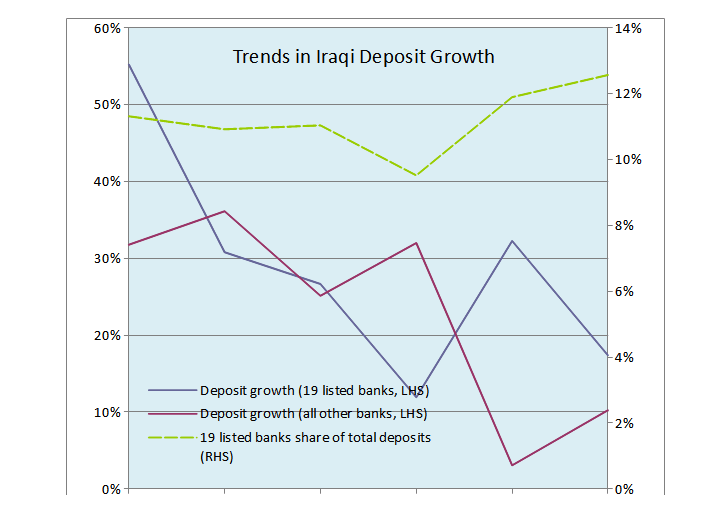
This is the highest share in at least six years. Nevertheless, it represents only a modest improvement from the 10% low in 2011.
Clearly the playing field remains steeply tilted in favor of the state-owned banks. These lenders not only enjoy a virtual monopoly on government deposits but also accounted for 60% of private sector deposits as of year-end 2012. They held about 85% of total deposits, despite having only a fifth of total bank-sector capital and somewhat fewer branches—479 versus the private banks’ 515. (See pages 27 and 112 of the central bank’s 2012 bulletin.)
From the depositor’s point of view, the state-owned banks’ obvious advantage is their lack of bankruptcy risk. While private banks have been allowed to go under, it is highly unlikely that state-owned institutions would be permitted to suffer a similar fate. The central bank can always be counted on to rescue them in a crisis.
This means that the private banks’ deposit share is likely to remain low for the foreseeable future. In the absence of deposit insurance or any effective mechanism for dealing with bank failures, depositors can hardly be blamed for continuing to view the state banks as their safest bet.
Posted in Investment, Mark DeWeaver on Investments and Finance 4 Comments

IBN - Home of Iraq's Best Bloggers!
Posted on 06 March 2014 .
We are proud to announce that in our newsletter this week the top four articles are all from our dedicated panel of bloggers:
- Our Expert Blogger Mark DeWeaver has written two very insightful artices on the Iraqi banking system;
- Expert Blogger Madeleine White has written on new initiatives to educate Iraqi youth; and,
- Guest blogger Layth Mahdi has written on the failure of politicians to address the issues of poverty and unemployment.
On our Expert Blogger section (to the right of the home page) you can also find recent contributions from Robert Tollast, Ahmed Mousa Jiyad, Michael Carr, and John Schnittker.
As always, you can count on Iraq Business News to give you the inside track!
(Flag image via Shutterstock)
Posted in Blog 5 Comments

Iraq’s Missing Market
Posted on 05 March 2014 .
By Mark DeWeaver.
In my last post I argued that Iraqi banks’ high cash/deposit ratios are due to the absence of an interbank market. If that is the case, you might think it would be easy to get the banks to put more of their deposits to work in the "real economy." Couldn’t somebody (e.g. the central bank) simply set up a system through which they could make short-term loans to one another?
A few years ago I met someone at a conference on Iraqi banking who said he had helped to set up just such a system. According to him, the IT platform he worked on was already in place. The banks just weren’t using it.
If the issue isn’t primarily technical, what is it? I think the root of the problem is the dominant role of the state banks, which together account for about 80% of system-wide deposits.
Without their participation, an interbank market would not work. There would be no guarantee that at the end of a given day the private banks collectively wouldn’t end up with a cash deficit while the state banks had a surplus. In a market with only the private banks, those with extra funds might not have enough cash to meet the demand of those with a shortfall.
So why not get the state banks involved? Unfortunately, that wouldn’t be ideal either. Like state-owned enterprises in general, these banks can always count on a bail-out if they get into trouble. This means that as interbank lenders they could afford to act recklessly, making funds available to anyone willing to pay a high enough interest rate, regardless of counter-party risk. The result would be an increase in the state banks’ non-performing loan ratios and a corresponding hit to the government budget.
The absence of an interbank market thus turns out to be symptomatic of much deeper problems in the structure of the Iraqi financial system. Until these are resolved, the banks are unlikely to begin either lending to one another or lending out a bigger share of their deposits to the non-financial sector.
Posted in Investment, Mark DeWeaver on Investments and Finance 4 Comments
Are Iraqi Banks Too Liquid?
Posted on 27 February 2014 .
By Mark DeWeaver.
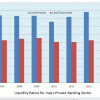
Fund managers visiting Iraq for the first time are often surprised by the large amounts of cash Iraqi banks typically hold. While the Central Bank of Iraq (CBI) requires lenders to hold 15% of their deposits in the form of vault cash and central bank reserves, most hold well over 50%. (See Chart.) “Cash in hand and at bank,” rather than loans, is usually a bank’s single biggest asset.
Bank managers will tell you that they need cash to meet unexpected large withdrawals by depositors. But this is true of banks everywhere. Why should Iraqi lenders be so much more liquid than their counterparts in other countries? Aren’t they being overly cautious?
Their behavior doesn’t seem so strange when you consider the fact that Iraq lacks an interbank market. Ordinarily, banks with a cash shortfall at the end of the day can borrow overnight from those with a surplus. As long as the public’s demand for banknotes is unchanged, withdrawals from bank A end up as deposits at bank B, ensuring that A’s demand for short-term money can usually be easily met.
In Iraq, a bank that ends up with a cash shortfall will be forced to borrow from the CBI, which offers seven-day facilities for this purpose. This is a much less attractive alternative than borrowing from another commercial bank.
Foreign institutions that are perceived to be in trouble may still be able to access funds in the interbank market provided that they are willing to pay a large enough premium over LIBOR. The central bank, however, is both lender and regulator. It is certainly not going to provide liquidity to the highest bidder regardless of the circumstances. (In fact, CBI facilities are available at a fixed rate—two percentage points above the CBI’s policy rate.)
It is thus not surprising that Iraqi banks choose to rely on their own funds. Their high levels of liquidity are not a sign of risk-aversion or incompetence, as is sometimes suggested. In the absence of an interbank market, liquidity risk is the biggest risk they face. They need to be ready not only for ordinary levels of withdrawals but for worst-case scenarios as well.
Posted in Investment, Mark DeWeaver on Investments and Finance 8 Comments

A Vote of Confidence for BDSI
Posted on 10 September 2013 .
By Mark DeWeaver.
So far this has been a bad year for shareholders of Dar Es Salaam Bank (BDSI). Adjusting for July’s 23.2% rights and 18.5% bonus issues, the shares are down 36% year-to-date (as of September 10). This compares to a ytd return of -5% for the ISX index and +6% for Rabee Securities RSISX index.
This dismal performance is mainly due to the decision of majority shareholder HSBC to exit its position. The British bank announced in June that it was looking for a buyer for its 70.1% (pre-rights issue) stake and that it would not be subscribing to BDSI’s rights issue. (See this story.) Indeed, getting rid of BDSI now seems to be quite high on the HSBC “to do” list. At one point it even offered to give away its stake for nothing! (This offer was blocked by the Iraqi regulators, however.)
Without HSBC as a shareholder, BDSI could conceivably lose a sizable share of its current business. But this does not necessarily mean that earnings growth will suffer. There is likely to be considerable room for the bank to expand into new areas.
Lending is the most obvious example. As of the end of June, BDSI’s loan/deposit ratio was a mere 2%, the second lowest among the listed banks. The average for the sector is 40%. HSBC’s approach to risk management in Iraq has clearly been unduly cautious. With a new majority shareholder, BDSI may be in a position to grow its loan book considerably, thereby replacing lost fee and commission revenue with interest income.
It is also encouraging that the bank recently increased its capital from IQD 105.8 to IQD 150 billion. Following HSBC’s decision not to take up its rights, its rights shares were offered to the public and were reportedly oversubscribed. The biggest subscriber is said to have been one of the local investors in last February’s Asiacell IPO.
This vote of confidence had an immediate effect on the share price. Since closing at a multi-year low of IQD 1.07 on August 28, the last day of the subscription period, as of September 10 BDSI is up 26%.
Life without HSBC might not be so bad after all.
Posted in Investment, Mark DeWeaver on Investments and Finance 5 Comments
Dinar Boosted by Iranian Election
Posted on 27 June 2013 .
By Mark DeWeaver.
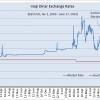
Since the beginning of 2012 the Iraqi dinar has been on something of a roller coaster ride. Changes in central bank policy combined with strong dollar demand from Iran and Syria have twice pushed the market rate above 1280. Both times, subsequent increases in dollar sales at the central bank’s currency auctions then steered the rate back toward 1200. (See chart. Data is from the Central Bank of Iraq website.)
In the most recent iteration of this cycle, the dinar appears to have gotten a boost from the Iranian election held on June 14. Hopes for an easing of US sanctions following the victory of moderate candidate Hassan Rouhani seem to have led to a significant drop in Iranian dollar demand both at home and abroad. The Iranian rial is reportedly up 20.7% post-election, rising from 36,200 to the dollar to 30,000. Iranians are now said to be selling down hoards of US dollar cash, the total value of which the Central Bank of Iran puts at USD 18 billion.
The effect on the dinar has been less dramatic but is still easy to see on the chart. The Iraqi currency rose 1.0% from June 13 to June 15 and was up 2.9% (to 1215) as of June 27.
How long this trend can continue remains to be seen, however. President Obama earlier this month signed an executive order that will take effect July 1 and is intended to increase the pressure on the rial.
Posted in Investment, Mark DeWeaver on Investments and Finance 16 Comments

Capital Increase Déjà Vu
Posted on 17 June 2013 .
By Mark DeWeaver.
A year ago I wrote a post called “Will the Banks Get More Time,” in which I argued that most of the ISX-listed banks weren’t going to make the central bank’s deadline of June 30, 2012 to reach IQD 150 bn in paid-up capital. I posted pretty much the same thing back in May, 2011 (see this post), when the banks were having trouble meeting the June 2011 target of IQD 100 bn.
Today it’s looking like “déjà vu all over again.” This time the deadline is June 30, 2013 and the CBI’s final target of IQD 250 bn is fast approaching.
Rabee Securities’ most recent bank-sector report found that as of May 23 only 5 of the 21 listed banks had either reached the target or would reach it once ongoing capital increase procedures were completed. (The five were BKUI, BMFI, BMNS, BNOR, and BUND.) Two banks—BDFD and HSBC-subsidiary BDSI—have yet to reach even last June’s IQD 150 bn target. In aggregate the banks still need to increase paid-up capital by a further IQD 1.6 trillion from the current total of IQD 3.5 trillion.
The CBI now has the same three options it had last time. It can (1) give the banks more time, (2) force some of them to merge, or (3) shut down those that miss the deadline. I think (2) and (3) are quite unlikely, simply because none of the banks appears to be at risk of failure. Most are already more than adequately capitalized for the amount of lending they do.
Giving the banks more time is clearly the most sensible option. This is also what the CBI did in 2011 and 2012. In both cases the deadline was extended by six months.
Once again I find myself asking “why should this time be different?”
Posted in Mark DeWeaver on Investments and Finance 1 Comment