



EU proposes Visa Restrictions for Iraq
Posted on 25 August 2021 .
By John Lee.
The European Commission has proposed to the Council to adopt temporary restrictive measures on short-stay visas for visa applicants who are nationals of Iraq, Bangladesh and The Gambia.
Under the revised Visa Code in force since February 2020, the EU's short-stay visa policy is linked to cooperation with partner countries on readmitting their nationals who do not have the right to stay in the EU. The proposals adopted last month aim to improve the 3 countries' cooperation with the Member States on readmission.
Effective return and readmission as well as sustainable reintegration are essential elements of comprehensive, balanced, tailor-made and mutually beneficial migration partnerships with countries outside the EU. Fostering co-operation is an important element of this policy and the EU needs to mobilise all available tools, including development co-operation, trade or visa. Improved and sustained cooperation could also potentially open the path to more favourable visa measures.
Temporary visa measures
According to the Commission's assessment for the year 2019 and taking into account subsequent developments, including steps taken by the Commission to improve such cooperation, the level of cooperation on readmission with Bangladesh, Iraq and The Gambia requires improvement. The proposed measures cover certain procedural aspects for issuing short-stay visas, specifically:
- Suspension of waiver of certain supporting documents for certain categories of applicants (e.g. bona fide travellers);
- Suspension of optional visa fee waiver for holders of diplomatic passports;
- Suspension of the maximum processing time (beyond 15 days);
- Suspension of the mandatory issuance of multiple entry visas with a long validity.
The measures do not apply to visa applicants who are family members of EU citizens or other beneficiaries of free movement in the EU.
Next steps
The Commission will continue its engagement and work with the partner countries concerned to improve cooperation on readmission as part of its continued overall engagement with these countries.
The Council will examine the Commission's proposals for Implementing Decisions and take a decision on their adoption. The measures will come into force immediately upon adoption.
To maintain a transparent and constructive partnership approach, which encourages rapid progress on readmission, the Commission will continue its engagement with the countries concerned to improve cooperation and overall relations with these countries.
Within 6 months of the measures entering into force, the Commission must report to the European Parliament and to the Council on the progress achieved. The Commission may then propose to repeal or amend these visa measures, taking into account the Union's overall relations with the countries concerned. In particular, in case the current measures are ineffective, the Commission could propose a further measure, namely a gradual increase of the standard visa fee to €120 or a maximum of €160.
Background
Readmission of own nationals is an obligation under international law. Under the revised Visa Code, the Commission annually assesses readmission cooperation with non-EU countries and reports to the Council. Temporary restrictions on certain short-stay may be introduced vis-à-vis non-EU countries whose nationals require visas to travel to the EU, where cooperation on readmission is not yet deemed sufficient.
This process supports wider efforts to put in place effective and comprehensive migration management in the EU under the New Pact on Migration and Asylum and to strengthen the external dimension of migration policy. This includes not only the readmission dimension but also, for example, addressing migrant smuggling, improving the use of EU funding, and fostering legal migration and mobility.
As the initial step of the process set out in the Visa Code to improve readmission cooperation, the Commission adopted on 10 February 2021 its first assessment of how non-EU countries cooperate on readmission. This factual report assessed all stages of the readmission process where assistance of the third countries' authorities is required - from identification of people without the right to stay to the issuance of travel documents and effective return.
On the basis of further assessment and following discussions with the Member States, the Commission and the European External Action Service engaged with partner countries, informing them of the process, the EU's expectations and the possible consequences of failing to improve the situation. The proposals follow the Commission's assessment that the three countries' cooperation with the EU on readmission matters is not sufficient and further action is needed, considering the steps taken so far by the Commission to improve the level of cooperation and taking into account the EU's overall relations with the third countries concerned.
For More Information:
Proposal for a Council Implementing Decision on temporary visa measures with respect to Iraq
(Source: EU)
Posted in Iraq Industry & Trade News, Iraq Transportation News, Politics, Security Comments Off on EU proposes Visa Restrictions for Iraq

Iran "Suspends" Export of Electricity to Iraq
Posted on 11 August 2021 .
By John Lee.
Iraq's Electricity Minister has reportedly said that Iran has suspended exports of electricity to Iraq on Tuesday.
According to Basnews, the decision is due to reduced water levels feeding hydro-electric plants in Iran.
Iraq had just received a waiver from the US allowing it to continue importing electricity from Iran.
(Source: Basnews)
Posted in Iraq Industry & Trade News, Politics Comments Off on Iran "Suspends" Export of Electricity to Iraq

Iraq gets New Waiver to Import Iranian Electricity
Posted on 09 August 2021 .
By John Lee.
The US State Department has reportedly granted a new sanctions waiver allowing Iraq to continue importing electricity from Iran for another 120 days.
(Source: S&P Global)
Posted in Construction & Engineering In Iraq Comments Off on Iraq gets New Waiver to Import Iranian Electricity

Iran presses for Visa Waiver from Iraq
Posted on 19 July 2021 .
By Omar Sattar for Al Monitor. Any opinions expressed here are those of the author(s) and do not necessarily reflect the views of Iraq Business News.
Iran presses for Visa Waiver from Iraq
Iranian authorities continue to pressure the Iraqi government into waiving its travel visa between the two countries.
Posted in Iraq Transportation News, Leisure and Tourism in Iraq, Politics, Security 1 Comment
ShaMaran Increases Stake in Sarsang Contract
Posted on 14 July 2021 .
By John Lee.
ShaMaran Petroleum has announced that it has signed an agreement with a subsidiary of French major TotalEnergies S.E. to acquire its affiliate (TEPKRI Sarsang A/S) holding an 18% non-operated participating interest in the Sarsang Production Sharing Contract in the Kurdistan Region of Iraq for an initial consideration of USD 155 million plus working capital adjustments amounting to USD 14.2 million as of January 1, 2021.
Shares in the company were up 16 percent on the news.
An additional contingent consideration of USD 15 million is payable in the future as more fully described below. The Acquisition is transformative to ShaMaran's production, reserves and financial profile and delivers on the Company's focused and disciplined strategy for growth by targeting this opportunity that is accretive to the Company, its shareholders and its bondholders.
HIGHLIGHTS
The Acquisition:
- Adds immediate incremental participating interest production of approximately 5,000 bopd of light crude oil;
- Is expected to double ShaMaran's Q2 2021 average net production of 11,090 bopd following the completion of the processing facility expansion at Swara Tika field by mid-2022;
- Enhances ShaMaran's oil reserves through the addition of high API and low sulphur oil that achieves a low discount to Brent; and
- Provides a low cost structure with life-of-field operating expenditure anticipated to be approximately USD 5.60/boe.
The Sarsang block is on the northern border of the Company's Atrush block and is comprised of two producing fields: Swara Tika and East Swara Tika. At Swara Tika, an expansion project is well underway with the addition of a new 25,000 bpd processing facility which is expected to lift gross production to approximately 50,000 bopd by mid-2022. Through the Acquisition, ShaMaran will add strong cash flow and a production growth trajectory underpinned by its interests in two cash-positive PSCs with three producing fields in the same vicinity.
Following a successful closing of the Acquisition, the Company's Q2 2021 average net production of 11,090 bopd is expected to double in second half of 2022 after the facility expansion at Swara Tika is completed. Additionally, the Sarsang crude is of high quality and enjoys one of the lowest price discounts to Brent in Kurdistan. In connection with the new facility being commissioned by mid-2022, the Sarsang block will also be connected to the Atrush feeder pipeline for future pipeline export and will thereby have a permanent pipeline connection to the export market.
The Acquisition is highly accretive and transformative to ShaMaran as it grows from a single asset company to a multi-field producer and paves the way for future growth opportunities for ShaMaran.
ShaMaran's President and Chief Executive, Dr. Adel Chaouch, said:
"We are delighted that we have agreed the acquisition of the TotalEnergies' non-operating interest in Sarsang, a high-quality producing asset with strong operational and financial fit to ShaMaran's business. This is a strategic transaction for ShaMaran delivering value to equity and debt holders and strengthening the financial profile of the Company.
"Upon completion, this acquisition will add immediate material production and cash flow to ShaMaran and will provide significant value enhancement. It demonstrates our continued commitment to Kurdistan and diversifies our existing production base.
"Sarsang has an attractive discovered reserves base with a strong track record of safety and sustained production. As a neighboring field to the Atrush field, becoming a partner in the Sarsang field presents opportunities for potential integration synergies with Atrush operations.
"We would like to thank TotalEnergies for their commitment in the negotiations of this acquisition and look forward to a constructive partnership in the future with the Sarsang operator, as well as a continued and trusted relationship with the Kurdistan Regional Government of Iraq."
TRANSACTION DETAILS
ShaMaran has agreed to acquire 100% of the shares of TEPKRI Sarsang A/S ("TEPKRI"), a subsidiary of TotalEnergies, which holds an 18% non-operated participating interest in the Sarsang PSC. The Acquisition has an effective date of January 1, 2021.
ShaMaran will pay an initial consideration of USD 155 million upon closing of the Acquisition before working capital and related adjustments and an additional contingent consideration of USD 15 million in the future, as follows:
- The initial consideration of USD 155 million is divided into (i) an upfront cash payment of USD 135 million payable upon closing and (ii) a deferred consideration of USD 20 million structured as a vendor finance in the form of a 5.5% convertible promissory note issued to a subsidiary of TotalEnergies with a 12-months' maturity from the date of closing.
- An additional contingent consideration of USD 15 million is payable in the future upon (i) cumulative gross production from the Sarsang PSC reaching 130 MMbbls and (ii) subject to Brent crude oil prices averaging at least USD 60/bbl for a twelve months' period.
ShaMaran expects to receive significant positive cash flow upon closing of the Acquisition based on 2021 cash flows at current oil prices.
The Company intends to finance the Acquisition through the issue of new debt, equity and by utilizing the Company's cash balance.
The "change of control" of TEPKRI resulting from the Acquisition is subject to regulatory and exchange approvals in Canada, the Kurdistan Region and Sweden.
DEBT FINANCING
The Company intends to issue an up to USD 300 million new 4-year bond to refinance existing debt and raise new capital for the Acquisition. Subject to the closing of the Acquisition, USD 175 million of the currently outstanding USD 180 million ShaMaran 2023 bond (after the USD 5 million repayment due in late 2021) will exchange at 102% of par into the proposed new bond at par value. In aggregate, USD 185.7 million (including the USD 7.2 million amount described below) will be issued to refinance the existing debt into the new bond upon closing of the Acquisition and up to USD 114.3 million will be issued for cash to finance the Acquisition and other general corporate purposes. Cash proceeds from the new bond will be placed in an escrow account and only released upon satisfaction of the closing conditions to the Acquisition. The existing debt that is proposed to be refinanced into the new bond includes USD 7.2 million of the total USD 22.8 million debt currently owed by the Company to Nemesia S.à.r.l. (a private company ultimately controlled by a trust the settlor of which is the Estate of the late Adolf H. Lundin) ("Nemesia"). The USD 15.6 million balance will remain outstanding as described below.
The Company and its advisors have engaged with a majority of bondholders that prior to the date of this news release have pre-committed to vote in favour of the conditional refinancing of the existing bond through a written summons and resolutions, as well as necessary waivers for the issuance of the new bond and other financial matters relating to the existing bond.
The Company has also obtained strong interest for the contemplated new bond from a group of existing and new bond investors. Book-building for the contemplated bond will be launched imminently together with a summons for written resolution to refinance the existing outstanding bond conditional on closing of the Acquisition.
EQUITY FINANCING
The Company intends to raise USD 30 million of additional equity capital to fund the Acquisition, which the Lundin family, as ShaMaran's largest shareholder, has agreed to support by Nemesia providing a USD 30 million equity underwriting. The new equity is expected to be issued through a rights issue in eligible jurisdictions in connection with the Acquisition in order to provide all shareholders to whom subscription rights may be lawfully issued with a proportionately equal opportunity to participate.
Further information on the contemplated rights offering will be announced in due course. The offering will be conditional on, inter alia, approval of the Acquisition by the TSX Venture Exchange, the approval of the Kurdistan Regional Government ("KRG"), the filing of a rights offering circular or prospectus in Canada and in Sweden and other regulatory approvals. It is anticipated that the rights offering would be commenced as soon as practicable following receipt of KRG approval for the Acquisition.
The Lundin family underwriting will be by way of a stand-by commitment, meeting the requirements of applicable securities laws, to acquire shares not subscribed for by others pursuant to subscription rights issued in the offering.
(Source: Shamaran)
Posted in Iraq Oil & Gas News Comments Off on ShaMaran Increases Stake in Sarsang Contract

Jiyad: Iraq, and the China-Iran Cooperation Program
Posted on 14 April 2021 .
By Ahmed Mousa Jiyad.
Any opinions expressed are those of the author, and do not necessarily reflect the views of Iraq Business News.
Iraq and the China-Iran Comprehensive Cooperation Program
The China-Iran Comprehensive Cooperation Program (CICCP) was signed on 27 March 2021; two days later the CICCP's direct impacts on Iraq began emerging and one of such impacts seems to benefits both Iraq and Iran!!
A few days ago I completed a detailed preliminary assessment of CICCP document. The assessment was written in Arabic entitled "China-Iran Comprehensive Cooperation Program: Tactically Important Strategically Impacting if Implemented", it was circulated widely and posted on many websites.
The assessment uses composite methodology of three researches approaches (Text analysis, SCOR (Strength, Challenges; Opportunities and Requirements) and facts/evidence based) and comprises an introduction, three parts and concluding remarks. Part one provide brief review of CICCP document structure: preamble, articles, annexes, effective date and term of the deal, coordinating and supervising authorities. Part two, provides detailed assessment of eight fundamental topics/ areas of cooperation, from the perspectives of the political economy of bilateral relations and geopolitical considerations. Part three provides the direct official reactions to CICCP from Iraq, USA, Arab Gulf States/Saudi Arabia and Russia.
The political economy perspectives are related to the following basic issues: The first relates to the nature of bilateral relations in terms of sovereign independence or dependency and hegemony; the second is whether the principle of "mutually beneficial" is also equitable; the third concerns the structuring of the Iranian economy on whether the deal will eventually deepens the dependence on the export of raw materials, oil and gas, or introduces the required and desirable structural changes horizontal, vertical and knowledge-based levels; and the fourth is about the financial and banking independence, monetary and currency issues pertaining to funding investments and trade exchange.
The geopolitical considerations were addressed at four levels, starting from the domestic (national for both countries), continental (Asian from China to Syria), regional (West Asia / Middle East) and international levels.
The assessment argues that the timing of signing and announcing CICCP is tactically motivated and important, while its proper and timely implementation could be a game-changer and thus strategically impacting; but, as usual, reality seldom coincides with expectations.
This brief intervention focuses on the direct current evidenced impacts on Iraq. Interested readers are kindly invited to read the Arabic version of my detailed initial assessment through the web-links mentioned at the end of this article.
In a remarkable speed and substance CICCP has already prompted both Iraq and the US to react!
First; after the current prime minister, Mustafa al-Kadhimi, denied, rather harshly, in a press conference on November 18, 2020, the existence of an Iraq-China agreement by saying, 'You know there is no China agreement, why are you promoting these lies?', he returned to authorize, on March 30 - that is, only three days after the signing of CICCP, "to start implementing the Chinese agreement"!!
While I do not find it necessary, now, to discuss what has happened between Iraq and China since the government of Haider al-Abadi, I find it useful to remember the statement by the Prime Minister's Financial Affairs Adviser, Dr. Modhir Muhammad Saleh, on March 29, 2021, that the "Iraq-China agreement" became effective on October 18, 2020, and then he affirmed the "cooperation framework agreement ... and the final accounting and oil annexes were signed on September 23, 2019." So why has not been published to this day any official document on this agreement / cooperation framework agreement, nor any of its annexes or memoranda of cooperation/ understanding related to it!!??
But there is a document at the Ministry of Finance entitled "Export Credit Insurance Cooperation Framework" between the China Export & Credit Insurance Corporation and the Iraqi Ministry of Finance) dating back to May 11, 2018 (that is, before the date of the agreement signed by former Prime Minister Adel Abdul Mahdi) !!!!
It is worth mentioning that 2021 State Budget Law includes a few infrastructure projects worth 1.803 trillion Iraq Dinnar to be funded, presumably by the above mentioned 2018 framework; since there is no new framework agreement officially published by the Ministry of Finance, nor approved by the Council of Ministers, nor legislated by the House of Representatives/ the Parliament. Moreover, even if such agreement is ratified and activated it utilization will be differed to future state budget for 2022 or even 2023 because of the national election scheduled for October this year.
Apparently, CICCP was a wakeup call for the Iraqi government but it is in reality too late for 2021 budget funding.
But on the other hand, the Iraqi Premier rushed for quick visits to Saudi Arabia and the UAE, immediately after signing CICCP; is there a relationship between the two events? Time will only tell!!!!
Second, among direct reactions by the US administration and as far as Iraq is concerned relates to Iraq-Iran interests. Just two days after signing the CICCP the U.S. renewed and extended the Iraqi exemption from the practices of maximum US pressure on Iran from 45 to 120 days; a waiver to avoid penalties for buying natural gas and electricity from Iran. This exception entails two positive consequences for both Iraq and Iran: the first is to ensure the continued supply of Iranian gas to generates electricity; this what the Iraqis suffer from its shortages especially the heated summer is on the doorstep, and the second is that Iraq pays Iran's accumulated dues for importing gas and electric power (which constitutes about a third Iraq's production of electricity) as the total of those receivables were mentioned in the 2021 budget, about 1688 billion Iraqi dinars.
Third, another important reaction by the US administration was its quick decision to hold a new round of strategic dialogue with Iraq; the discussions began on April 7, and mainly relate to the issue of US forces remaining in Iraq and the Strategic Framework Agreement signed in December 2008. (This agreement and related matters face strong opposition and many important, influential, legal and judicial challenges, especially after the Trump administration assassinated two leading heavy weight individuals, Abu Mahdi Al-Muhandis (Iraq) and General Qassem Soleimani (Iran), on January 3, 2021 near Baghdad airport).
It is worth noting that energy cooperation is one of the eight topics included in the said strategic framework agreement. Evidence suggests that the previous round of the Iraqi-American Committee for the Coordination of Cooperation in the Field of Energy, which was held, virtually remotely, on January 18 of this year was brief and did not include any important issues or noticeable impacts or new achievements. Hence, it did not attract attention from domestic or external media. Even the two ministries, i.e, Oil and Electricity, that should be directly involved, hardly mentioned anything on their websites on that latest meeting. Will CICCP invigorate Iraqi-American cooperation for the benefit of the energy sector in Iraq?? Who knows, will see!!!
Click here to download the full report in pdf format.
Mr Jiyad is an independent development consultant, scholar and Associate with the former Centre for Global Energy Studies (CGES), London. He was formerly a senior economist with the Iraq National Oil Company and Iraq's Ministry of Oil, Chief Expert for the Council of Ministers, Director at the Ministry of Trade, and International Specialist with UN organizations in Uganda, Sudan and Jordan. He is now based in Norway (Email: mou-jiya(at)online.no, Skype ID: Ahmed Mousa Jiyad). Read more of Mr Jiyad's biography here.
Posted in Ahmed Mousa Jiyad, Iraq Oil & Gas News, Politics Comments Off on Jiyad: Iraq, and the China-Iran Cooperation Program

US Grants Iraq New 60-day Waiver to Import Iranian Gas
Posted on 24 September 2020 .
By John Lee.
The United States has reportedly granted Iraq a 60-day extension to a sanctions waiver allowing it to import Iranian gas.
According to the report from AFP, Iraq relies on gas and electricity imports Iran to supply about a third of its electricity sector.
(Source: AFP)
Posted in Iraq Industry & Trade News, Iraq Oil & Gas News, Politics 1 Comment
US Welcomes New Iraq Govt; Extends Iran Sanctions Waiver
Posted on 07 May 2020 .
By John Lee.
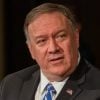
US Secretary of State Mike Pompeo (pictured) has welcomed the formation of a new government in Iraq following months of instability.
In a phone call with the new Prime Minister, Mustafa Kadhemi, he said that the US would not enforce sanctions on Iraq buying electricity from Iran for 120 days "as a display of our desire to help provide the right conditions for success".
The full statement via Spokesperson Morgan Ortagus said:
"Secretary of State Michael R. Pompeo spoke today with Iraqi Prime Minister Mustafa al-Kadhimi. Secretary Pompeo welcomed Prime Minister Kadhimi's new government, which was confirmed by the Council of Representatives.
"They discussed the urgent hard work ahead for the Iraqi government, implementing reforms, addressing COVID-19, and fighting corruption. In support of the new government the United States will move forward with a 120-day electricity waiver as a display of our desire to help provide the right conditions for success.
"The Secretary and the Prime Minister also discussed the upcoming U.S.-Iraq strategic dialogue and how they look forward to working together to provide the Iraqi people the prosperity and security they deserve."
(Source: US State Dept)
Posted in Iraq Oil & Gas News, Politics 1 Comment

US Renews Waiver for Iraq to Import Electricity from Iran
Posted on 28 April 2020 .
By John Lee.
Washington has renewed a waiver for Iraq to continue importing Iranian electricity, a US State Department official said.
"The Secretary granted this brief extension of the waiver to allow time for the formation of a credible government," the official said, referring to US Secretary of State Mike Pompeo, and added that the waiver would expire on May 26, according to Reuters.
Washington has repeatedly extended the exemption for Baghdad to use crucial Iranian energy supplies for its power grid, for periods of 90 or 120 days.
Earlier this month, Iraq's president named intelligence chief Mustafa al-Kadhimi as prime minister-designate, the third person tapped to lead Iraq in just 10 weeks as it struggles to replace a government that fell last year after months of deadly protests.
"Once that government is in place, the Secretary will reassess whether to renew the waiver and for how long," the US State Department official said.
The official added that the waiver applied only to electricity and referred to the Treasury Department for transactions related to Iranian natural gas imports.
Electricity Minister Luay al-Khatteeb told S&P Global Platts last week that Iraq needs three to four years to complete projects that would provide the necessary natural gas for its power stations.
(Sources: Tasnim, Reuters, S&P Global)
Posted in Iraq Oil & Gas News Comments Off on US Renews Waiver for Iraq to Import Electricity from Iran

Iraq's Power Conundrum: How to Secure Reliable Electricity
Posted on 27 March 2020 .
By Ahmed Tabaqchali, CIO of Asia Frontier Capital (AFC) Iraq Fund. This article was originally published by the LSE Middle East Centre.
Any opinions expressed are those of the author, and do not necessarily reflect the views of Iraq Business News.
Iraq's Power Conundrum: How to Secure Reliable Electricity While Achieving Energy Independence
Iraq remains in a bind regarding how to secure energy independence within its geopolitical constraints - most pertinently the American sanctions on Iran. The US is continuing to maintain pressure on Baghdad by extending 'final' waivers on the purchase of Iranian gas for only another 30 days, as part of its new tougher stance.
Iraq, in response, could produce credible plans to eliminate its dependence on Iranian imports, which it accelerated with the approval in January of the fifth round of gas exploration contracts. However, achieving this would not end the need for Iranian imports, nor would it secure any kind of energy independence. More importantly, it will not change the shortages in the provision of electricity, which have served as a lightning rod for public anger over the failings of the post-2003 system.
Appreciating the dependence on Iran for the provision of electricity means delving into the extraordinary mess that is Iraq's power grid, consisting of the power plants that generate electricity; transmission system that transport this electricity to population centres; and distribution networks which then distribute this electricity to end users. Decades of conflict have damaged most parts of the grid and, coupled with poor maintenance of the parts that escaped damage, this has rendered the grid impotent.
Rebuilding the grid post-2003 was hampered by the rolling dysfunction of successive governments, in which significant capital expenditures were neutralised by mismanagement, lack of coordination between ministries, and the county's corrosive corruption. The public's frustration over this impotence extends beyond the inadequate provisioning of electricity throughout the year, as the summer's intense heat creates a particularly acute need for electricity, exposing the grid's shortcomings.
These start at the generating stage with the gap between nameplate capacity, i.e. the maximum sustainable power output under ideal conditions, and actual output. While a gap always exists between these two, in 2018 the nameplate capacity was 30.3 gigawatts (GW), while effective capacity through the year was a mere 11.9 GW. A primary reason for this gap is the lack of appropriate fuel supply, in this case gas, which leads to substitutions by fuels such as crude or heavy fuel oil with the result that plants run at less than 60% of capacity - in 2018 only 62% of operating gas-powered plants actually used gas. Other reasons include poor maintenance and lack of cooling in high ambient heat. Moreover, up to 20% nameplate capacity in 2018 was non-operational.
In turn, this increases the gap between demand and supply - in 2018 average demand was 17.7 GW vs. effective generated power of 11.9 GW. But this gap is only part of the story, as the electricity generated to meet demand does not mean that it was actually delivered to end users. The total electricity generated in 2018 was 105.4 terawatt-hours (TWh), but only 43.7 TWh reached end users for a loss of 58.5%. Most of these losses take place at the distribution stage, with technical losses stemming from age, conflict damage, poor maintenance accounting for two thirds, and non-technical losses, mostly electricity theft, accounting for a third. Technical losses are natural, however they occur at an extremely high rate in Iraq, as do non-technical losses. Stolen electricity - still consumed but not billed - is estimated at 17 TWh, and so the electricity delivered would rise to 61 TWh, equating to a loss of 42.2%. This dynamic can be seen below.
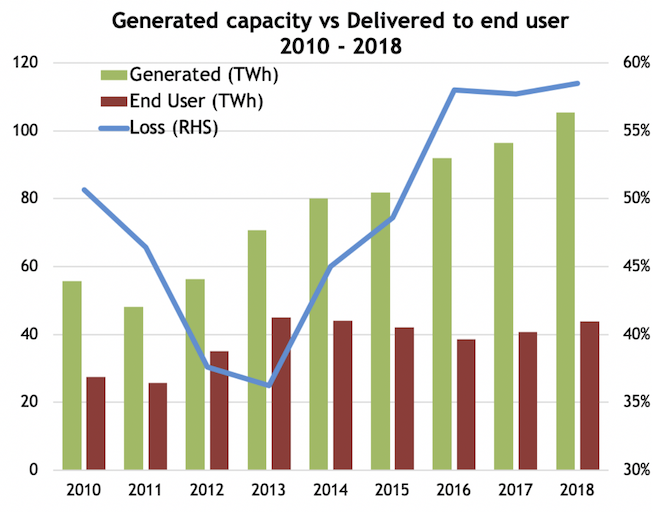
The increase in losses from 2014 onwards can be attributed to the ISIS conflict, which damaged 20% of the transmission system and 5.0 GW of generating capacity. 2019 saw meaningful improvement as effective capacity increased from 11.9 GW to 14.3 GW, and crucially during the summer months peak generation was 19.3 GW vs. peak demand of 27.5 GW. This gap of 8.2 GW has narrowed from 2018's 10.0 GW gap when peak supply was 16.5 GW vs. peak demand of 26.5 GW.
Electricity generated from Iranian electricity and gas imports accounted for 20.7% of that generated throughout 2019, and probably a much higher percentage during the peak summer months. These contributions from electricity imports from 2010 and gas imports from 2017 can be seen below.
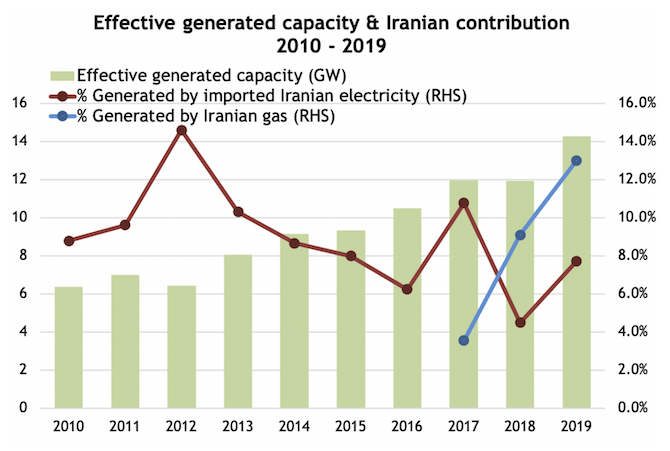
The importance of Iranian electricity imports as a percentage of the total have steadily decreased, even though they increased in absolute levels; nevertheless, the decline in summer of 2018 was large enough to ignite the demonstrations in Basra. Imports in 2019 returned to the trend line and averaged 1.1 GW for the year. Plans for other regional imports include 0.5 GW to be imported from Kuwait by the end of 2020, rising to 1.9 GW over subsequent years, including planned imports from Jordan and Turkey.
Iranian gas imports were 7.0 billion cubic meters (BCM) in 2019, up from 4.1 BCM in 2018, and accounted for 31% of total gas consumed - up from 24% in 2018. Plans for increased domestic production include increasing captured flared gas to 16-19 BCM by end of 2021 from 12 BCM in 2019. Additionally, the fifth round of gas contracts call for replacing Iranian imports in three years, i.e. generating 7.0-10.0 BCM over that period from the current 3.5 BCM.
Assuming that the government executes these plans, in three years' time this would replace the current electricity produced by Iranian imports. But demand is set to increase by 20% from current levels, meaning that the current the gap between supply and demand would increase by up to 20%. Moreover, planned capacity additions require additional fuel, which under existing plans is earmarked to replace imported gas. However, maintaining Iranian imports would significantly decrease their importance in power generation from the current 20.7%, and in the process Iraq would add meaningful capacity to address demand.
The goal posts are moving much faster than Iraq's ability to approach them, and as such the US's insistence on eliminating Iranian imports, far from achieving energy independence for Iraq, would instead exacerbate its energy vulnerabilities. Compounding these vulnerabilities is the massive investment spending needed to expand the grid's capacity, currently unaddressed in the government's structurally unbalanced budget, but which is ever more critical following the collapse of oil prices.
Iraq's pathway out of this predicament, even at much higher oil prices, involves electricity tariff reform and the removal of energy subsidies, both the source of monumental waste and substantial market distortions. However, this requires a popular buy-in and for the increasingly alienated population to renew their belief in the post-2003 system's legitimacy. It is here where the international community can help Iraq achieve energy independence.
Sources
The figures and charts used in the article are the author's estimates, and are based on data from the Ministry of Electricity's annual reports and conference presentations, the IEA, BP, MEES, Oxford Energy, and publicly available news sources. However, all errors and omissions are the author's own.
The data used in the article exclude electricity demand and generation in the Kurdistan Region of Iraq (KRI). However, figures for locally produced and consumed gas include the KRI, and as such the Iranian-origin percentages of total gas consumed would be somewhat higher than the 31% and 24% used if the KRI was excluded.
Disclaimer: Ahmed Tabaqchali's comments, opinions and analyses are personal views and are intended to be for informational purposes and general interest only and should not be construed as individual investment advice or a recommendation or solicitation to buy, sell or hold any fund or security or to adopt any investment strategy. It does not constitute legal or tax or investment advice. The information provided in this material is compiled from sources that are believed to be reliable, but no guarantee is made of its correctness, is rendered as at publication date and may change without notice and it is not intended as a complete analysis of every material fact regarding Iraq, the region, market or investment.
Posted in Iraq Industry & Trade News Comments Off on Iraq's Power Conundrum: How to Secure Reliable Electricity