


Zebari Participates in Arab-Russian Cooperation Forum
Posted on 23 February 2013 .
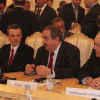
Foreign Minister Hoshyar Zebari has participated in the first session meeting of the Arab - Russian Cooperation Forum in Moscow.
The session was chaired by the Russian Federation Minister of Foreign Affairs, Sergey Lavrov. Present at the meeting were Hoshyar Zebari, Iraqi Minister of Foreign Affairs as Iraq is current President of the Arab Summit, Minister of Foreign Affairs of Lebanon, Adnan Mansour whose country heads the Arab Ministerial Council, Kuwaiti Ambassador to Russia, Nasser Al Mizian, as Kuwait was the last president of the Ministerial Council, Minister of Foreign Affairs of Egypt, Mohamed Kamel Amr, as Egypt will be the next President of the Ministerial Council, and Nabil Al Araby the Secretary-General of the League of Arab States.
The Arab Ministers and the Secretariat General of the AL stressed the unified Arab position towards the essential issues like the Palestinian cause, the Syrian crisis, and the issue of turning the Middle East into a zone free of nuclear weapons and weapons of mass destruction. They also discussed a plan of action to implement the principles and objectives of the Arab - Russian Cooperation Forum in the political, economic, cultural, social, educational, scientific, and media fields for the period 2013 to 2015.
(Source: MOFA)
Posted in Iraq Industry & Trade News Comments Off on Zebari Participates in Arab-Russian Cooperation Forum
KRG President Barzani meets Russia's Putin
Posted on 22 February 2013 .
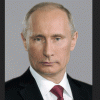
Russian President Vladimir Putin received President Barzani in Moscow for discussions on strengthening bilateral relations and to build on the historic friendship that exists between the people of Russia and the people of Kurdistan.
Today’s meeting focused on economic and cultural cooperation as well as on the role of Russian companies in the reconstruction process in both Kurdistan and Iraq.
Both sides reaffirmed that the historic friendship between the peoples of Russia and the Kurdistan Region of Iraq must be further strengthened. President Barzani said that the Kurdistan Region is committed to the Iraqi Constitution and, as part of Iraq, it strives to reach out to the outside world for mutual benefit and cooperation.
For his part, President Putin stated that he is aware of the struggle of the Kurdish people and of the struggle of Mulla Mustafa Barzani, President Masoud Barzani’s late father, who in the 1950s lived in exile in Moscow for several years.
President Barzani, together with a high-level Kurdistan Region delegation, arrived in Moscow on Tuesday on an official two-day visit, where he is also due to meet Foreign Minister Lavrov and other Russian government officials.
During his stay in Moscow, the President also visited the headquarters of the oil and gas company Gazprom and met with the Chairman of the Management Committee, Alexey Miller. The meeting focused on establishing a long-term partnership between Gazprom and the Kurdistan Regional Government that will include cooperation on energy and power. Both sides said that this cooperation will benefit all of Iraq.
(Source: KRG)
Posted in Iraq Industry & Trade News, Politics Comments Off on KRG President Barzani meets Russia's Putin
KRG President Barzani Begins Visit to Russia
Posted on 19 February 2013 .
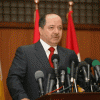
President Masoud Barzani departed from Erbil International Airport on Tuesday with a high-level delegation to make his first official visit to the Russian Federation.
During the visit, President Barzani is expected to meet senior Russian officials to discuss a number of important matters, including relations between the Kurdistan Region and the Russian Federation, political developments in Iraq, and the greater region in general.
The accompanying delegation includes Mr Masrour Barzani, Chancellor of the Kurdistan Region Security Council; Dr Fuad Hussein, Chief of Staff to the President; Dr Ashti Hawrami, Minister of Natural Resources; Mr Kamaran Ahmed Abdullah, Minister of Housing and Reconstruction; Minister Falah Mustafa Bakir, Head of the Department of Foreign Relations, as well as other senior staff members.
(Source: KRG)
Posted in Iraq Industry & Trade News Comments Off on KRG President Barzani Begins Visit to Russia

Announcement: Ownership of Knowledge, Transfer in Progress….
Posted on 12 February 2013 .
By Madeleine White, educationalist, writer and Head of Strategic Partnerships, Whizz Education.
I love books. The sense that I am holding something that belongs to me is precious - even down to the physical smell. This sense of ownership was extreme in my teenage years. I refused to lend anyone my books - somehow they were a part of me. Now, in my forties, and after years of exposure to shared, digital information and content via the internet (and more lately my Kindle), this has relaxed. I do still need something though, that validates my personal experience of this acquisition of knowledge. Sharing my thoughts by blogging and writing goes some way towards making this happen - however, I still feel slightly adrift. At an event I attended last week it suddenly struck me that other people might feel the same. The topic under discussion was ‘the competitive market for digital content providers’. The need for ‘knowledge ownership’ was only referenced in terms of the attachment that many educational purchasers have to physical books. The concept was not addressed at all within a digital landscape. This mirrored discussions I had had during my visit to Iraq around educational strategy and procurement decisions.
Put another way, a lovely new textbook one can physically hold, implies the potential of knowledge in a way that information presented on screen just doesn’t. Even if we don’t yet know the contents of a book, the fact that we can hold it presupposes future acquisition of – or even a right to - that knowledge. Digitalisation of content, especially when it is then shared via the internet, creates a completely different experience. Even though this medium offers a much wider repository (as opposed to the pages of a printed book) knowledge can no longer be owned in the same way. This is a radical shift and has far-reaching consequences as it supposes parity, i.e. all participants are shareholders in each other’s experience of - and access to - knowledge. In this brave new world for example, although his knowledge and experience is valued, an Oxford Don has no more or less of an important role than, say, young Malala Yousufzai from Pakistan. This teenage girl, shot by the Taliban a few months ago, is an equally important contributor to the overall pool of experience and knowledge. The same goes for the CEO looking for a workforce able to manifest his vision, the worker who cleans his building or indeed the teacher who facilitates both learning and a desire to learn.
This is completely contrary to the historical educational paradigm – which is essentially elitist. In this model ownership is retained by the few who then disseminate the commodity (in this case knowledge) in a controlled way, with ‘top down’ rewards. The right qualifications lead to the right university. A top degree leads to a top job, knowing the right people will get you to the right places… This has always worked in the past and many would argue it still does. However, the significant drawback is the limit that this model places upon the pool of human resource that can be drawn upon. This is particularly apparent when set against the almost infinite talent that exists when factors such as geography, gender or economic resource are not factored in.
What does this have to do with ownership of knowledge? The model above applies if knowledge is a commodity - in which case the scarcer it is, the more value it has.
However, in a world which sees a population increase of 150 every minute this paradigm is no longer sustainable. Making something freely available also has its pitfalls though, as it is often perceived as worthless. This is where the sea change comes in; today value is starting to be given to the vehicle which leads to scalable transfer and sharing of knowledge. Good educational technology makes innovative use of content and tools that are free. This is a service. Recognising the value of this service by commoditising it, drives the knowledge economy and allows us to make the most of human capital on a global scale. By delivering content, reporting usage and then communicating the return on investment, Educational Technology makes the sharing and transfer of knowledge sustainable. This reflects the fact that knowledge is the sum of all parts, as are we.
I will be chairing a panel which explores the role of the private sector in creating a sustainable education and skills pipeline. Hosted by the Middle East Association on 27th February in London, this event features many high profile speakers from both business and government sectors, including Rt Hon Baroness Symons of Vernham Dean, Salah Khalil founder of the Alexandra Trust, Hiwa Jwanroyi, Director of Education and Cultural Affairs, Kurdistan Regional Government in the UK and corporate representatives, including Accenture. This will be the first in a series of three events and focus on Building Human Capacity in MENA. Please join us!
Madeleine White is Head of Strategic Partnerships for Whizz Education. A former teacher and mother of, 3 she is passionate about education, communication and CSR and has written extensively around her experiences.
Since starting in 2004, Whizz Education’s mission has been to raise standards in Maths. Maths-Whizz is used by thousands of 5-13 year olds in 8 countries, with major growth coming from the USA, the Middle East and Russia. By mid-2013, Maths-Whizz is expected to have launched and rolled out into 10 markets. To support this model of sustained, positive growth, Maths-Whizz is supported by Whizz Education offices in London, Seattle and Dubai. Additional support is provided through authorised international partners. Whizz Education is looking forward to other international market entries in 2013 and always welcomes strong partner approaches to support further international expansion.
Posted in Iraq Education and Training News, Madeleine White Comments Off on Announcement: Ownership of Knowledge, Transfer in Progress….

Iraq Improves Press Freedom Rating
Posted on 05 February 2013 .
By John Lee.
Iraq has risen two places to rank 150th out of 179 countries in the World Press Freedom Index for 2013, but this followed a fall of 22 places last year.
The security situation for journalists continues to be very worrying, with three killed in connection with their work in 2012 and seven killed in 2011, according to the assessment from Reporters Without Borders. Journalists are constantly obstructed, it added.
The result puts Iraq behind countries such as Russia and Oman, but ahead of Iran and Burma. First place went to Finland, with Eritrea coming last, just behind North Korea.
You can download the full report here.
(Source: Reporters Without Borders)
Posted in Iraqi Communications News, Security Comments Off on Iraq Improves Press Freedom Rating
West Quran 2 Contract Terms Revised
Posted on 22 January 2013 .
By John Lee.
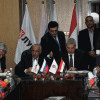
The Chairman of Russia's LUKoil, Vagit Alekperov, has signed an amendment to the contract to develop the West Qurna-2 oil field with the South Oil Company (SOC).
According to the amendment, the 18.75 percent share of the project formerly owned by the Norwegian company Statoil is to be taken over by LUKoil, bringing the latter's share to 75 percent.
Peak production targets are also to be cut from 1.8 million bpd to 1.2 million bpd, but are to be sustained for 19.5 years rather than 13 years, while the total contract period is to be extended from 20 to 25 years.
(Source: Ministry of Oil)
Posted in Iraq Oil & Gas News Comments Off on West Quran 2 Contract Terms Revised
Education for All – Cultural Empowerment, Political Imperative
Posted on 18 January 2013 .
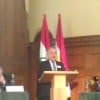
- Picture: Dr Mahmoud Osman, Member of the Council of Representatives Iraq, speaking at yesterday's conference.
By Madeleine White, educationalist, writer and Head of Strategic Partnerships, Whizz Education.
I was going to write about Educational Technology, as Bett (the world’s leading educational technology event) is happening in London at the end of the month. I also considered writing about the Education World Forum, which is linked to Bett and provides an opportunity for Ministers of Education from around the world share ideas and best practice knowledge.
However, yesterday’s International Conference The Untold Story: The Kurdish Genocide in Iraq, was a stark reminder of why the creation of a robust national and international educational frame-work, Education for All, remains a political imperative. Events that support these aims (such as Bett) are therefore not just self-important talking shops, but they provide an inestimable service to the international community by exploring what education really means. So rather than just writing about Bett or the EWF as events, I want to contexualise them.
“It was a beautiful evening, much like any other. The air was still and warm and farmers, after a long hard day, were taking their livestock home. We spotted Russian bombers flying overhead and then dropping a couple of bombs. The odd thing was, there were no major explosions. 15 minutes later though we all smelt it, a smell that didn’t quite fit in, that we didn’t recognise. It was the smell of death”.
Dr Zryan Abdel Yones, Health Adviser to President Barzani, former Health Minister, Kurdistan Regional Government, remembers the first chemical attack in the Anfal genocide operation.
Posted in Madeleine White Comments Off on Education for All – Cultural Empowerment, Political Imperative
Samsung Wins $879m Badra Deal
Posted on 17 January 2013 .
By John Lee.
Iraq and the Russian state oil producer Gazprom Neft have awarded an $879 million contract to South Korea's Samsung Group to develop the Badra oil field in eastern Iraq.
Samsung will design and build phase two of a central processing facility (CPF) for oil production in the field, which is expected to take two years to complete.
Dow Jones reports that initial production from the field is expected to be 15,000 bpd at the end of September this year, increasing to 170,000 bpd by 2017, according to the development plan agreed with the Iraqi government.
The field is being developed by Gazprom (30%), Korea’s KOGAS (22.5%), Malaysia’s Petronas (15%), Turkey’s TPAO (7.5%), and Iraq (25%).
Lead partner Gazprom angered Baghdad by signing a contract with the Kurdistan Regional Government; Baghdad has asked Gazprom to choose between its contract in Kurdistan and the Badra oil field.
(Source: Dow Jones)
Posted in Iraq Oil & Gas News Comments Off on Samsung Wins $879m Badra Deal
Try Iraq for a True Frontier Market
Posted on 15 January 2013 .
By John Lee.
Writing in the Financial Times, a partner at a London-based financial advisory business suggests Iraq as a true frontier market investment.
Citing precedents such as Japan in the early 1960s and Russia in 1995, Richard Greer, a partner at Laurel Capital Kingsway LLP, says:
"The greatest opportunities for emerging market investors have always come when political chaos coincides with a dire media consensus, and a major underlying economic improvement is thereby ignored. Iraq stands firmly in this tradition of missed investor opportunities."
He says that despite the political tensions, many listed Iraqi companies achieved record profits in 2012, there is the beginnings of some sense of civil order, the accumulation and investment of corporate cash, and a widening economic growth.
While energy companies such as Genel Energy, Sterling Energy, and Gulf Keystone Petroleum (GKP) have been investors favourites, Greer says the domestic companies on the Iraq Stock Exchange (ISX) are still waiting to be discovered by international investors.
You can find our latest weekly stock market report here.
Posted in Investment, Iraq Banking & Finance News Comments Off on Try Iraq for a True Frontier Market
Iraqi Firms Need Foreign Expertise as much as Capital
Posted on 02 January 2013 .
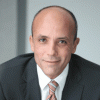
By Sherif Salem.
While attending an investment conference in Erbil in November, I was struck by a theme that came through in almost all my meetings with listed-company executives: a desire to engage with foreign companies.
It seems as if expertise is more in demand than capital as companies look to grow and take advantage of the undoubted potential in Iraq’s rapidly expanding economy.
The Iraqi stock market is still relatively small, with a total market capitalisation of around $5.1 billion, but it has shown signs that it will thrive in years to come. In the year after a new government was formed in late 2010, the market rose steadily as interest grew among both local and foreign investors. The first half of this year saw a dip, but since August, the market has rallied again, and daily trading volumes exceed $3 million in most sessions.
Banks and other firms have successfully raised money through rights issues, and telecoms operator AsiaCell is due to launch an IPO in early January 2013 that should boost total market capitalisation, possibly by as much as $1 billion, liquidity and, consequently, investor interest. A successful listing should pave the way for similar moves from the other two telecoms firms, Zain Iraq -- a subsidiary of Kuwait's Zain -- and France Telecom affiliate Korek.
But as companies look to invest, they realise the need to change the way they operate. Some have a history of state ownership and want to become more commercial, some just know that building scale means transforming business processes. And to implement change, they are keen to enter joint ventures, or simply to bring in foreign know-how into their management teams.
Al-Hilal Industries, which is minority owned by the Ministry of Industry, is a good example. The firm, which operates seven factories making evaporative air coolers, and air condition machines and equipment, raised 4 billion dinars in a rights issue at the end of 2010 to help fund expansion.
The company should be expanding quickly as rising income translates into demand for essential products in a hot country, but sales have stagnated in the last couple of years, partly because of rising competition from imports. The company says it is keen to find a partner to help improve operations, but discussions with a European firm have yet to yield any results.
Mamoura Real Estate Investment is in a similar position. The firm raised just over 3 billion dinar in late July to build much needed housing following a subdued 2011, when its development activities dropped markedly. Mamoura has a large plot of land in Baghdad and says it is looking to bring in an experienced foreign developer as a partner to develop it.
Obviously, security remains the major concern for foreign companies looking to do business in Iraq, as is uncertainty over the legal and regulatory environment. But at least from an economic point of view, brining expertise can yield fairly rapid and marked results.
Al-Kindi Veterinary Vaccines Drugs, for instance, recently entered into an agreement with a Russian company for the production of veterinary vaccines for sale to the Ministry of Agriculture. There has also been an agreement signed with the a French research institute that will help with upgrading production techniques. The company has made giant strides and has ambitious plans for the future even as sales have doubled in the last year, and operating profit has almost tripled.
Sherif Salem is portfolio manager at Abu Dhabi-based asset manager Invest AD. He manages the Invest AD Iraq Opportunity Fund, as well as helping to manage other equities funds investing in the Middle East and Africa.
Posted in Sherif Salem 4 Comments