



Investment Opportunity: Free Zones
Posted on 30 March 2020 .
By John Lee.
Iraq's National Investment Commission (NIC), in coordination with the General Committee for Free Zones, has announced the following investment opportunities:
- The expansional area in Khor Al- Zubair on the land lot No. (13/8 M 44 Hila and 1/3, 2/2, 1/3 M 20 Shaawan) with total area of (20,364,200 M²) that is overlooking khor Al- Zubair stream and adjacent to the sea port and the Fertilizers company with only 55 km paved distance from Safwan border point and full covered by the power grid services.
- Qaem [al-Qaim] Free zone , on the land lot No. (133/7533 M 21 Deyom Al- maneai) with total area of (430,000 M²) , the land is adjacent to Qaem Border Point and near to Electricity and water sources and close to the center of Qaem District while only (25) km distant from Ukaz gas field.
- Lands allocated for free zones in Qaem - Ukashat , on the land lot No. (133/7533 and 11/5 M 21 Deyom Al- maneai) with total area of (6,612,500 M²) , the land is adjacent to Qaem Border Point that is only 20 paved kilo meters distant from its strategic location which is close to the Phosphates factory in Ukashat near Ukaz Gas field.
Willing investors are invited to apply through sending their applications to the One Stop Shop dept. of NIC [email protected] or by visiting the General Committee for Free Zones in Baghdad - Nidhal Street - White palace next to the Building of the General Committee for customs.
(Source: NIC)
Posted in Investment Comments Off on Investment Opportunity: Free Zones

Iraq's Power Conundrum: How to Secure Reliable Electricity
Posted on 27 March 2020 .
By Ahmed Tabaqchali, CIO of Asia Frontier Capital (AFC) Iraq Fund. This article was originally published by the LSE Middle East Centre.
Any opinions expressed are those of the author, and do not necessarily reflect the views of Iraq Business News.
Iraq's Power Conundrum: How to Secure Reliable Electricity While Achieving Energy Independence
Iraq remains in a bind regarding how to secure energy independence within its geopolitical constraints - most pertinently the American sanctions on Iran. The US is continuing to maintain pressure on Baghdad by extending 'final' waivers on the purchase of Iranian gas for only another 30 days, as part of its new tougher stance.
Iraq, in response, could produce credible plans to eliminate its dependence on Iranian imports, which it accelerated with the approval in January of the fifth round of gas exploration contracts. However, achieving this would not end the need for Iranian imports, nor would it secure any kind of energy independence. More importantly, it will not change the shortages in the provision of electricity, which have served as a lightning rod for public anger over the failings of the post-2003 system.
Appreciating the dependence on Iran for the provision of electricity means delving into the extraordinary mess that is Iraq's power grid, consisting of the power plants that generate electricity; transmission system that transport this electricity to population centres; and distribution networks which then distribute this electricity to end users. Decades of conflict have damaged most parts of the grid and, coupled with poor maintenance of the parts that escaped damage, this has rendered the grid impotent.
Rebuilding the grid post-2003 was hampered by the rolling dysfunction of successive governments, in which significant capital expenditures were neutralised by mismanagement, lack of coordination between ministries, and the county's corrosive corruption. The public's frustration over this impotence extends beyond the inadequate provisioning of electricity throughout the year, as the summer's intense heat creates a particularly acute need for electricity, exposing the grid's shortcomings.
These start at the generating stage with the gap between nameplate capacity, i.e. the maximum sustainable power output under ideal conditions, and actual output. While a gap always exists between these two, in 2018 the nameplate capacity was 30.3 gigawatts (GW), while effective capacity through the year was a mere 11.9 GW. A primary reason for this gap is the lack of appropriate fuel supply, in this case gas, which leads to substitutions by fuels such as crude or heavy fuel oil with the result that plants run at less than 60% of capacity - in 2018 only 62% of operating gas-powered plants actually used gas. Other reasons include poor maintenance and lack of cooling in high ambient heat. Moreover, up to 20% nameplate capacity in 2018 was non-operational.
In turn, this increases the gap between demand and supply - in 2018 average demand was 17.7 GW vs. effective generated power of 11.9 GW. But this gap is only part of the story, as the electricity generated to meet demand does not mean that it was actually delivered to end users. The total electricity generated in 2018 was 105.4 terawatt-hours (TWh), but only 43.7 TWh reached end users for a loss of 58.5%. Most of these losses take place at the distribution stage, with technical losses stemming from age, conflict damage, poor maintenance accounting for two thirds, and non-technical losses, mostly electricity theft, accounting for a third. Technical losses are natural, however they occur at an extremely high rate in Iraq, as do non-technical losses. Stolen electricity - still consumed but not billed - is estimated at 17 TWh, and so the electricity delivered would rise to 61 TWh, equating to a loss of 42.2%. This dynamic can be seen below.
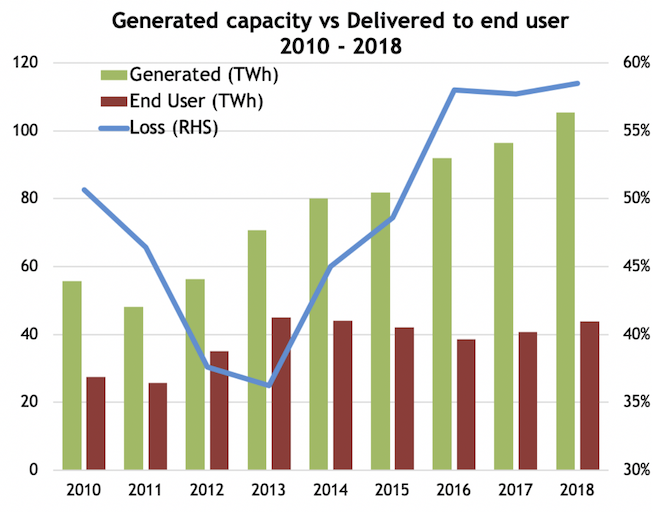
The increase in losses from 2014 onwards can be attributed to the ISIS conflict, which damaged 20% of the transmission system and 5.0 GW of generating capacity. 2019 saw meaningful improvement as effective capacity increased from 11.9 GW to 14.3 GW, and crucially during the summer months peak generation was 19.3 GW vs. peak demand of 27.5 GW. This gap of 8.2 GW has narrowed from 2018's 10.0 GW gap when peak supply was 16.5 GW vs. peak demand of 26.5 GW.
Electricity generated from Iranian electricity and gas imports accounted for 20.7% of that generated throughout 2019, and probably a much higher percentage during the peak summer months. These contributions from electricity imports from 2010 and gas imports from 2017 can be seen below.
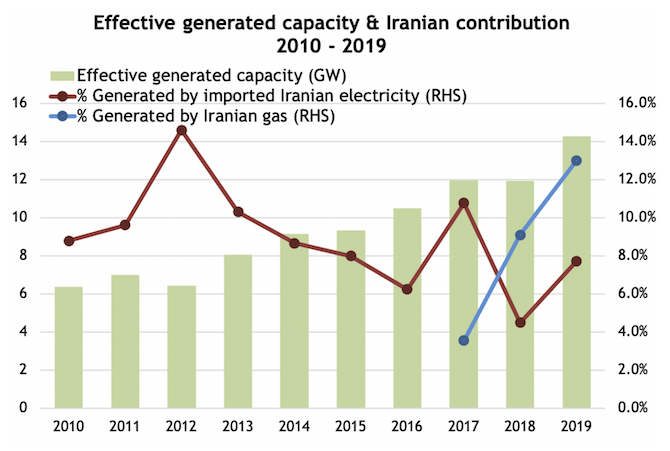
The importance of Iranian electricity imports as a percentage of the total have steadily decreased, even though they increased in absolute levels; nevertheless, the decline in summer of 2018 was large enough to ignite the demonstrations in Basra. Imports in 2019 returned to the trend line and averaged 1.1 GW for the year. Plans for other regional imports include 0.5 GW to be imported from Kuwait by the end of 2020, rising to 1.9 GW over subsequent years, including planned imports from Jordan and Turkey.
Iranian gas imports were 7.0 billion cubic meters (BCM) in 2019, up from 4.1 BCM in 2018, and accounted for 31% of total gas consumed - up from 24% in 2018. Plans for increased domestic production include increasing captured flared gas to 16-19 BCM by end of 2021 from 12 BCM in 2019. Additionally, the fifth round of gas contracts call for replacing Iranian imports in three years, i.e. generating 7.0-10.0 BCM over that period from the current 3.5 BCM.
Assuming that the government executes these plans, in three years' time this would replace the current electricity produced by Iranian imports. But demand is set to increase by 20% from current levels, meaning that the current the gap between supply and demand would increase by up to 20%. Moreover, planned capacity additions require additional fuel, which under existing plans is earmarked to replace imported gas. However, maintaining Iranian imports would significantly decrease their importance in power generation from the current 20.7%, and in the process Iraq would add meaningful capacity to address demand.
The goal posts are moving much faster than Iraq's ability to approach them, and as such the US's insistence on eliminating Iranian imports, far from achieving energy independence for Iraq, would instead exacerbate its energy vulnerabilities. Compounding these vulnerabilities is the massive investment spending needed to expand the grid's capacity, currently unaddressed in the government's structurally unbalanced budget, but which is ever more critical following the collapse of oil prices.
Iraq's pathway out of this predicament, even at much higher oil prices, involves electricity tariff reform and the removal of energy subsidies, both the source of monumental waste and substantial market distortions. However, this requires a popular buy-in and for the increasingly alienated population to renew their belief in the post-2003 system's legitimacy. It is here where the international community can help Iraq achieve energy independence.
Sources
The figures and charts used in the article are the author's estimates, and are based on data from the Ministry of Electricity's annual reports and conference presentations, the IEA, BP, MEES, Oxford Energy, and publicly available news sources. However, all errors and omissions are the author's own.
The data used in the article exclude electricity demand and generation in the Kurdistan Region of Iraq (KRI). However, figures for locally produced and consumed gas include the KRI, and as such the Iranian-origin percentages of total gas consumed would be somewhat higher than the 31% and 24% used if the KRI was excluded.
Disclaimer: Ahmed Tabaqchali's comments, opinions and analyses are personal views and are intended to be for informational purposes and general interest only and should not be construed as individual investment advice or a recommendation or solicitation to buy, sell or hold any fund or security or to adopt any investment strategy. It does not constitute legal or tax or investment advice. The information provided in this material is compiled from sources that are believed to be reliable, but no guarantee is made of its correctness, is rendered as at publication date and may change without notice and it is not intended as a complete analysis of every material fact regarding Iraq, the region, market or investment.
Posted in Iraq Industry & Trade News Comments Off on Iraq's Power Conundrum: How to Secure Reliable Electricity
New Power Plant opens in Umm Qasr
Posted on 13 March 2020 .
A 29 MW gas-fuelled power plant supplied by the technology group Wärtsilä to the Umm Qasr Ports Authority Zone in Basra, Iraq, commenced commercial operations in February. The plant ensures availability of a reliable supply of electricity to the port's operations, which had previously been subject to frequent power interruptions.
The Wärtsilä plant was ordered in October 2018 by Lebanon-based Butec, the engineering, procurement and construction (EPC) provider for the project. Butec was contracted by Prime Metro Power Holdings (PMPH), the company having a Power Purchase Agreement (PPA) with the General Company for the Ports of Iraq, an Iraqi Ministry of Transport entity.
Wärtsilä delivered the plant on a fast-track basis, and the project was completed in an exceptionally short period of time, despite delays caused by the ongoing political situation in the country.
Guillaume Lucci, President and COO of PMPH, said:
"We have been able to leverage the local natural gas resources to develop a first class, state-of-the-art power plant facility that adds a vital power generation infrastructure and services to the state of Iraq. The completion of this project in less than one year is a significant milestone in our strategy to quickly develop the needed power infrastructure.
"We are pleased to have worked with Wärtsilä on this project, and we are certain that the quality and performance of the engine will be an asset over the lifecycle of the plant."
Alexandre Eykerman, Energy Business Director, Middle East, Wärtsilä Energy Business, said:
"The fast-starting, flexible operation of the Wärtsilä engines was a decisive consideration in the award of this contract. The plant can run fewer engines when less power is demanded and start the additional engines only when and as needed. This provides a cost-effective, efficient, and highly reliable solution that will greatly enhance the port's operations."
The Umm Qasr plant operates on three Wärtsilä 34SG gas engines, which deliver reliable baseload power on a 24/7 basis. Wärtsilä has also signed a maintenance agreement, the scope of which includes field service, and engine maintenance planning based on remote monitoring and asset diagnostics. For this, the plant is already connected to the Wärtsilä Digital Expertise Centre located in Dubai.
In addition to providing cost predictability, the agreement ensures the safety, reliability, and efficiency of the plant's operations. Wärtsilä will have technical advisors stationed on site for mutually agreed periods of time to supervise the plant's performance.
This is the first phase of an overall power supply project that will be expanded to increase the availability of electricity throughout the region. It represents Wärtsilä's first gas-fired power plant in Iraq.
(Source: Wärtsilä)
Posted in Construction & Engineering In Iraq, Iraq Industry & Trade News Comments Off on New Power Plant opens in Umm Qasr

Major Sites re-open in Ramadi highlighting City’s Recovery
Posted on 02 March 2020 .
Hospitals and bridges: Major sites re-open in Ramadi highlighting city’s recovery
The Government of Iraq has re-opened two major infrastructure projects in Ramadi following their rehabilitation by the United Nations Development Programme (UNDP).
The re-opening of Ramadi Maternity Hospital and the Palestine Bridge marks a significant moment for the recovery of the city after years of ISIL occupation.
Ramadi Maternity Hospital is a large, 260 bed, modern medical facility – one that will provide over 400,000 women in Anbar with specialized maternity services. As the only such facility in Anbar, the hospital will serve women from areas as far away as Heet, Haditha, Anah, Rawa and Al Qaim.
UNDP carried out major work at the hospital, including the rehabilitation of operating theatres, labour wards, water and electrical systems and doctor’s accommodation.
UNDP’s Resident Representative in Iraq, Zena Ali Ahmad, said:
“Today marks an important day for Ramadi. After many difficult years, this great city is back on its feet. Access to healthcare is one of the foundations of strong societies, and UNDP is proud to be working to improve health services across the areas that suffered under ISIL with the support of our generous donors.”
The rehabilitation of the hospital was funded through a significant contribution by the Federal Republic of Germany, through KfW Development Bank.
KfW Country Director, Dr. Anna-Christine Janke, said:
“On behalf of the German Government KfW Development Bank is proud to finance a host of projects in Iraq. Projects range from the rehabilitation of basic and critical infrastructure including hospitals, electricity, roads and bridges, to support for small and medium enterprises and assistance to livelihoods.”
The nearby Palestine Bridge also suffered extensive damage during the battle to dislodge ISIL, and several of its parts were either partially damaged or completely destroyed. As the largest bridge in Anbar, it spans over 500m and measures three lanes wide on each side. The complex rehabilitation of the bridge was undertaken by UNDP, beginning in 2018.
Adds Ms. Ali Ahmad:
“Bridges don’t just connect roads; they connect people and communities. This bridge serves as critical passageway for residents of Ramadi and an integral gateway to Greater Anbar. UNDP’s commitment to restoring these vital pieces of infrastructure is clear, with 11 bridges across Anbar now completed.”
At the request of the Government of Iraq, UNDP established the Funding Facility for Stabilization (FFS) in June 2015 to facilitate the return of displaced Iraqis, lay the groundwork for reconstruction and recovery, and safeguard against the resurgence of violence.
Based on priorities identified by the Government of Iraq, FFS helps quickly repair essential public infrastructure, boosts the capacity of local government, provides short-term employment opportunities and helps to build cohesive communities.
To date, UNDP’s Funding Facility has completed more than 2,300 projects in key critical areas of Anbar, Salah al-Din, Diyala, Kirkuk and Ninewa.
(Source: UNDP)
Posted in Construction & Engineering In Iraq, Iraq Transportation News Comments Off on Major Sites re-open in Ramadi highlighting City’s Recovery

New Solar Park to ease Dohuk's Power Shortage
Posted on 25 February 2020 .
By Joe Snell for Al Monitor. Any opinions expressed here are those of the author and do not necessarily reflect the views of Iraq Business News.
New solar park to ease Iraqi governorate's power shortage
No one batted an eye when the power abruptly cut off in English teacher Miriam Zia's 11th-grade classroom at the Sardam International School in Duhok.
The cuts occur at least twice a day and are now "part of the fabric of our society," Zia told Al-Monitor.
To combat growing electricity concerns in the district, the Iraqi governorate of Duhok signed an agreement with the United Nations Development Programme (UNDP) earlier this month to set up the district's first solar energy park.
The project comes amid pressure on Iraq to diversify its energy sources and lessen its dependence on Iran.
Posted in Iraq Industry & Trade News Comments Off on New Solar Park to ease Dohuk's Power Shortage

Ambassador meets Russian Deputy Minister of Energy
Posted on 24 February 2020 .
The Ambassador of Iraq in Moscow, Mr. Abdul-Rahman Hamid Al-Hussaini, met with the Russian Deputy Minister of Energy, Mr. Pavel Sorokin to discuss bilateral cooperation in the fields of energy (oil, gas, and electricity).
Ambassador Al-Hussaini stressed Iraq’s keenness to develop relations with the Russian Federation in the energy sector and provide support to Russian companies working in it, noting the importance of increasing Russian investments to serve the interests of the two friendly countries.
Ambassador Al-Hussaini stated that the embassy will support all Russian companies willing to work in Iraq, and will work to provide facilities with the responsible authorities in Iraq.
The two sides discussed the possibility of employing Iraqi graduates from universities with engineering specializations in the fields of energy in Russian companies operating in Iraq.
The two sides also discussed the dangers of the Coronavirus and its impact on the energy market, as well as bilateral cooperation on stabilizing oil prices in global markets.
(Source: Ministry of Foreign Affairs)
Posted in Iraq Oil & Gas News Comments Off on Ambassador meets Russian Deputy Minister of Energy

Umm Qsar Power Plant begins Operation
Posted on 14 February 2020 .
Prime Power Middle East (PPME), a wholly owned subsidiary of Prime Metro Power Holdings Corporation, has commenced operation of its power plant in Umm Qasr, Basra.
The power plant started its commercial operation last Sunday, 09 February 2020, and is designed to deliver base load of 24/7 power to the Umm Qasr Ports Authority Zone.
The gas-fired power plant is equipped with three latest version Wartsila W20V34SG engines with fast start capability able to provide power to the GCPI grid within 30 seconds. It is fully automated with the latest control system allowing stable electricity generation to the Umm Qasr Port grid.
Prime Power started discussions with the Iraqi government in 2016 in light of the growing power shortages. In May 2018, Prime Power signed a 23-year Power Purchase Agreement with the Genral Company of Ports or Iraq (GCPI).
Benefiting from natural gas supply from a specially built 15km natural gas pipeline, the Umm Qasr Port Power Plant is the first phase of a multi-phase development program that starts with its current Phase 1 operational capacity of 29.3MW reaching total generation capacity 68.4MW in Phase 2, with room to increase capacity up to 150MW in the coming years.
The power plant operation will be integrated with a distribution system to support the port industrial zone and surrounding cities.
Enrique Razon Jr., Prime Power Chairman and CEO, said:
“We are delighted to start our greenfield power plant in Umm Qasr Port. It is a testament to the potential of Iraq.
"Under a join operation framework with GCPI we were able to leverage the Basra Governorate’s natural gas resources to develop a first class state of the art facility that adds vital power generation infrastructure and services to state of Iraq.
"We see this plant as the first phase of many as we continue to be long term investors in Iraq and to contribute to its economic and social development.”
In spite of some of geopolitical and social challenges Iraq is going through, the plant was built within record time and ahead of schedule.
Guillaume Lucci, Prime Power President and COO, said:
“We are pleased to have delivered such critical infrastructure and services to GCPI and the Port of Umm Qasr.
"The completion of Phase 1, in less than one year, is a significant milestone in Prime Power’s strategy to build up an infrastructure portfolio that delivers fast and critical investments to regions in need.
"We will continue to rest on our strong presence on the ground as we work hand in hand with the government and the communities we serve.”
Moving forward, PPME will continue to improve the electricity situation at the port, and is looking forward to launching the Phase 2 in the last quarter of 2020.
Prime Metro Power will continue to aim for an even greater contribution to the Iraq power market, and continue the boundless use of economical and sustainable power generation facilities.
(Source: ICTSI)
Posted in Construction & Engineering In Iraq, Iraq Industry & Trade News Comments Off on Umm Qsar Power Plant begins Operation

Iraq "likely" to get New Waiver for Iran Gas Imports
Posted on 13 February 2020 .
By Bryant Harris for Al Monitor. Any opinions expressed here are those of the author and do not necessarily reflect the views of Iraq Business News.
Iraq likely to continue importing Iranian natural gas under US waiver renewal
Iraqi officials have indicated that the United States is likely to renew a key Iran sanctions waiver that will allow Baghdad to continue importing Iranian natural gas to fuel its electricity needs, the AP reported.
The three-month waiver is set to expire Thursday.
Iraq relies on Iranian imports to meet the lion’s share of its electricity needs in the face of shortages that have helped provoke widespread protests in recent years.
Click here to read the full article.
(Picture credit: Tasnim, under Creative Commons licence)
Posted in Iraq Oil & Gas News, Politics Comments Off on Iraq "likely" to get New Waiver for Iran Gas Imports

IBBC Meetings and Dinner in Baghdad
Posted on 07 February 2020 .
IBBC meetings and dinner for members and guests at the Babylon Hotel, Baghdad on 5th and 6th February
On Wednesday, 5 February, Christophe Michels, Managing Director, Iraq Britain Business Council (IBBC) and Rasmi Al Jabri, Deputy Chairman, IBBC met with Dr Salar Ameen Acting Chairman of National Investment Commission (NIC).
They discussed the longstanding cooperation between the NIC and IBBC and how to deepen it and made plans for a joint Baghdad conference to be held as soon as a new Government is formed.
Later, Mohanad Al Khattab, Baghdad Office Manager, accompanied them to the British Embassy where they met with John Tucknott the Deputy British Ambassador to Iraq. Beverly Simpson, Director DIT Iraq also attended the meeting. They spoke about the present situation in Iraq and how it affected the business environment and discussed how best to work together in Iraq and in the UK in the month ahead.
In addition to the meetings IBBC held a dinner for its members and guests at the Babylon Hotel in Baghdad on 5th February. The dinner was hosted by Rasmi Al Jabri, Deputy Chairman of IBBC and Christophe Michels, Managing Director of IBBC.

Rasmi Al Jabri is welcoming IBBC members and guests
Rasmi Al Jabri gave an opening speech welcoming everyone and spoke about IBBC’s activities in Iraq and UK. The dinner also attended by Dr Salar Ameen, Chairman of the National Investment Commission, H.E. Dr Luay Al Khateeb, Minister of Electricity, Mr Abdul Aziz Shwan A Ahmed, Chief of Staff of DPM Dr Fouad Hussein and Mr Abdulrazzaq Al-Zuhairi, Chairman of the Iraqi Federation of Chambers of Commerce. IBBC member companies in attendance included Al-Burhan Group, Al-Maseer, ENKA, Eversheds Sutherland, G4S, GE, HHP Law, International Islamic Bank, KPMG, Management Partners, Serco Middle East, Shell, Siemens Iraq, SKA International, Standard Chartered Bank and TurnKey LLC.

Mohanad Al Khattab, Leena Zeyad, Christophe Michels and Rasmi Al Jabri next to evening’s sponsor’s – Sardar Trading Agency display
The evening’s sponsor was Sardar Trading Agencies who displayed their new Range Rover Mild Hybrid Car, Model Year 2020.
The next day the IBBC team visited the offices of International Islamic Bank, HHP Law and Serco at Baghdad air traffic control.
(Source: IBBC)
Posted in Investment, Iraq Industry & Trade News Comments Off on IBBC Meetings and Dinner in Baghdad

Fmr UK Defence Minister joins Genel Energy Board
Posted on 06 February 2020 .
Genel Energy has announced the appointment of David McManus as Chairman with immediate effect.
Sir Michael Fallon (pictured) has been appointed as senior independent Non-Executive Director, and Tolga Bilgin and Hassan Gozal have also been appointed to the Board as Non-Executive Directors.
David McManus has more than 40 years of experience in the oil and gas industry, having held various executive roles at Pioneer Natural Resources, BG Group, ARCO, Ultramar, and Shell. He is currently serving as a Non-Executive Director at Hess Corporation, a large, integrated US oil and gas company; FlexLNG, a Norwegian listed LNG shipping company; and Costain Group PLC, one of the UK's leading smart infrastructure solutions companies. Previous directorships include Rockhopper Exploration plc and Northern Drilling Limited.
Sir Michael Fallon has 30 years of senior political and business experience, serving in four British Cabinets, and as Non-Executive Director on City and commercial boards. He was MP for Sevenoaks from 1997 to 2019, serving as Energy Minister responsible for the oil and gas sector from 2013 to 2014 and as Secretary of State for Defence from 2014 to 2017.
Sir Michael will act as Senior Independent Director, Deputy Chairman and Chairman of the International Relations Committee. George Rose is remaining at Genel as an independent Non-Executive Director and Chairman of the Audit Committee.
Tolga Bilgin has been CEO of Bilgin Energy Holding, and its subsidiaries, since 2014. Bilgin Energy Holding is a pioneer and a leading Turkish energy firm, that owns, operates and sells electricity from wind, natural gas, and hydroelectric projects, and is a major shareholder of Genel.
Hassan Gozal is Chairman of Daax Corporation, a Dubai based company with investments in a wide range of sectors, notably energy and oil, oil and gas trading, construction, and property development with significant Middle Eastern experience, including the Kurdistan Region of Iraq. Daax Corporation is a major shareholder of Genel.
As a temporary result of these appointments, the majority of the Board (excluding the Chairman) is not independent. It is the intention of the Board to appoint one further independent Director to return to an equal balance of independent versus non-independent Directors as soon as reasonably practicable.
George Rose, Non-Executive Director of Genel, said:
"I am delighted to welcome David to the Board. He has vast experience which will help guide the Company through the next phase in our development, as we build our operating capability and seek material growth. The appointments today bring significant industry and international expertise, with experience of operating, investing, and delivering major projects in the region."
David McManus, Chairman of Genel, said:
"Genel has built a portfolio with a compelling mix of cash-generation and funded growth options. I look forward to working with the Board as the Company continues to deliver on its strategy, enters an exciting new chapter, and strives to take advantage of the significant opportunities ahead."
(Source: Genel Energy)
Posted in Iraq Oil & Gas News Comments Off on Fmr UK Defence Minister joins Genel Energy Board