

Ambassador meets Russian Deputy Minister of Energy
Posted on 24 February 2020 .
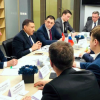
The Ambassador of Iraq in Moscow, Mr. Abdul-Rahman Hamid Al-Hussaini, met with the Russian Deputy Minister of Energy, Mr. Pavel Sorokin to discuss bilateral cooperation in the fields of energy (oil, gas, and electricity).
Ambassador Al-Hussaini stressed Iraq’s keenness to develop relations with the Russian Federation in the energy sector and provide support to Russian companies working in it, noting the importance of increasing Russian investments to serve the interests of the two friendly countries.
Ambassador Al-Hussaini stated that the embassy will support all Russian companies willing to work in Iraq, and will work to provide facilities with the responsible authorities in Iraq.
The two sides discussed the possibility of employing Iraqi graduates from universities with engineering specializations in the fields of energy in Russian companies operating in Iraq.
The two sides also discussed the dangers of the Coronavirus and its impact on the energy market, as well as bilateral cooperation on stabilizing oil prices in global markets.
(Source: Ministry of Foreign Affairs)
Posted in Iraq Oil & Gas News Comments Off on Ambassador meets Russian Deputy Minister of Energy

Umm Qsar Power Plant begins Operation
Posted on 14 February 2020 .
Prime Power Middle East (PPME), a wholly owned subsidiary of Prime Metro Power Holdings Corporation, has commenced operation of its power plant in Umm Qasr, Basra.
The power plant started its commercial operation last Sunday, 09 February 2020, and is designed to deliver base load of 24/7 power to the Umm Qasr Ports Authority Zone.
The gas-fired power plant is equipped with three latest version Wartsila W20V34SG engines with fast start capability able to provide power to the GCPI grid within 30 seconds. It is fully automated with the latest control system allowing stable electricity generation to the Umm Qasr Port grid.
Prime Power started discussions with the Iraqi government in 2016 in light of the growing power shortages. In May 2018, Prime Power signed a 23-year Power Purchase Agreement with the Genral Company of Ports or Iraq (GCPI).
Benefiting from natural gas supply from a specially built 15km natural gas pipeline, the Umm Qasr Port Power Plant is the first phase of a multi-phase development program that starts with its current Phase 1 operational capacity of 29.3MW reaching total generation capacity 68.4MW in Phase 2, with room to increase capacity up to 150MW in the coming years.
The power plant operation will be integrated with a distribution system to support the port industrial zone and surrounding cities.
Enrique Razon Jr., Prime Power Chairman and CEO, said:
“We are delighted to start our greenfield power plant in Umm Qasr Port. It is a testament to the potential of Iraq.
"Under a join operation framework with GCPI we were able to leverage the Basra Governorate’s natural gas resources to develop a first class state of the art facility that adds vital power generation infrastructure and services to state of Iraq.
"We see this plant as the first phase of many as we continue to be long term investors in Iraq and to contribute to its economic and social development.”
In spite of some of geopolitical and social challenges Iraq is going through, the plant was built within record time and ahead of schedule.
Guillaume Lucci, Prime Power President and COO, said:
“We are pleased to have delivered such critical infrastructure and services to GCPI and the Port of Umm Qasr.
"The completion of Phase 1, in less than one year, is a significant milestone in Prime Power’s strategy to build up an infrastructure portfolio that delivers fast and critical investments to regions in need.
"We will continue to rest on our strong presence on the ground as we work hand in hand with the government and the communities we serve.”
Moving forward, PPME will continue to improve the electricity situation at the port, and is looking forward to launching the Phase 2 in the last quarter of 2020.
Prime Metro Power will continue to aim for an even greater contribution to the Iraq power market, and continue the boundless use of economical and sustainable power generation facilities.
(Source: ICTSI)
Posted in Construction & Engineering In Iraq, Iraq Industry & Trade News Comments Off on Umm Qsar Power Plant begins Operation

Iraq "likely" to get New Waiver for Iran Gas Imports
Posted on 13 February 2020 .
By Bryant Harris for Al Monitor. Any opinions expressed here are those of the author and do not necessarily reflect the views of Iraq Business News.
Iraq likely to continue importing Iranian natural gas under US waiver renewal
Iraqi officials have indicated that the United States is likely to renew a key Iran sanctions waiver that will allow Baghdad to continue importing Iranian natural gas to fuel its electricity needs, the AP reported.
The three-month waiver is set to expire Thursday.
Iraq relies on Iranian imports to meet the lion’s share of its electricity needs in the face of shortages that have helped provoke widespread protests in recent years.
Click here to read the full article.
(Picture credit: Tasnim, under Creative Commons licence)
Posted in Iraq Oil & Gas News, Politics Comments Off on Iraq "likely" to get New Waiver for Iran Gas Imports

IBBC Meetings and Dinner in Baghdad
Posted on 07 February 2020 .
IBBC meetings and dinner for members and guests at the Babylon Hotel, Baghdad on 5th and 6th February
On Wednesday, 5 February, Christophe Michels, Managing Director, Iraq Britain Business Council (IBBC) and Rasmi Al Jabri, Deputy Chairman, IBBC met with Dr Salar Ameen Acting Chairman of National Investment Commission (NIC).
They discussed the longstanding cooperation between the NIC and IBBC and how to deepen it and made plans for a joint Baghdad conference to be held as soon as a new Government is formed.
Later, Mohanad Al Khattab, Baghdad Office Manager, accompanied them to the British Embassy where they met with John Tucknott the Deputy British Ambassador to Iraq. Beverly Simpson, Director DIT Iraq also attended the meeting. They spoke about the present situation in Iraq and how it affected the business environment and discussed how best to work together in Iraq and in the UK in the month ahead.
In addition to the meetings IBBC held a dinner for its members and guests at the Babylon Hotel in Baghdad on 5th February. The dinner was hosted by Rasmi Al Jabri, Deputy Chairman of IBBC and Christophe Michels, Managing Director of IBBC.

Rasmi Al Jabri is welcoming IBBC members and guests
Rasmi Al Jabri gave an opening speech welcoming everyone and spoke about IBBC’s activities in Iraq and UK. The dinner also attended by Dr Salar Ameen, Chairman of the National Investment Commission, H.E. Dr Luay Al Khateeb, Minister of Electricity, Mr Abdul Aziz Shwan A Ahmed, Chief of Staff of DPM Dr Fouad Hussein and Mr Abdulrazzaq Al-Zuhairi, Chairman of the Iraqi Federation of Chambers of Commerce. IBBC member companies in attendance included Al-Burhan Group, Al-Maseer, ENKA, Eversheds Sutherland, G4S, GE, HHP Law, International Islamic Bank, KPMG, Management Partners, Serco Middle East, Shell, Siemens Iraq, SKA International, Standard Chartered Bank and TurnKey LLC.

Mohanad Al Khattab, Leena Zeyad, Christophe Michels and Rasmi Al Jabri next to evening’s sponsor’s – Sardar Trading Agency display
The evening’s sponsor was Sardar Trading Agencies who displayed their new Range Rover Mild Hybrid Car, Model Year 2020.
The next day the IBBC team visited the offices of International Islamic Bank, HHP Law and Serco at Baghdad air traffic control.
(Source: IBBC)
Posted in Investment, Iraq Industry & Trade News Comments Off on IBBC Meetings and Dinner in Baghdad

Fmr UK Defence Minister joins Genel Energy Board
Posted on 06 February 2020 .
Genel Energy has announced the appointment of David McManus as Chairman with immediate effect.
Sir Michael Fallon (pictured) has been appointed as senior independent Non-Executive Director, and Tolga Bilgin and Hassan Gozal have also been appointed to the Board as Non-Executive Directors.
David McManus has more than 40 years of experience in the oil and gas industry, having held various executive roles at Pioneer Natural Resources, BG Group, ARCO, Ultramar, and Shell. He is currently serving as a Non-Executive Director at Hess Corporation, a large, integrated US oil and gas company; FlexLNG, a Norwegian listed LNG shipping company; and Costain Group PLC, one of the UK's leading smart infrastructure solutions companies. Previous directorships include Rockhopper Exploration plc and Northern Drilling Limited.
Sir Michael Fallon has 30 years of senior political and business experience, serving in four British Cabinets, and as Non-Executive Director on City and commercial boards. He was MP for Sevenoaks from 1997 to 2019, serving as Energy Minister responsible for the oil and gas sector from 2013 to 2014 and as Secretary of State for Defence from 2014 to 2017.
Sir Michael will act as Senior Independent Director, Deputy Chairman and Chairman of the International Relations Committee. George Rose is remaining at Genel as an independent Non-Executive Director and Chairman of the Audit Committee.
Tolga Bilgin has been CEO of Bilgin Energy Holding, and its subsidiaries, since 2014. Bilgin Energy Holding is a pioneer and a leading Turkish energy firm, that owns, operates and sells electricity from wind, natural gas, and hydroelectric projects, and is a major shareholder of Genel.
Hassan Gozal is Chairman of Daax Corporation, a Dubai based company with investments in a wide range of sectors, notably energy and oil, oil and gas trading, construction, and property development with significant Middle Eastern experience, including the Kurdistan Region of Iraq. Daax Corporation is a major shareholder of Genel.
As a temporary result of these appointments, the majority of the Board (excluding the Chairman) is not independent. It is the intention of the Board to appoint one further independent Director to return to an equal balance of independent versus non-independent Directors as soon as reasonably practicable.
George Rose, Non-Executive Director of Genel, said:
"I am delighted to welcome David to the Board. He has vast experience which will help guide the Company through the next phase in our development, as we build our operating capability and seek material growth. The appointments today bring significant industry and international expertise, with experience of operating, investing, and delivering major projects in the region."
David McManus, Chairman of Genel, said:
"Genel has built a portfolio with a compelling mix of cash-generation and funded growth options. I look forward to working with the Board as the Company continues to deliver on its strategy, enters an exciting new chapter, and strives to take advantage of the significant opportunities ahead."
(Source: Genel Energy)
Posted in Iraq Oil & Gas News Comments Off on Fmr UK Defence Minister joins Genel Energy Board

Duhok to Establish First Solar Energy Park
Posted on 06 February 2020 .
Duhok will soon have its first solar energy park in a major step towards becoming a low-carbon governorate, setting an example on sustainable renewable energy to follow in Iraq.
On 04 February 2020, the United Nations Development Programme (UNDP) signed a letter of agreement with the Governorate of Duhok to establish a pilot solar park that will provide a minimum of two megawatts of electricity within two years.
The European Union (EU) provided US$2 million of funding for this project under the UNDP programme “Supporting Recovery and Stability in Iraq through Local Development.”
Governor of Duhok, Mr. Farhad Atrushi, said:
“Our commitment to take climate action, deliver affordable, clean energy to the citizens and address electricity shortages remains as strong as ever. Under the Duhok Sustainable Energy Action Plan (SEAP), we pledged to reduce greenhouse gas emissions by 2030.
"Establishing the first solar park in Duhok will contribute to achieving this goal and meet the needs of the market. We are grateful to the EU and UNDP for helping to make this happen. We look forward to purposeful partnerships with the private sector for green energy for present and future generations.”
Duhok experiences serious deficits in electricity and has over 1000 electricity generators that are causing chronic air and noise pollution. According to the Sustainable Energy Action Plan that was developed under the Local Area Development Programme (LADP II), Duhok foresees the installation of solar parks to provide up to 40 megawatts of clean electricity by 2030.
Head of the EU Delegation to the Republic of Iraq, H.E. Ambassador Martin Huth, said:
“This intervention will not only improve access to energy for the population in Duhok Governorate but will also ensure that this energy is green. In Europe, we are strongly determined to tackle climate change and succeed in our recently launched green deal, becoming the world's first climate-neutral continent by 2050. And I am delighted that we are able to support KRI in its own sustainable energy deal''.
Resident Representative of UNDP Iraq, Ms. Zena Ali-Ahmad, said:
“We are encouraged by the Governorate of Duhok’s commitment to reducing its carbon footprint and providing green energy to its citizens. Establishing a solar park will stimulate the economy through private sector investments, create more jobs in green economy, and above all reduce pollution. The project will represent the first introduction of solar energy supply on such a scale in Iraq.”
The programme Supporting Recovery and Stability in Iraq through Local Development aims at contributing to the stability and socio-economic development of Iraq by enhancing democratic governance at the local level. It is working to improve the ability of selected governorates to efficiently manage local government and public services.
Economic growth and job creation are prioritized, with a focus on green projects, involving youth and women, in addition to enhancing the living conditions of returnees and in conflict affected areas.
The programme fact sheet can be downloaded through this link: https://bit.ly/2Wlw17e
(Source: UNDP)
Posted in Investment, Iraq Industry & Trade News Comments Off on Duhok to Establish First Solar Energy Park

Trump "Would Support" Siemens in Iraq
Posted on 27 January 2020 .
By John Lee.
The CEO of Germany's Siemens has said that US President Donald Trump would support his company's role in reconstruction projects in countries like Iraq.
Joe Kaeser (pictured) made the comment to CNBC at the World Economic Forum (WEF) in Davos, Switzerland.
Following a hotly-contested competition in 2018, it was agreed that Siemens and rival GE would share the work to upgrade Iraq's electricity system, with GE supplying 14 gigawatts (GW), and Siemens 11 GW.
Siemens employs around 60,000 workers in the US.
(Source: CNBC)
Posted in Construction & Engineering In Iraq, Iraq Industry & Trade News Comments Off on Trump "Would Support" Siemens in Iraq

Iraq may Stop Iran Gas Transfers if US Waiver Ends
Posted on 22 January 2020 .
By John Lee.
The head of Trade Bank of Iraq (TBI) has reportedly said that the bank would stop processing payments for Iranian gas imports if a US sanctions exemption expires next month.
Faisal al-Haimus told AFP:
"As a bank, the most important thing we have is that we are compliant (with international regulations). That's why people trust us."
Iraq relies heavily on Iran to support its struggling electricity sector.
When the United States imposed sanctions on Iran's energy sector in 2018, it granted Iraq a series of temporary waivers to allow it to buy gas from Iran.
(Source: AFP)
Posted in Iraq Oil & Gas News Comments Off on Iraq may Stop Iran Gas Transfers if US Waiver Ends

Iraq signs Electricity deal with GCC
Posted on 03 January 2020 .
By John Lee.
Iraq has reportedly signed a deal with the Gulf Cooperation Council Interconnection Authority (GCCIA) to import electricity at a rate of 500 megawatts of electricity from Sunni Arab gulf countries before next summer, Iraqi Ministry of Electricity spokesperson a told state newspaper on Thurday.
According to Rudaw, the GCCIA will fund the cost of building the two 400-KV lines, which will run for 300 kilometers across Iraq and Kuwait.
(Source: Rudaw)
Posted in Construction & Engineering In Iraq, Iraq Industry & Trade News Comments Off on Iraq signs Electricity deal with GCC

An Iraq for All Iraqis
Posted on 17 December 2019 .
By Yassir Khudayri, for Open Society Foundations (OSF).
In early October 2019, in Baghdad’s Tahrir Square and in many of Iraq’s other major cities, young Iraqis took the streets, chanting slogans such as “with life and blood we defend you, Iraq.” To those unfamiliar with the specifics of political and social life in the Middle East, where sectarian divisions often trump national identities, this may not have seemed like a big deal.
It may have seemed, in fact, like just one more of the countless mass protests that have engulfed the region over the past decade.
In both respects, however, these observers would be wrong. The chants were a big deal. And the protests, while not entirely unprecedented, were nevertheless a sharp break from the norm. Because, for the first time in recent memory, Iraqis weren’t demanding their rights under the banner of any specific religious or ethnic group, but their rights as Iraqi citizens.
And they weren’t demanding privileges—they were demanding the fall of a system that has worked to keep them apart, and that has been feeding into the pockets of corrupt elites to the detriment of ordinary citizens.
To understand why this embrace of nationality is so important, however, a look into the recent past is necessary. Under Iraq’s current model of ethno-sectarian balancing [paywall], established after the United States-led invasion of 2003, coalition governments hand out ministerial positions and budgets according to the proportion of the country’s sectarian populations—Shiite or Sunni Muslim Arabs, and Kurds.
This has led to staggering corruption in which the elite’s control over government ministries, major enterprises, and media has actively worked to maintain the status quo. Spawned in the aftermath foreign occupation, this form of governance has benefitted few and served as little more than a failed attempt for perpetual ceasefire, rather than a sustainable system of government meeting the needs of the Iraqi people.
Corruption and sectarian favoritism in the public sector have played a major role in entrenching sectarian division among Iraqis and have led to rampant unemployment and lack of access to basic services. Transparency International ranks Iraq as the 18th most corrupt country in the world; according to official figures cited in a report from the Telegraph, since 2004, a remarkable $450 billion in public funds have been unaccounted for. Meanwhile, about a quarter of the country’s young population is unemployed, while access to clean water and electricity is unreliable at best.
This wave of protests—which encompasses multiple sectors of the population—illustrates the rise of a pan-Iraqi movement. Just as importantly, this remains an essentially grassroots-run and leaderless movement. In the same streets that recently staged over a decade of inter-sectarian fighting, Iraqis are now refusing to be torn apart, demanding a universal government for all its citizens, and are willing to face the rain of bullets and tear gas to see it happen. This is unique and its importance should not be understated. It is a rare moment that could build a new bedrock for a country that has been through so much, by the hands of its people.
The international community must acknowledge the magnitude of this movement and rise to its responsibility in ensuring protesters’ rights to call for a better life, and support them in their legitimate demands—but it must tread carefully. States and international groups should learn from past mistakes and refrain from throwing money at the problem or call for new elections in hopes that the country will miraculously jump to its feet and prosper. This has proven to be counterproductive or even disastrous in the past, especially in the Middle East.
What can the international community do, then? As a start, it should use its leverage with the Iraqi government to ensure an immediate halt to the slaughter of peaceful protesters. Since the movement began in October, about 400 protesters have been killed and thousands injured by government forces, and all efforts should prioritize an immediate halt to the onslaught. Further, it should pressure the government to address protesters demands and provide any support in doing so in a way that is consistent with their human rights.
This applies regardless of the resignation of Prime Minister Abdul Mahdi, since this systemic problem transcends who heads the government. The UN Secretary General has uttered harsh words at the Iraqi government’s brutality against its people, while the Arab League’s chief called for “restraint.”
Any systemic change should not be held hostage to constitutional rupture or the loss of any more lives. Change must start now in support of a transition to a new form of governance, which can then build on its own progress. The demands of protesters should be met now, and the international community has a duty to acknowledge them and support the sitting Iraqi government in adopting structural changes for a new system, regardless of who sits in in Baghdad now or in the future.
What is outlined above is necessary, but it will not sufficiently address the matter. There are too many dimensions to resolving this issue than I could possibly explain or understand. But one thing is for certain: The rage that initially drew people to Tahrir Square rapidly turned into a passionate display of popular unity that was once thought impossible, and it does not appear to be slowing down. A generation born into war and ripped apart by tragedy is now rising—and demanding recognition of their common identity.
(Source: The Intercept, under a Creative Commons licence)
Posted in Politics Comments Off on An Iraq for All Iraqis