


Why Salafists see Shiites as their Greatest Enemy
Posted on 15 February 2015 .
By Ali Mamouri for Al-Monitor. Any opinions expressed are those of the author, and do not necessarily reflect the views of Iraq Business News.
Helping Shiite groups in their military operations against Israel or the United States has always been a source of discord among Salafists.
Radical Salafists consider both Shiites and Jews the enemies of Islam. But anti-Shiite enmity is often stronger than that against Jews among Salafists, who consider the Shiites a fifth column and thus see "damage" by Shiites as more serious than that caused by others.
In the latest chapter of this contentious relationship, a number of Salafist clerics praised the deaths of Shiite leaders in an Israeli airstrike on the Syrian Golan Heights on Jan. 18. Among the most prominent of these Salafist clerics is Mohammed al-Barrak, a professor at Umm al-Qura and a member of the Muslim Scholars Association in Saudi Arabia.
He tweeted: “When the [Shiites] die at the hands of the Jews we thank God that he answered our prayers,” and “The damage inflicted by the [Shiites] on the Muslims is more than that inflicted by the Jews.” He also criticized Hamas for issuing a statement of condolence to the leadership of Hezbollah after the event. Barrak said that the statement “shows a theological deficiency within [Hamas], which is not fighting the Jews according to doctrine.”
He asked Hamas’ leaders not to be courteous at the expense of doctrine and the community, adding, “No matter what the [Shiites] gave to Hamas, it does not justify appeasing them or supporting them.”
Comparing Shiites to Jews, Barrak said over Twitter: “Shiites are more harmful [to the Muslims] than the Jews because the [Shiites'] crimes in four years have exceeded all the Jews’ crimes in 60 years,” adding, “Shiites are the Muslims’ worst enemy because they are polytheists in terms of belief and religion and because their religion is creation of the Jews, making [the Shiites] worse enemies than the Western infidels or the Jews loyal to the State of Israel.”

Decentralization of Powers Weakens IS
Posted on 23 January 2015 .
By Mushreq Abbas for Al-Monitor. Any opinions expressed are those of the author, and do not necessarily reflect the views of Iraq Business News.
Just like any Middle Eastern leader, Islamic State (IS) leader Abu Bakr al-Baghdadi (Ibrahim al-Badri) relies upon his relatives to guarantee his own security.
However, ever since his spectacular appearance in the Mosul mosque in July, he has been missing a great deal of freedom of movement, which has prompted him to resort to traditional ways to camouflage his whereabouts. Meanwhile, the new generation of leaders in contact with him remains anonymous after leaders close to him were killed during recent months.
A researcher in the field of armed groups, Hashem al-Hashemi, spoke to Al-Monitor about leaders currently surrounding Baghdadi. Chief among these is Abu Bakr al-Khatuna, who hails from Zammar in Mosul, and Hashemi — who published a few weeks ago a book titled “The IS World” — knows that he is one of the most prominent leaders that Baghdadi counts on, being his personal friend. Noman al-Zaidi, according to Hashemi, is another friend of Baghdadi who was killed in Anbar in 2011.
“Baghdadi’s council was made up of 18 leaders, most of whom were killed in 2014, most notably Abu Abdul Rahman Albiloa, Abu Ahmed al-Alwani, Abu Muhannad al-Suedawi, Abu Muslim al-Turkmani and his security minister Abu Musa Al-Shawakh,” Hashemi said.
Hashemi confirmed that Baghdadi’s remaining associates, or those who know his place now, are Badr al-Shaalan (Saudi), Turki al-Benali (Bahraini), Abu Ali al-Anbari (Iraqi) and Osman al-Nazeh (Iraqi).
According to information obtained by Al-Monitor from sources in Mosul, Baghdadi’s movements are surrounded by a great deal of vagueness. After his appearance in Mosul, he never made any other public appearance, and IS associates did not mention any meetings held in his presence, nor have they informed of any visit he made to a certain place.
Posted in Politics, Security Comments Off on Decentralization of Powers Weakens IS
Iran Wins $40m Iraq Cable Contract
Posted on 20 January 2015 .
By John Lee.
An Iranian company has struck a $40-million deal with Iraq for the supply of high voltage cables.
Alireza Kolahi, the Managing Director of Abhar Cable & Wire Co., said the contract was won despite competition from Malaysia, South Korea, Turkey, Italy, Germany, Switzerland, UAE and Saudi Arabia.
He said the Iraqi electricity industry has $400 million potential by 2030.
(Source: IRNA)
Posted in Construction & Engineering In Iraq, Iraq Industry & Trade News 10 Comments
Saudi Arabia to Open Consulate in Erbil
Posted on 19 January 2015 .
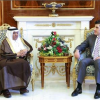
A high ranking delegation from the Ministry of Foreign Affairs of the Kingdom of Saudi Arabia, headed by Mr. Abdul-Rahman al-Shahri, visited Kurdistan Region to prepare the opening of the Saudi Arabian Consulate in Erbil in a near future.
In a meeting held yesterday with the Kurdistan Region Prime Minister, Nechirvan Barzani, Mr. al-Shahri stated that the decision of opening the Saudi Arabian Consulate in Erbil was taken personally by His Majesty King Abdulla bin Abdul-Aziz.
He expressed his hope that it would help developing and strengthening the relations between Erbil and Riyadh in various fields, including providing assistance to those who wish to accomplish their duty of Hajj or Umrah pilgrimage.
He pointed out that opening of the Consulate in Erbil will take place shortly after the Saudi Arabian Embassy begins its mission in Baghdad, which is expected to be soon.
Prime Minister Barzani welcomed the decision of the Kingdom of Saudi Arabia to open an Embassy in Baghdad and a Consulate in Erbil. He said that opening the Embassy in Baghdad would help the normalisation and development of ties between Iraq and Saudi Arabia.
He added that whilst relations between Saudi Arabia and the Kurdistan Region have always been friendly, it is hoped that they would further develop in the future, helping to encourage Saudi Arabian investment in the Kurdistan Region.
The Prime Minister also reiterated that the Kurdistan Regional Government is ready to provide all the assistance and cooperation necessary for the opening of the Saudi Arabian Consulate.
(Source: KRG)
Posted in Iraq Industry & Trade News, Politics, Security 4 Comments

Saudis Building Iraq Border Wall
Posted on 16 January 2015 .
By Patrick Schmidt.
The Kingdom of Saudi Arabia recently announced a plan to build a 600-mile “Great Wall” along its border with Iraq. The announcement follows continued violence in Iraq as the Islamic State (IS) still controls vast swaths of the country.
The plan had previously been discussed in Saudi Arabia as early as 2006, but was abandoned once the security situation in Iraq improved.
The wall consists of multiple layers of barriers, and fences along with surveillance equipment and watchtowers. The border fence currently is composed of multiple layers of barriers.
Saudi Arabia recently reinforced its border security with the deployment of 30,000 National Guard troops. The country has undertaken a similar project on its border with Yemen.
(Source: The Telegraph, UPI)
(Flag image via Shutterstock)
Posted in Security 6 Comments
The Kharijites and IS
Posted on 10 January 2015 .
By Ali Mamouri for Al-Monitor. Any opinions expressed are those of the author, and do not necessarily reflect the views of Iraq Business News.
Who are the Kharijites and what do they have to do with IS?
Members of the Islamic State (IS) have often been described as modern-age Kharijites, in reference to the Muslims who rebelled against the ruling powers in early Islamic history. The Kharijite rebellions began in the 7th century, against the Umayyad Caliphate, and persisted against the Abbasid Caliphate.
Salafists such as the grand mufti of Saudi Arabia — who shares IS' religious principles, but not political views — call IS members Kharijites. Notably, these Salafists refused to pledge allegiance to Abu Bakr al-Baghdadi, who surprised the other Salafist movements by declaring himself the caliph of all Muslims. Salafist movements never expressed a serious disagreement with IS until Baghdadi's announcement of the caliphate last June.
Saudi Mufti Sheikh Abdul Aziz Al ash-Sheikh issued a statement in August 2014 calling IS an extension of the Kharijites who "believed that killing Muslims was not a crime, and we do not consider either of them Muslims." Even al-Qaeda, which was, until recently, the most dangerous Salafist jihadist movement in the world, renounced IS for being Kharijites. Jabhat al-Nusra declared in December 2014 that it was waging a war of elimination against what it called “Kharijites,” indicating IS.
In a voice recording, Jabhat al-Nusra’s spiritual leader, Sami al-Aridi, said, “The swords that God ordered us to use are many. One of these swords is the one pointed at Kharijites. This group [IS] has provided solid proof that it is Kharijite. Thus, killing them is a religious duty and there is no doubt about it. Whoever underestimates killing them, is underestimating the blood of Sunnis.”
Who are the Kharijites?
The word Kharijite means “those who defected from the group,” referring to the Islamic groups that rebelled against the third and fourth caliphs, Uthman and Ali, and the rulers of the Umayyad and Abbasid caliphates, beginning in 644. These "Kharijites" organized rebellions against Uthman, Ali, Muawiya and other caliphs. Those in opposition to the rebellions called the rebelling groups the Kharijites and accused them of turning their backs on Islam, since the caliphate and its leaders represented true Islam.
Posted in Security 4 Comments

New Hopes for Iraq-Saudi Pipeline
Posted on 08 January 2015 .
By John Lee.
Following the strengthening of relations between Iraq and Saudi Arabia, and the planned reopening of the Saudi embassy in Baghdad next week, there is now a real possibility that the oil pipeline between the two countries could be reinstated.
Saudi Arabia closed its embassy in Baghdad following Iraq's invasion of Kuwait in 1990, and it took over the pipeline in 2001 as compensation for Iraqi debts.
Worldbulletin reports that the Saudi-Iraqi pipeline at one time carried one million barrels of oil per day to Saudi Arabia's Red Sea coast, and the condition of the pipeline has not deteriorated significantly.
The Iraqi Oil Minister Adel Abdul Mahdi has reportedly come out in support of the pipeline.
(Source: Worldbulletin)
(Flag image via Shutterstock)
Posted in Iraq Oil & Gas News 4 Comments
Sinjar Refugees Move to New UN-Habitat Camp
Posted on 08 January 2015 .
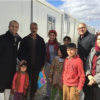
Days before snow was expected to fall in the foothills of Dohuk, Iraq, 900 families are moving into the new camp for internally-displaced persons (IDPs) built through the collaboration of 8 UN agencies planned and led by UN-Habitat.
UN-Habitat’s acting Regional Director from Arab States, Mr Dyfed Aubrey and UN-Habitat’s Country Director Dr Erfan Ali visited the camp built in Dawodye to inspect the shelter units prior to handover to the Dohuk Governorate on 6 January, and to meet the 300 families that were moving into their new homes that day.
Families had been displaced from Sinjar in August due to the ongoing conflict with Islamic State in the region and had been trapped on Mount Sinjar for weeks before fleeing to and being successively displaced from a series of locations on the Syrian border. They eventually took temporary refuge in a tented camp in Sarrensk Dohuk and arrived at the Dawodye camp for longer term refuge in early 2015.
A new model of IDP camp
UN-Habitat has noted how many camps in the region, over years of protracted conflicts, have become slums as tents get replaced with more permanent housing. This camp, funded by the Government of Saudi Arabia, has been planned with adequate street widths and with public spaces, in line with urban planning principles, and shelter is provided in prefabricated units.
Over an approximate three-year time-frame, prefabricated units, with a 15 year design life, are expected to be more cost effective than traditional tented camps, and provide dignity, improved protection from the elements and good sanitary conditions to the users.
“We are so happy and relieved to be in a place where we feel safe and will be comfortable even in the winter,” remarked a teenage girl who was moving into her family’s new shelter. Parents remarked on how they looked forward to their children returning soon to school, and returning to a more normal life.
Delivering as One-UN
Working together, UN-Habitat and the International Organisation for Migration (IOM) provided shelters in partnership with local NGOs, UNDP provided roads, drainage, water and sanitation in partnership with the local government and the UN Office for Project Services (UNOPS) provided solar lighting.
In addition, UNICEF will provide play areas and is building a primary school and the UN Education, Science and Culture Organisation (UNESCO) will provide a secondary school, WHO is providing a health facility and the UN’s population agency, UNFPA, will build maternal health facilities.
All social facilities are also built with prefabricated units. The UN High Commission for Refugees, UNHCR, is providing non-food items and has co-led the beneficiary identification process with the Dohuk Governorate. They will work with the Dohuk Governorate on the camp’s management.
UN-Habitat is planning and coordinating the construction of three IDP camps in Iraq with total capacity of 5,329 shelter units to host over 30,000 IDPs in Suleymaniah, Dohuk and Erbil, and plans to extend the programme to new sites in Dohuk, Kerbala and Baghdad.
(Source: UN)
Posted in Security 6 Comments
Weekly Security Update, 30 December 2014 - 05 January 2015
Posted on 06 January 2015 .
 National Overview
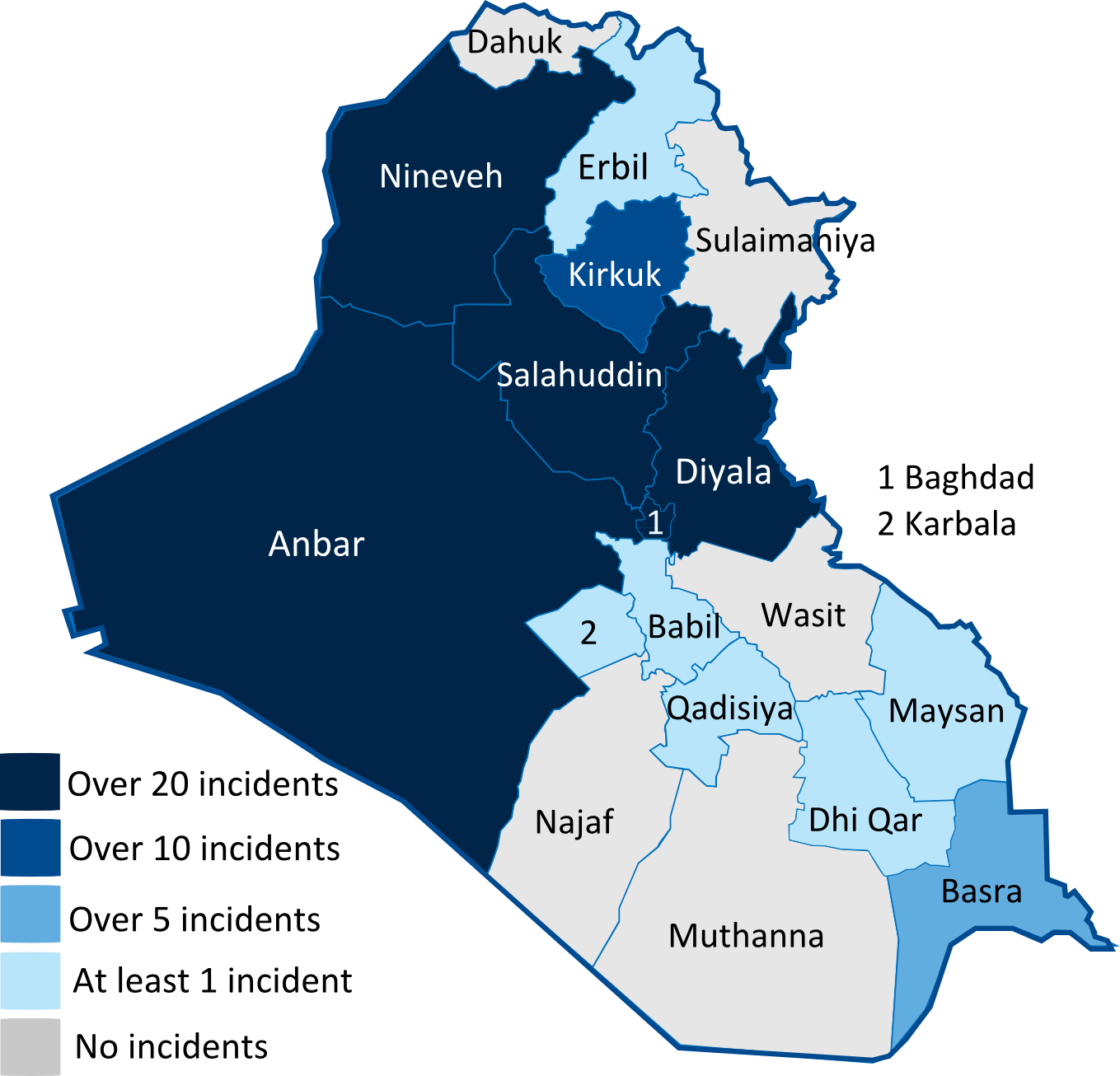
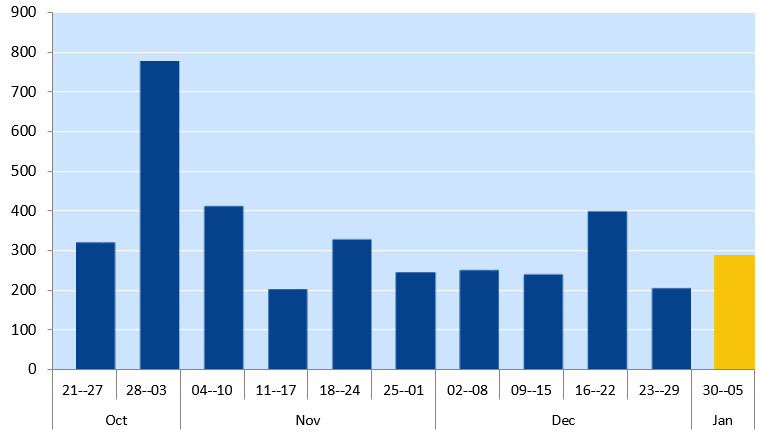
One year on from the start of the militant uprising in Anbar province, Iraq’s fractured regions remain on sharply different political trajectories. In the Sunni heartlands of Ramadi and Fallujah where an initial protest by local tribesmen forced the withdrawal of the Iraqi security forces in December 2014, ISIS units launched a major offensive against urban centres and ISF border posts this week, driving up nationwide fatalities even as the pace of attacks on northern battlefields slowed to a halt on many key fronts. Figures released by the Iraqi government estimating the death of at least 15,000 people in 2014 (an increase of 130% from the previous year), along with hundreds of thousands of refugees also occurred amid the confirmation of yet further growth of the Iraqi oil economy, with production now reaching levels unseen since the 1980s. Embodying these distinct trends has been the province of Kirkuk, which despite witnessing considerable security challenges and refugee influxes over recent months continues to operate a functioning oil economy, resuming international exports this week through the Turkish port of Ceyhan.
North
Peshmerga-led forces report limited gains in the Makhmour and Qayara areas south-east of Mosul, as the allied advance slows in the central plains. While ISIS units continue to fiercely resist all movement west from Peshmerga-held villages in the disputed territories, no major assaults were organized this week in the northern governorates, most likely in order to support the ongoing Anbar offensive. Instead, the majority of violence took the form of skirmishes and mortar fire on ISF-held frontline cities, including Samarra, Tikrit and Muqdadiya, where sporadic VBIEDs continue to be used regularly as means of undermining and delaying the allied push. While challenging to independently corroborate, a growing number of local reports have also suggested a depletion of manpower and support in ISIS-held areas of Hawijah, Sharqat and Mosul with hundreds of civilians reported to have been abducted over the past seven days as a targeted policy to cow the local population.
Central
ISIS forces press in on Ramadi and coalition training centres in line with a sustained assault on remaining ISF positions in south-central Anbar. At the time of writing, fierce battles are underway to gain control of the Andalus, Hoz and Mostaudah districts of downtown Ramadi, following an offensive launched over the past 24 hours. The energy of the current ISIS advances is likely to have been facilitated by the redirection supplies and heavy armour further south on 04 January, which has enabled the group’s ground forces to surround and besiege key ISF installations in the vicinity of Ramadi, including the Ain Al Assad air base where US military personnel are currently stationed. Control of the Iraqi-Jordanian, and Iraq-Saudi Arabian borders was also tested this week in a series of deadly VBIED complex attacks upon ISF and Saudi military posts. Such attacks have come at the expense of momentum in the northern battlefields of Hit and Haditha, a fact ISF units are expected to exploit over the coming days in renewed clearance operations against the Kubaisa sub-district.
South
Localised demonstrations in the Qurna area over the reporting period increase the prospect of an escalation in economic unrest against oil and gas facilities, amid unchanged security dynamics in neighbouring governorates. The largest of these disruptions occurred on 04 January when as many as 600 protestors erected tents and closed roads close to the Jabani bridge of north-eastern Basra, demanding jobs and work opportunities from IOCs in the area. News sources have indicated that Royal Dutch Shell, one of the main developers of the Majnoon field were specifically targeted by the demonstrators, due to alleged failure to uphold employment commitments, with protests only ending after local political representatives invited the group’s leaders to discuss job allocations the following day. While no further incidents have occurred, community relations are expected to remain tense in the Qurna area as details of the deal with local government are made public. Less than a year ago, hundreds of protestors blocked a main entrance to the West Qurna-2 oilfield in the area following an employment dispute with Russian IOC Lukoil.
Posted in Weekly Security Update 7 Comments

Saudi Arabia to Reopen Diplomatic Facilities
Posted on 05 January 2015 .
By Patrick Schmidt.
After more than twenty-five years without an embassy in Iraq, the Saudi Foreign Ministry has announced that it will reopen its embassy in Baghdad.
Saudi officials will travel to the country this week to begin preparations for the construction of the new facility.
Saudi Arabia also plans to open a consulate in Erbil.
In an unrelated development, two Saudi border guards have been killed and a third wounded in a suicide bomb attack at the frontier town of Judayyidat Arar, close to the border with Iraq's Anbar province.
(Sources: IBTimes, BBC)
(Flag image via Shutterstock)
Posted in Iraq Industry & Trade News, Iraq Oil & Gas News 1 Comment