


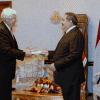
Foreign Minister Receives Irish Ambassador's Credentials
Posted on 22 September 2013 .
Iraqi Foreign Minister, Hoshyar Zebari, has received the credentials of the newly-appointed non-resident Ambassador of Ireland to Iraq, Dr Niall Holohan.
During the meeting, the two sides discussed relations between the two countries, and the Minister urged the Irish Ambassador to open an Embassy in Iraq.
Based in Riyadh, Dr Holohan also serves as Irish Ambassador to Saudi Arabia.
(Source: MoFA)
Posted in Iraq Industry & Trade News 5 Comments

Reef Subsea Wins Cable Deal
Posted on 18 September 2013 .
Reef Subsea Dredging and Excavation (D&E) has secured a number of substantial contracts in the Middle-East and Asia Pacific as the company continues to grow its global footprint.
The Middle-East contracts will involve two teams from the company’s UK workforce managing subsea excavation work in Saudi Arabia and Iraq. The work in the Al Khafji field in Saudi Arabia, on behalf of Technip and Khafji Joint Operations (KJO), is a shore approach cable excavation in shallow waters. Specialist personnel will also be deployed for the post-lay burial of the 165mm composite cable.
The second contract is the first project for Reef Subsea in Iraqi waters working with Leighton Offshore as part of the Iraqi Crude Oil Expansion programme (ICOEEP). The work involves post lay burial of a fibre optic cable in excess of 50km in length in Iraq’s largest producing oil field.
Reef Subsea’s specialist controlled flow excavation tools, the T4000 (pictured) and Twin R2000, will be deployed for both projects, as these can work effectively on live cables and pipelines without compromising the subsea assets integrity. The company has two sets of equipment based in Abu Dhabi for operations in the UAE and surrounding areas.
Niels-Henrik Brodtkorb, Managing Director, Reef Subsea Dredging and Excavation, commented:
"These substantial contract wins in the Middle East and Asia allows us to demonstrate the capabilities of our versatile subsea excavation tools.
"Our employees are highly skilled at operating these tools and bring a huge amount of experience to operations in these global industry projects.
"Increasing our presence and equipment capabilities across the world will allow us to further strengthen our reputation as a leader in subsea dredging and excavation.”
(Source: Reef Subsea)
Posted in Construction & Engineering In Iraq, Iraq Oil & Gas News, Iraqi Communications News 5 Comments

Iraqis Less Happy than Neighbours
Posted on 12 September 2013 .
The World Happiness Report 2013, published by the UN Sustainable Development Solutions Network (UNSDSN), reports that Iraqis are the 105th happiest nation worldwide, out of 156 countries surveyed.
The country scored lower than neighbouring Kuwait (32nd), Saudi Arabia (33rd), Jordan (74th), Turkey (77th) and Iraq (115th).
Denmark headed the table, with Togo in last place.
(Source: UNSDSN)
Posted in Politics 2 Comments

Gulf Precast Builds 65 Schools in Iraq
Posted on 10 September 2013 .
UAE-based Gulf Precast has signed a contract to build 65 precast schools in various locations in Central Iraq.
The design of the schools and their boundary walls has already been finalised. While the initial part of the production is under way in the UAE, Gulf Precast is already in the process of setting up a production plant in Iraq. This is the first phase of the international expansion strategy of the UAE Precast Leader.
The Precast schools awarded to Gulf Precast are a part of an Iraqi national program to build 1,485 schools across Iraq this year. The schools have been specified using precast construction, and consist of 6, 9, 12, 18, and 24 class rooms. While several potential Precast Manufacturers had been considered, Gulf Precast, which has been operating in the Emirates for the last 28 years, has been selected both for its wealth of expertise and for its readiness to set up a Precast Plant in Iraq.
The Iraq factory will cater for the second production phase of the schools project as well as for the fast-track infrastructure and housing program launched by the Iraq government, delivering quality construction by the UAE expert which handled many iconic projects, such as the Dubai Mall, the Paris Sorbonne University Abu Dhabi, high rise towers in the Jumeirah Beach Residence complex, more than 2,000 villas in the Al Falah Community Development, to name a few.
The new Iraq factory will complement the current 6 UAE plants managed by Gulf Precast as well as its 2 recent additions: its new Al Ain mobile Plant and Abu Dhabi Airport extension on-site Plant. Located in Baghdad, the Iraq factory is designed to produce 200 M3 of Precast per day in addition to 900 M2 of Hollowcore slabs daily.
Omar Araim, the representative of Gulf Precast in Iraq stated:
"The Iraqi government has launched an ambitious program of construction development which can only be achieved if modern performing technologies such as Precast are employed. By being present in the country during the initial stages of this program, companies such as Gulf Precast are positioning themselves as a key actor of the expected national expansion."
Gulf Precast's expansion strategy is not limited to Iraq only, but also includes numerous countries such as Saudi Arabia, Qatar, Libya, Oman, India and or Nigeria, countries in which Joint Ventures are in progress with governmental and private organisations.
Elias Seraphim (pictured), CEO of Gulf Precast declared that:
"The expertise gained by Gulf Precast in the very mature and demanding construction sector of the United Arab Emirates is perceived as a critical success factor by many of our Joint Venture partners or intended partners.
"They, in turn, bring to the partnership their extensive knowledge of the local construction market. In a few years' time, Gulf Precast intends to become an internationally renowned key player of the construction economy."
(Source: Gulf Precast)
Posted in Construction & Engineering In Iraq, Iraq Education and Training News 6 Comments
Should US go into Syria: What do Ordinary Iraqis Think?
Posted on 09 September 2013 .
By Mustafa Habib.
This article was originally published by Niqash. Any opinions expressed are those of the author, and do not necessarily reflect the views of Iraq Business News.
Iraqis know better than most that military intervention comes at a price. Ten years after foreigners invaded their country and toppled their dictatorship, the country still isn’t stable. So do they think the West should intervene in Syria?
It has been just over ten years since the US-led invasion of Iraq. But that event and its aftermath have been hanging heavily over the current debate in the West over whether it should intervene in Syria or not.
But how do Iraqis feel about a potential invasion or intervention in Syria? Most of them are well aware that the US military helped to oust a dictator, Saddam Hussein, a man who governed their country with iron and fire for over 24 years. However the destruction and virtual civil war that followed Hussein’s ousting is more than enough to make many of them unenthusiastic about the prospect of external intervention in Syria. And it seems that, no matter what sect or ethnicity they claim, most Iraqis are only too well aware of what comes after intervention.
“When foreign forces overthrew Saddam Hussein, I couldn’t hide my joy,” recalls Saeed Jabbar, a Baghdad university professor. “But we didn’t expect all the devastation and destruction that came afterwards,” he told NIQASH.
“Bashar al-Assad is clearly a dictator – but he should be removed by the Syrian people and not by external forces.”
In the west of Anbar province, where the population is mostly Sunni Muslim like former Iraqi leader Hussein was, a tribal leader there told NIQASH: “The people of Anbar have a clear position on Syria. They all believe that al-Assad and his regime should be toppled, just like Saddam Hussein’s was,” argues Ahmad al-Jumaili.
Iran Divides Iraqi Politicians
Posted on 01 September 2013 .
By Harith Hasan for Al-Monitor. Any opinions expressed are those of the author, and do not necessarily reflect the views of Iraq Business News.
Iraq is currently the scene of a sharp regional conflict between Iran and its opponents. This is nothing new, however. Regional events have come to show that any country witnessing political or social instability, amid weak state control, can be exposed to a similar power struggle on the part of rich and stable regional powers that have a geopolitical agenda.
This is the case in Lebanon, Syria, Egypt, Yemen and Bahrain. One can say that the current regional rivalry is hampering the process of rebuilding the state and national identity. It is due to this rivalry that internal conflicts have become complicated, as they turn into an extension of a wider regional conflict waged by powerful countries on the soft lands of unstable countries.
Moreover, the political, ideological and financial alliances that are forged between the regional powers and their local collaborators fuel internal division. In a country like Iraq, where this division takes on a sectarian character, the regional conflict leaves a major destructive effect.
Therefore, the most violent aspects of this conflict take place in countries where a power struggle is more intense, either because of their strategic importance or due to the lack of an ultimate hegemonic power.
This is particularly the case in Iraq, Syria and Lebanon, which together form the main part of the Fertile Crescent. Step by step, the regional rivalries plaguing these three countries fell within the framework of a wider foreign conflict whose two major poles are Iran and Saudi Arabia.
Thus, it currently seems impossible to deem that the instability plaguing these countries is the result of a mere lack of compatibility between the subnational communities. These communities have increasingly become transnational communities.
By rampant “sectarianization,” we mean that there is in the region a continuous process that aims to establish sectarian, rather than national, identities.
It is noteworthy that this process affects the internal conflict, for the political community is divided over the identification of friends and enemies. Ernst Renan once defined the nation as a group of people united by a common hatred of their neighbors. If this is true, then the current problem in a country like Iraq is the absence of this “common hatred” for a given enemy.
Posted in Politics, Security Comments Off on Iran Divides Iraqi Politicians
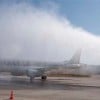
Qatar Airways Launches 5th Iraqi Destination
Posted on 22 August 2013 .
Qatar Airways launched flights on Wednesday to its fifth destination in the Republic of Iraq, Sulaymaniyah, increasing the airline’s frequency across Iraq from 16 to 20 flights each week.
The new services, which will operate four-times-a-week non-stop from the airline’s Doha hub, brings the carrier’s global network to 129 destinations worldwide.
The Doha – Sulaymaniyah route is being operated by a state-of-the-art Airbus A320 featuring 144 seats in a two-class configuration of 12 seats in Business Class and 132 seats in Economy.
Selected aircraft feature seatback TV screens, providing passengers with the next generation interactive on board entertainment system, featuring a choice of more than 800 audio and video on-demand options, together with an SMS text messaging service from each seat.
The launch marks the rapid expansion by Qatar Airways in Iraq since the middle of 2012 when it began flights to Erbil, followed by the capital Baghdad, Najaf and Basra. Sulaymaniyah also marks the carrier’s fifth new Middle Eastern destination launched this year after Basra, Najaf, Gassim in the Kingdom of Saudi Arabia and Salalah in Oman.
The arrival of Qatar Airways’ flight QR438 was welcomed with a water salute at Sulaymaniyah International Airport and a warm reception presided by local officials. Fathi Al Shehab, Qatar Airways Senior Vice President GCC, Levant, Iran and Indian Subcontinent, led an official delegation on the flight from Doha and was welcomed at the airport by Director General Sulaymaniyah International Airport Eng.Tahir Qadir.
Posted in Iraq Transportation News 2 Comments
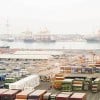
After Port Bombing, Basra Gov'r Sees Price to Pay
Posted on 21 August 2013 .
By Mushreq Abbas for Al-Monitor. Any opinions expressed are those of the author, and do not necessarily reflect the views of Iraq Business News.
The truck bomb that exploded on Aug. 17 at dock No. 17 of the Iraqi port of Umm Qasr located on the Arabian Gulf surprised Iraqi political and security circles. Although the human losses were limited, the operation constituted a serious and exceptional breach of Iraqi security, and suggested that al-Qaeda seeks to cut off Iraq’s only economic gateway to the sea.
The governor of Basra, Majid al-Nasrawi, who belongs to the Basra First coalition and managed to seize the headship of Basra’s provincial council from the State of Law Coalition after the April 20 elections, told Al-Monitor that "his city is paying the price for the political differences in the country." He added that "the security information [available] indicates that vital installations in Basra, a key strategic area for import and export in Iraq, are under threat of being targeted."
Although the political class in Iraq does not openly say that the security situation is being exploited for political purposes, all parties fear that the security escalation would be invested against them politically.
Basra's governor says that his [local council] “will not bear the results of the security deficiencies, since it had demanded that security powers fall within its jurisdiction, as the [central] government in Baghdad insists on managing the security file.”
Nasrawi said that he holds Baghdad responsible for any new security breach, especially given the available information which confirms that al-Qaeda is directing its compass towards Basra. Up to 90% of Iraqi oil runs through the ports of Basra, and a similar percentage of Iraqi commercial traffic with the world passes through it. It also includes a number of major oil wells, which provide Iraq with about 80% of its oil.
Posted in Iraq Industry & Trade News, Politics, Security 1 Comment
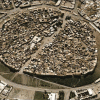
Erbil is Middle East Capital of Tourism
Posted on 17 August 2013 .
By Haider Najm.
This article was originally published by Niqash. Any opinions expressed are those of the author, and do not necessarily reflect the views of Iraq Business News.
In May, the northern city of Erbil was declared Tourism Capital for the Middle East region for 2014. As Lebanese and Turkish investors compete to spend money there, various obstacles include too-high prices, non-Arabic-speaking border guards, uneven urban development and potential human rights abuses.
Most ordinary Iraqis who have been there know exactly why Erbil, the capital city of the semi-autonomous, northern region of Iraqi Kurdistan, has been named the 2014 Tourism Capital by the Arab Council of Tourism. For someone coming from Baghdad for instance, once their bus has passed through passport and security controls, the gloomy picture of a tormented Iraq changes.
Instead of security checkpoints, men with guns, traffic jams, miitary helicopters overhead and fearful or angry passers-by, one sees reconstruction efforts in full swing. There are public gardens, hotels and casinos, similar to those one would find in any prosperous nation. Many have said that the local authorities' plan is for Erbil to be a lot more like Dubai, with the same economic, touristic and international prestige.
“Erbil is constantly evolving and as officials, we're open to learn from the experiences of the capital cities of Arab and foreign countries so we can benefit from them and put our city in particular, and the Iraqi Kurdish region in general, on the path toward ongoing development,” Erbil's mayor, Nawzat Hadi, told NIQASH. “And we place particular emphasis on tourism – there's a big budget to get the city ready for next year.”
The title of tourism capital is, as the New York Times put it recently, “a singular honour for a non-Arab city. It won out over Beirut, Sharjah and the Saudi resort of Taif”.
Posted in Leisure and Tourism in Iraq 2 Comments

Anbar Completes Highway to Saudi Arabia
Posted on 13 August 2013 .
Anbar province recently announced its completion of a 12 billion Iraqi dinar ($10.3 million) highway project linking western Iraq to Saudi Arabia.
Anbar province spokesman Mohammed Fathi Hantoush explained that the highway, called the Land Pilgrimage Road, is 230 kilometres long and links central Anbar to the Saudi border at Arar border crossing.
Hantoush added that the highway is slated to be used for hajj, umrah and trade exchange purposes, and aims to improve trade relations and religious tourism between the two countries.
The highway was constructed by local and government companies, and was completed within two years.
(Source: Al-Shorfa)
Posted in Construction & Engineering In Iraq, Iraq Transportation News 2 Comments