


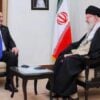
Khamenei "pushes for US Withdrawal from Iraq"
Posted on 09 January 2025 .
By Adam Lucente for Al Monitor. Any opinions expressed here are those of the author(s) and do not necessarily reflect the views of Iraq Business News.
Khamenei pushes for US withdrawal from Iraq in meeting with Sudani
Prime Minister Mohammed Shia al-Sudani's trip to Tehran is his first since the ouster of Syrian President Bashar al-Assad and comes ahead of Donald Trump's return to the White House.
Click here to read the full article (subscription required).
Posted in Politics, Security Comments Off on Khamenei "pushes for US Withdrawal from Iraq"

Donald Trump and the "Great Iraqi Dinar Revaluation"
Posted on 21 December 2024 .
By a Guest Blogger. Any opinions expressed are those of the author(s), and do not necessarily reflect the views of Iraq Business News.
Anecdotal evidence, including inquiries to Iraq Business News, seems to suggest that supporters of US President-elect Donald Trump are more likely to believe that the Iraqi currency, the Dinar (IQD), will increase in value by an unprecedented multiple, some saying by as much as 1,000-fold!
The correlation between being a Trump voter and believing in a significant revaluation of the Iraqi dinar (often called the "dinar RV" theory) is not rigorously studied, but there are social and cultural dynamics that might help explain the connection between the two groups.
The Dinar revaluation theory emerged after the 2003 Iraq War: The basic premise is that the Iraqi Dinar, which traded at around 3 IQD per USD before the 1991 Gulf War but crashed to roughly 1,310 IQD per USD, would suddenly revalue back to its previous rate or even higher. Believers often hold large quantities of physical Dinar notes, sometimes investing tens of thousands of dollars.
The theory's spread among Trump supporters was facilitated by several factors:
The "Global Reset" Narrative:
- Many believers connected the Dinar revaluation to a broader theory about Trump leading a massive reorganization of the global financial system
- This often tied into QAnon-adjacent beliefs about Trump secretly fighting a "deep state" that was suppressing the Dinar's true value
- Some proponents claimed Trump and his team were directly involved in orchestrating a coming revaluation
Social Media Dynamics:
- The theory spread rapidly through Facebook groups, YouTube channels, and forums that also shared pro-Trump content
- Many of these platforms used similar language about "mainstream media suppression" of both Trump and the "truth" about the Dinar
- Currency speculators and scammers actively targeted these communities, recognizing their receptiveness to anti-establishment financial narratives
Political Context:
- The theory appealed to a desire for both financial windfall and validation of political beliefs
- Some promoters claimed Trump's Middle East policies, particularly regarding Iraq and Saudi Arabia, would trigger the revaluation
- The belief often aligned with broader skepticism of traditional financial institutions and expertise
Psychological Factors:
- The combination of potential financial reward and political validation created a powerful motivational force
- Believers often interpreted skepticism from financial experts as further evidence of a cover-up
- The complexity of international currency markets made it easier for promoters to make plausible-sounding but false claims
- Investment in the theory often strengthened social bonds within these communities, making it harder to abandon the belief
Despite years of failed predictions, the theory continues to circulate; some believers have modified the timeline but maintain their basic conviction. The persistence of this belief system despite contrary evidence and expert warnings illustrates how financial conspiracy theories can become deeply intertwined with political identity and resistant to contrary evidence. Both Trump supporters and proponents of the dinar revaluation theory often demonstrate a tendency toward belief in conspiracy theories or "hidden truths" that challenge mainstream narratives.
For more information on the Iraqi dinar, check out IBN's Dinar Page here: https://www.iraq-businessnews.com/the-dinar-page/?swcfpc=1
The Iraqi Dinar Revaluation Scam: False Hope, Financial Deception
Have you seen a connection between support for Trump and a belief in the revaluation theory? Please let us know in the comments below.
[UPDATE, January 21st 2025: Following Donald Trump's inauguration, let us know your thoughts on Dinar RV in our survey here: https://www.iraq-businessnews.com/2025/01/21/survey-trump-and-the-iraqi-dinar/?swcfpc=1]
See also:
Posted in Iraq Banking & Finance News 29 Comments
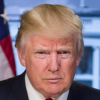
Trump "may Target Iraq's Oil Sector with Sanctions"
Posted on 03 December 2024 .
By Herman Wang and Lauren Holtmeier, for S&P Global. Any opinions expressed are those of the author(s), and do not necessarily reflect the views of Iraq Business News.
Trump may target Iraq's oil sector with sanctions to counter Iranian influence: sources
US President-elect Donald Trump's planned maximum pressure sanctions campaign on Iran may extend to neighboring Iraq, according to three sources familiar with the discussions, targeting OPEC's second largest crude producer and a known oil smuggling hotbed.
Posted in Iraq Industry & Trade News, Iraq Oil & Gas News, Politics, Security Comments Off on Trump "may Target Iraq's Oil Sector with Sanctions"
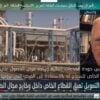
Video: Prof Gunter on Iraq's Private Sector; Shwan Aziz on Energy Opportunities
Posted on 29 November 2024 .
From the Iraq Britain Business Council (IBBC):
Professor Frank Gunter outlines what Iraq needs to do to support the private sector and IBBCs Shwan Aziz on Iraq's energy opportunities via Iraq 24 channel
Professor Frank Gunter Economics professor at Lehigh University and long-term observer of Iraq's economy, is launching an 'Ease of Doing business 'report for IBBC, with observations and recommendations for changes at the IBBC Dubai conference on 13th December.
Here he undertakes a long interview outlining what the issues are and steps the Government of Iraq needs to consider supporting the economy going forward.
The key issues outlined here include: the rapid growth of the Iraqi population at 1millon a year, means the Government needs to create 350,000 jobs a year just to stop unemployment getting worse. Government income from oil is set to decline ( currently 96% revenues from oil exports) in the medium term due to price reductions to $70 per barrel, and it must find other sources of income from taxes, sales taxes or industrial production to fill the income gap and to provide investment and opportunities for jobs.
The education system is geared for pupils to get government jobs, but must reorientate towards the private sector, for engineers and businesspeople to work in the energy and other expanding sectors. Furthermore, the PPP system is not working as Governments have renegotiated terms after a year or two to make the long-term private investment conditions unviable.
Finally, the exchange rate was also uprated 11% to the dollar, which has made imports cheaper and exports more expensive and competitive for local producers. Expanding the private sector is the only real option to provide jobs, opportunities, and sources of income
All these conditions must change, to create incentives for the private sector to invest in Iraq. Professor Gunter is holding a roundtable at the IBBC Dubai conference for member and attendees to hear more about the report, its solutions to easing business in Iraq and what can be done to address the key issues outlined above.
Register here
During the same program, channel 24 Iraq, Mr. Shwan Aziz,also a member of IBBC's Advisory Council, discussed the electricity sector, pointing out that Iraq offers significant investment opportunities in power generation, particularly through clean energy sources like solar and wind.
However, the transmission and distribution sectors face considerable challenges, including limited profitability and difficulties in effectively collecting consumption fees from citizens and various sectors, which hinder the sector's overall growth and efficiency.
Mr. Aziz also discussed the potential shift in focus under the Trump administration, highlighting how its interest in Iraq is likely to extend beyond political considerations. He emphasized Iraq's strategic significance in the Middle East and suggested that the administration might prioritise strengthening economic ties, bolstering the private sector, and attracting both U.S. and international investments to drive sustainable development in the country.
Regarding Iraqi businesses, Mr. Aziz highlighted that the Iraqi economy faces significant challenges in transitioning small businesses into medium-sized enterprises due to pervasive government bureaucracy and rising inflation, both of which obstruct job creation and economic growth.
He stressed that ensuring a conducive business environment in Iraq requires robust support for the private sector, positioning it as a key partner for foreign companies. Prioritising collaboration with local private enterprises over reliance on the public sector is essential to enhance competitiveness and drive sustainable development.
Register here to attend IBBC Autumn Conference 2024 in Dubai
Posted in Iraq Industry & Trade News, Iraq Oil & Gas News, Politics Comments Off on Video: Prof Gunter on Iraq's Private Sector; Shwan Aziz on Energy Opportunities
The Trump Administration and Iraq: What Comes Next?
Posted on 27 November 2024 .
By Michael Knights, for the French Research Center on Iraq (CFRI). Any opinions expressed are those of the author(s), and do not necessarily reflect the views of Iraq Business News.
The Trump Administration and Iraq: What Comes Next?
The re-election of Donald Trump probably signals the commencement of a more assertive U.S. effort versus Iranian influence in Iraq.
This is not because Trump himself has any interest in Iraq: he views it as a dusty junkyard with oil but nothing else. However, Republicans across the board want to reduce Iran's influence and Iraq is the scene of Iran's greatest success: taking control of a major Arab nation using the blood and treasure of America's wars in Iraq as Tehran's springboard to success.
Posted in Iraq Industry & Trade News, Politics, Security Comments Off on The Trump Administration and Iraq: What Comes Next?

US Renews Iran-Iraq Energy Waiver
Posted on 16 November 2023 .
By John Lee.
The United States has reportedly issued a new waiver allowing Iraq to pay Iran for electricity.
According to Reuters, the waiver lasts for 120 days.
While not directly confirming the waiver, US State Department spokesperson Matthew Miller told a press briefing on Tuesday:
"So I don't have a comment to give on the expiration of the waiver at this time. But I would remind you of a few things with respect to these waivers in general, and that is that, number one, there are 20 waivers that have been issued for the payment from Iraq for Iranian electricity imports. They go back to 2018; they started during the Trump administration.
"All - in each of these waivers, it has been the case that none of this money goes to Iran. It is held in accounts that are restricted where they can only be used to pay for food, medicine, humanitarian purposes, and other non-sanctionable activities. And it has been consistent with several policies that we have - one, to try to reduce Iran's leverage over Iraq, and two, to try to wean Iraq from Iranian energy independence. We've had a number of policies we've worked with to try to ensure their energy independence, but in the meantime, they continue to buy Iranian electricity. And so we have in the past, as has the Trump administration, issued waivers to allow these funds to move to restricted accounts, or as I said, that can be used for humanitarian and other non-sanctionable purposes."
(Sources: US State Dept, Reuters)
Posted in Iraq Industry & Trade News, Politics, Security Comments Off on US Renews Iran-Iraq Energy Waiver
Can Economic Trump Card Reverse Iraq's Water Crisis?
Posted on 31 March 2022 .
From Amwaj Media. Any opinions expressed are those of the author(s), and do not necessarily reflect the views of Iraq Business News.
Can economic trump card reverse Iraq's water crisis?
Increasing water scarcity is a major issue in Iraq, where it threatens all aspects of society.
The severity of the situation is reflected by the UN Environment Program's ranking of Iraq as the fifth most vulnerable country in the world to decreased water and food availability.
But the situation has not always been as dire. Iraq has historically had plentiful access to water from the Tigris and Euphrates rivers.
However, river inflows have been reduced by upstream countries, namely Turkey and Iran
Posted in Agriculture, Iraq Public Works News, Politics Comments Off on Can Economic Trump Card Reverse Iraq's Water Crisis?

Jiyad: Iraq, and the China-Iran Cooperation Program
Posted on 14 April 2021 .
By Ahmed Mousa Jiyad.
Any opinions expressed are those of the author, and do not necessarily reflect the views of Iraq Business News.
Iraq and the China-Iran Comprehensive Cooperation Program
The China-Iran Comprehensive Cooperation Program (CICCP) was signed on 27 March 2021; two days later the CICCP's direct impacts on Iraq began emerging and one of such impacts seems to benefits both Iraq and Iran!!
A few days ago I completed a detailed preliminary assessment of CICCP document. The assessment was written in Arabic entitled "China-Iran Comprehensive Cooperation Program: Tactically Important Strategically Impacting if Implemented", it was circulated widely and posted on many websites.
The assessment uses composite methodology of three researches approaches (Text analysis, SCOR (Strength, Challenges; Opportunities and Requirements) and facts/evidence based) and comprises an introduction, three parts and concluding remarks. Part one provide brief review of CICCP document structure: preamble, articles, annexes, effective date and term of the deal, coordinating and supervising authorities. Part two, provides detailed assessment of eight fundamental topics/ areas of cooperation, from the perspectives of the political economy of bilateral relations and geopolitical considerations. Part three provides the direct official reactions to CICCP from Iraq, USA, Arab Gulf States/Saudi Arabia and Russia.
The political economy perspectives are related to the following basic issues: The first relates to the nature of bilateral relations in terms of sovereign independence or dependency and hegemony; the second is whether the principle of "mutually beneficial" is also equitable; the third concerns the structuring of the Iranian economy on whether the deal will eventually deepens the dependence on the export of raw materials, oil and gas, or introduces the required and desirable structural changes horizontal, vertical and knowledge-based levels; and the fourth is about the financial and banking independence, monetary and currency issues pertaining to funding investments and trade exchange.
The geopolitical considerations were addressed at four levels, starting from the domestic (national for both countries), continental (Asian from China to Syria), regional (West Asia / Middle East) and international levels.
The assessment argues that the timing of signing and announcing CICCP is tactically motivated and important, while its proper and timely implementation could be a game-changer and thus strategically impacting; but, as usual, reality seldom coincides with expectations.
This brief intervention focuses on the direct current evidenced impacts on Iraq. Interested readers are kindly invited to read the Arabic version of my detailed initial assessment through the web-links mentioned at the end of this article.
In a remarkable speed and substance CICCP has already prompted both Iraq and the US to react!
First; after the current prime minister, Mustafa al-Kadhimi, denied, rather harshly, in a press conference on November 18, 2020, the existence of an Iraq-China agreement by saying, 'You know there is no China agreement, why are you promoting these lies?', he returned to authorize, on March 30 - that is, only three days after the signing of CICCP, "to start implementing the Chinese agreement"!!
While I do not find it necessary, now, to discuss what has happened between Iraq and China since the government of Haider al-Abadi, I find it useful to remember the statement by the Prime Minister's Financial Affairs Adviser, Dr. Modhir Muhammad Saleh, on March 29, 2021, that the "Iraq-China agreement" became effective on October 18, 2020, and then he affirmed the "cooperation framework agreement ... and the final accounting and oil annexes were signed on September 23, 2019." So why has not been published to this day any official document on this agreement / cooperation framework agreement, nor any of its annexes or memoranda of cooperation/ understanding related to it!!??
But there is a document at the Ministry of Finance entitled "Export Credit Insurance Cooperation Framework" between the China Export & Credit Insurance Corporation and the Iraqi Ministry of Finance) dating back to May 11, 2018 (that is, before the date of the agreement signed by former Prime Minister Adel Abdul Mahdi) !!!!
It is worth mentioning that 2021 State Budget Law includes a few infrastructure projects worth 1.803 trillion Iraq Dinnar to be funded, presumably by the above mentioned 2018 framework; since there is no new framework agreement officially published by the Ministry of Finance, nor approved by the Council of Ministers, nor legislated by the House of Representatives/ the Parliament. Moreover, even if such agreement is ratified and activated it utilization will be differed to future state budget for 2022 or even 2023 because of the national election scheduled for October this year.
Apparently, CICCP was a wakeup call for the Iraqi government but it is in reality too late for 2021 budget funding.
But on the other hand, the Iraqi Premier rushed for quick visits to Saudi Arabia and the UAE, immediately after signing CICCP; is there a relationship between the two events? Time will only tell!!!!
Second, among direct reactions by the US administration and as far as Iraq is concerned relates to Iraq-Iran interests. Just two days after signing the CICCP the U.S. renewed and extended the Iraqi exemption from the practices of maximum US pressure on Iran from 45 to 120 days; a waiver to avoid penalties for buying natural gas and electricity from Iran. This exception entails two positive consequences for both Iraq and Iran: the first is to ensure the continued supply of Iranian gas to generates electricity; this what the Iraqis suffer from its shortages especially the heated summer is on the doorstep, and the second is that Iraq pays Iran's accumulated dues for importing gas and electric power (which constitutes about a third Iraq's production of electricity) as the total of those receivables were mentioned in the 2021 budget, about 1688 billion Iraqi dinars.
Third, another important reaction by the US administration was its quick decision to hold a new round of strategic dialogue with Iraq; the discussions began on April 7, and mainly relate to the issue of US forces remaining in Iraq and the Strategic Framework Agreement signed in December 2008. (This agreement and related matters face strong opposition and many important, influential, legal and judicial challenges, especially after the Trump administration assassinated two leading heavy weight individuals, Abu Mahdi Al-Muhandis (Iraq) and General Qassem Soleimani (Iran), on January 3, 2021 near Baghdad airport).
It is worth noting that energy cooperation is one of the eight topics included in the said strategic framework agreement. Evidence suggests that the previous round of the Iraqi-American Committee for the Coordination of Cooperation in the Field of Energy, which was held, virtually remotely, on January 18 of this year was brief and did not include any important issues or noticeable impacts or new achievements. Hence, it did not attract attention from domestic or external media. Even the two ministries, i.e, Oil and Electricity, that should be directly involved, hardly mentioned anything on their websites on that latest meeting. Will CICCP invigorate Iraqi-American cooperation for the benefit of the energy sector in Iraq?? Who knows, will see!!!
Click here to download the full report in pdf format.
Mr Jiyad is an independent development consultant, scholar and Associate with the former Centre for Global Energy Studies (CGES), London. He was formerly a senior economist with the Iraq National Oil Company and Iraq's Ministry of Oil, Chief Expert for the Council of Ministers, Director at the Ministry of Trade, and International Specialist with UN organizations in Uganda, Sudan and Jordan. He is now based in Norway (Email: mou-jiya(at)online.no, Skype ID: Ahmed Mousa Jiyad). Read more of Mr Jiyad's biography here.
Posted in Ahmed Mousa Jiyad, Iraq Oil & Gas News, Politics Comments Off on Jiyad: Iraq, and the China-Iran Cooperation Program

Market Review: "Of Assassinations and Corporate Activities"
Posted on 04 February 2021 .
By Ahmed Tabaqchali, CIO of Asia Frontier Capital (AFC) Iraq Fund.
Any opinions expressed are those of the author, and do not necessarily reflect the views of Iraq Business News.
Market Review: "Of Assassinations and Corporate Activities"
A quiet start to the new year would have been welcome after the drama of the currency devaluation in December. However, this January, the stage was set for a potential conflict between the US and Iran fought across Iraq.
In mid-December, Iran's supreme leader renewed his revenge vow two weeks ahead the first anniversary, on January 3rd, of the US strike in Baghdad that killed Iran's top general. At the same time, the prior US administration was escalating its aggressive stance against Iran before its term expired on January 20th.
The US increased its military presence in the Gulf in the weeks before the anniversary which further exacerbated tensions between the two antagonists. This increased presence was extremely concerning in light of reports in November that the prior US President considered options for attacking Iran's nuclear facilities before leaving office.
While thankfully none of these fears materialised, on January 21st a suicide bombing took place in central Baghdad for the first time in years, in which the Islamic State Group (ISIS) claimed responsibility. The combination of fears and the bombing had a chilling effect on economic activities, including trading on the Iraq Stock Exchange (ISX) where average daily turnover (excluding block transactions) declined by 26% month on month (chart below).
Foreign buying, a solid trend of the last few months of 2020, almost disappeared, while foreign selling was very low in both relative and absolute terms (second chart below). Not surprisingly, the market, as measured by the Rabee Securities RSISX USD Index, ended the month down 9.3%.
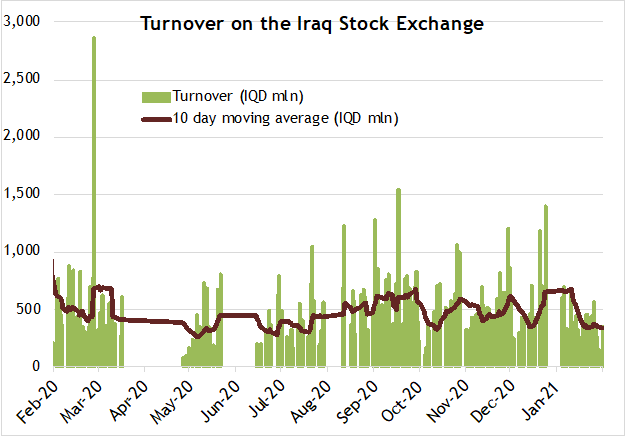
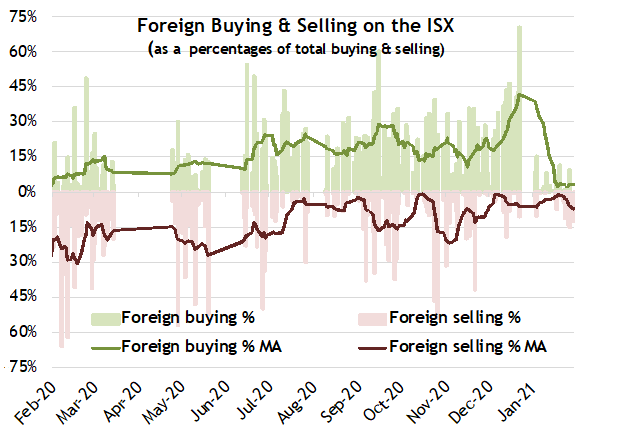
(Source: Iraq Stock Exchange (ISX), Asia Frontier Capital (AFC), data as of January 31st)
Away from the concerns of the US-Iran conflict, the equity market digested several positive corporate activities that affected listed companies in the banking, consumer, and telecom sectors.
The first corporate development took place in the banking sector with the takeover by the National Bank of Iraq (BNOI) of the Iraqi branch network of Lebanon's Bank Audi, as part of a larger acquisition by BNOI's parent Capital Bank of Jordan (owning 61.9% of BNOI) of Bank Audi's Jordanian branch network. The combined takeover of the assets and the assumptions of the liabilities of one of Lebanon's top banking institutions in Iraq and Jordan was made possible by Lebanon's financial crisis which forced its banks to halt their international expansion, divest their prized international assets, and refocus on their domestic market. Also, the takeover fits in with Capital Bank of Jordan's expansion strategy in its domestic market, and in its much larger neighbouring market of Iraq, as it seeks to grow both its asset base as well as its revenue streams.
For BNOI, the acquisition increases its assets by IQD 275.0 bln (USD 188.4 mln), or by 32%, to IQD 1,137.6 bln (USD 779.2 mln), and the acquisition takes it into the league of the Iraq Stock Exchange (ISX) largest banks by assets, such as the Bank of Baghdad (BBOB) at IQD 1,248.3 bln (USD 855.0 mln) and Mansour Bank (BMNS) at IQD 1,200.6 bln (USD 822.3 mln). All data are as of end of the third quarter 2020.
While BNOI hasn't reported audited full year 2020 numbers, its unaudited fourth quarter numbers show for 2020 year-over-year pre-tax earnings growth of 116.3%, loan book growth of 88.0%, and deposit growth of 44.9%, for a loan/deposit ratio of 64.5% versus 54.9% in 2019. The December market review "Private Sector Deposit & Loan Growth Continues" looked at the growth of private sector loans and deposits generally, and specifically for selected ISX banking stocks. The piece highlighted with data and charts BNOI's growth in the key metrics of loan book and deposit growth both in absolute terms and relative to its peers on the ISX. Upcoming financial data in 2021 should incorporate the figures from the Iraqi branches of Bank Audi and would provide data for the combined entity's potential future growth rate, while the increased asset size of the combined entity should enhance its competitive market position.
This acquisition by BNOI of Bank Audi's Iraqi branch network is a first in the Iraqi banking sector and is likely to accelerate the sector's development. It is also the first expansion of the sector following the initial foreign bank's acquisition of major shareholdings in local banks post the March 2003 US invasion of Iraq. Then, the governing Coalition Provisional Authority (CPA) brought the country's legal framework for banking in-line with international standards, and lifted restrictions on foreign participation in the banking industry. A number of regional and international banks bought majority stakes in a number of Iraqi banks to take advantage of the potential growth as banking adoption takes hold in Iraq's cash dominant economy.
Most of these banks, increased their ownership in the selected Iraqi banks and participated in the significant expansion of these banks' capital base between 2011 and 2013. At the time, the Central Bank of Iraq (CBI), mandated all Iraqi banks to increase their capital to at least IQD 100 bln by mid-2011, then to IQD 150 bln by mid-2012, and finally to IQD 250 bln by mid-2013. As of the end of 2019: Al Ahli Bank of Bahrain owned 75.0% of the Commercial Bank of Iraq (BCOI), Burgan Bank of Kuwait owned 51.7% of the Bank of Baghdad (BBOB), Capital Bank of Jordan owned 61.9% of the National Bank of Iraq (BNOI), the National Bank of Kuwait owned 91.0% of the Credit Bank of Iraq (BROI), and Qatar National Bank of Qatar owned 54.2% of Mansour Bank (BMNS).
The second corporate development was in the consumer sector with the acquisition by Pepsi bottler Baghdad Soft Drinks (IBSD) of privately held Al-Zaki Group - another bottler, but of juices and water, and about to extend its offerings to bottled milk. This acquisition fits in with IBSD's strategy of both expanding its product line and deepening its relations with PepsiCo; and follows up on its prior takeover in 2016 of Ynabee' Al Zawraa Company, a bottler of Aquafina, PepsiCo's water brand. The 2016 acquisition increased IBSD's product line and addressable market, and the 2021 acquisition should expand both further. Moreover, while Al-Zaki Group is not a PepsiCo franchisee, it is expected that a successful penetration of the juice market in Iraq by IBSD would enable the group to obtain from PepsiCo the franchise for its Tropicana juice brand.
While IBSD hasn't reported audited full year 2020 numbers, its unaudited fourth quarter numbers show full year revenue growth of 12.6% year-over-year, while pre-tax income was up 20.9% year-over-year.
The final corporate development was in the telecom sector with the introduction of 4G-LTE (fourth generation long-term evolution) by the telecom operators. While the offering is in the very early stages, it promises to bring significant advantages to both internet users and to the ISX's listed mobile telecom operators such as AsiaCell (TASC) and Zain-Iraq (TZNI). Growth in mobile internet usage expanded considerably after 3G was launched by the mobile operators in early 2015 - which currently accounts for a meaningful share of all internet access in the country.
Industry data as of January 2020 shows that there were 29.8 mln internet users, or about 75% of the population, across all devices. Moreover, the number of internet users increased by 55% from 2019 to 2020. While not all of these are mobile internet users, the same data shows that active social media users were 21.0 mln, or about 53% of the population; all of these active social media users accessed the internet via their mobiles. It should be noted that while the phone is the main device for connecting to the internet for most of Iraq's internet users, not all of these connections are through a 3G subscription - a large portion of the population uses their phone to access the internet via public Wi-Fi networks which might be either fibre broadband or 3G mobile broadband.
This is a massive market with significant growth opportunities as Iraq's mobile internet usage catches up with its regional peers. The introduction of 4G-LTE presents a significant opportunity for the mobile telecom operators to enhance their competitive offerings. Moreover, 4G-LTE's materially faster download-speeds and broader bandwidth versus 3G will allow them to offer meaningfully better service and charge higher prices.
These positive corporate activities in the banking, consumer, and telecom sectors underscore the significant earnings growth opportunities for focused and well-run companies in Iraq's under-developed, yet large, economy. Moreover, these recent developments also underscore the relative attractiveness of the stocks in these sectors, within the context of the Iraqi equity market that is at the tail end of a brutal six-year bear market, and as such a re-rating of the Iraqi equity market along with other frontier markets is likely to happen sooner than generally expected.
Please click here to download Ahmed Tabaqchali's full report in pdf format.
Mr Tabaqchali (@AMTabaqchali) is the CIO of the AFC Iraq Fund, and is an experienced capital markets professional with over 25 years' experience in US and MENA markets. He is a non-resident Fellow at the Institute of Regional and International Studies (IRIS) at the American University of Iraq-Sulaimani (AUIS), and an Adjunct Assistant Professor at AUIS. He is a board member of the Credit Bank of Iraq.
His comments, opinions and analyses are personal views and are intended to be for informational purposes and general interest only and should not be construed as individual investment advice or a recommendation or solicitation to buy, sell or hold any fund or security or to adopt any investment strategy. It does not constitute legal or tax or investment advice. The information provided in this material is compiled from sources that are believed to be reliable, but no guarantee is made of its correctness, is rendered as at publication date and may change without notice and it is not intended as a complete analysis of every material fact regarding Iraq, the region, market or investment.
Posted in Ahmed Tabaqchali, Investment Comments Off on Market Review: "Of Assassinations and Corporate Activities"
Iraq issues Arrest Warrant for Donald Trump
Posted on 09 January 2021 .
By Al Monitor staff. Any opinions expressed here are those of the author(s) and do not necessarily reflect the views of Iraq Business News.
Iraqi judge issues arrest warrant for Donald Trump over Soleimani killing
The charge of premeditated murder carries a death sentence under Iraqi law but is not likely to be enforced.
Posted in Politics, Security Comments Off on Iraq issues Arrest Warrant for Donald Trump