


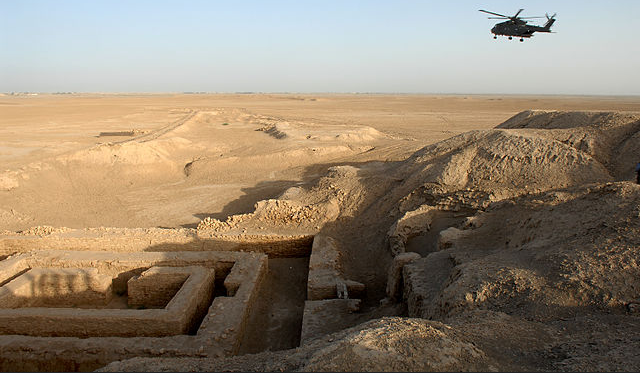
The most prominent archaeological monument is a massive rectangular structure with a sign that reads, "Ziggurat of Ur, built by King Ur-Nammu founder of the Third Dynasty of Ur, a place of worship." In fact, this monument looked more like a pile of sand and rocks.
Most archaeological sites in Iraq are located in the desert and in agricultural areas where farmers and their families live, far from the city centers, making them vulnerable to thieves. The city of Uruk lacks security services, and only one guard, Mehr, has been residing there with his family since the 1970s.
Mehr told Al-Monitor, "I guard the site with my child and with the help of my family. We have grown used to it ever since I was appointed as a guard here in 1975. I still guard this site although I am retired now."
Mehr is one of the few security guards whom the Iraqi Ministry of Antiquities has appointed. According to the security committee of the Dhi Qar provincial council, guards are accused of assisting thieves excavate historical sites and stealing artifacts.
Mehr said, pointing to a weapon on his shoulder, "I only have this weapon to guard the site from thieves who sneak into the area to carry out excavation works [to steal antiquities].”
Mehr is proud to have been able with his family to save the site from illegal excavation works, indicating in this respect that the headquarters of the German mission that excavated the site back in the 1970s has been left untouched.
The German mission began excavations in Uruk in 1973-74, where it found clay tablets on which the Epic of Gilgamesh, the legendary god, was inscribed. The Pergamon Museum in Berlin, which held a special exhibition in 2013 on the history of Uruk, has some of these tablets on display.
Comments are closed.