


To the question of what might be the solution, Khafaji replied, "The solution is to facilitate private sector investments and to draw up contracts with international excavation missions to salvage buried monuments."
The reputation of the ancient city of Uruk became world news in 2003, following the looting of a rare archaeological object from the National Museum of Iraq in Baghdad. This artifact, called the Mask of Uruk, dates back to 3100 B.C., and was discovered in 1938 and represents the face of the goddess Inanna, or one of her priestesses.
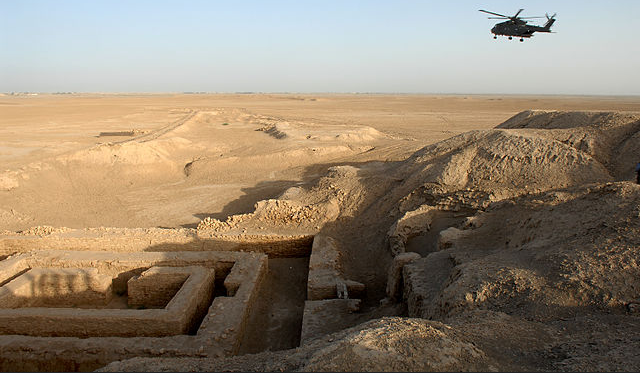
Archaeological researcher Hassan Hamza, who closely follows the situation at Uruk and collects information on the geology of the region, pointed to the wall and told Al-Monitor during a private tour, "This wall that contains black bricks is the remains of the Akitu Temple. Excavations uncovered the foundations of the Akitu Temple where religious ceremonies were held."
Five hundred meters (0.3 miles) from the ziggurat, there is a deep well whose walls are padded with bricks and which has remained in tact for thousands of years.
Awsaf al-Zalimi, head of the Committee of Tourism, Culture and Antiquities at the Muthanna provincial council, told Al-Monitor, "The most important achievement in preserving the archaeological monuments of Uruk was their inclusion on the list of World Heritage Sites in April 2015."
But this achievement will only be complete when the premises are rehabilitated, archaeological monuments are extracted and the site is turned into a tourist attraction, to provide the funds for excavation and development activities.
Comments are closed.