


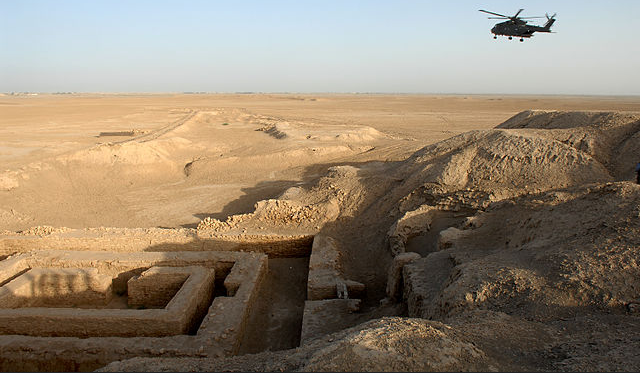
Mehr showed the workshop of the German mission, where dusty files were piled up as well as hundreds of artifacts in baskets and excavation tools.
Not far from the site, the railway tracks built by the Germans still hold the rusty carts that were used to transport debris. Now, they’re nothing but a pile of junk.
Many of Iraq's historical sites only employ one or two guards, as the excavation works in the country ended decades ago because of the various wars.
Shawan Daoudi, a member of parliament and member of the Iraqi Parliamentary Culture Committee, told Al-Monitor, "The Iraqi parliament called on the government to take extraordinary measures to preserve the Iraqi archaeological sites, most notably Uruk."
However, Daoudi himself believes that “these measures will not see the light in the near future as the government is preoccupied with merging the Ministry of Tourism and Antiquities with the Culture Ministry. Moreover, the excavation projects — which the Ministry of Tourism and Antiquities is in charge of — have only been ink on paper since 2003.”
Iraqi Prime Minister Haider al-Abadi decided Aug. 16 to merge the Ministry of Tourism and Antiquities with the Ministry of Culture to reduce government expenditures.
Iraqi Minister of Tourism and Antiquities Liwa Smaisim had admitted in a press statement in 2013 to the neglect of Uruk, promising a contingency plan to save the city.
Ahmed al-Khafaji, an academic from the Hospitality and Tourism Institute who worked in the antiquities department in Babil for about 20 years before retiring in 2002, told Al-Monitor that this plan has yet to materialize. “The minister’s promises have yet to be achieved and Uruk has remained unchanged just like most of the archaeological areas of Iraq that suffer not only from neglect but also lack protection," he said.
Comments are closed.