



Evidence of War Crimes by Govt-backed Militias
Posted on 17 October 2014 .
From Amnesty International.
Shi’a militias, supported and armed by the government of Iraq, have abducted and killed scores of Sunni civilians in recent months and enjoy total impunity for these war crimes, said Amnesty International in a new briefing published today.
Absolute Impunity: Militia Rule in Iraq provides harrowing details of sectarian attacks carried out by increasingly powerful Shi’a militias in Baghdad, Samarra and Kirkuk, apparently in revenge for attacks by the armed group that calls itself the Islamic State (IS). Scores of unidentified bodies have been discovered across the country handcuffed and with gunshot wounds to the head, indicating a pattern of deliberate execution-style killings.
“By granting its blessing to militias who routinely commit such abhorrent abuses, the Iraqi government is sanctioning war crimes and fuelling a dangerous cycle of sectarian violence that is tearing the country apart. Iraqi government support for militia rule must end now,” said Donatella Rovera, Amnesty International’s Senior Crisis Response Adviser.
The fate of many of those abducted by Shi'a militias weeks and months ago remains unknown. Some captives were killed even after their families had paid ransoms of $80,000 and more to secure their release.
Salem, a 40-year-old businessman and father of nine from Baghdad was abducted in July. Two weeks after his family had paid the kidnappers a $60,000 ransom, his body was found in Baghdad’s morgue; with his head crushed and his hands still cuffed together.
The growing power of Shi’a militias has contributed to an overall deterioration in security and an atmosphere of lawlessness. The relative of one victim from Kirkuk told Amnesty International:
“I have lost one son and don’t want to lose any more. Nothing can bring him back and I can’t put my other children at risk. Who knows who will be next? There is no rule of law, no protection.”
Among the Shi’a militias believed to be behind the string of abductions and killings are: ‘Asa’ib Ahl al-Haq, the Badr Brigades, the Mahdi Army, and Kata’ib Hizbullah.
These militias have further risen in power and prominence since June, after the Iraqi army retreated, ceding nearly a third of the country to IS fighters. Militia members, numbering tens of thousands, wear military uniforms, but they operate outside any legal framework and without any official oversight.
Posted in Security Comments Off on Evidence of War Crimes by Govt-backed Militias

GE’s to Provide Turbines to Iraq
Posted on 15 October 2014 .
GE (NYSE: GE) has signed a contract with ENKA to supply power generation equipment for a new 750-megawatt (MW) combined-cycle plant being developed by Qaiwan Group in Iraq.
GE will provide four 9E gas turbines and one steam turbine for a new power plant in Sulaimaniyah to support the government’s goal of strengthening the electricity infrastructure in the Kurdistan region.
GE has played a key role in supporting the region’s focus on providing uninterrupted power for its people and driving industrial growth. Through its regional partnerships, GE’s turbines support more than 90 percent of the electricity generated in the Kurdistan region, supplying nearly 20 hours of electricity a day.
The new power plant in Bazyan marks the fourth power project that GE is supporting with its heavy-duty gas turbine technologies in the region.
The Erbil, Sulaiymaniyah and Dohuk plants, powered by 24 GE 9E gas turbines, produce more than 3,000 MW, the equivalent to the required annual energy needs of approximately 3 million households in Iraq. The Bazyan plant will help deliver power to an additional 750,000 households.
Saad Hassan, CEO of Qaiwan Company, said:
“The Bazyan power plant is expected to address the growing demand for power in the Kurdistan region. Our objective is to enhance its operations through a combined-cycle plant with reliable and advanced technologies that contribute to greater efficiency in the long run. GE’s gas and steam turbines are an ideal fit to our requirements.”
Fehmi Bayramoglu, member of the executive committee, ENKA said:
“The Bazyan project is one of our key contracts in the region, which we are committed to developing as per an aggressive project schedule. Having worked with GE on three earlier projects in the region, we are confident of the additional value that the company’s technologies bring to the project.”
Mohammed Mohaisen, CEO, GE Power Generation Products and Services Sales, Middle East and North Africa said:
“With over 40 years of presence in Iraq, GE is committed to supporting its developmental goals to build a strong electricity infrastructure. Our contract for the Bazyan power plant is the fourth with ENKA in this region, highlighting the trust of our partners in delivering advanced technologies that strengthen the efficiency of power projects. GE’s gas and steam turbines will assist in enhancing plant operations that support the rapidly growing industrial area of Bazyan.”
(Source: GE)
Posted in Construction & Engineering In Iraq, Iraq Public Works News Comments Off on GE’s to Provide Turbines to Iraq
Electricity Minister Meets with US Ambassador
Posted on 14 October 2014 .
By John Lee.
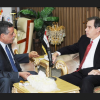
Iraq's Electricity Minister, Qassim Fahdawi [Qassim al-Fahdawi], has met the American ambassador Stuart E Jones to discuss the participation of American companies in developing the country's electricity infrastructure.
In addition to possible new sources of gas for electricity generation, the Minister also pointed out the opportunities available in renewable energy, including solar and wind.
The meeting as also attended by the Chairman of Anbar Provincial Council.
(Source: Ministry of Electricity)
Posted in Construction & Engineering In Iraq, Iraq Public Works News Comments Off on Electricity Minister Meets with US Ambassador
New US Airbase 'No Threat To Iran’
Posted on 03 October 2014 .
This article was originally published by Niqash. Any opinions expressed are those of the author, and do not necessarily reflect the views of Iraq Business News.
Spokesman For Iraqi Kurdish Govt: ‘New US Airbase in Erbil No Threat To Iran’
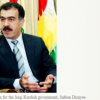
NIQASH interviewed Safeen Dizayee, the spokesperson for the government of semi-autonomous Iraqi Kurdistan. During a candid and wide ranging conversation, Dizayee spoke about why the US is building a new airbase in the region, where exactly Iraqi Kurdish oil is going and whether refugees in the region are being maltreated.
Over the past few months, Iraqi Kurdistan has come under attack from Sunni Muslim extremists in the group known as the Islamic State, it has become home to over a million refugees and it has also been subject to a “financial blockade” by the Iraqi government in Baghdad.
NIQASH held a wide-ranging conversation with Safeen Dizayee, the spokesperson for the Iraqi Kurdish government in the semi-autonomous northern region and a member of the region’s biggest political party, the Kurdish Democratic Party.
The conversation covered everything from the establishment of a new US air base in Iraqi Kurdistan to whether Iraqi Kurdish authorities were discriminating against Arab refugees. He also discussed whether Iranian and Turkish reactions to Iraq’s security crisis were adequate as well as where exactly Iraqi Kurdish oil was being exported to, and how much of it was going there.
Dizayee also commented on whether Iraqi Kurdish authorities might be getting any closer to resolving their long standing disputes with the government in Baghdad, especially now there is a new Prime Minister in charge.
The conversation has been split into three parts for ease of reading.
On US Plans To Build Air Base in Erbil
NIQASH: Apparently the US has also decided to build a military base – maybe more than one – in Iraqi Kurdistan. What can you tell us about this?
Safeen Dizayee: Discussions are continuing about the specifics of this issue. Nothing has happened on the ground as yet.
NIQASH: Would this base be a substitute to the nearest US base, the Incirlik Air Base in Turkey?
Dizayee: No. Incirlik Air Base is a NATO base and it will remain so. The prospective air base in Erbil is in order to confront the IS group in the nearby area.
NIQASH: Do you think that the Iranians will see this as a threat to their influence in the region?
Dizayee: Incirlik Air Base and other US military bases in the Gulf States - in places like Bahrain, Qatar, Kuwait and the United Arab Emirates – are also close to Iran. The base to be built in Erbil is all about fighting the IS group, not about confronting Iran, or any other country, in any way. We have stressed time and again that we don’t want Iraqi Kurdistan to become a battlefield for major powers in the region.
Posted in Security Comments Off on New US Airbase 'No Threat To Iran’

CG Awarded $25m Contract
Posted on 25 September 2014 .
By John Lee.
Crompton Greaves Ltd (CG), part of the Indian company Avantha Group, has announced a $25-million new contract win for the design, construction and delivery of 16 mobile electrical substations.
The order was placed by the General Directorate for Transmission, Upper Euphrates Region, Ministry of Electricity in Iraq.
The key deliverables are engineering and supply of 16 mobile substations containing 31.5 MVA transformers delivered by CG’s Power Transformer factory in Hungary, auxiliary/earthing units manufactured in the Distribution Transformer factory in Belgium and control and protection equipment provided by CG’s Automation arm ZIV. Integration and assembly work for the project will be concluded at the CG factory in Belgium.
The suite of mobile substations will be flexibly deployed throughout Iraq for utilities and industries to provide interim grid connections and temporary power supplies. CG’s short-track delivery of mobile units allows flexible use in the Iraqi grid.
Typically its applications would range from power supply during emergency or planned outages, to moving loads, and the integration of distributed or renewable generation. Delivery is expected to be completed by September 2015.
The Ministry of Electricity in Iraq selected CG to execute this project on account of an enduring business trust and in recognition of CG’s high quality, reliable T&D products. CG has a successful track record of providing reliable mobile substations and conventional (Gas Insulated Switchgear/Air Insulated Switchgear) substations to the Middle East region and has the reputation of being one of the leading manufacturers of mobile substations, worldwide
Commenting on the order, Avantha Group Company CG’s CEO and Managing Director, Laurent Demortier (pictured), said:
“We thank the Ministry of Electricity, Iraq, for renewing their trust in us. CG has a long-established business foundation in Iraq for over 25 years.
"Combining our global technology, engineering expertise and strong local presence, we have positioned Iraq as a strategically important market, for a wide range of projects in electric power and other industries. We are pleased to continue supporting the country’s growth and development.”
(Source: CG)
Posted in Construction & Engineering In Iraq Comments Off on CG Awarded $25m Contract
Erbil, Iraq and the ISIL Offensive
Posted on 23 September 2014 .
By Robert Tollast.
The following is an interview with an Iraqi finance professional with a degree in Accounting and Finance. He is also a Chartered Certified Accountant with extensive experience in Banking.
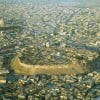
He returned to Iraq in early 2013 and now works as a Portfolio Manager, travelling across Iraq but residing in the Iraqi Kurdistan. He was kind enough to give some of his time to discuss his perspective from Erbil during the June ISIL offensive, focusing on current economic opportunities and challenges in Iraq. The opinions expressed here do not necessarily reflect the views of Iraq Business News.
RT: What does your organisation do?
We provide loans to existing businesses, from half a million up to three million US dollars, mainly for manufacturing but also for some service companies. I am a portfolio manager; I manage our portfolio of loans.
RT: Regarding your organisation, is there anything in the past couple of years in the Kurdish Region that you’re particularly proud of?
Absolutely. We’ve created hundreds and hundreds of jobs, and we've really helped a lot of companies become a lot more efficient. We've brought in a credit culture and we provide better lending terms than any other bank or institution in Iraq, over a longer period. We do this at a lower interest rate with a smaller amount of collateral requirements. So we have helped a lot of companies take off and grow from humble beginnings, for example from 10 staff into 70-80 employees.
We’ve helped these firms become more efficient. Another thing I’m very proud of is that we financed the first modern corn drying facility in the KRG in addition to water bottling plants, which help locals in terms of hygiene and lowering prices of clean water. We’ve done a lot of good but the most important thing is creating private sector employment. This is something I think is a matter of urgency for the Iraqi economy.
RT: That’s certainly something I have seen as a challenge not just in Arab Iraq but in the KRG too - you have quite a heavy slant to the public sector. The Asiacells and Lafarges are really the minority, and the state rules supreme. But you've been trying to change that.
Posted in Robert Tollast Comments Off on Erbil, Iraq and the ISIL Offensive
Listing of New Iraqi Cabinet
Posted on 12 September 2014 .
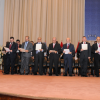
Niqash has issued the following listing of the new Iraqi cabinet, translated from the Arabic official government announcement:
Deputy Prime Ministers:
Hoshyar Zebari (Kurdish);
Saleh al-Mutlaq (Sunni);
Bahaa al-Araji (Shiite)
Ministry of Agriculture: Falah Hassan al-Zaidan (Sunni)
Ministry of Communication: Kazem Hassan Rashed (Shiite)
Ministry of Construction and Housing: Tariq al-Khikani (Shiite)
Ministry of Culture: Firyad Rawandouzi (Kurdish)
Ministry of Education: Mohammed Iqbal (Sunni)
Ministry of Electricity: Qassim al-Fahdawi (Sunni)
Ministry of the Environment: Qutaiba al-Jibouri (Sunni)
Ministry of Finance: Rose Nuri Shaways (Kurdish)
Ministry of Foreign Affairs: Ibrahim al-Jaafari (Shiite)
Ministry of Health: Adila Hammoud (Shiite)
Posted in Construction & Engineering In Iraq Comments Off on Listing of New Iraqi Cabinet

Dhi Qar to Invest $430m in Power Projects
Posted on 09 September 2014 .
By John Lee.
The Dhi Qar governorate intends to invest 500 billion Iraqi dinars ($430 million) in power projects in the next three years, according to a report from Emirates 24/7.
Shanan Al Zamli, chairman of the electricity committee in the governing council, told al-Sumaria that the investment will add 2,000 MW to its generating capacity, bringing it up from 1,000 MW to 3,000 MW, which will help to tackle the severe power shortage in the governorate.
He added that the council had already approved a project to build a 1,000-MW power plant to the north of Nasiriyah, and another 1,000-MW plant in Suq Al Shuyukh in the south of the province.
(Source: Emirates 24/7)
(Electricity image via Shutterstock)
Posted in Construction & Engineering In Iraq Comments Off on Dhi Qar to Invest $430m in Power Projects
Threat to Haditha Dam 'Contained'
Posted on 08 September 2014 .
By John Lee.
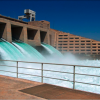
The Financial Times reports that US forces, Iraqi government troops and their militia allies say they have cleared Islamist militants threatening the crucial Haditha dam (pictured) in Anbar province, in Washington’s first attack in direct support of Baghdad since the launch of US operations a month ago.
Baghdad has controlled the dam along the Euphrates River since late August but the insurgents have continued to threaten the hydroelectric facility that provides electricity and water to millions of Iraqis.
Chuck Hagel, US defence secretary, said:
“If that dam would fall into [Isis’s] hands or if that dam would be destroyed, the damage that would cause would be very significant and it would put a significant, additional and big risk into the mix in Iraq.”
Rear Admiral John Kirby, the Pentagon press secretary, said:
"At the request of the government of Iraq, U.S. military aircraft attacked terrorists from the Islamic State of Iraq and the Levant yesterday in support of Iraqi security forces and Sunni tribes protecting the Haditha and Mosul dams, according to a news release from U.S. Central Command.
"A mix of fighter and bomber aircraft conducted four airstrikes near Haditha. In total, the strikes destroyed five ISIL Humvees, one ISIL armed vehicle, an ISIL checkpoint and also damaged an ISIL bunker. All aircraft exited the strike areas safely."
(Sources: FT, NY Times, US Dept of Defense)
Posted in Security Comments Off on Threat to Haditha Dam 'Contained'
Cleric Wrecking Karbala’s Tourism-Based Economy
Posted on 07 September 2014 .
This article was originally published by Niqash. Any opinions expressed are those of the author, and do not necessarily reflect the views of Iraq Business News.
Extremists And Errant Cleric Wrecking Karbala’s Tourism-Based Economy
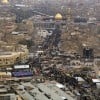
The southern Iraqi city of Karbala makes a lot of its money from religious tourism; it is the site of some of Islam’s holiest shrines. But Iraq’s security problems have seen many would-be visitors stay at home. And locals are divided as to when they will return.
Tourists have never stopped coming to the holy Iraqi city of Karbala before. Even after 2003, after the US-led invasion that toppled Saddam Hussein’s regime, the devout still came to visit some of the sites considered most holy by Shiite Muslims.
And many of the city’s millions of tourists came from neighbouring Iran, where most of the population is Shiite Muslim. Hotel owners and other businesses depended heavily on these tourists, many of them coming on package tours in large groups. But because of the events of the last few months in Iraq, numbers are dwindling and the one Iraqi business that has never been at risk, is not doing well.
“This place used to be full of visitors and everyone working was happy and enthusiastic,” says Ali Mahdi, who owns a modern hotel in central Karbala. “But now we just feel bored. We have nothing to do. Everything has stopped because tourists have stopped coming to Karbala.”
Boredom is not the only problem. Because of the turndown in business, Mahdi doesn’t have enough to pay all of his employees. After delaying salaries for some time, Mahdi has had to lay off some.
“I also have problems paying water and electricity bills, which are usually very expensive, as well as taxes,” Mahdi complains.
Hotel owners like Mahdi believe there are two main reasons for the decline in tourist numbers in Karbala. Firstly the security problems in the country after the Sunni Muslim extremist group, known as the Islamic State, managed to take control of various parts of the country, including the northern city of Mosul.
The other main reason is the clashes that have started between followers of a more radical Shiite Muslim cleric, Mahmoud al-Sarkhi, and Iraqi government security staff. Hundreds of al-Sarkhi’s followers have been arrested and his office has been destroyed.
Posted in Leisure and Tourism in Iraq, Security Comments Off on Cleric Wrecking Karbala’s Tourism-Based Economy