


Maliki: Govt Needs Private Help to Solve Electricity Shortage
Posted on 21 June 2011 .
Iraq’s Prime Minister, Nouri al-Maliki, has said on Sunday that his government can’t solve the country’s electricity supply problems without the help of private investment companies, reports Aswat al-Iraq.
“The government is unable to increase the electric power alone, without the help of investing companies, and we have information that several businessmen wish to invest in the electricity sector,” Maliki told a meeting of the leaders of the Independent Commissions.
He said that “investors have demanded protection by the security forces ... adding that they demanded their supply with power and we gave such promise, demanded fuel and the Oil Ministry’s Undersecretary had given such commitment; but the problem, facing the sector are high prices ... if we allocate all the State budget, it won’t cover the wages of the investing companies.”
Maliki said that over the past 7 years Iraq had paid $10.5 billion [13 trillion Iraqi dinars] to companies investing in electric power sector, to secure an output of 2,500 Megawatts.
(Source: Aswat al-Iraq)
Posted in Iraq Public Works News Comments Off on Maliki: Govt Needs Private Help to Solve Electricity Shortage

Iraqi Inflation Up Again in May
Posted on 20 June 2011 .
Iraq's core annual inflation rose to 6.3 percent in May from 6.1 percent in April, a senior official at the Central Bank of Iraq told Reuters on Sunday.
The agency reports that the figure is driven by the cost of imported goods and services, especially healthcare.
Inflation had previously risen from 5.5% in February to 5.7% in March due rising electricity prices.
(Sources: Reuters, AKnews)
Posted in Iraq Banking & Finance News 3 Comments

Exiled TBI Boss Denies Allegations - Open Letter from Bank's Advisor
Posted on 15 June 2011 .
The exiled former head of the Trade Bank of Iraq (TBI), Hussein Al-Uzri [Hussein al-Azri], has denied allegations of corruption and mis-management in a telephone interview with Reuters.
"It's about control of this bank," the U.S.-educated banker, aged 48, told the news agency in his first media interview since fleeing Iraq. "Having control of the bank gives them control of substantial assets and they can basically utilize it."
For his own security, he did not want to say from which country he was speaking.
A top Maliki aide, cabinet general secretary Ali al-Alaq, has said authorities moved against the bank because its leadership was suspected of violating banking regulations and issuing improperly secured loans. Alaq said the irregular practices had cost the country "millions of dollars."
But Sir Claude Hankes, a British adviser to TBI’s board, has written an open letter to Iraqi President Jalal Talabani saying that the charges are simply a political ploy to give Prime Minister Nouri Al-Malik control of the bank.
The full text of Sir Claude's letter follows:
Posted in Iraq Banking & Finance News, Security Comments Off on Exiled TBI Boss Denies Allegations - Open Letter from Bank's Advisor

Baghdad Co Wins $130m Najaf Power Contract
Posted on 15 June 2011 .
According to a report from Bloomberg, the $130 million [150 billion Iraqi dinar] contract to build a 500-megawatt power station in central Iraq has been won by the Baghdad Company for Gas Turbines Ltd.
The privately owned company was founded in 1993, and re-registered in 2003.
The company is scheduled to build the natural-gas fired power plant within 18 months in Haidariya in the Najaf region, Electricity Ministry spokesman Masaab Serri told the news agency.
The other five bidders for the project were South Korea's Hyundai Engineering & Construction Co., Metka SA (METTK) of Greece, Turkey's Enka Insaat & Sanayi AS, Lanco Infratech Ltd. (LANCI) of India and one unidentified Jordanian company.
AKnews reports that the plant will consist of four 125 MW turbines.
(Sources: Bloomberg, AKnews, Baghdad Company for Gas Turbines Ltd)
Posted in Construction & Engineering In Iraq, Iraq Public Works News Comments Off on Baghdad Co Wins $130m Najaf Power Contract
Plans Changed for Four New Power Stations
Posted on 15 June 2011 .
The Iraqi government energy committee decided to cancel plans for the construction of four power plants to boost power-generation capacity by 2,750 megawatts, according to Bloomberg.
The bids were for a 1,250-megawatt plant near Basra, and three 500-megawatt plants in the cities of Samawa, Diwaniya and Amara.
“These proved to be non-profitable for the Electricity Ministry, as the tenders were for building and operating the stations,” Electricity Ministry spokesman Masaab Serri said.
“We are studying the possibility of issuing new tenders just for their construction.”
(Sources: Bloomberg)
Posted in Construction & Engineering In Iraq, Iraq Public Works News Comments Off on Plans Changed for Four New Power Stations
Weekly Security Update for 15th June 2011
Posted on 15 June 2011 .
Overview
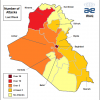
Levels of violence rose in Iraq last week, making it the worst recorded by AKE since the national elections were held in March 2010. There were over 90 separate attacks documented, mainly in Baghdad and the districts surrounding it, although the southern city of Basrah also saw a rare suicide attack, potentially conducted by an al-Qaeda affiliated group such as the Islamic State of Iraq. The same group may be responsible for a similar style of suicide attack on a provincial council building in Diyala province on 14 June, although investigations are ongoing and at the time of writing an official claim of responsibility has not yet been made. The majority of victims and targets of the latest spate of attacks have been the Iraqi police, the Iraqi government and its various devolved entities (such as the provincial councils) and the US military. US forces have experienced a notable rise in attacks over recent weeks with a number of troops having been killed in targeted attacks. This rise in targeting may be aimed at pressuring Washington into adhering to its 31 December withdrawal deadline.
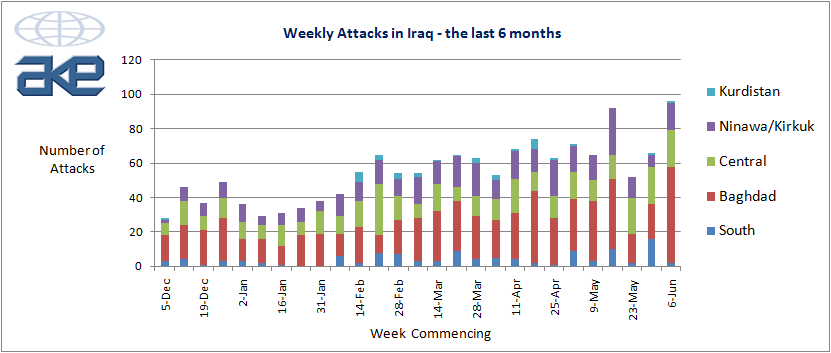
Violence continues to rise in Iraq
North
The north was relatively quiet last week, with no incidents reported in Kurdistan, and a decline in militant activity around Kirkuk. Mosul on the other hand saw a rise in attacks, with a number of bombings and targeted shootings. A series of bodies were also recovered scattered around the city, usually from unrelated, opportunistic attacks, potentially related to failed kidnap for ransom attempts, although civilians continue to be murdered for reasons of community intimidation and even in order to take revenge on the family members of suspected al-Qaeda militants.
Centre
Protests are likely to become a more common occurrence in urbanised parts of the central region over the course of the summer. Many residents are going to be frustrated by the slow progress of the government’s reconstruction plans and the lack of tangible progress in electricity provision. Although work is certainly being done to improve the output of the sector it is going to take many months for output to increase sufficiently.
Many are also upset at possible plans to extend the mandate of the US military beyond the current 31 December mandate of the Status Of Forces Agreement (SOFA). As discussion on the withdrawal continues there has been a rise in the number of attacks against US troops in recent weeks, with a number of American soldiers killed in recent bombings and indirect fire (rocket and mortar) attacks, primarily in Baghdad and provinces to the south of the capital. Baghdad saw a large number of attacks last week, although most of the bombs were relatively small devices, usually incurring injuries rather than large numbers of fatalities. At present it is targeted shootings which are causing the majority of the deaths in the city, particularly amongst the police and mid-level civic employees.
On 14 June terrorists attacked a provincial government building in Ba’qubah, Diyala province. Five suicide bombers gained access to the facility, killing at least eight people and injuring over 20 more. The incident will likely be claimed by the Islamic State of Iraq, which has conducted similar attacks in recent months. It remains a highly relevant threat group, despite the killing of key leadership figures over recent months.
South
While the south of Iraq remains far quieter than the central provinces, a notable suicide attack in the city of Basrah serves as a reminder that conditions are not entirely safe in the region. Further information on this specific attack is available in the Iraq Business News article here. Otherwise, there have been a scattering of roadside bombs and indirect fire attacks over recent weeks in the southern provinces, primarily targeting US military interests such as bases and convoys.
John Drake is a senior risk consultant with AKE, a British private security firm working in Iraq from before 2003. Further details on the company can be found here while AKE’s intelligence and political risk website Global IntAKE can be accessed here.
You can obtain a free trial of AKE’s intelligence reports here.
You can also follow John Drake on twitter here.

Posted in Weekly Security Update Comments Off on Weekly Security Update for 15th June 2011
Iraqi Govt Allocates $927m to Electricity
Posted on 15 June 2011 .
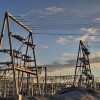
The Iraqi government has approved only $927 million [1.1 billion Iraqi dinars] in the 2011 budget to tackle the electricity shortage in the country.
In February, the Ministry of Electricity had demanded $6 billion (6.99 trillion Dinars) to resolve the energy crisis. On top of that an investment of between $3 billion and $4 billion (3.5 trillion to 4.7 trillion Dinars) a year would be needed, a ministry spokesperson said then.
AKnews reports that the cabinet of Prime Minister Nuri al-Mailiki decided yesterday to spend only 16 percent of what was originally demanded for electricity projects, such as the installment of gas turbines that were purchased from General Electric and Siemens in 2008.
The government hopes to add up to 9,000 megawatts of electricity to the nation’s grid with these turbines.
With temperatures often soaring over 50 degrees Celsius during the summer months, demand for electricity in Iraq during this period is estimated at around 14,000 MW.
According to government figures, the energy currently available to Iraq stands at around 9,000 MW.
The provision of adequate electricity supplies was a central point of contention in the wave of public protests that swept through the Iraqi provinces in recent months.
In 2010, several civilians were killed in clashes with the police when angry protestors took to the streets to demonstrate against the government as national electricity supplies left them with just four hours of power a day.
Former Electricity Minister Karim Washid was forced to step down due to mounting public pressure.
Iraq’s acute shortage of electricity is the result of damage and neglect of its generating plants and power lines during more than three decades of economic sanctions, successive wars and more recently, targeting by insurgent groups.
(Sources: AKnews, Aswat al-Iraq)
Posted in Construction & Engineering In Iraq, Iraq Public Works News Comments Off on Iraqi Govt Allocates $927m to Electricity

Maliki Begins Another 100 Days
Posted on 09 June 2011 .
As Prime Minister Nouri al-Maliki's 100-day deadline passed this week, no ministerial heads have rolled; the delicate power balance in cabinet would not have allowed it.
While it's true that any dismissals from cabinet should take account of the scale of Iraq's challenges, and the fact that it would have taken much longer than 100 days to solve them, there is widespread discontent at what is being seen as a failure.
The reported cancellation of a major press conference on electricity supply has added to public dissatisfaction, and many are expecting increased numbers on the streets for Friday's demonstrations.
Meanwhile, the Prime Minister claims that his ultimatum had been misinterpreted (although he had 100 days to clarify his position), and has given a new 100-day deadline for further improvements.
Posted in Blog, Politics Comments Off on Maliki Begins Another 100 Days

Hyundai May Build Mobile Power Plants for Karbala
Posted on 08 June 2011 .
The Province of Karbala is negotiating with Hyundai Motors regarding the construction of mobile electricity plants to serve areas suffering most from blackouts, according to a report from Azzaman.
Governor Amaludeen al-Hir said the two sides were discussing building several generators powered by fuel oil, that can withstand the country’s tough weather conditions, particularly the soaring temperatures in summer.
“The delegation representing Hyundai is in the province and they have expressed a willingness to build power plants that will operate on fuel oil,” Hir said.
Iraq produces large quantities of fuel oil but most of it is wasted due to lack of modern refining systems. Several power plants in Iraq run on fuel oil, but most of the country’s contracts for new plants are gas-driven.
The governor said he opted for fuel oil-driven plants because they “can bear Iraq’s extreme heat. These plants can work even in temperatures reaching 54 degrees centigrade”.
The mobility of the plants is important, so the plants will be installed on special trucks. According to the governor, “we can move them to areas which suffer most from electricity shortages.”
The governor did not say how many such plants were to be ordered, or give any information regarding the cost.
(Source: Azzaman)
Posted in Iraq Public Works News Comments Off on Hyundai May Build Mobile Power Plants for Karbala

Is Iraqiyya a Sectarian or a National Party?
Posted on 05 June 2011 .
The following article was published on Saturday by Reidar Visser, an historian of Iraq educated at the University of Oxford and currently based at the Norwegian Institute of International Affairs. It is reproduced here with the author’s permission. The opinions expressed are those of the author, and do not necessarily reflect the views of Iraq Business News.
After having previously dismissed it useless, Ayyad Allawi has recently expressed a renewed interest in the stillborn strategic policy council as a way of influencing Iraqi politics. Today, creating the council and furnishing it with real power are apparently once more official goals of his Iraqiyya coalition – which aspires to be the number one secular political movement in Iraq, but emerged in the last elections with markedly heavier support in Sunni-majority parts of the country than elsewhere.
Leaving aside for a moment the would-be council and the legion constitutional problems involved in its creation (it is not even mentioned in the constitution of 2005 and would need confirmation by popular referendum before it could attain any real power), it can be useful to look at what sort of political demands accompany the demand for Iraqiyya as a prerequisite for “staying committed to the political process”. One item that stands out in particular is the requirement that there be “balance in the ministries of state” . This is a concept that has popped out over and again during the past few weeks in relation to the endless discussion about a possible summit between Allawi and Prime Minister Nuri al-Maliki for the purpose of healing rifts in the still-emerging “government of national unity” whose formation started as long back as last November.
What exactly is meant by this “balance” is not entirely clear, but almost regardless of interpretation it will bode ill for the future of Iraqi politics and the status of Iraqiyya as a nationally oriented party. In a more limited definition, it might refer to “ministers of state”, of which Iraqiyya has just two (which is less than Maliki’s State of Law). This sounds like a demand for more positions for Iraqiyya just for the sake of positions, and would be an affront to the limited Iraqi spring and the criticisms of a vastly oversized government that have accompanied it. It could also refer to ministries more generally, but the problem is that Iraqiyya has got more of them than anyone else, with one sovereign ministry (finance and possibly defence in addition), plus six regular ones (agriculture, communications, education, electricity, industry, science & technology). In a recent interview, Ahmad Abdallah al-Jibburi of the Iraqiyyun (Nujayfi) faction of Iraqiyya presented yet another interpretation, and it is not a more promising one: In his view, there should be “balance (tawazun) in the institutions of state, and each governorate should have an entitlement in the security ministries proportional to its share of the population!”
Posted in Politics Comments Off on Is Iraqiyya a Sectarian or a National Party?