


Has al-Maliki Painted Himself into a Corner?
Posted on 02 June 2011 .
Ninety-five days ago, Nouri al-Maliki set himself, or more specifically, his ministers, a target: They had 100 days to improve public services and root out corruption.
Since then, progress has been made in important areas such as the provision of electricity, but many of these projects will take time to implement.
In the meantime, protests continue, and there are reports of demonstrators being arrested, and being prevented from reaching Baghdad's Tahrir Square.
There have been hints in recent weeks that Maliki is considering dissolving the government; one of the newly-appointed Deputy Presidents has already resigned after just two weeks in the post.
Maliki's 100-day promise may have taken some of the heat out of protests three months ago, but some find it strange that such an experienced politician has given this hostage to fortune.
Many are now wondering if the Prime Minister has painted himself into a corner.
Upper Quartile and AAIB are the ideal partners to guide your business through the complexities of Iraqi life. For more information please contact Gavin Jones or Adrian Shaw.
Posted in Blog, Politics Comments Off on Has al-Maliki Painted Himself into a Corner?
Former UK Prime Minister Addresses the Kurdish National Assembly
Posted on 31 May 2011 .
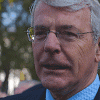
The UK's former prime minister, the Rt Hon Sir John Major KG CH, addressed the Kurdistan National Assembly on Sunday 29th May. The full text of his address is provided below:
I am immensely grateful to President Barzani for his kind invitation for me to visit Kurdistan. His invitation was issued a long time ago but alas, for various reasons, I have not been able to accept until now. The President - and the people of Kurdistan - have lived up to their reputation of being the warmest of hosts, with the most generous of welcomes, and I would like to thank you, Mr Speaker, for affording me the great privilege of addressing this Assembly today.
It is a great honour for me to be here. I stand here with a sense of pride and pleasure. Pride in the role Britain has played in supporting Iraqi Kurdistan. And pleasure at seeing the progress you have made in developing a democracy, in building your economy, and in helping to stabilise Iraq as a whole.
For me, this visit brings back powerful memories.
At the end of the first Gulf War, when Saddam Hussein was committing genocide on the Kurdish people, I looked on – we in Britain looked on – with horror, and pressed a plan to establish "safe havens" for the brave Kurds who were being attacked. The European Union, and then the whole international community, accepted our ideas. The "safe havens" were established, and a human tragedy of enormous proportions was avoided.
The recent street demonstrations across the Middle East and North Africa have shown the world that millions of people in this region want democracy. It is a demand for freedom and accountable Government. They want to influence how they are governed. Since the fall of Saddam, Iraqi Kurdistan – and Iraq as a whole – has led the way in taking steps towards democracy. You have confronted many of the challenges that others will now face.
Every country is different and has the right to develop in its own way, with its own culture and traditions. It is not for the West to dictate the terms of change in the region. This is an Arab revolution, not a Western one. The United Kingdom's approach is built on our longstanding respect for the dignity and aspirations of the Arab peoples.
Posted in Construction & Engineering In Iraq, Iraq Banking & Finance News, Iraq Industry & Trade News, Iraq Oil & Gas News, Politics Comments Off on Former UK Prime Minister Addresses the Kurdish National Assembly
Iraq to Import Iranian Gas
Posted on 29 May 2011 .
Bloomberg reports that Iraq has signed an initial agreement to import 25 million cubic meters of natural gas a day from Iran in order to supply its power stations.
The agreement provides for the installation of pipelines within 18 months to transport gas from Iran to the Sadr and al-Quds power stations in Baghdad, Mosaab Serri, a spokesman for the Iraqi Ministry of Electricity, said.
The agreement with Iran, which holds the world’s second- largest gas reserves, requires the approval of the Iraqi Council of Ministers and Parliament.
The pipelines will pass the Mansouriya gas field, which is due to supply gas to the two power plants instead of Iran starting 2016. Kuwait Energy Co., Turkiye Petrolleri AO and Korea's KOGAS, secured rights to develop Mansouriya.
The license, granted last year along with two other natural-gas contracts, has yet to be officially ratified by the Iraqi Council of Ministers.
Posted in Iraq Oil & Gas News Comments Off on Iraq to Import Iranian Gas
Basra Airport Renovation Begins
Posted on 26 May 2011 .
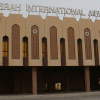
Basra council decided this week to renovate and upgrade Basra International Airport as part of preparation to host the Gulf Cup in 2013, reports AKnews.
The airport is Iraq's second biggest. Jabbar Amin Jaber, Basra Council chairman, said: “More than $100 million (116.5 billion Dinars) were allocated to begin the construction within the next couple of days.”
The airport will be brought up to international standards, and infrastructure in the surrounding area, including electricity on the roads leading to the airport, will also be upgraded.
It has spent much of its existence, spanning six decades, closed due to the two Gulf Wars and the Iraq War. Now it has several dozen international flights every day.
The Gulf Cup comprises of eight nations competing in football, volleyball, handball and basketball.
(Sources: AKnews)
Posted in Construction & Engineering In Iraq, Iraq Transportation News 2 Comments
Strengthening Iraq
Posted on 23 May 2011 .
The U.S. Department of State has made a statement about the "substantial investment and great sacrifices" that the United States has made to "bring about progress":
Since 2003, the United States has been an active partner to help Iraqis strengthen their democracy, build civil society, improve security, and re-integrate fully into the regional and global community and economy. Since 2009, we have worked through the U.S. Iraq Strategic Framework Agreement to reinvigorate this partnership in a range of sectors, including democracy-building, security, education, energy, trade, health, culture, information technology, law enforcement, and judicial cooperation.
We have made a substantial investment and great sacrifices to bring about progress. We have strengthened Iraq’s democracy, rule of law, and civil society. We have helped rebuild its security infrastructure and helped Iraq rejoin the international community after decades of isolation. Our support – with significant assistance from international partners since 2003 – has helped Iraq successfully conduct five major elections or referenda since 2004, including two parliamentary elections. Over 12 million Iraqis voted in the 2010 parliamentary election – a 62 percent turnout. The U.S. has also substantially assisted Iraq’s new parliament, the Council of Representatives, in building core capacity and competence. State and USAID programs have helped Iraqi civil society – including women’s groups, human rights organizations, budget transparency entities, and the media -- play an active role in Iraq’s democracy. We are also supporting Iraqi parliamentary efforts that produced the region’s most progressive non-governmental organization law. In December 2010, the United States also helped Iraq secure UN Security Council termination of most Chapter VII sanctions against Iraq, bringing Iraq into a more normal relationship with the community of nations.
Since November 2008, our security relationship with Iraq has undergone a significant transition. Building on the success and sacrifice of our troops who partnered with Iraqi Security Forces to bring an end to sectarian fighting and combat insurgency, we have ended the combat mission, reduced our troop level to below 50,000, and handed the lead for the security of their nation to Iraqi Security Forces. The Iraqis have developed the capacity to successfully provide internal security, as our forces have shifted from a combat role to a role focused on advising and training.
The U.S. has provided training, technical expertise, and equipment to bolster critical rule of law capacity in Iraq, focusing in particular on the police, corrections service, and judiciary. This investment has improved the Iraqi government’s ability to provide for the humane treatment and legal rights of its citizens, while also properly incarcerating criminals and insurgents.
On the economic front, we have worked to promote growth and reform in multiple sectors of Iraq’s economy. We have helped the Iraqis realize better management in key ministries with procedural and institutional reforms and training on international procedures and standards. U.S. programs have produced or supported key benchmarks:
- Three transparent and efficient oil and gas bid rounds since 2009.
- An Electricity Master Plan which lays out a strategy to improve and reform Iraq’s electricity sector.
- Iraq setting up the first commercial court to settle arbitration disputes for international investors in 2011.
- Iraqi ministry and provincial officials reforming agricultural policies and boosting productivity in a sector that is key to Iraq’s employment.
- Iraq’s accession to the World Trade Organization to expand Iraq’s trade and global economic integration.
- Iraq’s successful engagements with the IMF and World Bank to undertake key public financial management, social safety net, and banking sector reforms.
- Intense interaction between U.S. and Iraqi businesses to promote investment in Iraq.
Our assistance has helped Iraq combat corruption with programs for integrity institutions: the Board of Supreme Audit, the Commission on Integrity, and the Inspectors General. Our assistance also helped Iraq produce and begin to implement a 2010 comprehensive national anti-corruption strategy.
We have promoted long-term economic growth, political development, and strong cultural links to the U.S. by assisting the educational sector in Iraq. Iraq has the largest Fulbright Foreign Visiting Student Program in Middle East, and the International Visitor Leadership Program in Iraq is the largest in the world. Iraq is the eighth-largest foreign government contributor to the Fulbright program. Additionally, USDA has cemented links between Iraqi universities and U.S. land grant universities to build an agricultural extension program.
Refinery To Bring Along Jobs, Housing And Electricity
Posted on 23 May 2011 .
A delegation from Kahlid Group in the United Arab Emirates has revealed intentions to invest in a refinery in Dhi Qar, Iraq, capable of processing 300,000 barrels per day, according to Aswat Al-Iraq.
The request is still to be submitted to the Iraq Ministry of Oil, but the project should involve work placements for 6,000 people. In addition, it will include building 750 housing units and a power station capable of producing 250 megawatts.
Governor of Dhi Qar, Taleb Al-Hassan, expressed his full support for the project, writes Aswat Al-Iraq. Dhi Qar province has tens of billions of barrels per oil in proven reserves.
(Sources: Aswat Al-Iraq)
Posted in Iraq Oil & Gas News, Iraq Public Works News Comments Off on Refinery To Bring Along Jobs, Housing And Electricity

STX Signs Deal for 25 Power Plants
Posted on 19 May 2011 .
Korean company STX Heavy Industries has signed an agreement today to install 25 power plants to generate a total of 2,500 megawatts in Iraq, according to a report from Bloomberg.
“This is a big event as the company will be establishing 25 plants in a region ranging from the southern city of Basra to the south of Baghdad,” Iraqi Electricity Minister Raad Shallal said in a speech during the signing, aired on the state-sponsored Iraqiya television.
The diesel-fired plants will be built over the next 13 months, he said during the ceremony attended by Iraqi Prime Minister Nuri al-Maliki.
The units are half of the 50 new 100-megawatt power plants planned by the Iraqi government at a cost of $6.25 billion. A group of South Korean companies won the contract for the first 25 installations on April 7.
(Source: Bloomberg)
Posted in Iraq Public Works News 1 Comment
Hyundai Starts Work at al-Quds Power Station
Posted on 19 May 2011 .
South Korea’s Hyundai Engineering & Construction Co. has started work on a $219 million project to expand a gas-fired power station near Baghdad, Bloomberg has reported.
The Al-Quds station located in a suburb northeast of the capital will increase production to 1,400 megawatts from 900 megawatts withing 18 months, according to Qais al-Waeli, a spokesman for the ministry’s gas projects.
Iraq still struggles with severe electricity shortages eight years after the U.S.-led invasion that ousted President Saddam Hussein. The government has sought bids this year for the construction of more than 60 power plants.
(Source: Bloomberg)
Posted in Iraq Oil & Gas News, Iraq Public Works News Comments Off on Hyundai Starts Work at al-Quds Power Station
How the Iraqi Govt Can Help Iraqi Growers
Posted on 16 May 2011 .
By Ronald P Verdonk, Agricultural Counselor at the U.S. Embassy in Baghdad.
In my last piece I made mention of a sizable irrigation equipment purchase by Iraq’s Ministry of Agriculture and underscored the role the private sector needs to play to contribute to the revitalization of the agricultural sector. In this edition of the blog, I’d like to address areas where government has an important role to play in supporting Iraqi farmers.
While much of the cropland north of Kirkuk receives sufficient rain, almost everywhere southward is irrigated. Without question, the irrigation infrastructure would benefit from a well-planned modernization program. One of the most pressing challenges is to ensure adequate water flow at the level of pumping stations, a number of which need new hardware, including the pumps themselves. In addition, it is generally accepted that considerable irrigation water is lost due to canals that are not lined to prevent seepage. Soil salinity and waterlogging must also be dealt with by rehabilitating drainage systems and on-farm canals.
And moving from the “big water” coming off the rivers to the “small water” at the farm level, producers would also be helped by increased electricity supply that can run the irrigation pumps necessary to move water into the fields, in addition to powering refrigeration equipment that would keep produce, meat and fish chilled or frozen. These are some of the fundamental services government can provide, and without a doubt, the Government of Iraq is spending huge sums of money to expand the country’s electricity supply, though it will take a few years to catch up to rapidly increasing demand.
As critical as the availability and quality of water and seed, another fundamental challenge for the Iraqi Government concerns fertilizer supply. For the past few years, the Government of Iraq has cited electricity shortages as a reason for fertilizer plants in Basrah and Al Qaim to run on a part-time basis, and the facility in Bayji has been out of production for at least four years. Iraq has the potential to emerge as a net exporter of fertilizers, but the country is currently dependent on imports, and the import volume not proven sufficient for optimal crop production.
I’m not advocating government fertilizer imports; that’s best handled on the private side, but it is clear that many of Iraq’s development challenges are interrelated. The agriculture sector will benefit as the electricity shortfall is addressed and fertilizer production expands to meet local farming needs.
Posted in Agriculture, Ronald Verdonk Comments Off on How the Iraqi Govt Can Help Iraqi Growers

Indian Company to Build Power Station in Wassit
Posted on 10 May 2011 .
Wassit local government has signed a memorandum of understanding with the Indian company BHEL (Bharat Heavy Electricals Limited) to build a 500 MW power station, according to a report from Aswat al-Iraq.
Taha Rudaini, a member of the local government's Media Committee, told the news agency that the station will be powered by diesel (black oil).
"The province got the final permission from the Ministry of Electricity to build this station", he added.
BHEL has reportedly implemented power stations in Sulaimaniyah, Beiji [Baiji, Bayji], Rumaila (Basra), Oman, Yemen and UAE, in addition to its responsibility of 70 electrical projects in the region.
Discussions to find a venue for the station are underway.
(Source: Aswat al-Iraq)
Posted in Iraq Oil & Gas News, Iraq Public Works News Comments Off on Indian Company to Build Power Station in Wassit