



Interview with Gavin Jones on Radio Dijla
Posted on 12 October 2010 .
Gavin Jones, Director of Iraq Business News, and Partner at consultancy firm Upper Quartile, was recently interviewed by Iraq's Radio Dijla. The full transcript is shown below:

Radio Dijla: How do foreign investors look at the Iraqi market today?
Gavin Jones: There are three main reasons for foreign investors committing to a market – a large and growing population i.e. China; a free, secure and functioning business environment i.e. Ireland and large reserves of natural resources. Iraq sits in the last category.
Foreign investors will come to Iraq without doubt but the value that Iraq will retain from the investments made will be limited unless the Government has a clear and transparent investment environment and a policy of building long term prosperity.
Currently the Iraqi Government does not have this and this is restricting the long term commitments that foreign investors are prepared to make. Many investors are waiting. The future is potentially extremely good. Iraq has its own destiny in its own hands.
RD: A large number of investors, who wish to enter the Iraqi market, suffer from the lack of information.
What is the best solution to overcome this obstacle?
Posted in Blog, Construction & Engineering In Iraq, Iraq Banking & Finance News, Iraq Industry & Trade News, Iraq Oil & Gas News Comments Off on Interview with Gavin Jones on Radio Dijla

Iraq's political sectarianism: National Reconciliation and the Oil Curse
Posted on 01 October 2010 .
By Tariq Abdell, Founder & Chairman, Mesopotamia Insight.
The opinions expressed here are those of the author, and do not necessarily reflect the views of Iraq Business News.
The absence, thus far, of a democratically elected and accountable government -- over six months of political horse-trading -- underscores Iraq's fragile democracy that is exacerbated by a host of concomitant factors: inept and Self-serving political class, the region's geopolitical tensions and ploys (Iran's nuclear and expansionist ambitions, for instance), end of U.S. combat operations, and the resource curse - oil and gas.
The deep-rooted causes of the protracted political crisis and its calamitous symptoms (e.g., extremely impoverished population, lack of basic services, higher unemployment, severely languished infrastructure, dysfunctional State's institutions, political violence and organized crime, etc...) are most likely to linger for years to come if the coming government is a sectarian-based, non-inclusive, and opts for political marginalization. Consequently, entrenching Iraq's centuries-old ethno-sectarian schisms and setting the conditions for a weak and failed government... Simply put, Lebanization of Iraq's nascent democracy.
Abraham Lincoln once said "A house divided against itself cannot stand.", Iraqi politicians are morally and legally accountable before their constituents; thus, they are compelled to devise a concerted and comprehensive post-conflict National Reconciliation strategy capable of a) preserving Iraq’s unity b) averting the collapse of the State’s institutions and c) creating the conditions for a sustainable and inclusive socio-economic recovery.
Drawing on past experiences, Iraqi leaders and lawmakers --from different political factions-- need to reach out to nations with similar past and build on their learned lessons: President Nelson Mandela's post-apartheid Truth and Reconciliation Commission (SA TRC) in South Africa, Rwanda's post-genocide National Unity and Reconciliation Commission (NURC), etc... Moreover, the United Nations (UN), as an honest broker in conflict and post-conflict zones, could play a major role in overseeing and promoting Iraq’s National Reconciliation, rule of law, and help rehabilitate Iraq's decadent institutions as result of decades of wars and sanctions.
In the absence of a comprehensive and concerted national reconciliation strategy addressing the aspirations and preoccupations of Iraq's different ethno-sectarian groups, Iraq is most likely to revert to its darkest years of sectarian violence and lawlessness (05-07) -- geopolitically fueled and petro-dollars funded-- and, subsequently, jeopardizing all the hard-earned achievements chiefly the toppling of Saddam's tyranny.
Juan Pablo Pérez Alfonso, a prominent Venezuelan diplomat primarily responsible for OPEC inception which Iraq is a founding member, coined the phrase: “You will see oil will bring us ruin … oil is the devil’s excrement.”
Irrefutably, if Iraq's ruling class persists on pursuing the perilous path of political sectarianism and inequitable distribution of wealth, the outcomes of such tendencies would be a devastating political upheavals and vicious cycle of violent communal conflicts over the control and exploitation of Iraq's resources (oil and gas) and the allocation of the petro-dollars.
Historically, the bulk of Iraq's oil revenues are distributed along ethno-sectarian and tribal allegiances, as opposed to inclusive and growth-oriented economic policies, to preserve the ruling class power and maintain loyalties among its favored constituents. Consequently, giving rise to a wealthy and influential -- religiously and politically -- elite class .
"By 2012, surplus oil production capacity could entirely disappear, and as early as 2015, the shortfall in output could reach nearly 10 million barrels per day," according to report from the US Joint Forces Command
Given Iraq's proven oil and gas reserves, 115 billion barrels of oil and 112 trillion cubic feet of gas, and current Peak Oil as result of global markets insatiable appetite for energy resources e.g., U.S., China, and India. Iraq is strategically positioned as ever before to lead the oil market and bring immeasurable inflow of petro-dollars --commensurate with its colossal reserves-- that can be used to fund its impending multi-billion dollar mega-reconstruction projects (e.g., houses, roads, hospitals, bridges, airports, schools, dams, etc) and, ultimately, lift millions of Iraqis out of poverty in a country where over 20 per cent of the population still live below the poverty line.
To this end, Iraq needs to institute an independent and inclusive Petroleum Council -- reflecting the geographic distribution of Iraq's energy resources -- that is responsible for formulating oil strategies, deflecting the politicization of the oil sector, enforcing transparency and accountability as bulwarks against corruption , and robust enough to reign SOC, NOC, and IOCs. Furthermore, Iraq can draw on other resource-rich nations' experiences in coping with the resource curse phenomenon e.g., Canada, Norway, and UAE. Also, Iraq needs to tap into its expatriates' knowledge and expertise such as Mr. Farouk al-Kasim who helped Norway established its successful and prosperous oil industry.
Inarguably, a genuine national reconciliation is Iraq's holy grail, in other words, it's an imperative prerequisite for preserving Iraq's unity, terrotorial integrity, and political stability. Conversely, lack of a genuine national reconciliation strategy, strategic foresight, and leadership could easily trigger a resource war, resource-rich nations' deleterious disease, over Iraq's black gold. Alas, Iraq and its future generations would have to pay dearly for today's injudicious choices , in other words, perpetuating Iraq's ethno-sectarian strife, political instability, religious fanaticism, foreign interventions, economic setbacks, enormous debt and, consequently, undermining the desperately needed investments.
In sum, "A nation' s strength ultimately consists in what it can do on its own, and not in what it can borrow from others." Indira Gandhi.
The opinions expressed here are those of the author, and do not necessarily reflect the views of Iraq Business News.
The author, Tariq Abdell, is an Iraq analyst, and Founder & Chairman of Mesopotamia Insight
He can be contacted at: [email protected]
or
Followed on twitter: http://www.twitter.com/atariqx
Posted in Iraq Oil & Gas News, Tariq Abdell 1 Comment
Business Deals Despite Political Delays
Posted on 23 September 2010 .
It was reassuring to read the comments this week from BP's Iraq’s President, Michael Townshend, in which he confirmed that the delays in forming a government are not causing problems for the development of the giant Rumaila oilfield.
This is good, and despite the refusal of Iraq's politicians to resolve the political impasse, we have seen a string of major deals in both the private and public sectors in recent days:
- $66 Billion New Projects from Abu Dhabi Developers
- $10 Billion to be Spent on Oilfield Water Injection
- Iraq's Transport Ministry leasing 66 ships
But not everyone has the power of BP, and not everyone is dealing in billions of dollars; smaller businesses are less well able to negotiate the complexities of Iraqi business. Encouraging as Mr Townsend's comments are, we cannot ignore the fact that Iraq is suffering because of weak government. (See our article “Weak Laws Deter Iraq Investors More Than Violence”).
Ayad Allawi admitted as much in a flying visit to London last week: “... services are stagnant, the economy is extremely poor, and unemployment is rising”.
Meanwhile, there are signs that progress is being made on the political front, with the Shi'ite-led political blocs reportedly coming closer to agreement on a nominee for the position of Prime Minister.
But let's not get ahead of ourselves – they've only had six months, after all.
Posted in Blog Comments Off on Business Deals Despite Political Delays

Iraq's reconstruction: Strategy and players
Posted on 07 September 2010 .
By Tariq Abdell, Founder & Chairman, Mesopotamia Insight.
The opinions expressed here are those of the author, and do not necessarily reflect the views of Iraq Business News.
The end of U.S. combat operations in Iraq presents a unique opportunity for a new beginning in U.S.- Iraq’s relationship. However, given Iraq’s crippling challenges and U.S. sluggish economy, the success of a such strategic partnership is contingent upon the political will of both U.S. and Iraqi governments, the support of the international community, and the genuine commitment of the international oil companies - Iraq’s biggest investors.
Drawing on past experiences, the stakeholders (U.S. government, Iraqi government, UNDP, World Bank, international oil companies, etc…) need to devise a concerted post-conflict reconstruction strategy, Marshall plan type, that is capable of a) averting the collapse of State's institutions and b) creating the conditions for a sustainable socio-economic recovery. However, before undertaking a such colossal challenge, stakeholders need to build a strategic framework defining the mission's objectives (attainable and realistic), organizational design (steering committee, for instance) , stakeholders' roles and responsibilities, needed resources, and performance metrics.
Respectively, I'll explore key stakeholders' roles and responsibilities in Iraq's post-conflict reconstruction as it's mandated by their respective missions.
Iraqi government
In this process, Iraqi government should be treated as an equal partner that is fully responsible and accountable of its actions before its constituents and the international community. Consequently, the new elected government needs to formulate a comprehensive development strategy in concert with key stakeholders, including the planning for the impending multi-billion dollar mega-reconstruction projects, and the followings are some key areas of common interest and cooperation:
- National reconciliation to fend off ethno-sectarian strife and political violence.
- Reining in corruption and enhancing institutions efficiency.
- Providing basic services (e.g., drinking water, electricity, running sewer, health care, education, etc....)
- Promoting rule of law and human rights.
- Tackling illiteracy challenges, a serious threat to the country’s future.
- Creating jobs, higher unemployment rates are source of societal and political upheavals e.g., organized crime, militias, etc....
- Revamping severely languished infrastructure.
- Reviving the country strategic industries to curtail its dependence on petrodollars.
U.S. Government
To ensure the success of its new mission "New Dawn" in Iraq, the U.S. needs to learn from its past mistakes - $53 billion of unfinished or poorly executed projects-- and capitalize on its acquired knowledge and understanding of Iraq's ethno-sectarian fabric, political landscape, and socio-economic dynamics. Thus, U.S. Department of State's Iraq strategic partnership office ISPO and USAID should play a crucial role in coordinating and overseeing the reconstruction efforts in concert with other stakeholders e.g., Iraqi government, UNDP, etc....
United Nations Development Programme
Given UNDP extensive experience --Honest broker-- in conflict and post-conflict zones, the UNDP is well-positioned to promote and oversee national reconciliation, rule of law, and rehabilitate State's decadent institutions to enhance efficiency and inclusiveness - Hiring and promotions are merit-based and not politically dictated.
World Bank
Given the decay of Iraq's financial institutions as result of decades of wars and sanctions, the World Bank's role, key partner in this reconstruction efforts, is to provide post-conflict reconstruction expertise, financial and technical assistance, which are key ingredients for a sustainable development.
International oil companies (IOCs)
Given the current Peak Oil and IOCs vested interest in a stable and secure Iraq, IOCs should play a major role in this reconstruction efforts. Oil sector is the engine of Iraq’s economy -%90 of government revenue. Nonetheless, the oil sector challenges are hampering the country's economic recovery:
- Major oil fields require billions of dollars for rehabilitation and development as result of decades of wars and sanctions.
- Current oil workforce is in desperate need of training and technological know-how.
- Oil sector is a highly politicized field.
Thus, given Iraq's vast reserves of oil and gas, IOCs' should help revamp the oil sector swiftly by introducing technological know-how, the industry best practices, and fostering local workforce. With such perspicacious initiatives, IOCs will help enhance the oil sector efficiency, increase production, spur economic recovery; and, eventually, countervail some of deep-seated distrust and apprehension.
In sum, in the absence of a clear post-conflict reconstruction strategy, Iraq's convoluted political impasse and the international community inaction -- lack of political will-- are recipes for a prolonged political instability and ethno-sectarian strife; subsequently, jeopardizing all the hard-earned successes (e.g., fair elections, strong Army, etc...) and exacerbating geopolitical tensions. Moreover, given the endured sacrifices, thus far, in blood and treasure -- thousands of lives and over $ 751 billion war price tag -- it's imperative to stand by Iraq in these difficult times to prevent it from reverting to a military dictatorship or ,worst, religious tyranny. In his speech to congress (12th March, 1947), President Truman exquisitely puts it when he warns us against lose of hope, destitution, and their grim outcomes chiefly chaos and tyranny:
"... The seeds of totalitarian regimes are nurtured by misery and want. They spread and grow in the evil soil of poverty and strife. They reach their full potential when the hope of a people for a better life has died. We must keep that hope alive. If we falter in our leadership, we may endanger the peace of the world - and we shall surely endanger the welfare of our own nation..."
The opinions expressed here are those of the author, and do not necessarily reflect the views of Iraq Business News.
The author, Tariq Abdell, is an Iraq analyst, and Founder & Chairman of Mesopotamia Insight
He can be contacted at: [email protected]
or
Followed on twitter: http://www.twitter.com/atariqx
Posted in Blog, Iraq Oil & Gas News, Tariq Abdell 1 Comment
Iraq's Economy Mounts Shaky Advance, Led by Oil
Posted on 29 August 2010 .
"Seven years after the U.S.-led invasion, Iraq's petroleum industry shows signs of living up to the potential that American planners hoped for at the start of the military operation, a potential boost to the war-ravaged country's economic recovery.
"After fits and starts, Iraq's oil production has rebounded to pre-war levels."
So reports the Wall Street Journal on Friday, in a feature article on Iraq's economic recovery.
While the country suffers from a shortage of electricity, the increasing demand for power is a sign of overall economic growth.
"The International Monetary Fund estimates Iraq's gross domestic product will grow at above 7% this year, compared to a contraction of almost three quarters of a percent in 2005, the first year the IMF started posting reliable data.
"Inflation slipped to 2.7% in June, the lowest level in three decades, according to Mr. Kassim at the central bank. The IMF pegs inflation at just over 5% this year, down from about 37% in 2005.
"But unemployment remains stubborn, with official figures showing 20% of eligible workers without jobs. While that figure is down from previous years ... U.S. commanders and diplomats are pushing job creation as a way of keeping young Iraqi men out of the insurgency."
(Source: Wall Street Journal)
Posted in Iraq Industry & Trade News, Iraq Oil & Gas News Comments Off on Iraq's Economy Mounts Shaky Advance, Led by Oil
Weekly Security Update for 19th August 2010
Posted on 19 August 2010 .
National Overview
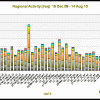
This reporting period saw the levels of incidents rise by approximately 20% compared to the previous week. There was a significant rise in the number of recorded incidents in the North, North Central and Western Regions of Iraq, with the rest of the country experiencing no real change or slight reductions in the number of incidents. In the week that has seen Iraq's top army officer criticising the planned US troop withdrawal by the end of next year as premature, and even more political wrangling with the suspension of talks to break the stalemate, Baghdad suffered from yet another ‘spectacular’ attack when 60 potential Iraqi Army recruits were killed in a suicide attack; again bringing the media spotlight firmly on Iraq security.
The holy month of Ramadan started on 11 Aug in Iraq, presenting an opportunity for insurgents, throughout the country, to exploit a time in the calendar where security may not be at it best. This period has been used in the past to attack security forces and may now also be used to take advantage of the political vacuum across the country to launch attacks. Military leaders, both U.S. and Iraqi, have made reference to this period as a chance for insurgents to attack across the country.
 It is known that attacks have increased in the time preceding Ramadan and during the early parts of the month, but this year sees more problems for Iraq, most notably a lack of a robust Government and the thoughts of the local population that security may be an issue. Iraq is without a new government more than five months after voters handed the secular Iraqiya slate a narrow victory over the State of Law party of Iraqi Prime Minister Nouri al-Maliki; still none of the competing parties secured the clear majority needed to form a government alone.
There has been news to suggest that the Al-Dawa Party has unanimously decided to choose an alternative for Al-Maliki as a candidate to head the next government; and with the Iranian ambassador to Iraq expressing optimism that a new Iraqi government will be formed in the near future, it may be the the stalemate could be broken. Al-Hakim's alliance stopped its negotiations with Al-Maliki's coalition over a week ago and demanded changing Al-Maliki and submitting a candidate who is acceptable by the components of the National Alliance, particularly the Al-Sadr Trend and the other blocs as a condition for resuming the talks.
It has not been confirmed whether an alternative has been identified, but this may go someway to break the political deadlock that has been experienced since the elections in March 2010. The country is waiting for an official announcement on this subject before any official posture is taken by other political parties in Iraq. It comes, as already mentioned, at the beginning of Ramadan, so this may go some way to placate the Iraqi population, but it may also take some time to resolve this – longer than the period of Ramadan and potentially weeks if not months. As a result this may improve the security situation, but may also add fuel to the fire if the potential for momentum is not maintained.
However, the Iraqi Parliament will apparently not meet again unless there is a deal made between political blocs to distribute major state posts among them and U.S. and Iraqi officials have warned that insurgent groups may use the lack of a new government to step up their attacks.
Baghdad
 Officially reported incidents in Baghdad increased for the second week in a row. This is now the highest level of incidents in the capital since the beginning of June. The International Zone has been targeted on five separate occasions with Indirect Fire this reporting period; however, none of the attacks were classed as successful. This reporting period has also seen Baghdad targeted five times with Explosively Formed Projectiles bringing the total this month to seven. It is evident that, along with Indirect Fire and Explosively Formed Projectile attacks, that Under Vehicle Improvised Explosive Devices targeted at individuals are becoming more prevalent. The capital has been hit with many Improvised Explosive Devices this week with 16 official reports of this method of attack with an attack on 09 Aug killing two Iraqi policemen and wounding three others.
Of particular note this week was the attack on an Iraqi Army recruitment centre by a suicide bomber wearing an explosive-laden who blew himself up in the Baab al-Muatham neighborhood of central Baghdad, killing approximately 60 people and wounding 125. The attack, the deadliest this year, came a day after Iraq's two main political parties suspended talks over the formation of a new government five months after elections took place in March.
As many as 1,000 army recruits were gathered at the army division headquarters due to 17 Aug being the last day for soldiers to sign up at the unit. Iraqi Security Forces were trying to bolster their ranks to prepare for the military withdrawal of the U.S. Major-General Qassim Al Moussawi, an Iraqi Army spokesman, blamed the deaths on a single suicide bomber, also citing Al Qaeda for enlisting the bomber.
The country's security forces have been persistent targets at the hands of insurgent groups, especially in the capital, and it has sparked even more discussion as to the preparedness of the Iraqi Security Forces to handle the country's security on their own in light of the U.S. planned withdrawal.
Lt Gen Babaker Zebari warned that the Iraqi military might not be ready to take control for another decade; he stated to a defence conference in Baghdad that the Iraqi Army would not be able to ensure the country's security until 2020 and that the U.S. should keep its troops in Iraq until then. However, the U.S. says it is on target to end combat operations by the end of August and meet its deadline for removing all troops by the end of 2011.
Zebari's warning echoes the remark by Saddam Hussein's former foreign minister Tarik Aziz last week that the Americans were "leaving Iraq to the wolves".
Basra
 Incidents numbers in the Basra have reduced this week, however, of note are the two Indirect Fire attacks against the Basra Contingency Operating Base on the 15 and 16 August.
On 15 August one round of Indirect Fire landed to the south east of the Basra Contingency Operating Base, but no explosion was heard or seen. On 16 Aug the Basra Contingency Operating Base was targeted by seven rounds of Indirect Fire; in both instances both firing points were tracked from the north of Basra. There were no confirmed reports of casualties or damage in the Base.
A report was released in Basra by the Iraqi Security Forces suggesting that there was a heightened kidnap threat from an unidentified Shia group planning to kidnap U.S. Civilian personnel in the south east of Iraq. This is a threat that remains extant throughout the country even in times of heightened stability.
It is a distinct possibility that attacks seen on 07 August could now become more of the ‘norm’ in Basra, but on a more infrequent scale compared to the likes of Baghdad. This attack is most likely linked to Al Qaeda in Iraq or its Associated Movements. Iraqi Security Forces have suspected an Al Qaeda cell of operating in the Az Zubayr region since the 10 May Basra attacks, however, it is questionable whether a cell would be able to build and deploy devices of this size in a Shia dominated province under the scrutiny of Iraqi Security Forces. It is possible that the devices were constructed outside of Basra and then deployed by volunteers with good local knowledge. Public anger is likely to be directed against provincial and national level politicians.
Criminal activity will continue to take place in across the province. At present the number of high profile criminal incidents is relatively low, however, attacks on logistics convoys transiting through Basra is likely to increase as Basra province becomes busier with transiting convoys; criminality could also rise during time of increased unemployment and rises in inflation coupled with higher food prices – especially during the period of Ramadan.

Posted in Weekly Security Update Comments Off on Weekly Security Update for 19th August 2010
UN Expands Cash-for-Work Programme in Iraq
Posted on 17 August 2010 .
The United Nations World Food Programme (WFP) is targeting unemployment in some of the areas most affected by violence and insecurity in Iraq through expanding its cash-for-work programme to reach more than 11,000 vulnerable people and help them meet their daily food needs.
The scheme provides beneficiaries with short-term employment in agricultural infrastructure projects with the long-term aim of ensuring they don’t go short of food.
“Cash-for-work projects work really effectively in places where food is available in the market yet people cannot afford it -- as is the case in Iraq,” said WFP Country Director Edward Kallon. “This project not only gives beneficiaries a job but it secures future food production by focusing on the agricultural sector.”
The UN food agency is implementing the scheme in Diyala and Baghdad governorates where many people have returned from overseas or from elsewhere inside the country to find their properties looted and jobs lost.
WFP piloted the scheme earlier this year as part of the “Diyala Initiative,” which included measures to help with the resettlement of internally displaced people (IDPs), returnees and other vulnerable groups.
“Thank God for this chance -- now I can buy food for my family; I bought them meat for the first time in months,” said Haytham Abd Kathem, one of the 500 workers on the Diyala pilot project.
With the support of US$5 million from the United States government, this project is now being expanded so that others like Haytham can provide for their families.
Participants will be paid the Iraqi dinar equivalent of US$10 per day for a three-month period, with supervisors paid the equivalent of US$13 per day. The pay rates have been set below the average daily wage of US$13-17 for labourers, so that it benefits only the most vulnerable members of the community who might not otherwise be able to find work.
WFP is will be paying beneficiaries in cash in the beginning while exploring the possibilities of using electronic technology, such as smart cards, to facilitate payments and minimise risk.
Cash-for-work activities are selected based on the community’s priorities and could include the clearing and rehabilitation of sewage and irrigation canals, tree planting, rehabilitation of farmland and improving sanitation.
While Iraq is potentially a rich country with large oil deposits, decades of war and instability have led to a deterioration in infrastructure and social services, as a result of which many people have been left poor and vulnerable. A 2008 survey estimated that 930,000 Iraqis were food insecure, with a further 6.4 million vulnerable to food security without the Public Distribution System.
Posted in Uncategorised Comments Off on UN Expands Cash-for-Work Programme in Iraq
Iraqi Labour Minister Rejects Joining WTO
Posted on 15 August 2010 .
The Iraqi Minister of Labor and Social Affairs, Mahmoud al-Sheikh Radhi, has rejected the idea that Iraq should join the World Trade Organization (WTO).
“My ministry examined this issue considering its effects on the levels of labor and unemployment,” the minister told Aswat al-Iraq news agency on Sunday.
He noted that his ministry has conclusively found that membership of the WTO would negatively affect the country.
(Source: Aswat al-Iraq)
Related articles:
Posted in Iraq Industry & Trade News Comments Off on Iraqi Labour Minister Rejects Joining WTO

Economist: Iraq Lacks Plan to Develop Industry
Posted on 11 August 2010 .
An Iraqi economist blamed the high unemployment rate in the country on the government’s failure to develop the industries and reduce food imports, according to a report from AKnews.
“The Iraqi government has failed significantly to rescue Iraq from being the main country in the region in terms of consumption of imported foods. There is no plan that promotes industries in the country," said Abdul Hadi Salman.
Estimates of the unemployment rate in Iraq vary -- Iraqi government ministries put the rate in the range from 30 to 48 percent.
Salman said a large portion of Iraq's unemployment problem would be solved if industries were created.
"The next government has a mission to promote industrial development and help Iraq recover from the large imports which have damaged the country's financial position over the past years.
According to the United Nations, food prices in Iraq have doubled between 2004 and 2008. In 2008, the food import dependency ratio for Iraq was estimated to be at 76 percent, with the remainder covered by locally-produced foods.
(Source: AKnews)
Related articles:
Posted in Agriculture, Iraq Industry & Trade News Comments Off on Economist: Iraq Lacks Plan to Develop Industry

Investing in Iraq: Post-Conflict Constraints and Rewards
Posted on 16 July 2010 .
By Tariq Abdell, Founder & Chairman, Mesopotamia Insight.
The opinions expressed here are those of the author, and do not necessarily reflect the views of Iraq Business News.
Iraq's Lebanized democracy coupled with its lingering and convoluted political impasse are perfect recipes for a week and sectarian-based government, that is shackled by the region's geopolitics (e.g., Iran's nuclear and regional ambitions, Saudi Arabia, Syria, Turkey, etc...) consequently turning Iraq into proxy wars battleground for years to come and long after the U.S. forces are gone.
Thus, investors contemplating on doing business in Iraq, given the country's untapped natural resources (billions of oil and gas reserves), are most likely to encounter a series of costly and challenging constraints common to post-conflict environments both internal and regional. These constraints are most likely to derail investors’ market entrée strategies, left unchecked, and damaged their long-term business interests in Iraq:
Internal constraints:
- According to transparency international 2009 corruption index, Iraq is the fourth most corrupt country along with Sudan.
- Well-entrenched tribal laws and archaic costumes undermine central government and foreign investors' interests alike (tribal discontent of the oil companies, for instance).
- 20 to 25 percent of Iraqis still live below the country's poverty line (Ministry of Planning), a potential source of societal and political upheavals.
- Higher illiteracy levels make it difficult for domestic and foreign investors to find a skilled and professionally literate workforce.
- Higher unemployment rates, notably among military-age male population, are direct causes of the sudden surge of organized crime and militia's activities.
- Lack of basic services, e.g., drinking water, electricity, and running sewer nurtures resentment vis-a-vis public officials and foreign investors alike as recently demonstrated by electricity protests across Iraq.
- Deep-seeded distrust and apprehension of oil companies are crippling residues of decades of planned economy, e.g., oil union fervent opposition to the oil law and contracts.
Regional constraints:
- Iran, third's largest oil producer (3.2 million bpd), is a major player in Iraq's politics through its infamous Islamic Revolutionary Guard Corps' elite Qods Force and its proxies. As top U.S. commander in the country Gen. Ray Odierno said "There is a very consistent threat from Iranian surrogates operating in Iraq," (Washington Post July 13th).
- The fallouts of Iran nuclear standoff with the West, United States recent approved new unilateral sanctions against Tehran, could easily spillover to Iraq's internal politics and further undermine its stability. In fact, early signs of undercutting U.S. sanctions already been detected in the northern region where millions of dollars of oil and goods are smuggled to Iran (New York times report July 8).
- The proximity of Iraq's major oil fields to Iraq-Iran porous borders makes international oil companies’ workforce and equipments a vulnerable target for kidnapping and sabotage -Granting Iran invaluable leverage against the west.
- Saudi Arabia, world's largest oil producer (8.2 million bpd), could be a potential destabilizing force if the Shiite establishment continues to marginalize and ignore Sunnis' demands.
- Turkey's recurrent incursion into Northern Iraq in the pursuit of the Kurdish workers party (PKK) elements and PKK assiduous attacks on the northern oil pipelines are a major threat to the country's sovereignty and unity. According to Gen. IIker Basbug, head of the Turkish army, "The presence of PKK bases in northern Iraq will certainly affect Turkey and Iraq's relationship, and will negatively influence relations between the U.S. and Turkey" (VOA News).
- Kirkuk's unsettled dispute (Northern oil hub) is a timed bomb that could expeditiously ignite a second civil war given Kirkuk's ethnic diversity, e.g., Arabs, Kurds, Turkmens, etc...
- U.S. planned hastily withdrawal in the absence of a legitimate and strong government it's a strategic misjudgment with a dangerous and costly repercussions - Foreign investors may need to beef up their security personnel to countervail U.S. troops withdrawal.
Hence, foreign investors' only cogent avenue, to overcome the aforementioned challenges, is to foster a sustainable political capital via a genuine and acculturated corporate social responsibility, and as Abraham Lincoln once said "Public sentiment is everything. With public sentiment, nothing can fail. Without it, nothing can succeed"
Case in point:
According to the terms of certain service contracts, in the absence of the hydrocarbon law, the international oil companies (IOCs) will receive $1.90 for each additional barrel produced, which is then charged with 35 percent tax and 25 percent cut for the state oil partner. Moreover, IOCs must factor in the financial impacts of the oil sector current constraints, for instance:
- Major Oil fields require billions of dollars for rehabilitation and development as result of years of sanctions and wars.
- Current oil workforce is in desperate need of training and know-how.
- The Iraqi federation of Oil Union could be extremely problematic if both the IOCs and the government continue to ignore the Union's demands.
- Oil facilities protection services (FPS) lacks adequate training, equipments, and, most importantly, loyalty.
- Contractually, ministry of oil can ask IOCs to reduce production to either meet Global markets demands (OPEC quotas, for instance) or to avoid systematic bottleneck as result of inadequate infrastructure.
Consequently, in order for IOCs to minimize their capital exposure while safeguarding their bottom line, IOCs should ask the following before committing billions of dollars for years to come:
a) Does the IOC's leadership embody Transcultural competence and strategic insight?
b) What's the IOC’s risk tolerance and price tag it's willing to pay to mitigate the impact of unforeseen externalities associated with the post-conflict environment.
In sum, given international investors and oil companies experiences in high-risk environments, understanding and anticipating policy risks in a politically volatile environment such as Iraq could be a valuable source of a competitive advantage. furthermore, IOCs and investors who adopt business model which entails balanced operational efficiency with sustainable political capital (efficient leverage of trusted relationships) are most likely to survive Iraq's political quagmire for years to come. Conversely, operating impetuously with no apparent understanding of the country's political landmines and nuances could be a costly and dangerous venture with detrimental effects on both humans and capital, and as the renowned American businessman Malcolm Forbes once said "The best vision is insight".
The opinions expressed here are those of the author, and do not necessarily reflect the views of Iraq Business News.
Tariq Abdell, founder & chairman, Mesopotamia Insight and Iraq analyst
Can be contacted at: [email protected]
or
Follow him on twitter: www.twitter.com/atariqx
Posted in Blog, Tariq Abdell Comments Off on Investing in Iraq: Post-Conflict Constraints and Rewards