


IMF Forecasts Growth in Iraq's Real Non-Oil GDP of 3.7%
Posted on 06 June 2023 .
By John Lee.
The International Monetary Fund (IMF) has forecast growth in Iraq's real non-oil GDP 3.7 percent in 2023.
Following a recent visit to Iraq, the IMF team also predicts inflation of 5.6 percent in for the year.
Full statement from IMF:
A staff team of the International Monetary Fund (IMF) led by Tokhir Mirzoev visited Amman, Jordan from May 24-31 to discuss with the Iraqi authorities the recent economic developments and outlook as well as policy plans in the period ahead.
At the end of the mission, Mr. Mirzoev issued the following statement:
" The Iraqi economy's growth momentum has slowed in recent months. After recovering to its pre-pandemic level last year, oil production is set to contract by 5 percent in 2023 owing to the OPEC+ production cut and outage of the Kirkuk-Ceyhan oil pipeline. The foreign exchange (FX) market volatility in the wake of tighter anti-money laundering/combating the financing of terrorism (AML/CFT) controls by the Central Bank of Iraq (CBI) on FX sales has adversely affected import-dependent non-oil sectors. Real non-oil GDP is estimated to have contracted by 9-percent (year-on-year) in the last quarter of 2022, negating its growth during the previous three quarters. With the FX market appearing to be stabilizing, helped by CBI's actions, growth of real non-oil GDP is expected to resume and reach 3.7 percent in 2023. After spiking to 7 percent in January, inflation has begun to moderate-reflecting lower international commodity prices as well as a 10-percent revaluation of the dinar-and is projected to average 5.6 percent in 2023.
"Favorable oil market conditions have supported Iraq's fiscal and external positions, but structural imbalances continue to widen. In 2022, fiscal and external current account surpluses have reached 7.6 and 17.3 percent of GDP respectively on the back of record-high oil revenues. The CBI's FX reserves rose to US$97 billion (11 months of imports), including US$16.3 billion (6 percent of GDP) in fiscal savings accumulated by the government. At the same time, a large fiscal expansion has widened the non-oil primary deficit from 52 to over 68 percent of non-oil GDP in the course of 2022.
" An even bigger fiscal loosening envisaged in the draft 2023 budget law would widen the non-oil primary fiscal deficit further to 75 percent of non-oil GDP and bring the overall fiscal balance to a deficit of 6.5 percent of GDP. The combined effects of increased government spending, the exchange rate revaluation, and reduced oil production would bring the fiscal break-even oil price to $96 per barrel.
" In the short run, implementation of the authorities' fiscal plans could re-ignite inflation and FX market volatility. Over the medium term, continuation of current policies in the presence of substantial uncertainty about the future path of oil prices poses critical macroeconomic stability risks. Barring a large increase in oil prices, the current fiscal stance could lead to mounting deficits and intensifying financing pressures in the coming years.
"A significantly tighter fiscal policy is needed to strengthen resilience and reduce the government's dependence on oil revenues while safeguarding critical social spending needs. Key priorities include diversifying fiscal revenues, reducing the oversized government wage bill, and reforming the pension system to make it financially sound and more inclusive. While supporting the government's plan to increase social assistance, the mission recommends stronger targeting to ensure that it is directed to those who are most vulnerable.
"Improving public financial management remains of critical importance. In this context, the mission cautions against the planned establishment of new extrabudgetary funds, which raise governance and efficiency concerns, and strongly recommends adhering to on-budget government expenditures Furthermore, the mission urges full implementation of the framework for managing government guarantees, including Parliamentary approval and publication of an annual ceiling on and the list of government guarantees as part of the budget law. Accelerated efforts to establish a Treasury Single Account are also needed to strengthen public financial management.
"The mission welcomes the progress made by the CBI in improving its liquidity management and the AML/CFT frameworks and underscores the importance of close alignment of the stance of fiscal and monetary policies in managing the economy.
"Creating an enabling environment for private sector development will be of utmost importance for achieving durable and more inclusive growth. Priorities include continued efforts to enhance governance and reduce corruption, restructuring large state-owned banks to improve access to finance, reforming the labor market to promote private sector job creation, improving cost recovery in the electricity sector to enhance its ability to meet demand in a sustainable manner, and improving the broader business environment.
"The IMF staff team stands ready to support the authorities in their reform efforts and would like to thank them for candid and productive discussions during this mission."
(Source: IMF)
Posted in Iraq Industry & Trade News, Iraq Oil & Gas News, Politics Comments Off on IMF Forecasts Growth in Iraq's Real Non-Oil GDP of 3.7%

Tabaqchali: Dinar Revalued Upwards, Market Shrugs
Posted on 12 March 2023 .
By Ahmed Tabaqchali, Chief Strategist of AFC Iraq Fund.
Any opinions expressed are those of the author, and do not necessarily reflect the views of Iraq Business News.
Iraq Market Report: Dinar Revalued Upwards, Market Shrugs
The market, as measured by the Rabee Securities RSISX USD Index, was up 24.9% in February, and up 18.8% for the year. However, this strong performance was positively affected by two crucial decisions taken by the Central Bank of Iraq (CBI).
The first was a revaluation, in early February, of the official exchange rate of the Iraqi Dinar (IQD) versus the US Dollar (USD) by 10.3% or from USD 1 = IQD 1,450 to USD 1 = IQD 1,300. The second was the implementation of its recent measures to widen access to the official rate and to remove bureaucratic barriers for the transfer of funds to/from Iraq, as discussed here a few months ago. The combination effectively means that most transfers to/from Iraq will be affected at the effective official rate of USD 1 = IQD 1,290/1,320 instead of the parallel market rate of USD 1 = IQD 1,552/1,562 at month end, and as such the official exchange rate would be the rate to be used for the valuation of the index going forward - both of which explains the strong monthly performance.
Adjusted for the CBI's measures, in other words, if the currency had been flat at February's close, then the RSISX USD Index's would have declined 2.1% for the month - this underling decline, coupled with the 36.0% month-on-month decline in the average daily traded volume on the Iraq Stock Exchange (ISX), suggests that the market has largely shrugged off the effects of the IQD's 10% revaluation against the USD and that it has continued with its looking through and discounting the currency's volatility as discussed last month.
The RSISX USD Index's performance is mirrored in those of its constituents, especially considering the strong performance of a number of constituents last month which this month had minor declines. In local currency terms, only the Bank of Baghdad (BBOB) was up 2.1%, Asiacell (TASC) almost flat at -0.1%, and the rest were down. The decliners were led by Al-Mansour Hotels down 8.1%, Kharkh Tour Amusement City (SKTA) down 5.5%, Al Mansour Bank (BMNS) down 4.5%, Baghdad Soft Drinks (IBSD) down 4.2%, the National Bank of Iraq (BNOI) down 3.8%, the Commercial Bank of Iraq (BCOI) down 1.9%, Iraqi for Seed Production (AISP) down 1.8%, and Al-Mansour Pharmaceutical Industries (IMAP) down 1.4%.
The revaluation of the IQD versus the USD and the valuation of the index at the official exchange rate going forward, has not fundamentally altered the technical picture of the market, as it is now halfway through its 34-month up-trending channel reversing most of the negative effects of the currency's declines since mid-November 2022 (chart below) - which still supports the market's positive technical picture as discussed here in the past few months. The macroeconomic fundamentals discussed here last year support our view that this uptrend will likely remain in force; however, its upward slope might moderate or even go sideways - as the effects of the CBI's measures would not affect the coming months' market action. The 2023 budget proposal was not submitted in January 2023 as expected, nor in February 2023 as hoped for, but hopefully will be submitted this month or the following month - which means a delayed catalyst for the market's next move - especially as all indications suggest that it would be a much more expansionary budget that was discussed here a few months ago.
RSISX USD Index versus Average Daily Turnover
 (Source: Iraq Stock Exchange, Rabee Securities, AFC Research, data as of March 9th)
Revaluation of the Iraqi Dinar versus the US Dollar
Background: As written here last month, the Central Bank of Iraq (CBI), as part of an ongoing process of encouraging the move towards the adoption of banking and away from the informality that dominates economic activity, implemented in mid-November 2022 new procedural requirements to those for its provisioning of USD for importers. These procedural requirements would bring the country's cross-border fund transfers in-line with global standards which require a high level of transparency. However, they represent a seismic shift to the country's cash-dominated economy, in which large informal sectors drive the bulk of economic activity. As such, the introduction of the new procedural requirements immediately affected the volumes of the CBI's daily USD-IQD transactions for cross-border fund transfers, which led to a supply-demand mismatch and consequently to a depreciation in the market price of the IQD versus the USD.
The government and the CBI subsequently introduced a sequence of measures to create demand for the IQD and for furthering the adoption of banking - crucial measures to de-dollarize the economy, and to accelerate its evolution away from the dominance of cash. As crucial as these measures are, their full effectiveness will take place over several years, and as such, the IQD's market prices versus the USD continued to decline. Given public pressures, spurred by populist rhetoric, for immediate measures, the CBI, with the government's blessing, implemented a 10 per cent revaluation of the IQD exchange rate against the USD - from 1,450 to 1,300 IQDs per USD - in the hope that the market price of the IQD would reverse its depreciation versus the USD.
Fundamentally, the revaluation in nominally lowering the official exchange rate does not alter the relationship between the official exchange rate and the market rate that existed pre-revaluation - a relationship that reasserted itself with the premium of the market rate over the official rate staying at the same elevated levels as those pre-revaluation (green line in lower half of chart below).
Volumes in CBI's USD-IQD Transactions versus the USD/IQD Exchange Rates
 (Source: Central Bank of Iraq until February 7th, Baghdad FX exchange houses from February8th, AFC Research, daily data as of March 9th)
While the revaluation was nominal, yet the combination with the CBI's measures - that eased onerous bureaucratic processes for cross border-fund transfers at the official USD-IQD exchange rate, and the creation of incentives for the adoption of banking away from the prevalence of cash in economic transactions and payments - has accelerated the move away from informality that dominates the bulk of economic activities. The 22% premium of the market exchange rate over the official exchange rate (lower half of chart above) created a huge competitive advantage for companies operating formally versus those operating informally - consequently providing the economic incentive for informal companies to transfer to formality and to access the banking sector for the first time. These developments, and the high transparency levels demanded by the CBI's procedural requirements introduced in mid-November 2022, have benefited the higher-quality banks whose infrastructure is able to deal with the inflow of new clients and the subsequent increased volumes of cross-border transactions. Moreover, they have accelerated the adoption of banking away from the dominance of cash as both a store of value and a means of economic exchange - a process that is positive for the investment thesis for the banking sector in Iraq as discussed here in "Banks & the Iraq Investment Thesis" in February 2022.
Consequently, the volumes of the CBI's USD-IQD transactions have begun to recover from the lows at the end of the prior year and began a gradual upward trend, helped by the market's on-going adjustment to the increased levels of transparency demanded in cross-border fund transfers (first half of above chart). However, the still high degrees of informality, the dollarization in economic activities and the time needed for the market to fully adjust to the increased levels of transparency demanded in cross-border fund transfers, mean that volumes will likely remain lower than the pre-November 2022 levels - when the CBI's new measure for cross-border fund transfers was first introduced. Consequently, the pressures on the market price of the exchange rate of the IQD versus the USD will likely continue, however, these will ease in time and the premium over the official rate will likely stabilize in a range that is lower than the current high levels.
Please click here to download Ahmed Tabaqchali's full report in pdf format.
Mr Tabaqchali (@AMTabaqchali) is the Chief Strategist of the AFC Iraq Fund, and is an experienced capital markets professional with over 25 years' experience in US and MENA markets. He is a Visiting Fellow at the LSE Middle East Centre, Senior Fellow at the Institute of Regional and International Studies (IRIS), and a Senior Non-resident Fellow at the Atlantic Council. He is also a board member of Capital Investments, the investment banking arm of Capital Bank in Jordan.
His comments, opinions and analyses are personal views and are intended to be for informational purposes and general interest only and should not be construed as individual investment advice or a recommendation or solicitation to buy, sell or hold any fund or security or to adopt any investment strategy. It does not constitute legal or tax or investment advice. The information provided in this material is compiled from sources that are believed to be reliable, but no guarantee is made of its correctness, is rendered as at publication date and may change without notice and it is not intended as a complete analysis of every material fact regarding Iraq, the region, market or investment.
Posted in Ahmed Tabaqchali, Investment, Iraq Banking & Finance News, Politics Comments Off on Tabaqchali: Dinar Revalued Upwards, Market Shrugs

Iraq Restores Value of Dinar
Posted on 07 February 2023 .
By John Lee.
The Iraqi authorities have approved a revaluation of the Iraqi dinar.
In a statement said on Tuesday, the Central Bank of Iraq (CBI) said that, starting on Wednesday, the exchange rates will be as follows:
- 1,300 dinars per dollar: the price of purchasing a dollar from the Ministry of Finance;
- 1,310 dinars per dollar: the selling price of the dollar to banks through the electronic platform; and,
- 1,320 dinars per dollar: the sale price of the dollar from banks and non-bank financial institutions to the final beneficiary.
The dinar had fallen as low as 1,470 dinars per dollar in recent days, causing increased prices for imported goods.
(Sources: Govt of Iraq, CBI)
Posted in Iraq Banking & Finance News, Iraq Industry & Trade News, Politics 2 Comments
Possible Revaluation of the Iraqi Dinar?
Posted on 04 November 2022 .
By John Lee.
Iraqi Prime Minister has reportedly told a press conference that his government intends to increase the value of the Iraqi dinar (IQD) against the US dollar.
Kurdistan24 quotes Mohammed Shia al-Sudani as saying that the interests of the needy were not taken into consideration when the currency was devalued by approximately 20 percent in December 2020. "We tend not to repeat that in this cabinet," he said.
But according to Asharq al-Awsat, even though more than 50 MPs have petitioned the government to reverse the devaluation, it is considered unlikely to happen, as it would increase the government's costs by more than $24 billion each year.
Al Araby also cites the Iraqi Finance Minister as saying that the dinar value will not be changed in the 2023 budget bill.
It adds, however, that former Prime Minister Nouri Al Maliki has suggested an exchange rate of 1,375 dinars per dollar, down from the current level of 1,460, but not back to the pre-devaluation level of 1,182.
(Sources: Kurdistan24, Asharq al-Awsat, Al Araby)
Posted in Investment, Iraq Banking & Finance News, Iraq Industry & Trade News, Politics Comments Off on Possible Revaluation of the Iraqi Dinar?
Central Bank of Iraq: "No Future Plan to change Exchange Rate"
Posted on 11 July 2022 .
By John Lee.
The Central Bank of Iraq (CBI) has said that there is no justification for changing the exchange rate of the Iraqi dinar relative to the US dollar.
CBI Deputy Governor, Ammar Khalaf, confirmed to the official Iraqi News Agency (INA) that, "in our belief as a monetary authority, there is no justification for changing it ... changing the exchange rate remains within the monetary authority's policy and according to circumstances."
He repeated that economic circumstances are the main criterion, and "there is no future plan to change the exchange rate ... there is no justification or need to modify it."
Since the change of regime in Iraq in 2003, many unsophisticated investors in the United States have been persuaded to buy Iraqi dinars in the hope of stratospheric upward revaluations.
See also:
https://www.iraq-businessnews.com/2012/08/29/7-questions-for-dinar-speculators/
https://www.iraq-businessnews.com/2012/08/06/you-cant-fix-stupid-the-iraqi-dinar-scam/
https://www.iraq-businessnews.com/2012/07/04/iraqi-dinar-investments-opportunity-or-scam/
Posted in Iraq Banking & Finance News, Iraq Industry & Trade News 1 Comment
Iraq Dinar Devalued by approx 20%
Posted on 21 December 2020 .
By John Lee.
Iraq has reportedly devalued its currency by about 20 percent against the dollar.
According to Bloomberg and The Arab Weekly, the Central Bank of Iraq (CBI) has reduced the official rate to 1,450 dinar per US dollar.
The previous official rate was 1,182 dinar to the dollar.
Reuters adds that the decision came as a preemptive move to prevent "draining Iraq's foreign reserves" and help government to secure public servants' salaries.
Riot police were reportedly sent to protect the central bank HQ in advance of the annoucement.
(Source: Bloomberg, Reuters, The Arab Weekly)
Posted in Investment, Iraq Banking & Finance News Comments Off on Iraq Dinar Devalued by approx 20%

Convictions in $600m Dinar Fraud
Posted on 22 November 2018 .
The co-owners and chief operating officer of one of the largest Iraqi dinar exchangers in the United States were convicted last month by a federal jury following a five-week trial.
Tyson Rhame, James Shaw, and Frank Bell were each convicted of mail and wire fraud conspiracy, as well as multiple counts of mail and wire fraud. Rhame and Bell were also convicted of making false statements to federal law enforcement agents.
“These executives engaged in a lengthy campaign to defraud investors by spreading lies about the investment potential of the Iraqi dinar,” said Acting U.S. Attorney Kurt R. Erskine. “These convictions resulted from years of investigation, which included dozens of electronic and physical search warrants, hundreds of witness interviews, and extensive financial analysis.”
“The conviction of these three defendants is the result of an extensive effort by the government to protect investors from those who make unsubstantiated claims about the potential revaluation of a foreign currency,” said Chris Hacker, Special Agent in Charge of FBI Atlanta. “Their greed led them to steal the hopes of unsuspecting investors and ultimately led them to their demise. The FBI and its partners make it a priority to root out and punish anyone who preys on investors for their own selfish desires.”
“This was a trial about fraudulent inducements, conspiracy, investment fraud and outright greed,” said Thomas J. Holloman, Special Agent in Charge, IRS-Criminal Investigation. “Rhame, Shaw, and Bell saw an opportunity to build their personal net worth and business position in the currency market by seizing on investors’ desire for high returns on their investments. At the end of the trial, the jury agreed with the government and found the Sterling Currency Group co-owners and chief operating officer guilty of the conspiracy and the underlying frauds. Despite the challenges these complex cases present, IRS-CI is committed to working with our partners at the FBI, and the U.S. Attorney’s Office to show white-collar fraud is still an investigative priority.”
According to Acting U.S Attorney Erskine, the charges, and other information presented in court: Rhame and Shaw owned and operated the Sterling Currency Group, which was once one of the country’s largest sellers of the Iraqi dinar. Bell was Sterling’s chief operating officer. Between 2010 and June 2015, Sterling grossed over $600 million in revenue from the sale of the Iraqi dinar and other currencies, while Rhame and Shaw received over $180 million in distributions.
The evidence at trial established that the defendants took steps to make investors believe they would get rich by investing in the Iraqi dinar. At one point, Rhame posted information on Sterling’s website falsely suggesting that the dinar was about to revalue. At other times, Rhame and Bell falsely claimed that Sterling would cash out investors at airports around the country following a dinar “revaluation.” The defendants also paid substantial sums of money to third parties who in turn spread false information about the dinar on conference calls and Internet chat rooms.
Tyson Rhame, 53, and James Shaw, 55, both of Atlanta, Georgia, and Frank Bell, 55, of Decatur, Georgia, were convicted of conspiracy to commit mail and wire fraud and multiple mail and wire fraud counts. Rhame and Bell were also convicted of making false statements to federal agents regarding Sterling’s operations. The jury acquitted the defendants of money laundering charges. A fourth defendant, Terrence Keller, was acquitted of all charges at trial.
(Source: US Dept of Justice)
Posted in Iraq Banking & Finance News, Security 12 Comments
APRIL FOOL: How to Make Millions Selling Iraqi Dinars
Posted on 01 April 2015 .
The great Iraqi dinar scam, in which con artists peddle the false hope of a massive revaluation of the Iraqi dinar, seems to be finally dying out.
That makes the time right for one of the architects of the scheme to make some more money, this time writing a book about her road to riches.
Eve Dakota (not her real name) told Iraq Business News that while the tricks used to gull people out of money are as old as civilization, the Iraqi dinar presented an opportunity probably unique in the history of scams.
"Many of our victims believe there someone or something mysterious is controlling everything that happens, and we were able to tap in to that," she said.
"It appeals to some strands of Christianity, who see some association with the Book of Revelations and a resurgent Babylon; it appeals to the sort of conspiracy theorists who think that the CIA, Goldman Sachs, the Illuminati and the Republican Party have a grand plan for what they call a 'Global Currency Reset (GCR)'; there are even people who think that this is all being controlled by extraterrestrial life forms."
"All these people want to be on the inside, to be part of the chosen few who will profit spectacularly."
"On top of all that, people desperately want to believe, with many even believing that by thinking positively and having 'faith' they can change the course of world events ... these are the people we target."
Eve's new book, "How to Make Millions Selling Iraqi Dinars", will be launched later today.
Posted in Iraq Banking & Finance News 19 Comments
World Bank Questions Iraq Currency Peg
Posted on 30 January 2015 .
By John Lee.
A report published on Thursday by the World Bank focuses on the implications of low oil prices for eight developing countries -- Egypt, Tunisia, Lebanon, Jordan, Iran, Iraq, Yemen and Libya -- and the economies of the GCC (Gulf Cooperation Council).
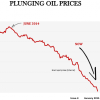
The Plunging Oil Prices report questions the practice of pegging the Iraqi dinar to the US dollar, noting the that value of the dinar has been falling against the dollar in the parallel market:
"Iraq pursues a policy of a de facto peg to the U.S. Dollar, and therefore monetary policy is constrained in tackling the current shock.
"The Central Bank of Iraq (CBI) had kept the Dinar steady through January 2009.
"In 2014, the nominal exchange rate in the official market remained stable against the U.S. Dollar at 1,166 IQD/1 USD, but the rate in the parallel market increased.
"The CBI has recently taken steps to simplify foreign exchange market regulations, but has not eliminated all existing exchange restrictions and the multiple currency practice.
"With the peg, fiscal policy carries the burden of macroeconomic stabilization, but in this case does not have the space to do so."
Read also:
- End of the Road for the Dinar Scam?
- ISIS and the Dinar Traders
- Iraqi Dinar Investments: Opportunity Or Scam?
- Iraqi Dinar Revaluation Enthusiasts are Unaware of Bernie Madoff’s Fame
Posted in Iraq Banking & Finance News 10 Comments
Poll: End of the Road for Iraqi Dinar Scam?
Posted on 07 January 2015 .
By Guest Blogger.
Any opinions expressed are those of the author, and do not necessarily reflect the views of Iraq Business News.
For several years, con artists have been peddling the Iraqi Dinar scam – the myth of a massive revaluation of the Iraqi dinar, but that may be about to change.
Using a range of convoluted arguments, these people push the idea that the dinar will increase to 1,000 times, or even 3,000 times, its current value; they or their associates then profit by selling the currency at a fat profit to people who desperately want to believe that they have found a pot of gold.
In a particularly cruel twist, they often target people who are in financial difficulty, and string them along with the fear that they wouldn't want to miss out on this once-in-a-history-of-the-world opportunity.
Self-reinforcing online communities have been created, where the unwitting victims can feel that they are finally part of an elite group destined to prosper, just as long as they continue to keep the faith.
Emotional commitment, and a quasi-religious zeal, all play a role: An April Fool article spelling out the utter absurdity of the Iraqi Dinar scam get-rich-quick scheme was met with widespread anger and hostility in dinar chatrooms.
Anecdotal evidence, however, suggests that even the most diehard "dinarians" are finally starting to accept reality, and that by the end of 2015 this scam may have been consigned to history. Sadly, this will be too late for the many who have been cheated of their savings, their time, and their hope.
[poll id="4"]
(Dinar image via Shutterstock)
Posted in Iraq Banking & Finance News 8 Comments