


Update on Iraqi Oil Production
Posted on 19 December 2010 .
The following update on output at Iraq's oilfields comes from Early Warning, citing a report from UPI:
Rumaila: Iraq's biggest field with the equivalent of 17.8 billion barrels of oil. That makes it the fourth largest oil field in the world. It contains around 15 percent of Iraq's oil. It is operated by BP and the China National Petroleum Corp (CNPC).
Production is 1.052 million bpd and is expected to reach its initial production rate of 1.065 million bpd by the end of the year, Jafaar says. That's three years ahead of schedule.
West Qurna 1: Contains 8.7 billion barrels. Exxon Mobil of the United States and Royal Dutch Shell secured the production contract in 2009. Production has been slipping but is expected to hit the IPR of 285,000 bpd within a year.
West Qurna 2: Holds 12.9 billion barrels and is operated by a consortium headed by Russia's Lukoil and StatoilHydro of Norway. Peak production of 1.8 million bpd is expected by the end of 2012, sustainable for more than a decade.
Majnoon: With reserves of 12.6 billion barrels, this is one of the top Iraqi fields and lies near the border with Iran. It is operated by Royal Dutch Shell and Petronas, which say they have boosted production from a paltry 46,000 bpd to 70,000 bpd, rising eventually to 1.8 million bpd.
Zubair: Operated by a consortium of Italy's ENI, the U.S. Occidental Petroleum Corp. and the Korea Gas Corp. (KOGAS) of South Korea. It has reserves of 4.1 billion barrels. Production is 200,000 bpd, up from 183,000 bpd in 2009. That's expected to eventually reach 1.2 million bpd.
Halfaya: Contains 4.1 billion barrels and is operated by the China National Petroleum Corp. Production is running at 3,600 bpd but potential output has been pegged as high as 535,000 bpd.
The Baghdad government expects production from just three of these fields -- Rumaila, West Qurna 2 and Zubair -- to hit 7 million bpd within six years.
(Source: Early Warning)
Posted in Iraq Oil & Gas News Comments Off on Update on Iraqi Oil Production

Full Details of UN Statement on Iraq
Posted on 15 December 2010 .
Today's session of United Nations Security Council, which led to the crucially important easing of restriction on Iraq, was chaired by the US Vice President, Joe Biden (pictured). The following is the text of the statement issued from his office, including full details of the decisions made by the Council.
Today marks an important milestone in the restoration of Iraq’s normalized ties to the international community. The UN Security Council, in a special session chaired by Vice President Biden, took significant steps to return Iraq to the legal and international standing it held prior to the 1990 invasion of Kuwait with the passage of three resolutions. Additionally, the Security Council issued a Presidential statement reaffirming the Security Council’s commitment to Iraq and support for UNAMI, welcoming Iraqi progress and reintegration into the region, and encouraging Iraq and all regional states to deepen and broaden their relationships.
With today’s action by the Security Council the United States and the international community are keeping their commitments to the Government and the people of Iraq. The resolutions adopted today by the Security Council will lift several longstanding Chapter VII restrictions on Iraqi trade and activity.
The three Security Council resolutions passed today are Resolution 1956, which terminates the UN supervised arrangements for the Development Fund for Iraq on June 30, 2011; Resolution 1957 which ends restrictions related to civilian nuclear cooperation placed on Iraq after the first Gulf War; and Resolution 1958, which ends the residual activities of the Oil for Food program.
Despite hardships, Iraq has made tremendous progress over the past few years and today is a far safer, more secure, and economically stable country. The United States urges Iraq’s neighbors and the international community to work closely with Iraq to resolve remaining outstanding Chapter VII issues, particularly outstanding issues between Iraq and Kuwait.
Posted in Iraq Industry & Trade News, Security 2 Comments
History’s lesson for the dinar
Posted on 07 December 2010 .
I used to think that rapid increases in Iraqi oil production would practically guarantee a significant strengthening of the dinar over the next ten years. Surprisingly, however, history suggests that this is far from a foregone conclusion.
While the Oil Ministry claims that Iraqi capacity will rise by 10 million barrels per day (mn bbl/d) to something like 12 mn bbl/d by the end of this decade, few analysts take this projection seriously. In fact, no country has ever achieved such a large incremental increase in a ten-year period. Historically, a recent study by the Energy Policy Research Foundation (available at http://www.eprinc.org/pdf/EPRINC-Iraq-FirstLook.pdf) found that Saudi Arabia came closest, with an increase of about 6 mn bbl/d (up 150%) from 1970 – 79, followed by Iran, which went from around 2 – 6 mn bbl/d from 1965 – 1974, and Russia, which raised production by some 4 mn bbl/d (68%) from 1998 – 2007.
But suppose for the sake of argument that Iraq was able to match these precedents and raised production from approximately 2 mn bbl/d at present to, say, 6 mn bbl/d by 2019. What would happen to the dinar if it followed a trajectory similar to the Saudi riyal, Iranian rial, or Russian ruble during the oil booms in those three countries?
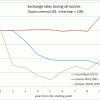
Not much, as it turns out. If it’s like the riyal or the ruble, the dinar would actually depreciate in US dollar terms by 25% or 16%, respectively. And the rial appreciated by just 12% from 1965 – 1974. (See chart. As the indices are based on year-end US$/local currency exchange rates, increases/decreases in an index correspond to appreciation/depreciation against the dollar.)
The problem with the idea that increased oil production must be bullish for the dinar is that it is based on the assumption that nothing changes except the output of oil (what economists call a “ceteris paribus” assumption). In fact, however, many other things can be expected to change. In the case of a large country like Russia, for example, domestic demand for refined products may rise significantly as well so that exports don’t go up at the same pace as crude production volumes. In the Saudi and Iranian cases, oil booms led to import booms, with the result that demand for foreign exchange rose along with increased export earnings. There might also be scenarios in which an increasingly confiscatory taxation regime led to greater dollar demand due to capital flight. And of course exporting more barrels won’t necessarily lead to higher forex revenues during an oil-price slump.
History’s lesson for the dinar is that whether it strengthens or weakens over the next decade will depend not only on Iraq’s success in increasing oil production but also on the economic changes that this increased production induces. If Iraqi demand for imports and refined products were frozen for ten years at current levels, a 4 mn bbl/d production increase would be unambiguously dinar positive. But in a more realistic scenario, supply and demand for foreign exchange are likely to grow together, with the result that the exchange rate may not deviate dramatically from its current level.
Posted in Iraq Banking & Finance News, Mark DeWeaver on Investments and Finance 600 Comments

New Consulates Planned for Basra
Posted on 23 November 2010 .
The Russian and German ambassadors to Iraq said on Monday that their countries want to open consulates in Basra in order to develop economic relations with the provincial government.
The news was announced following the two ambassadors’ visit to the governor of Basra province, Shiltagh Abboud, yesterday.
The German Ambassador to Iraq, George Christian, told AKnews that he had come to Basra seeking a safe location to open a consulate. He said that Germany is hoping to attract its companies to the province to take advantage of the available investment opportunities.
“The consulate….will attract German investors working in many sectors”.
For his part, the Russian Ambassador, Werbyal Gabriel, said that his country hopes to open a consulate in the region because of its unexploited investment opportunities, particularly following the entry of the Russian firm Lukoil into the oil investment sector.
"Russian companies will enter the large investment market in Basra and will not be limited to any particular sector,” he enthused, adding “including the armaments field.”
Shiltagh Abboud, the governor of Basra told AKnews that this week will be seen as a week of international visits, following meetings with the French Ambassador on Sunday, the Russian and German Ambassadors on Monday and the British Ambassador’s scheduled visit on Tuesday.
“…these ambassadors all seek to open consulates for their countries in the province and expand trade relations with Basra,” he said.
Mr Abboud told our reporters that the province will provide all the necessary support to countries wishing to establish consulates on its territory.
“The province is host to Turkish and Iranian consular offices with Egyptian, Russian, French and German consulates to follow.”
(Source: AKnews, National Media Center)
Posted in Iraq Industry & Trade News Comments Off on New Consulates Planned for Basra

Iraq Receives $156m Russian Helicopters
Posted on 19 November 2010 .
Iraq has received the last two in an order of eight Russian-made multi-purpose helicopters which cost 156 million dollars, the US army has said.
The purchase is Iraq’s latest effort to bolster the capacity of its armed forces ahead of a complete withdrawal of US forces by the end of next year, as the US military still provides much of Iraq’s transport and logistics.
The two Mi-171E helicopters were delivered to the Iraqi army’s base at Taji, 25 kilometres (15 miles) north of Baghdad, completing the order. “These Russian-made aircraft will be used to conduct a variety of missions, including counter-terrorism, airlift and intelligence, surveillance and reconnaissance,” the US army said in a statement.
Iraq’s fleet of multipurpose helicopters now includes eight Mi-171Es and 16 Mi-17 helicopters.
(Source: AFP, United States Forces)
Posted in Iraq Industry & Trade News, Security Comments Off on Iraq Receives $156m Russian Helicopters

Heritage Oil Gains on Kurdistan Update
Posted on 18 November 2010 .
Shares in Heritage Oil Plc (LSE: HOIL), the independent upstream exploration and production company with operation in Iraqi Kurdistan, were up more than 5% this morning after the company issued an Interim Management Statement for the periond July 2010 to 17 November 2010.
Highlights
- The Miran West-2 well, in the Kurdistan Region of Iraq, has reached a total depth of 4,426 metres
- The well has encountered indications of hydrocarbons from intervals within the Cretaceous, Jurassic and Triassic in excess of 2,500 metres
- Numerous zones for testing have been identified and testing operations have commenced
- Production in Russia averaged 516 bopd for the third quarter of 2010
- As at 30 September 2010, Heritage's cash position was $614 million, excluding reserved amounts related to the tax dispute in Uganda
EXPLORATION ASSETS
Kurdistan Region of Iraq
The Miran West-2 well has reached a total depth of 4,426 metres. The well encountered indications of hydrocarbons from intervals within the Cretaceous, Jurassic and Triassic in excess of 2,500 metres. A number of zones within these intervals have been identified for testing in both the deeper exploration targets and the initial appraisal objective in the Cretaceous. Testing operations have commenced and a further update will be provided on completion of these tests, expected within the next couple of months.
The acquisition of approximately 550 square kilometres of 3D seismic over the Miran Block has recently commenced. This, along with an extensive fieldwork study that began in October 2010, will help establish future drilling locations to exploit the reservoirs' fracture networks.
Heritage is looking to contract at least one rig to continue the drilling programme across the Block in 2011 which will include an exploration well on the Miran East structure. Heritage has operated in Kurdistan for approximately 700 days without any lost time or environmental incidents.
Other Assets
Posted in Iraq Oil & Gas News Comments Off on Heritage Oil Gains on Kurdistan Update

Sweden's Scania Accused of Corruption in Iraq
Posted on 02 November 2010 .
Swedish truck maker Scania paid $5 million in kickbacks through the U.N.'s oil-for-food program in Iraq, possibly violating both U.S. and Swedish laws, an anti-corruption investigator said on Friday, according to a report from Associated Press.
Swedish prosecutor Nils-Eric Schultz told the agency he is preparing to file charges in Sweden against several company officials later this year or in early 2011.
He sent a letter this week to the U.S. Justice Department and the Securities and Exchange Commission, presenting his findings and offering to provide more information on the case. Scania was listed on the New York Stock Exchange during the alleged kickback scheme, but applied to be delisted in late 2002.
"I believe the laws of the U.S. may have been breached," Schultz said in the letter, which was obtained by AP.
He said Scania did business with Saddam Hussein's regime through Tunisian and Russian companies, and that kickbacks of at least $5 million were paid for contracts worth about $70 million.
Posted in Iraq Industry & Trade News, Security Comments Off on Sweden's Scania Accused of Corruption in Iraq

Lukoil Awards 3D Seismic Contract at West Qurna 2
Posted on 30 October 2010 .
Russia's Lukoil announced on Friday that it has it awarded a 3D seismic contract at Iraq's West Qurna Phase 2 oil field to Terra Seis Trading Ltd. [Terraseis] (TSTL).
TSTL has been conducting seismic exploration in Iraq since 2005 and "possesses vast operational economic and legal experience, and is well aware of the country’s natural and climatic conditions".
The contract is set to run 9 months with a 3D seismic exploration scope of 540 square kilometers, but the value of the contract has not been revealed.
The pilot survey is scheduled for the beginning of December, while the seismic convoys will enter the contract area in the middle of December.
The data obtained will allow the Company to clarify the geological structure of the area under exploration and to develop a comprehensive seismic-facial field model.
The Russian company along with Norway's Statoil won the right to develop the 13-billion barrel West Qurna Phase 2 in Iraq's second postwar licensing auction held in Baghdad in December of last year.
Under the terms of the 20-year-long service contract, Lukoil and Statoil are required to pump at a rate of 1.8 million barrels a day for payment of $1.15 a barrel. That production target needs to be reached in 2017.
Lukoil holds a 56.25% stake in the project, Statoil 18.75% and the Iraqi state company holds the remaining 25%.
(Sources: Lukoil, Wall Street Journal)
Posted in Iraq Oil & Gas News Comments Off on Lukoil Awards 3D Seismic Contract at West Qurna 2

Russian Companies to Build Monorail in Baghdad
Posted on 30 October 2010 .
A group of Russian companies has been offered the project to build a monorail in Baghdad, according to Aswat al-Iraq.
“Baghdad’s Hanging Train [monorail?] project, offered tp Russian companies, is expected to stretch for 25 kms, with a total capacity of 10,000 passengers per hour, through 16 stations, distributed between Baghdad’s two banks of Rusafa and Karkkh,” Deputy Governor of Baghdad, Kamel Al-Saadi said told the agency on Saturday.
He said that the train would follow two routes, the first beginning from East Baghdad’s Shaab district, passing through Mustansiriya, Kazimiya and end in central Baghdad’s Alawi al-Hilla, whilst the other begins from west Baghdad’s Yarmouk district, passing through Muthann Airport and also ending in Alawi al-Hilla.
In June, Canadian company TransGlobim International won the contract to build a monorail in the holy city of Najaf.
(Source: Aswat al-Iraq)
Posted in Construction & Engineering In Iraq, Iraq Transportation News Comments Off on Russian Companies to Build Monorail in Baghdad

Kurds Want To Manage Oil Independently
Posted on 26 October 2010 .
Kurdistan's Prime Minister, Barham Salih, asserted that Kurdistan has had a successful oil policy and that any prospective government must allow the region to manage its own oil autonomously, according to a report from Rudaw.
Due to the policy under which the Kurdistan Regional Government (KRG) has signed dozens of contracts with foreign companies independently of Baghdad’s central government, the Kurdish region’s energy sector has seen a significant improvement, said Salih.
But Iraq’s Minister of Oil, Hussein al-Shahristani, has long accused Kurdistan of illegal management of oil and considered all the contracts that the region signed null and void.
“The Kurdistan Region has a clear-cut and transparent policy on oil,” said Mr. Salih, in an exclusive interview with Rudaw, rejecting criticisms from the opposition parties that accused a handful of Kurdish officials of “smuggling” oil for their own benefit.
Posted in Iraq Oil & Gas News Comments Off on Kurds Want To Manage Oil Independently