


How high can Iraqi stocks go?
Posted on 25 October 2010 .
In my October 11 post, I argued that the ISX stands a reasonable chance of joining this year’s emerging markets rally. Today, I’d like to make an even more audacious claim: in 2011, inflows of foreign money could potentially make Iraq the world’s top performing market.
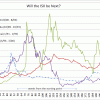
You can get some idea of the upside potential for Iraqi stocks from the chart, which shows the dizzying heights to which a sudden inflow of liquidity can push a tiny new market like this one. Whether the new money is primarily foreign—as in the Russian and Sri Lankan examples—or local—as was the case in China and Vietnam, the resulting bubble looks much the same. In a time span of from one to two years, you might make anywhere from five to ten times your money if you managed to get out at the top. (Note that all four of these markets went on to reach even higher levels in later years.)
These legendary emerging markets of yesteryear can also teach us two important lessons about when to sell. First, no stock is overvalued if it is going to continue going up. In a liquidity-driven market, concern with valuations will only lead you to take profits too early. And second, don’t believe the hype. No matter how rosy the prospects for the local economy and corporate earnings seem to have become, when the supply of liquidity begins to dry up, the bull market is over.
Posted in Iraq Banking & Finance News, Mark DeWeaver on Investments and Finance 15 Comments
Iraq Wants Hundreds of US Billions
Posted on 19 October 2010 .
...and it looks like it is going to get it.
Iraq has lofty investment targets for the next five years. Sami al-Araji, chairman of Iraq's National Investment Commission, told Reuters:
"We'd like to go ahead and shoot for $600 billion. We hope of course we can realize it, but we will be very happy if we realize a good percentage of it. That's if we pass the 50% in a solid way."
This does not seem too far-fetched. New deals are reported in a steady stream by Iraq Business News, from budgets of $75m to complete hundreds of small deals to a $50bn deal to build one million housing units for millions of people.
It doesn't stop there. "If we go for the two million housing units, by itself, that will give us a good chunk of that mark," Araji continued in his interview. "As of today, 132 companies have applied. We are concentrating on 35."
Just this week, Baghdad Province completed deals with Russian and Ukrainian companies worth $20bn for projects in various sectors: bridges, education, energy, health, roads, sewers, tourism, water and youth.
A statement from the Office of the Mayor of Baghdad, Salah Abdul-Razzaq, said that the projects include "building nine hospitals accommodating 200 beds and 400 schools with laboratories, cafeterias and gymnasiums. There are other projects in the fields of housing and tourism through building a hotel at Baghdad International Airport and 50,000 housing units."
"Other projects include transport field through building an expressway adjacent to Tigris river 250 km long...which contributes to transport 10,000 passengers an hour, in addition to building five bridges in different areas of the capital and other projects in the field of youth including building 14 swimming pools, 20 entertainment and sports clubs, 12 women's clubs, football and basketball fields and 28 houses for culture and arts; and a power station with capacity of 1,300 mw will be built as well."
(Sources: Reuters, Nina, Office of the Mayor of Baghdad)
Posted in Iraq Public Works News 2 Comments

Russia Eyes Deals in Iraq
Posted on 15 October 2010 .
Reuters reports that Russia is talking directly with Iraq's oil-rich Kurdistan region about investment opportunities there, Russia's ambassador to Iraq said on Tuesday, a strategy that could irritate Iraq's central government.
Baghdad is at odds with the semi-autonomous northern region and has strongly opposed oil deals the Kurds have signed independently with foreign companies. The row has interrupted exports from Kurdish oilfields.
Speaking inside the heavily fortified Russian embassy compound in Baghdad, ambassador Valerian Shuvayev said Russian delegates often visited Kurdistan to explore opportunities.
"They go to Kurdistan quite a lot. There is nothing concrete but both sides are thinking about how to take this further," he said in an interview.
Asked if Russian companies considered signing contracts with Kurdistan directly, Shuvayev said: "Why not? If (a project) is feasible, then why not. And there have been talks." He was tight-lipped on the details and declined to name the companies.
Posted in Iraq Oil & Gas News Comments Off on Russia Eyes Deals in Iraq
Lukoil Earmarks $4.5bn for West Qurna 2
Posted on 13 October 2010 .
Russia’s Lukoil aims to produce 120,000 barrels of oil a day at Iraq’s field by the end of 2012, and is seeking customers for the fuel in Asia, according to a report from BusinessWeek.
The Moscow-based company plans to begin selling crude from the field in 2013, Paul Hawkins, director of supply and trading at Litasco (Lukoil International Trade and Supply Company) said in a presentation in Singapore on Wednesday. Lukoil won rights in December to develop phase 2 of the West Qurna deposit together with Norway’s Statoil.
West Qurna 2 is likely to yield heavy, sour crude from the Mishrif reservoir during the early stages of production. Lighter, sweeter crude from the Yamamah reservoir in the same deposit is set to begin production later and be marketed from as early as 2016, Hawkins said.
The lightness or heaviness of oil refers to how thick it is, a key consideration for refiners. Sourness or sweetness refers to how much environmentally harmful sulfur it contains. Lighter, sweeter crudes are typically easier to refine and command higher prices.
Lukoil plans to invest $300 million in the field this year, with as much as $4.5 billion earmarked for the next four to five years, Hawkins said. Output from the field is set to rise to 650 million barrels a year by 2017, he said.
(Source: BusinessWeek)
Posted in Iraq Oil & Gas News Comments Off on Lukoil Earmarks $4.5bn for West Qurna 2
New Auction for Three Gas Fields
Posted on 11 October 2010 .
Iraq's Ministry of Oil will auction off more gas fields on the 20th October 2010.
Xinhua was told by an official: "The bidding for the gas fields of Akkas in Iraq's western province of Anbar, Mansuriyah in eastern Diyala province and Siba in the southern province of Basra, will be held on October 20th." Ministry of Oil figures put the gas reserves of these fields at 11.23tn cubic feet. Currently, the country is producing just 1.5bn to 1.65bn cubic feet per day from proven reserves of 112tn.
This auction has been delayed from May, as firms needed time to look into the contracts, which could last 20 years, according to Nina News. There was a symposium last month so that firms could review the petroleum reserves of the fields.
Countries with interested companies include: France, India, Japan, Kuwait, Norway, Turkey, Russia, South Korea and the UK.
In the first two rounds of licensing, the Ministry of Oil signed 12 contracts, with the aim of increasing oil production to 12m barrels per day by 2017. Currently it produces about 2.5m barrels and exports about 2m.
Read more on oil and gas.
(Sources: Nina News, Xinhua)
Posted in Iraq Oil & Gas News Comments Off on New Auction for Three Gas Fields
Nabucco Investment Decision Delayed to 2011
Posted on 09 October 2010 .
A final investment decision on investment for the Nabucco pipeline will definitely not happen this year, and will be delayed until 2011 because gas supply talks with Azerbaijan are dragging on, an Austrian newspaper reported on Friday.
The 7.9 billion euro ($11 billion) Nabucco pipeline is part of the EU's effort to diversify its natural gas supplies by bringing up to 31 billion cubic metres of gas annually from the Caspian region to an Austrian hub via Turkey and the Balkans.
Construction on the project, which has already been subject to several delays, is scheduled to start next year with the first gas deliveries at the end of 2014.
"We are definitely not going to manage it (the decision) this year, it will not happen until 2011," Michael Ulbrich, head of international pipeline projects at Austrian energy group OMV, was quoted in the daily Der Standard as saying.
Der Standard said longer-than-expected talks with Azerbaijan had led to the delay.
Azerbaijan has been in talks with more than 20 firms and consortiums and will decide later this year which project gets gas from its giant Shah Deniz II gas fields, co-led by BP (BP.L) and Statoil (STL.OL).
The government has said the gas contracts will go to the company that offers the highest price, and the Nabucco and Russian offers are seen as the main contenders.
Russian gas export monopoly Gazprom (GAZP.MM) said recently its competitors would not be able to beat its price for gas from Shah Deniz.
Nabucco expects the pipeline will transport its first gas from Iraq, 10 billion bcm, and another 8 billion bcm from Shah Deniz in 2015.
Nabucco's other shareholder(MOLB.BU), Romania's Transgaz (TGNM.BX), Bulgaria's Bulgargaz, Turkey's Botas and Germany's RWE (RWEG.DE).
(Source: Reuters)
Posted in Iraq Oil & Gas News 2 Comments
Sonoro Signs Asphalt License Agreement
Posted on 06 October 2010 .
Sonoro announced that its wholly owned subsidiary, Sonoro Energy Iraq, and its partner, Berkeley Petroleum Mesopotamia Asphalts Limited (together, the "Licensee"), have signed an Asphalt License Agreement (the "Agreement") with the Al-Salah ad Din Provincial Government in the Republic of Iraq.
The Salah ad Din Province lies just to the North of Baghdad and lies within the trend of mega oilfields including production of roughly 300,000 barrels oil equivalent per day. It is estimated that Iraq may hold the world's fourth largest heavy oil resources behind Canada, Venezuela and Russia. The key terms of the Agreement are the following:
Sonoro Iraq will have a 70% working interest and will be the operator and Berkeley will have a 30% working interest.
Licensee has the exclusive rights to explore, develop and produce asphalts and related organics within the entire Al-Salah ad Din
Province and to sell the asphalts and its related organics produced (and/or the by-products after processing) domestically and/or internationally.
The Agreement provides for an initial exploration period of 5 years and is followed by a 30 year exploitation period with extensions for any carved out exploitation areas to develop asphalts and related organics.
Licensee has the right to construct and operate asphalt-heavy oil topping facilities within the Al-Salah ad Din Province, with certain processing capacity commitments.
Licensee is entitled to 50% of the revenues from the sales of asphalts and related organics (and its by-products after processing), after tax and after cost recovery.
80% of the revenues are available for cost recovery. Licensee is committed to a minimum initial investment commitment of US $1.5 million.
Posted in Construction & Engineering In Iraq, Iraq Oil & Gas News Comments Off on Sonoro Signs Asphalt License Agreement

Russian Firm to Invest in New Industrial Park
Posted on 06 October 2010 .
A Russian firm has expressed interest in investing in the construction of the new industrial area east of Amara city.
“The firm is ready to execute the project according to credit payment system,” a local Iraqi source told Aswat al-Iraq news agency on Wednesday.
He explained that the new industrial area will be on the Amara-Msharah road.
(Source: Aswat al-Iraq)
Posted in Iraq Industry & Trade News 1 Comment
Nabucco Pipeline May Be Extended to Iraq
Posted on 05 October 2010 .
- Ashti Hawrami says Iraq can fill Nabucco.
A day after Iraq said its proven oil reserves surged to world's third biggest, talks are on to extend the Nabucco pipeline to country's Kurdish region.
According to Richard Morningstar, the Special Envoy of the United States Secretary of State for Eurasian Energy, it is important that natural gas from the Kurdish region of Iraq reaches the Southern Corridor of European energy networks.
He said Washington considered Iraq's participation in the Nabucco pipeline integral to the project.
Europe aims to break the Russian grip on the European energy sector through the so-called Southern Corridor of transit networks that includes the Nabucco pipeline.
The Nabucco consortium in Vienna said it confirmed and ordered the engineering work for feeder lines from Georgia and Iraq to connect to the main artery in Turkey.
Energy deals in Iraq require mutual agreements between the central government in Baghdad and the regional Kurdish government in Erbil. Morningstar said he hoped both sides would agree to the Nabucco terms to move the project forward.
Meanwhile, Ashti Hawrami, the Natural Resources Minister of the Kurdistan Regional Government, said at the energy conference in Istanbul that Iraq's oil and gas fields contain 100 trillion to 200 trillion cubic feet of natural gas.
"This is more than adequate for internal use, the domestic supply of Turkey as well as to satisfy the requirements of Nabucco," Hawrami was quoted as saying by Turkish English-language newspaper Today's Zaman. "We are confident, if we can prove the full 200 trillion cubic feet, we can supply the entire needs of Nabucco."
(Sources: Commodity Online, UPI)
Posted in Iraq Oil & Gas News Comments Off on Nabucco Pipeline May Be Extended to Iraq

Ashti Hawrami Addresses UK Businesses and Politicians
Posted on 04 October 2010 .
Dr Ashti Hawrami is Minister for Energy Resources for the KRG (Kurdistan Regional Government) and will be speaking alongside Foreign Office Minister Alistair Burt and Nadhim Zahawi MP at a fringe meeting on October 5th at the Conservative Party annual conference.
Iraq’s Kurds have a great and long-standing respect for Britain. In particular, we remember the role of Sir John Major in helping to establish the Kurdish safe haven in 1991 when millions were in grave danger. Now that the major British and American military role in Iraq has ended, Kurds want Britain to trade and engage with, not turn away from, Iraq’s emerging federal democratic state. We believe that Britain would benefit from a strategic political and economic partnership with Kurdistan and Iraq.
Our success will be your success. It will be vital for stability in the immediate neighborhood and could galvanise long overdue reform throughout the Middle East, whose potential is being wasted on a huge scale.
As Minister of Natural Resources in the Kurdistan Regional Government in Iraq, I will be at the Conservative party conference to discuss ways in which these goals can be met.
With trade the new focus of UK foreign policy, I believe that the Conservative-led coalition must strengthen Britain’s partnership with the Kurdistan Region and Iraq so that it can capitalize on our booming economy, energy resources and geostrategic importance, and so that it can maximise relations with its other allies in the region, such as Turkey.
Our message to British business is this:
Posted in Construction & Engineering In Iraq, Iraq Industry & Trade News, Iraq Oil & Gas News Comments Off on Ashti Hawrami Addresses UK Businesses and Politicians