


More Lives in Jeopardy as Fighting Expands
Posted on 28 February 2015 .
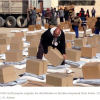
As a result of the recent widening of the conflict in Iraq, many more people – numbering in the hundreds of thousands – have been affected.
The provinces of Al-Anbar, Ninawa, Salah al-Din, Diyala, and Kirkuk have been under heavy attack, driving more people to abandon their homes to seek shelter in safer areas. This is in addition to the over two million people who had already been displaced since last year. People in these provinces have virtually no access to basic services, and essential supplies reach them only irregularly.
"The displaced people have barely survived the harsh winter," says Patrick Youssef, the head of the ICRC's delegation in Iraq. "Going home is not an option for most of them. Those who do, return to badly damaged houses and radically disrupted supplies of water and electricity. Hospitals are either damaged or working at well below their usual capacity. Unexploded munitions are a huge threat: they are strewn all over the areas where fighting is particularly heavy."
Looming humanitarian needs
The broadening of the conflict to populated areas along the Tigris and Euphrates rivers will create more humanitarian needs. If major cities like Mosul come under fire again, thousands more people will have to flee. Because security conditions are so uncertain, many areas remain out of reach for humanitarian organizations, and large numbers of people will be without help when they need it most.
The ICRC reminds all parties to the conflict to take all precautions necessary to minimize loss of civilian life and damage to property, treat detainees with dignity, facilitate access to health care for everyone, and ensure that the work of medical staff and hospitals proceeds unhindered. Humanitarian workers must be allowed to safely reach people who need help, and all possible measures should be taken to protect people from attacks and displacement.
ICRC activities
Difficulties of access notwithstanding, the ICRC has been striving to assist displaced people throughout Iraq, and the communities hosting them: since the beginning of the year, over 300,000 people have received essential aid. Several relief operations have been carried out across front lines to take food, water, and other basic items to people, and essential medical supplies to the wounded and the sick.
Posted in Security Comments Off on More Lives in Jeopardy as Fighting Expands
Al-Abadi Receives World Bank Director
Posted on 23 February 2015 .
By John Lee.
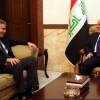
Prime Minister Dr. Haider Al-Abadi recently received in his office the director of the World Bank in the Middle East and North Africa, Mr. Farid Belhaj, and the Special Representative of the World Bank Mission in Iraq, Mr. Robert Bu Jodah.
The meeting discussed the challenges of Iraq's economy caused by the global drop of oil prices in addition to reorganizing the economy in Iraq, the government support to private sector, and turning the challenges of Iraq into opportunities for real reforms besides following up the results of the meeting between PM Dr. Al-Abadi and Director of the World Bank on the margin of Davos Forum last month.
Dr. Al-Abadi mentioned that the government is continuing in implementing its economic reforms and supporting private sector; "this is what we started to seek for through ratifying the budget of this year which adopted abstinence" and "the government started in this project and it has plans in this field but it needs the help and experience of the World Bank".
H.E. emphasized the determination of the government to activate a retirement system which guarantees the rights of all Iraqis including those who work in the private sector.
On its part the delegation of the world bank expressed its intention to provide all kinds of support to Iraq and its readiness to establish programs and projects to activate public Banks, cooperate with the Iraqi Central Bank, rehabilitate the state owned companies in addition to supporting infrastructure projects like electricity and water.
(Source: Office of the Prime Minister)
Posted in Construction & Engineering In Iraq, Iraq Banking & Finance News, Iraq Industry & Trade News, Iraq Public Works News Comments Off on Al-Abadi Receives World Bank Director

Ministers Offer Iran Site for new Car Plant
Posted on 21 February 2015 .
By John Lee.
The Deputy Managing Director of of Iranian vehicle maker Iran Khodro (IKCO) has said the company has chosen Iraq as a target market for its car exports, and opened a new showroom in Baghdad last week as a first step.
Meqdad Mahmudi told Iran's IRNA news agency that both the Iraqi Oil Minister and the Iraqi Electricity Minister had proposed giving a large site to the company to build a car manufacturing plant.
(Source: IRNA)
Posted in Iraq Industry & Trade News Comments Off on Ministers Offer Iran Site for new Car Plant

Shares in APR Rise on Basra Contract
Posted on 18 February 2015 .
By John Lee.
Shares in APR Energy were up 3 percent on Wednesday morning after the company announced that it has signed a contract renewal for its power generation contract in Iraq, taking the term through the end of 2015.
The power plant has been in operation since 2012 and comprises six GE TM2500 mobile gas turbines capable of generating more than 120MW of electricity. APR Energy acquired the plant in 2013 as part of its acquisition of GE's power rental business.
Located in Basra, the gas-fired power plant provides reliable base load power and grid stability to the population of the Basra province, as well as supporting oil and gas, petrochemical and agricultural industries.
Commenting on the contract renewal, APR Energy's Managing Director for Europe, Middle East and Africa, Ranjit Singh said:
"Our fast-track solution is providing Basra residents and industries with reliable power, helping to fill critical needs and supporting economic and social stability. Mobile turbine technology helps stabilise the grid, uses approximately a third of the space required by a mobile reciprocating engine site and requires only a small team to operate and maintain.
"This renewal reflects our customer's ongoing demand for electricity, as well as our proven ability to deliver large-scale power quickly, reliably and consistently."
Laurence Anderson (pictured), APR Energy Chief Executive Officer added:
"I'm very pleased to have renewed this significant contract in Iraq, which follows on the heels of our 135MW contract extension and expansion in Indonesia.
"Our focus following the acquisition of the GE power rental business has been to renew the former GE contracts under more favourable terms or else relocate the assets to higher-value opportunities, and this renewal is very much aligned with that strategy."
(Sources: APR Energy, Yahoo!)
Posted in Construction & Engineering In Iraq, Iraq Public Works News 4 Comments
Iran-Iraq Sign Cooperation Deals
Posted on 16 February 2015 .
Dr. Haider al-Abadi, the Prime Minister, received Mr. Isaac Jhangere [Es'haq Jahangiri], Vice President of the Islamic Republic of Iran, who arrived in Baghdad this morning at the head of a senior-level delegation.
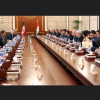
After an official reception ceremony, a bilateral meeting was held to tackle the development of relations between the two countries and issues of common interest. After which a joint meeting was held presided from the Iraqi side by, Dr. Haider Abadi, head of the Council of Ministers, and from the Iranian side by, Mr. Isaac Jhangere, with the presence of the whole members of the two delegations.
Dr. Haider al-Abadi, at the beginning of the meeting, welcomed the Iranian Vice President and the accompanied delegation, expressing satisfaction with the increase of trade exchange between the two countries, calling for the completion of all suspended situations, confirming the continuation of dialogue, communication and follow-up to the previous agreements between the two countries.
H.E. stressed the importance of cooperation between the two neighbors and hoped to expand the horizons of cooperation in the fields of trade, oil and gas, electricity, agriculture, housing and transportation as well as the financial and banking cooperation.
For his part, the Vice President said:
"Our policy strategy is to support unity of the Iraqi people, restoration of security, stability and the progress of Iraq, pointing to the victories the Iraqi people and armed forces achieved in the face of terrorist Daash gangs, hoping to continue these successes in the face of terrorism.
Mr. Jhangere stressed that:
"The economic relations between the two countries grew well, as we move forward in cooperation in the fields of railway linkage and oil pipelines extension with all that serves the interests of both neighboring peoples".
The Iranian Vice President's renewed the desire of Iranian companies to contribute to the energy, construction and housing, agriculture, health, medicine and medical equipment fields.
The meeting was attended from the Iraqi side by the ministers of Finance, Municipalities, Transport, Trade, Health, Industry and Minerals, Agriculture, Construction and Housing, Environment, Culture, Tourism and Antiquities and Minister of State for Provincial Affairs, besides members from the Council of Representative and the Governor of the Central Bank, while attended from the Iranian side by, the ministers of Industry and Mines, Trade, Roads and Urban Construction, Agriculture, Health and Economy as well as Deputy Minister of Energy, the Governor of the Central Bank of Iran and Deputy Foreign Minister for Arab and African Affairs.
(Source: Office of the Prime Minister)
Posted in Iraq Industry & Trade News, Security Comments Off on Iran-Iraq Sign Cooperation Deals

Iraq has Lost Billions from Gas Flaring
Posted on 16 February 2015 .
By John Lee.
The former head of the Energy Studies Department at the Opec Secretariat in Vienna has said that delays in capturing associated gas from Iraq's oilfields is costing the country billions of dollars.
Saadallah Al Fathi told GulfNews.com that the Basra Gas Company (BGC) is very slow in rehabilitating and maintaining the plants at North Rumaila and Khor Zubair.
The Basra Gas Company (BGC) is a $17.2-billion joint venture set up in November 2011 to gather and process gas from the three southern oilfields of Rumaila, West Qurna 1, and Zubair; it is owned by the Iraqi South Gas Company (SGC) (51%), Shell (44%) and Mitsubishi (5%).
Al-Fathi added:
"Only in April 2014 did the company award the technical studies of a new gas plant in Ratawi of 500 mcfd capacity, which would cost $2 billion. But it is too little compared with gas production now assuming current facilities are completely rehabilitated.
"By the time the plant is ready, it will probably be five years from now and gas flaring would continue. Iraq probably needs four of such plants if flaring is to be avoided and electricity demand is satisfied.
"This is what prompted the IEA in June 2012 to say that the implied value of the gas flared to 2020 would be $70 to $100 billion and that ‘This lost value provides a compelling reason for Iraq to move as quickly as it can to make early additions to gas processing capacity’."
(Source: GulfNews.com)
Posted in Iraq Oil & Gas News 12 Comments
Finance Minister Meets General Electric
Posted on 25 January 2015 .
By John Lee.
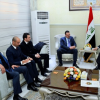
Finance Minister Hoshyar Zebari received this week the CEO of the General Electric Company (GE), Mr. Aziz Koleilat, and his delegation.
During the meeting, they discussed projects and activities of the company in the country in the energy, electricity and health sectors.
The Minister of Finance stressed the government's keenness to secure and provide financial guarantees required for the work of foreign companies in the country.
(Source: Ministry of Finance)
Posted in Iraq Industry & Trade News Comments Off on Finance Minister Meets General Electric
Turkey Sends Power-Generation Ship to Basra
Posted on 21 January 2015 .
By John Lee.
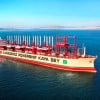
Turkey is to send a power-generation ship to Basra to help alleviate its electricity shortages.
The announcement was made by Turkish Energy Minister, Taner Yildiz, on Sunday during the 17th Turkey-Iraq Joint Economic Commission meeting in Baghdad.
According to Worldbulletin, the ship will add 410 megawatts to the existing capacity of 250 MW in the city.
Turkey-based Karadeniz Holding is a major player in the power ship market.
(Source: Worldbulletin)
Posted in Iraq Industry & Trade News, Iraq Public Works News 2 Comments
Iran Wins $40m Iraq Cable Contract
Posted on 20 January 2015 .
By John Lee.
An Iranian company has struck a $40-million deal with Iraq for the supply of high voltage cables.
Alireza Kolahi, the Managing Director of Abhar Cable & Wire Co., said the contract was won despite competition from Malaysia, South Korea, Turkey, Italy, Germany, Switzerland, UAE and Saudi Arabia.
He said the Iraqi electricity industry has $400 million potential by 2030.
(Source: IRNA)
Posted in Construction & Engineering In Iraq, Iraq Industry & Trade News 10 Comments
Displaced Iraqis seek Safety as Winter Falls
Posted on 31 December 2014 .
More than 3,000 internally displaced Iraqis are living in Arbat camp three months after it opened to shelter to some of the 2 million people uprooted by conflict in northern and central Iraq in 2014.
They comprise some 660 families, including 40-year-old Laila, her husband Khalaf and their seven children. The family from Sinjar fled to the city of Suleymaniyah in northern Iraq's Kurdistan region in August to escape the deadly advance in other parts of the country of militant forces.
They stayed in a partly built building with no windows or doors, but when temperatures began to drop in early December, and the US$200 monthly rent became too much to pay, Laila and Khalaf opted to move to one of Iraq's growing number of tented camps.
Thousands of other internally displaced people have been doing the same thing as temperatures continue to drop and the job market contracts. Running short of financial resources, they hope to receive winter assistance in the safety of camps from organizations like UNHCR.
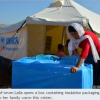
A television, satellite dish, bags of clothing, a tricycle and a refrigerator are piled up outside the two UNHCR tents at Arbat camp that Laila and her family now call home. "Tent camps are for those without money and who have nowhere to go," says 46-year-old Khalaf, a former construction worker in Sinjar. "Those who complain most about living in camps can usually afford to live elsewhere."
Here in Arbat, there is water, latrines, electricity, children's areas and a monthly ration of food. But it is far from ideal. Most such camps across Iraq lack hot water while schools are still in the planning stage. Mud is a near-constant companion.
Arbat is just one of 24 camps for displaced Iraqis now open across the country. Another 17 are under construction, with almost all slated for completion by the end of January. There are more than 160,000 people living in these camps, but that number will likely more than double in the next few weeks.
While most of the displaced have now been moved out of schools, there are still tens of thousands living in unfinished buildings, with relatives, in rented apartments or in collective centres.
As of November, an estimated 40 per cent of the 2 million displaced were living in sub-standard shelter – that's the population that UNHCR and other aid agencies have prioritized to ensure that they will remain warm and dry through the winter.
"We are in a race against the clock here," says UNHCR Representative in Iraq Neill Wright. "We are making substantial progress, but the sheer numbers of those in need, and the fact that they are spread out across some 2,000 sites across Iraq, makes it a daunting challenge."
The weatherproofing of thousands of houses and collective centres is under way, and, since early November, UNHCR has been airlifting to Iraq 25,000 tent insulation kits from a factory in Pakistan. Thousands have been distributed, tent-by-tent, to camp populations. The priority is to help those living in high elevations where the winter snow is falling.
One of those camps is Arbat. Earlier this month, on their move-in day, the Laila and her family received their tent insulation kit. Within 30 minutes they had laid out the polystyrene flooring panels and hung fibre liners along the walls ¬- essentially creating a tent within a tent. Laila says camp life is far from ideal, but this winter, they can plan on being warm and dry.
(Source: UN)
Posted in Security 9 Comments