

Iraq's Defunct Military Industry
Posted on 04 July 2015 .
By Omar al-Jaffal for Al-Monitor. Any opinions expressed are those of the author, and do not necessarily reflect the views of Iraq Business News.
The Iraqi Military Industry Commission (MIC) has a tragic story. Iraq developed its local military industry during the Iran-Iraq War, but in 1991, the international coalition — which was established in 1990 by a United Nations decision to force the Iraqi forces out of Kuwait and monitor Iraq’s activities in the military industry field — brought down most of the MIC’s important facilities, and the coalition’s inspection teams destroyed what was left of it under the pretext of destroying weapons of mass destruction.
However, after the end of the Gulf War in February 1991, the regime of late President Saddam Hussein restored some of these facilities and the MIC rebuilt the country’s infrastructure in terms of water, electricity, roads, bridges and military industry.
The MIC facilities were once again looted and vandalized by Iraqis following the US occupation in 2003. Hundreds of billions of dollars went down the drain.
Iraq has a relatively long history with the military industry, as the Ministry of Industry and Minerals owns several companies that manufacture guns, rockets and mortar bombs, which still exist today but are no longer operational. To develop these industries, Saddam's regime established the MIC in 1981; it was initially affiliated with the Ministry of Industry and Minerals.
The MIC helped the Iraqi armed forces in securing military gear and supplies during its war with Iran from 1980 to 1988. However, Saddam issued a decree in 1991 transferring the subordination of the MIC from the Ministry of Industry and Minerals to the Ministry of Defense.
The MIC continued its operations despite the devastation it sustained by the war with Iran and the economic blockade imposed by the UN Security Council on Iraq in 1990, until the overthrow of the regime by the United States in April 2003.
Posted in Construction & Engineering In Iraq, Iraq Industry & Trade News, Security Comments Off on Iraq's Defunct Military Industry

Syrian Traders Flock to Mosul
Posted on 21 June 2015 .
This article was originally published by Niqash. Any opinions expressed are those of the author, and do not necessarily reflect the views of Iraq Business News.
The New Masters of the Market: Syrian Traders Flock to ISIS' Mosul For Iraqi Profits
The city of Mosul had turned its back to the other Iraqi cities as of the day it fell under the control of Daash, but it had opened its arms for the neighboring Syrian cities with which it shares the same fate because Mosul as well as those cities are all parts of the so-called "Islamic state".
Certain streets in Mosul now ring with the cries of Syrian traders. Locals in the Wadi Hajar neighbourhood in the city, which has been under the control of the extremist group known as the Islamic State since last June, are used to traders and street vendors touring their streets in cars or with trolleys and using loudspeakers to advertise their goods.
Ever since the city was taken over by the Islamic State, or IS, group Mosul has been increasingly cut off from Iraq. Instead the roads to the Syrian territories that the IS group controls have opened up. And now traders like the 45-year-old Syrian who wished to be known as Abu Staif have become well-known regulars in Mosul.
As soon as local women who want to shop hear him calling, the heavily veiled ladies surround his old Hyundai like black-faced bees around honey. The car has a sign that says “Syria – Homs” on it and its filled with kitchen and cleaning utensils and products like detergents.
Selling goods like this – on the streets – was very popular in Iraq between 1991 and 2003, when the country under Saddam Hussein was heavily sanctioned. Now once again merchants have returned to trade on the streets although this time they are mostly Syrian, rather than Iraqi.
Posted in Iraq Industry & Trade News, Security Comments Off on Syrian Traders Flock to Mosul

New Army to Defend Oil and Electricity Facilities
Posted on 08 June 2015 .
By John Lee.
Iraq is committing 27,000 security personnel to protect its oil and energy infrastructue from attacks by the Islamic State (IS, ISIS, ISIL).
Oil Minister Adel Abdel Mahdi (pictured) announced the new force following the latest round of meeting with the Organisation of Petroleum Exporting Countries (OPEC).
According to a report from The Telegraph, the new 'oil army' would be drawn from an existing energy police corp that is under control of the country's Interior Ministry.
Meetings will take place in the coming weeks to finalise the structure of the force, which will receive additional training and equipment.
"Their mission is to secure all oil and electricity facilities," said Mr Abdel Mahdi.
(Source: The Telegraph, Reuters)
Posted in Iraq Oil & Gas News, Security 8 Comments

How Much is Fight Against IS Costing?
Posted on 07 June 2015 .
This article was originally published by Niqash. Any opinions expressed are those of the author, and do not necessarily reflect the views of Iraq Business News.
Can The Country Ever Recover? How Much Iraq's Fight Against ISIS Extremists Is Really Costing
The security crisis caused by the extremist group known as the Islamic State has not just had an impact on security in Iraq, it's also having a major impact on the country's finances. Yet nobody really seems to know exactly how much it is all costing.
“The cost of the war is around US$300 billion,” Iraqi politician, Baleigh Abu Kallal, an MP for the Islamic Supreme Council of Iraq, told NIQASH. “That includes direct costs for weapons and arms as well as other costs and the impact on the economy in general. The impacts of the crisis have reached around US$200 billion and the government has spent around another US$100 billion on weapons and funding the fighting since June last year,” he explains.
Local economist Bassem Jamil Antoine believes that talk that the crisis may have cost US$300 billion so far is not an exaggeration. He agrees that US$1 billion has been spent on weapons – this is a figure that most experts agree on when trying to calculate the cost of the crisis - but that indirect costs of things like taking care of internally displaced Iraqis, the damage done to infrastructure and the economy, and other impacts would add up to more than that again.
The costs of paying soldiers to fight against the Islamic State, or IS, group have also mounted. A source at the Iraqi Central Bank, speaking on condition of anonymity, told NIQASH that after June 2014, around a million extra salaries were added to the salaries already paid to official Iraqi security forces. These are being paid to the volunteers who make up Iraq's unofficial fighting force, the mostly Shiite Muslim militias, who have caused some concern over the past few months. The salaries are also being paid to Sunni Muslim tribal fighters who are opposed to the IS group.
Posted in Iraq Banking & Finance News, Security Comments Off on How Much is Fight Against IS Costing?

The Foundations of Thi Qar
Posted on 01 June 2015 .
By Robert Tollast, Iraq analyst with The Brecon Group.
Standing on the Ziggurat, an impressive religious temple from the Sumerian period which was largely restored in the 1980s, you can still see solidified tar seeping out from the several thousand year old brickwork.
In fact "qar" in the province’s name refers to tar that was used in construction here. Apart from artifacts recently dug up by British and Italian teams, it’s one of the visible reminders that here was a civilization with developed sanitation, bureaucracy and emerging institutions that place the settlement of Ur as an early manifestation of a state.
It is here in Iraq that the earliest known examples of “true writing” (as distinct from the ancient Chinese “proto writing” of the Shang Dynasty) were found. Undoubtedly, the early inhabitants of Mesopotamia were innovative.
“Ziggurat” means roughly, “structure whose foundations inspire fear.” Today, there is little to fear coming to Thi Qar, providing you carefully plan your trip and seek expert advice on security. While Nasiriyah is about to pass one year with no terrorist attacks, it is still located in a transitional, post conflict part of Iraq: Ramadi is over 400km away.
As with many places in post conflict transition, kidnapping is a risk. But kidnapping is also a risk in Mexico, Colombia, South Africa, and Nigeria, and sure enough people still travel there with the right precautions in place. But don’t go without speaking to a consultancy or specialist travel agency, such as Hinterland Travel. For this trip, we relied on local contacts, but Iraq Advisory Group kindly resolved a last minute Visa delay to clarify our situation with border authorities. Nature Iraq were also our hosts.
Posted in Blog, Iraq Industry & Trade News, Robert Tollast 16 Comments
Japan to Finance Electricity, Sewerage Projects
Posted on 01 June 2015 .
By John Lee.
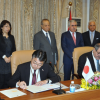
Finance Minister Hoshyar Zebari has signed a memorandum of understanding with the Japanese charge d'affaires in Iraq to finance two development projects using loans from Japan.
The first involves a loan of $450 million (525 billion Iraqi dinars) for reconstruction in the electricity sector, while the second is to finance the reconstruction of the sewerage system in the city of Erbil at a cost of $285 million.
(Source: Ministry of Finance)
Posted in Construction & Engineering In Iraq, Iraq Public Works News Comments Off on Japan to Finance Electricity, Sewerage Projects

Urgent Funding Needed for Health Care Projects
Posted on 31 May 2015 .
If urgently needed funds are not secured by the end of June 2015, more than 84% of health care projects serving populations in need in Iraq will be forced to close.
If this happens, more than 3 million refugees, internally displaced persons and host communities will not have access to the treatment and care that these projects provide.
The World Health Organization (WHO) calls on donors to urgently provide financial support to prevent further avoidable deaths and additional suffering for millions of the most vulnerable people in Iraq.
The closure of these projects means the suspension of critical services, such as trauma care, nutrition supplementation, primary health care, outbreak detection and management, immunization for children and reproductive health care in 10 out of 18 governorates in Iraqi. These governorates are: Missan, Basrah, Sulaymania, Ninwan, Najaf, Kirkuk, Karbala, Erbil, Diala, Dohuk, Baghdad and Anbar.
Deteriorating health situation
The recent escalation of violence in Ramadi has magnified the suffering of civilians, in particular, the sick, older people, children and pregnant women.
Since 15 May 2015, according to the United Nations, an estimated 55 980 people have been displaced and dispersed to over 65 locations inside Anbar, and to different northern, central, and southern parts of the country, bringing the number of people displaced to nearly 190 000. This population is in dire need of urgent humanitarian support, including access to health services.
Posted in Healthcare, Security 5 Comments

Iraq’s Missing Money
Posted on 21 May 2015 .
By Walid Khoudouri for Al-Monitor. Any opinions expressed are those of the author, and do not necessarily reflect the views of Iraq Business News.
Iraq is passing through a dangerous phase. There is a lot of waste and corruption and little transparency in state institutions. The security situation is deteriorating. And lately, there has been negative information about Iraqi officials responsible for the oil revenues during the last years. This has led to the dangerous situation that Iraq is [now] in.
It was shown that during the first week of May, the Iraqi parliament received, all at once, the final accounts of the eight years of the rule of former Prime Minister Nouri al-Maliki for the 2006-13 period to “review and approve them.” This means that the previous years’ accounts had not been reviewed or approved. And parliament is now being asked to approve them all at once after Maliki lost the prime minister post.
The move to approve all the past years’ final accounts is considered an illegal act according to the norms of parliamentary systems and traditions. The main role of the legislative branch is to review and approve the previous year’s accounts, and then approve the new year’s budget submitted to parliament by the government or the executive branch. This is already provided for in the Iraqi constitution.
Earlier this year, parliament member Magda Tamimi declared that she was preparing studies indicating that hundreds of billions of dollars are missing from the state’s annual budgets during Maliki’s reign. Tamimi has access to state financial figures because she has been a member of the parliamentary Finance Committee during the current and previous sessions. She is conducting a study on corruption in state institutions.
State budgets for the years between 2006 and 2013 were submitted, but not the budget for 2014. This is not strange, since the parliament at the time did not agree on the 2014 budget. And there was no budget for that year, which means that it is not possible to calculate and audit the budget of that year.
Posted in Politics, Security 3 Comments

Restrictions on IDPs Worsen Shiite-Sunni Divide
Posted on 13 May 2015 .
By Shelly Kittleson for Al-Monitor. Any opinions expressed are those of the author, and do not necessarily reflect the views of Iraq Business News.
Restrictions on Iraq's displaced people worsen Shiite-Sunni divide
Shiite Turkmen who fled Islamic State (IS, ISIS, ISIL) beheadings in northwestern cities have traveled several hundred kilometers to places of pilgrimage and camps in southern and central Iraq.
Sunni Arabs relatively close to the capital are instead being refused entry to Baghdad and go north, conditions allowing, though many are subsequently barred from the larger cities in the Kurdistan Regional Government (KRG).
In the Laylan camp for internally displaced persons (IDP), just southeast of Kirkuk in one of Iraq’s disputed territories, one Sunni family from Muqdadiyah recounts being shelled by government forces and having relatives "disappeared" by Shiite militias.
Four of the children were killed by Iraqi government airstrikes in the fall of 2014, their father told Al-Monitor, and shrapnel is still embedded in his remaining three sons’ bodies. They have not been able to get past checkpoints to reach health care facilities in Sulaymaniyah and Kirkuk, despite referrals from other facilities.
Al-Monitor was shown pictures of the family’s mutilated flatbed truck, hit while several children were in the vehicle. The family was forced to wait for six hours along the road by continued bombing, and several of the injured died during that time.
One of the girls in the tent with them, a 7-year-old relative named Nour, does not have ID papers. "Her father had them with him when he stayed behind to bury the bodies" of the relatives who had died of wounds from the airstrikes, said one man. "He was later taken by the Shiite militias along the road," he explained, rattling off the names of various groups within the Popular Mobilization Units active in the area.
Posted in Security Comments Off on Restrictions on IDPs Worsen Shiite-Sunni Divide
Medair Provides Health Support in Wana
Posted on 11 May 2015 .
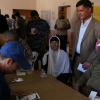
This week, emergency relief organisation Medair is distributing essential health and hygiene items to more than 7,000 people in Wana, northern Iraq.
More than 1,400 families have returned to Wana since it was liberated from militants in February, and people are in urgent need of health and hygiene support.
Many arrived home to find their houses pillaged or destroyed, electricity access severed, and livelihoods wrecked. Medicines and equipment had also been looted and tampered with in the town’s health clinic.
Medair will distribute hygiene kits, including soap, shampoo, and feminine products, as well as run a health screening programme to address the outbreak of scabies in the town. Medair is also supporting the understaffed and under-resourced local clinic by providing health services, seeing approximately 90 patients a day from Wana and the surrounding villages.
“Wana is a tough place to live. Families are returning to looted homes in the best of cases, and homes that are completely destroyed in the worst,” said Chappy Rago, Medair’s Shelter Manager. “On top of this, humanitarian relief can be held back by the risks of going to areas so close to the front lines, which shift with the constantly fluctuating boundaries of the conflict. These are places that are hard to reach with lots of people in need.”
In August 2014, militants swept through Wana, forcing thousands to flee for safety, some of them becoming trapped in nearby Mosul. Now that Wana has been reclaimed, cleared of explosives, and the front lines are holding, families are beginning to return.
A local farmer told Medair he had escaped Mosul and recently returned to Wana after hearing it had been liberated.
“Mosul was occupied by ISIS when we fled Wana last year, but the whole area around us was closed off by fighting, so Mosul was the only place we could get to,” he said. “It felt like we were suffocating there. When we learned that our area had been liberated, we started making plans to come back. When I first returned to Wana, I saw that some of the houses had been blown up. There was death everywhere. Now it’s starting to feel more secure here ̶ liberated.”
(Source: Medair)
Posted in Security 2 Comments