


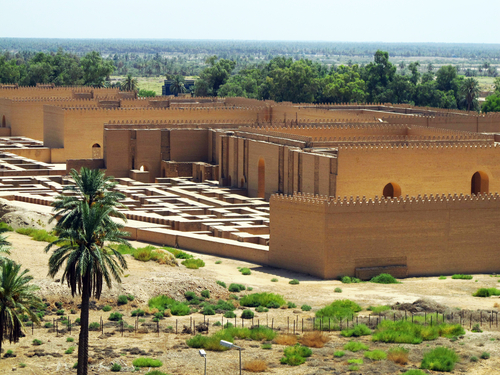
A history teacher from Babil province, Hassan al-Sultani, told Al-Monitor he was “honored to have set foot on the land of this great civilization.” He said, “Some people visit the city to experience this magic and grab a handful of small stones from the city’s soil, believing it will help them accomplish miraculous deeds.” He added, “Historically, the city’s name has always been associated with magic.”
Sultani pointed out, however, “In general, Iraqis pay little attention to the historical monuments from a perspective other than a religious one. Some look at Babil and other pre-Islamic historical cities as if they belong to a 'shirk' [polytheistic] civilization and thus should not be revered.” He said, “I heard a cleric say this.”
Journalist and writer Tariq Hussain told Al-Monitor, “Some Iraqis believe that the city of Babil has been deformed by an earthquake that turned it upside down. They also believe that God punished the city for corruption that had spread in 539 BC [Revelation 16:19], which led some [religious] scholars to forbid praying on its land.” On the other hand, Hussain noted, as had the history teacher, “Some people visit the city because they believe there is magic in its stones.”
Poet and writer Riad al-Gharib lives near the historic city walls. Speaking of the place he knows and loves, he said, “Babil’s intellectuals are interested in working to restore the city's glory through reviving tourism after Saddam's regime ruined its authentic landmarks with its renovation, which was not up to international standards and led to removing it from UNESCO’s World Heritage List.”
Gharib stated, “Saddam built three high-rise palaces in Babil and engraved his name on their bricks as well as on the bricks used in reconstruction works in the ancient city, to make his name immortal.”
Comments are closed.