



Weekly Security Update 01 - 07 Apr 2014
Posted on 08 April 2014 .
By Constellis Consulting www.constellis-consulting.com
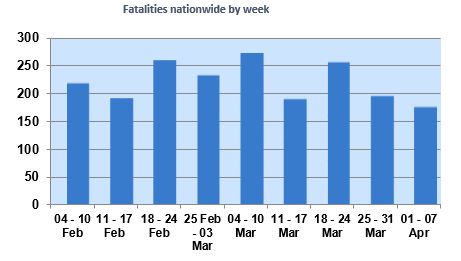
 Despite reasserting his retirement from politics on 02 April, Muqtada al-Sadr publicly urged Maliki not to run for a third term, citing the failure of his sectarian policies and the increasingly autocratic nature of the regime. As the parliamentary elections approach, each party seems to be appealing to their own sectarian base, with the government capitalising on the relatively more peaceful situation in Shia-dominated southern provinces. On 06 April, Osama al-Nujaifi, Parliament Speaker and leader of the Sunni Mutahidoun bloc, accused Maliki of seeking to marginalise and exclude Sunnis from the elections, notably by using Shia militias to displace Sunni populations in the north. While it has become increasingly clear that current Prime Minister Nouri al-Maliki will compete for another term, high levels of violence in central and northern governorates and heightened sectarian tensions have led Maliki to frame the unrest solely as a security issue, ignoring the political dimension of the insurgency. This has been reflected in a number of populist actions over the reporting period, with several arrests on terrorism charges legalised under Article 4 of the constitution. While Maliki’s rivals have been accusing the ruling coalition of ignoring Sunni grievances, which range from lack of political representation to rampant corruption and unemployment, increased tensions continued to be reflected in high levels of violence across Iraq.
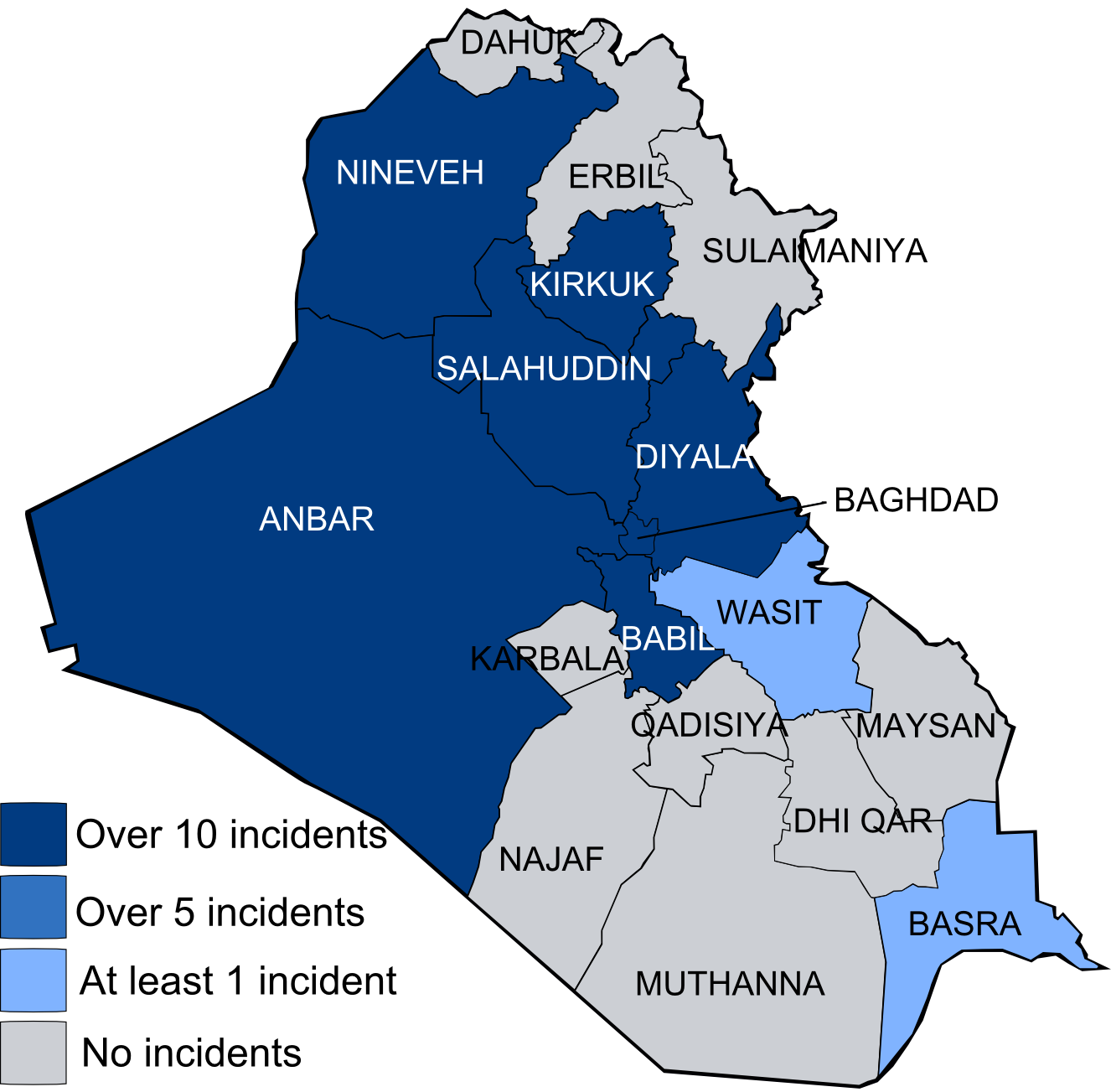
The Anbar unrest has now spread to several fronts surrounding Baghdad, with accounts of ISIS militants positioning themselves in neighbourhoods of Baquba, Diyala province, and areas of Salahuddin. While these movements prove the capabilities of ISIS, they also mirror the growing disaffection of Sunni populations, which has allowed insurgents to establish strongholds in cities and challenge the state in several areas. Militants have been able to maintain control over Fallujah, where tribes are particularly resentful of government policies, and hold key neighbourhoods of Ramadi. As predicted and in line with current patterns of violence, complex militant incursions returned to Babil, with car bombs recorded across several districts of the province. Amid political stagnation in the approach of the elections, incident levels are expected to continue increasing in central and northern governorates over the coming weeks, as insurgents seek to disrupt the electoral campaign and influence the voting.
North
Levels of violence witnessed across northern provinces remained consistent with previous weekly averages, with an increase in the number of VBIEDs and complex attacks. Most incidents continued to be concentrated in Nineveh and Salahuddin, while violence recorded in Diyala and Kirkuk mainly consisted of IEDs against ISF elements. Five car bombs detonated in Tikrit, Salahuddin, causing scores of casualties within the civilian population. On 03 April, a VBIED parked near a restaurant killed three civilians and injured 13 others in the district of Suleiman Bek, which has witnessed a considerable uptick in violence over the past weeks. Four car bombs detonated in areas surrounding Mosul. On 02 April, a complex assault involving a militant wearing a suicide vest and a VBIED detonated in the Muthana area of Mosul, causing several injuries. While Kurdish provinces remained free from major incidents, tensions have been gradually increasing between Erbil and Baghdad, over controversial oil exports with Turkey and the continued delay of the 2014 budget bill which is blocked in parliament. In this context of heightened tensions between the government and its different constituencies, levels of violence are expected to continue increasing in the lead-up to the elections.
Central
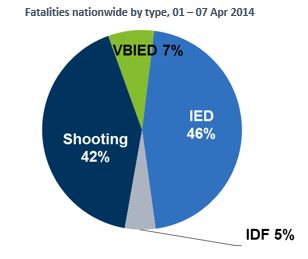 Although the number of car bombs recorded in Baghdad remained below average, the capital continued to attract most deadly incidents, with levels of violence noticeably increasing. On 01 April, a VBIED detonated in Mushada district, killing a civilian and injuring scores of others. On 03 April, three civilians were injured when a car bomb exploded in the district of Mahmoudiya. The continued focus of ISIS militants on Baghdad reinforces expectations that violence levels will rise in the lead-up to the polls, especially as political leaders increasingly appeal to their respective sectarian base. Meanwhile, the situation in Anbar remained unchanged, with militants holding key areas of Ramadi and reinforcing their positions inside Fallujah, where local tribes tend to be more sympathetic to ISIS. Insurgents have reportedly been able to launch assaults against the Iraqi army surrounding the city, bringing the unrest closer to Baghdad. Three VBIEDs were recorded in eastern districts of Ramadi, though the lack of media reporting overshadows the magnitude of the conflict. While it has become increasingly certain that elections will be delayed in Anbar, the majority of militant resources are expected to remain directed against targets in Baghdad in the lead-up to the polls.
South
Babil continued to witness most of the violence across the south. On 03 April, three VBIEDs detonated in sequence in several areas of the restive province. In the most significant incident, a car bomb hit a crowded street of Hay Shuhada Thaniyah district, killing two civilians and injuring at least six others. Another VBIED detonated in eastern Wasit, killing a civilian and wounding three others. Though ISIS insurgents have moved closer to Baghdad, fuelling militant activity south of the capital, south-eastern provinces have remained insulated from major attacks. With elections looming and PM Maliki focusing his strategy on the Shia electorate, militant penetration in the south cannot be ruled out in the lead-up to the elections, as insurgents will most probably seek to influence the voting.
Posted in Weekly Security Update Comments Off on Weekly Security Update 01 - 07 Apr 2014

IBN - Home of Iraq's Best Bloggers!
Posted on 06 March 2014 .
We are proud to announce that in our newsletter this week the top four articles are all from our dedicated panel of bloggers:
- Our Expert Blogger Mark DeWeaver has written two very insightful artices on the Iraqi banking system;
- Expert Blogger Madeleine White has written on new initiatives to educate Iraqi youth; and,
- Guest blogger Layth Mahdi has written on the failure of politicians to address the issues of poverty and unemployment.
On our Expert Blogger section (to the right of the home page) you can also find recent contributions from Robert Tollast, Ahmed Mousa Jiyad, Michael Carr, and John Schnittker.
As always, you can count on Iraq Business News to give you the inside track!
(Flag image via Shutterstock)
Posted in Blog 5 Comments
Poverty and Unemployment Not Being Addressed
Posted on 05 March 2014 .
By Layth Mahdi, Agricultural Advisor. The opinions expressed are those of the author, and do not necessarily reflect the views of Iraq Business News.
Poverty and Unemployment Not Being Addressed in the Coming Iraqi Elections
Iraq's poverty and unemployment is increasing every year despite the Government's efforts to implement programs to lower it. The United Nations and other International Organizations have published that more than 23% of Iraq's population lives below the poverty line.
While 23% is the official figure, the real number exceeds 35% (12 million). The Iraqi people have endured a lot of hardship and suffering during the last four decades of war, in addition to crippling sanctions. The devastating living conditions have resulted in the brain drain of the intellectual workforce.
The remaining officials in charge of the redevelopment programs lack vital experience, such as project management, needed to rebuild the country back to its glory. It is essential that foreign agencies enter Iraq in order to educate these officials towards good governance, which will address the main barrier to success: poverty and unemployment.
The Ministry of Planning (MoP) has implemented several programs aimed to decrease poverty in Iraq. In 2010, it started a five year program (2010-14) in hopes to bring the poverty level down to 10%. However; the MoP has admitted that its plans have failed to achieve their objectives. During my consultancy years with Provincial Reconstruction Teams (PRTs) we worked to assist provincial and local governments to govern effectively and deliver essential services, as part of the plan for a "New Way Forward" in Iraq.
This new plan introduced a unique Provincial Development Strategy (PDS) for each province from 2007-2011. Unfortunately, these strategies were never implemented by any Provincial Council or Governor due to a lack of trust and understanding of the PDS.
Posted in Agriculture, Blog, Employment, Politics 1 Comment

Massive Potential from Trade and Investment
Posted on 24 February 2014 .
By Michael Carr, Anglo Arab Insurance Brokers (AAIB).
Iraq’s Massive Potential – The Promise from Trade and Investment
The newly appointed Baroness Nicholson as the United Kingdoms Trade Envoy to Iraq underscores the view felt by some senior business interests, that “Iraq has massive potential … the future is very good indeed (and) it’s a tough struggle to get there, but that’s no reason not to be in there to help.”
This, from a seasoned UK politician who has wide experience of foreign affairs; economic development in the Middle East, aspects of European union policy and who is the Executive Chairman of the Iraq Britain Business Council. She will have been well briefed before taking up her new appointment and can draw upon her knowledge and understanding of the country.
So, what underpins her outlook? Is her optimism justified? No doubt, the country’s strengthening economic position played a factor – Iraq has seen its Gross Domestic Product double since 2003 and the World Bank recorded growth rates of 8% in the past two years. A robust picture on trade and investment flows exists. Further investments and expansion of trade will further drive economic improvements and fuel Iraq’s vibrant economy.
However these can be in tandem with internal structural changes and liberalisation of economic policy and a reduction in the power of state owned enterprises. With the official unemployment rate standing at 17% and with persistent complaints from the business community about corruption and too much bureaucracy and red tape, more needs to be done to reduce these barriers to trade and investment.
Also, as the growth of commerce and trade is inseparable from issues of security and business confidence, and reflects the situation of political stability, these are the areas that must receive continued attention. They are all interlinked and interdependent.
Iraq has achieved impressive economic progress over the last few years, despite the difficulties and setbacks that have happened, and the pressures that its institutions and its people have faced. As Baroness Nicholson has said, “Iraq has massive potential”, but the road to reaching that potential will be a long and difficult one. It’s a road worth taking.
Michael Carr is a consultant specialising in development, risk and insurance in Emerging Markets. He has worked in various conflict and post conflict territories and has written on these subjects for various publications. Any opinions expressed are those of the author, and do not necessarily reflect the views of AAIB or Iraq Business News.
Posted in Blog, Iraq Banking & Finance News, Iraq Industry & Trade News, Michael Carr 6 Comments
Poverty Rates on the Rise
Posted on 12 February 2014 .
By Amal Sakr for Al-Monitor. Any opinions expressed are those of the author, and do not necessarily reflect the views of Iraq Business News.
Iraq has been struggling with an increase in poverty rates for many years. While the Iraqi Ministry of Planning notes that the rate of poverty has recently decreased, reaching 11%, statistics released by the World Bank show that 28% of Iraqi families live below the poverty line.
In the event that the country may face any kind of crisis, this rate could increase by 70%. This is currently happening because of the spike in violent acts and tense political situation.
The head of the Model Iraqi Women Organization, Athraa Hassani, provided Al-Monitor with this information, quoting World Bank officials who discussed these statistics during a meeting in Turkey with a number of members of civil society organizations seeking to find a solution to the poverty crisis in Iraq.
Hassani questions the accuracy of the poverty rates announced by the Iraqi government, affirming that these rates are continuously increasing because of a rise in daily violence and spike in unemployment rates in addition to a weakening of the Iraqi economy.
Based on the World Bank’s figures, this would mean that out of Iraq’s 34.7 million citizens, more than 9.5 million individuals are living below the poverty line.
Governor of Baghdad Ali al-Tamimi told Al-Monitor that the Iraqi government is not able to provide genuine solutions to deal with the poverty crisis in the country. Its role is limited to doling out a monthly salary for the poor, ranging between $40 and $100 depending on the number of family members.
This amount is disbursed every three months; however, it does not even meet the daily needs of families. Tamimi affirmed that poverty rates are very high, and that whoever says otherwise knows nothing about the situation of Iraqi society. Tamimi, like Hassani, objects to the attempt of some governmental sources to deceive the public regarding poverty rates in Iraq and the resulting risks.
Posted in Iraq Industry & Trade News, Politics 3 Comments

Iraq Fails to Attract Domestic Capital
Posted on 31 December 2013 .
By Ayser Jabbar for Al-Monitor. Any opinions expressed are those of the author, and do not necessarily reflect the views of Iraq Business News.
Iraq is not attracting domestic capital belonging to its citizens. Inadequate economic and investment policies in addition to widespread corruption have contributed to a new migration of Iraqi capital. This time, capital is going to Georgia, which provides much assistance for those who want to invest in the country.
The head of the Federation of Iraqi Chambers of Commerce, Jaafar al-Hamdani, a businessman and investor, told Al-Monitor that Iraqi capital — valued at billions of dollars — has began moving toward other countries such as states of the [former] Soviet Union, including Georgia, which is now attracting a lot of capital from Iraq.
This shift of capital, according to Hamdani, can be attributed to investment and banking facilities that owners of Iraqi capital find in Georgia; such facilities are not available in Iraq.
For its part, the government admits that the capital found inside Iraq is "weak" compared to the capital that has left the country, in light of the security situation, the decline in the labor market and decreased investment opportunities.
In a telephone conversation with Al-Monitor, Abdul Hussein al-Anbaki, adviser to the prime minister for economic affairs, explained, "The migration of Iraqi capital did not start after US troops entered the country in 2003. Rather, it began in the 1980s, when the former regime split profits with the private sector."
Anbaki pointed out, "The migration of Iraqi capital that occurred after 2003 was due to the deteriorating security situation in the country and the lack of employment opportunities as well as the absence of a legislative or physical environment, or even infrastructure."
Posted in Investment 2 Comments

Border Smuggling Rises In Iranian Kurdistan
Posted on 09 November 2013 .
By Fazel Hawramy for Al-Monitor. Any opinions expressed are those of the author, and do not necessarily reflect the views of Iraq Business News.
Mohammad Karimi was driving his car between two towns in the mountainous region of western Iran on an evening in early October. The vehicle was laden with satellite dishes, illegal under Iranian law, while his wife and two young children awaited his return.
As he drove in that fateful night, a single bullet pierced his windscreen and struck him in the head. He died instantly.
Mohammad was the latest kulbar — border couriers who carry untaxed goods coming from Iraq or Turkey for a small fee — to be killed by Iranian border police. The police have killed close to 100 of these petty smugglers over the last two years, treating them like dangerous criminals.
While the official unemployment rate among the youth in Iran is 26%, the figure in the Kurdish areas in the west and northwest of the country is much higher, forcing people like Mohammad to resort to the perilous profession of smuggling goods across international borders.
"Unemployment in the province has become a serious dilemma," Salar Muradi, a parliament member from Kurdistan province, stated in the Iranian parliament several months ago.
In his recent report to the UN General Assembly, UN Special Rapporteur on Iran Ahmed Shaheed highlighted the "indiscriminate killings of kulbaran in violation of the domestic laws and international obligations of Iran."
Mohammad's mother, Hajya Malek Khedryan, speaking to Al-Monitor via telephone from Iran, said that her son was only trying to make a living for his young family. She said, "There were no warning shots; they just fired at his car and a bullet hit him in the head and killed him instantly."
Posted in Iraq Industry & Trade News, Security Comments Off on Border Smuggling Rises In Iranian Kurdistan
New UK Boost for Arab Businesses
Posted on 30 October 2013 .
Businesses across the Middle East and North Africa will get a £4.5 million boost from the UK, Prime Minister David Cameron announced at the World Islamic Economic Forum on Tuesday.
The UK’s funding to the Nomou business fund will be matched by the Shell Foundation to support ‘missing middle’ businesses - those too large for microfinance but too small for traditional bank loans.
The fund will provide business support to more than 600 medium sized businesses and create more than 15,000 jobs, focusing on Jordan and Egypt where unemployment remains a huge problem.
Thousands of women across the Middle East and North Africa will also get help in growing their businesses and finding employment under a separate joint initiative from the UK and the Islamic Development Bank.
The UK will provide £6 million in new funding on top of an existing £4 million commitment to the Arab Women’s Enterprise Fund, which will be matched by the Islamic Development Bank.
Minister of State for International Development Alan Duncan said:
"Jobs and growth are critical to the stability of the Middle East and North Africa. We are pleased to be working with the Shell Foundation to create thousands of jobs that will contribute towards the stable economic environment needed for growth and prosperity in the region.
"Women are the engine of growth and it is not possible for a country to develop without investing in women. We are delighted to be working with the Islamic Development Bank to design and implement exciting projects that will strengthen women’s economic contribution to the Middle East and North Africa."
The new support for the Arab Women’s Enterprise Fund is aimed at improving the competitiveness of women entrepreneurs in the Arab world, which currently has the lowest rates of female participation in the global labour force.
The initiative focuses on poor and vulnerable women in Jordan, Egypt and Libya, where current crises are particularly affecting their incomes. It will also aim to reach women and girls in difficult to access rural areas right across the region.
(Source: UK FCO)
Posted in 'Your Country' - United Kingdom, Iraq Banking & Finance News, Iraq Industry & Trade News 14 Comments

Economists Divided Over Deletion Of Zeros
Posted on 03 October 2013 .
By Amina al-Dahabi for Al-Monitor. Any opinions expressed are those of the author, and do not necessarily reflect the views of Iraq Business News.
The Central Bank of Iraq (CBI) has been attempting to delete three zeros from the Iraqi currency since 2003. This project has raised many concerns among the Iraqi public and within the business community, and Iraqi economists are divided. While some support the project and consider it a chance to decrease inflation and unemployment, others warn of economic shocks that may prevail over the Iraqi market as a result of the project’s implementation.
Following amendments made by the CBI, implementation of the project has been postponed several times. This is because of fears that are mostly related to the lack of security, the presence of a market open to foreign commodities without any restrictions, the prevalence of counterfeit money in the market and rampant corruption in the country.
The independent Iraqi News Agency (INA) quoted Abdul Hussein al-Yasiri, a member of the Iraqi parliamentary Finance Committee, as saying that 2014 will witness the deletion of zeros from the Iraqi currency. He noted that the deletion will occur in coordination with the CBI, and that as a result of the project, the number of banknotes in circulation will be reduced from 4 billion to 1 billion.
Haider al-Abadi, the head of the Iraqi parliamentary Finance Committee, told Al-Monitor that while deleting zeros from the current currency is possible, this has been postponed until after parliamentary elections. He noted that studies are being carried out to ensure that, following the currency change, counterfeiting is limited and that Iraqis don’t go back to trading in the old currency.
The step to delete zeros from the currency has been postponed several times, leading the parliamentary Economic Committee to demand that the CBI accelerate this project, as Al-Sharqiya reported. In a news conference held July 6, the Economic Committee confirmed that the deletion of zeros will lead to an increase in the value of the Iraqi dinar and will have positive repercussions, including a reduction in unemployment and poverty rates in the country.
Posted in Iraq Banking & Finance News 131 Comments
Driving Risk, Reaping Rewards: G8 Investment Conference
Posted on 18 September 2013 .
By Madeleine White, capacity building and communications specialist.
Driving Risk, Reaping Rewards: Perspectives from the G8 Deauville Partnership Investment Conference
It’s nearly a year since I wrote my first blog. Having spent time at the World Bank in Washington and linking that to the great experiences I had had when I visited Kurdistan I felt compelled to write about what I referred to as Infinite Possibility and Immediate Need. It’s funny how in life a personal journey often mirrors a corporate one.
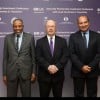
As such this blog will be focussing on some key points discussed in Monday’s G8 Deauville partnership investment conference for Arab countries in Transition however, bringing a bit more of a personal perspective by linking my own ‘micro’ risk and reward story - to Sir Suma Chakrabati’s ‘macro’ perspective of “ how to translate desire for change into a practical solution” .
The core premise is this. Depending on who you listen to between 46 and 70 million jobs need to be created across the MENA region between now and 2020 (that translates into about 5 million in Iraq). At the start of 2010 Iraq had the highest rates of youth unemployment in the Middle East, thanks to intervention from a number of sources, it is now hovering at around 23%.
In order to reduce this figure, economic growth needs to be at around 6% . In order to make that happen, Iraq needs further significant inward investment with large scale capital corporate investors needing a sense security - social, political and economic.
However, in order to create a sufficiently ‘welcoming’ sense of security, macroeconomic stability is required. Now, this is the nub of it (and was discussed in detail on Monday) – this kind of stability requires a stable political landscape, a thriving internal private sector and a people that are sufficiently engaged in the political and economic process. If this is the case, policy makers agreed that policies implemented would unite a population in a way that would drive economic empowerment on an individual as well as a national level.
A stable frame-work and an empowered people, linked to a strong civil society would allow individuals, MSME’s and communities to take risks. 'How to create a frame-work that is able to successfully harmonise national environments and global perspectives', was a theme some of the world’s leading economists returned to again and again.
Posted in Iraq Education and Training News, Madeleine White 6 Comments