


Splitting Iraq: How Likely is an Independent Kurdistan?
Posted on 13 July 2012 .
By Shwan Zulal.
This article was originally published by Niqash. Any opinions expressed are those of the author, and do not necessarily reflect the views of Iraq Business News.
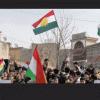
The disputes between Baghdad and Iraqi Kurdistan have led some local politicians to call for the semi-autonomous region to secede from Iraq and become its own country. But, as one Kurdish commentator argues, this is far from realistic. Because now it’s all about money and oil, not politics.
Recently there has been a lot of comment about an independent Iraqi Kurdistan. As tensions between Baghdad and the semi-autonomous, northern state of Iraqi Kurdistan continue, the Kurdish have been playing the “independence card”, with local politicians and commentators airing their views on the subject like never before.
It is no secret that the majority of Kurds, if not in fact, all of them, would love to see an independent Kurdistan. And the easiest way for a Kurdish politician to become popular is to call for an independent state.
Although the Kurdish president, Massoud Barzani, has recently given the impression that he wants to see an independent Iraqi Kurdistan, the political party to which he belongs, the Kurdish Democratic Party (KDP), and the other major political party in the area, the Patriotic Union of Kurdistan (PUK), have so far resisted similar temptations. In fact, most Kurdish politicians are still talking about a “united Iraq” despite Kurdish public opinion against this idea.
And they have a point. If you are a Kurdish politician and you need to maintain diplomatic relations with your neighbours, and if you’re aware of the economic and political realities for Iraqi Kurdistan, then it’s very hard to call for Kurdish independence and really mean it.
Posted in Politics, Security Comments Off on Splitting Iraq: How Likely is an Independent Kurdistan?
Arab-Kurdish Rapprochement in Northern Iraqi Region
Posted on 08 June 2012 .
This article was written by Ahmed Younis, Khalid Waleed and Mustafa Mohammed, and was originally published by the Institute for War and Peace Reporting, iwpr.net. It is reproduced by Iraq Business News with permission. Any opinions expressed are those of the author, and do not necessarily reflect the views of Iraq Business News.
Residents of Iraq’s volatile Nineveh province say they are cautiously optimistic that their lives will get better because Sunni Arab and Kurdish politicians have decided to work with rather than against one another.
After Iraqi president Saddam Hussein was ousted in 2003, this northern province became one of the most dangerous places in the country, despite American, Iraqi and Kurdish efforts to crush the Sunni insurgents and al-Qaeda militants who made Nineveh their base.
Security is still a serious issue, along with poor public services and high unemployment, and residents blame many of the problems on continued animosity between local Sunni Arab and Kurdish leaders.
The Arabs have accused Kurdish leaders and their “peshmerga” troops of abuses and discrimination against non-Kurds. They have also accused the Kurdish authorities of seeking to incorporate Nineveh into the Kurdistan Region to the north.
Kurdish politicians argue that it is their community that has been persecuted, and that Sunni Arab insurgents have killed several thousand of them in the provincial capital Mosul in recent years.
Posted in Politics Comments Off on Arab-Kurdish Rapprochement in Northern Iraqi Region
Iraqi Unemployment Falls to 16%
Posted on 06 June 2012 .
Iraq's Minister for Planning and Development Cooperation, Ali Yusuf Al Shukri, has announced unemployment in Iraq of about 16%, with a poverty rate of about 11%, according to Alsumaria TV.
“Poverty and unemployment rates are decreasing in Iraq after Iraqi GDP improved and investment in constructions and services projects increased,” Shukri told the news agency, stressing that unemployment decrease resulted from creating new job opportunities.
He said the Planning Ministry is also preparing a database of companies that are falling behind in existing service and construction projects, and these companies and their directors will be barred from future projects.
(Source: Alsumaria TV)
Posted in Construction & Engineering In Iraq 1 Comment
USAID Initiative Boosts Youth Employment
Posted on 01 June 2012 .
USAID-supported job training, apprenticeships and microfinance loans help unemployed Iraqi youth secure meaningful work.
CHALLENGE. At the start of 2010 Iraq had the highest rates of unemployment in the Middle East. Thirty percent of its adults lacked jobs. More than half of the country's young urban males were unemployed. At 19 percent, female participation in the workforce was even lower, according to World Bank estimates at the time. Restless youths desperate for something to do often joined terrorist militias, perpetuating the cycle of violence.
INITIATIVE. With funding from the U.S. Ambassador’s Targeted Development Program, the USAID-Tijara Provincial Economic Growth Program designed the Iraqi Youth Initiative. The goal was to create 2,500 full-time jobs for Iraqis between the ages of 18 to 35. Selected youths received training at one of 11 Small Business Development Centers around the country. Those wanting to start their own business were referred to the Youth Entrepreneurship Access to Finance Program (YEAF). There aspiring entrepreneurs received help writing a business plan and were introduced to microfinance institutions working with USAID-Tijara that could provide startup financing.
Young people with no interest in running a business were sent to the Youth Employment Promotion (YEP) program where training consisted of language and computer skills plus information on resume writing and office etiquette. USAID-Tijara located Iraqi companies willing to provide apprenticeships to worthy young Iraqis and then matched prospective employees with appropriate employers.
RESULTS. Since the start of the Iraqi Youth Initiative (IYI) two years ago, 3,256 youth have been trained to be independent entrepreneurs under the YEAF program. Some 1,165, 13% of them women, have started businesses with microfinancing worth $4,049,000.
Of the 1,455 people trained by YEP, 800 received apprenticeships with Iraqi companies. Thirty-four percent were women. More than 845 Iraqi companies have pledged an additional 2,861 apprenticeships that could evolve into permanent jobs.
Thanks in part to IYI and other USAID development efforts, Iraq’s unemployment now hovers slightly above 15% and the United Nations estimates youth unemployment has fallen to 23%.
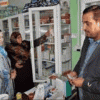
About the Photo: Rana Mohammed Ali, 29, is one of 15 young Iraqis who found jobs at five Tikrit pharmacies thanks to Wedad Abdul-Halim, 55, a licensed pharmacist active in Salah ad Din’s medical services community. A corporate supporter of USAID’s Iraqi Youth Initiative, Wedad also placed 13 IYI graduates in local medical diagnostic clinics as laboratory assistants. Fifteen of the 28 now have permanent jobs paying higher salaries.
Active in the volunteer community, Wedad approached a local orphanage she supports and convinced it to employ two young people as care givers. They, too, now have lasting employment.
(Source: USAID)
Posted in Employment Comments Off on USAID Initiative Boosts Youth Employment
Swedish Transport Academy Inaugurated in Erbil
Posted on 20 April 2012 .
The Swedish Transport Academy, officially inaugurated this week in Erbil, will help Iraq’s unemployed and young people acquire the new industrial skills critical for the reconstruction and recovery of the country`s economy.
The Academy, which will supply much-needed skilled mechanics to the Iraqi sectors of logistics, manufacturing, and industrial maintenance of heavy machinery such as trucks, engines and agricultural equipment, was established by the United Nations Industrial Development Organization (UNIDO) and Scania, a leading manufacturer of trucks, buses and engines.
The project is the fruit of an ongoing Swedish public-private partnership agreement to help young Iraqis develop new skills and find jobs. Training is offered not only in maintaining and operating equipment such as modern fleets of trucks, but also in languages, IT and business management.
Unemployment remains a serious problem in Iraq, especially for young people, while the lack of skilled Iraqi labour is stalling the development of industry and the economy as a whole.
“This academy is a first of its kind in Iraq and the region,” said Asoos Nabeel Abdulla, the Minister of Labour and Social Affairs in the Kurdistan Regional Government. “This public-private partnership will serve the needs of hundreds of youth by providing them with the necessary skills to help themselves and the country.”
Chakib Jenane, Chief of UNIDO’s Agro-Industries Technology Unit, added that UNIDO was proud of delivering this new vocational training facility. “This would not be possible without significant inputs from our partners at the Ministry of Labour and Social Affairs, and the Swedish International Development Cooperation Agency (SIDA), and the expert input of Scania. I would like to thank the government of Sweden for its generous contribution to this project,” he said.
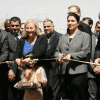
The inauguration of the Academy was also attended by Sweden’s Minister of Trade, Ewa Björling, the Govenor of Erbil, Nawzad Hadi, and the Minister of Trade and Industry, Sinan Chalabi.
The first round of training started on 2 April, with some 160 students attending the three-month mechanical training courses. The Academy is aiming for a target of nearly 400 graduates each year.
The project is funded by SIDA, the Ministry of Labour and Social Affairs, and Scania
Posted in Iraq Education and Training News, Iraq Industry & Trade News Comments Off on Swedish Transport Academy Inaugurated in Erbil

Kurdistan to Double Trade Volume with Sweden
Posted on 18 April 2012 .
Trade between the Kurdistan Region of Iraq and Sweden hit $154 million last year and the Swedish authorities are planning to double that figure by 2015, reports AKnews.
Swedish Minister of Trade, Eva Bjorling (pictured), opened the Swedish Embassy’s trade office in Erbil, and an institute to help Iraqis address unemployment, on Tuesday.
Fathi Mohammed, an adviser to the KRG Ministry of Trade and Industry, said that trade between Kurdistan and Sweden has totalled $1 billion since 2005, particular after the Swedish truck maker Scania entered the country in May 2010.
Scania has recorded sales of over US$150 million since it entered Iraq, and it strengthened its position in 2011 when it entered into a cooperation agreement with Iraq’s Ministry of Industry and Minerals to deliver 4,000 vehicles over five years, together with its Iraqi partner Qanadeel al Rafidain.
Currently, there are 56 Swedish companies registered in the region, operating in the auto industry, health, trade and industry.
(Source: AKnews)
Posted in Iraq Industry & Trade News Comments Off on Kurdistan to Double Trade Volume with Sweden
The Resource Curse: Will Ordinary Iraqis Ever See Their Oil Money?
Posted on 18 April 2012 .
Iraq is on the way to becoming one of the biggest oil exporters in the world. As a nation it earns billions. But many ordinary Iraqis live in poverty. Now calls for a direct cash payout to each citizen are getting louder, according to this article from NIQASH.
Any opinions expressed are those of the author, and do not necessarily reflect the views of Iraq Business News.
Iraq's oil production facilities are recovering after years of violence and unrest. The state has grand plans for increasing oil exports and the nation should, by all rights, be a wealthy one. But as Baghdad student Istabraq Ghazi strolls the streets, she says she sees absolutely no evidence of that wealth.
“You just need to look at how many beggars there are at traffic lights and junctions to work out what the economic situation is in Iraq,” she says.
For Ghazi, it is clear that the average household income of Iraqis was not sufficient to cover costs. It also seemed clear to her that the government hadn’t spent Iraq’s oil income in a way that served its citizens best. In fact recent statistics from both the United Nations and the Iraqi government itself indicate that anywhere between a quarter and one third of Iraqis live in poverty.
Meanwhile the government has ambitious plans to boost Iraq's oil output to 12 million barrels per day by 2017 and although this forecast is considered overly optimistic, there’s no doubt that if things go according to plan, Iraq is well on the way to becoming one of the world’s biggest oil exporters.
So perhaps it’s hardly surprising that calls advocating giving the country’s oil wealth directly to its people are growing louder.
Proponents of what is known as a direct oil dividend argue that direct cash transfers would very quickly eradicate the most severe poverty and would increase loyalty to the state in a country divided – often violently - between various communities, sects and ethnicities.
Posted in Iraq Oil & Gas News Comments Off on The Resource Curse: Will Ordinary Iraqis Ever See Their Oil Money?

Sweden to Open Trade Offices in Kurdistan
Posted on 17 April 2012 .
AKnews reports that Sweden is planning to open trade offices in Erbil, as well as an institute to help Iraqis address unemployment, in an attempt to broaden trade relations with both the region and Iraq.
The announcement came in a press conference for the Swedish Trade Minister Eva Björling who is in Erbil on a visit.
"We'll cooperate with the Kurdistan Region in order for the region to enhance its infrastructure and to develop bilateral trade and economic relations," said the minister.
(Source: AKnews)
Posted in Iraq Industry & Trade News Comments Off on Sweden to Open Trade Offices in Kurdistan
KRG Prime Minister Barzani's Inaugural Speech
Posted on 13 April 2012 .
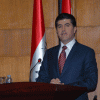
Inaugural speech by KRG Prime Minister Nechirvan Barzani, at the swearing in of the seventh KRG cabinet, Kurdistan Parliament, Erbil, 5 April 2012.
Your Excellency the Speaker of the Kurdistan parliament, your Excellency Vice President of the Kurdistan Region, Excellencies Members of the Kurdistan Parliament, dear audience,
We are glad that we are present today in front of the Kurdistan Parliament to announce the formation of the seventh cabinet of the Kurdistan Regional Government.
The people of Kurdistan are the source of legitimacy of the KRG
It is a huge responsibility that has been entrusted to us, and with my dear colleague Mr Imad Ahmad and all my colleagues in the seventh cabinet, we will work hard to meet this challenge.
The people of Kurdistan are the source of legitimacy for the Kurdistan Regional Government (KRG), and today we are honoured to receive their endorsement through their representatives in the Kurdistan Parliament.
In spite of its remaining shortcomings, the Kurdistan Region has witnessed tremendous political, economic and social development. However, we will continue our efforts to fulfill our duty and the promises that have been made to our people.
We thank our dear friends Dr Barham Salih the Prime Minister of the Sixth KRG Cabinet, his Deputy Mr Azad Barwari and the members of their cabinet for the important work that they accomplished in the time that they had. Their efforts are appreciated both by us and by the people of Kurdistan.
We would also like to faithfully remember and appreciate the sacrifices of all the martyrs of the Kurdistan liberation and freedom movement. We promise to continue the struggle for the development and the prosperity of our people in their memory, for we wouldn't be here today if it hadn’t been for their struggle and sacrifices.
A strong will
Today, we have come here to the parliament of Kurdistan with a strong will. While we will continue the work of the fifth and sixth cabinets, we will also partner with the Kurdistan parliament to implement a new program, with strategies and initiatives that will take into consideration the political, economic and social changes that have taken place in recent years.
Recently, some countries of the Middle East and North Africa have a begun to see the emergence of democracy and justice. The Kurdistan Region welcomes these changes, and supports any change that is in the direction of democracy, freedom and human rights. By contrast, the Kurdish Spring began twenty years ago when the people of Kurdistan rose up, with the support of the Kurdistan political parties, and managed to end the authority of one of the most dangerous dictators of that time in our land, choosing to install the rule of law, democracy and freedom without the support of foreign countries.
Posted in Politics Comments Off on KRG Prime Minister Barzani's Inaugural Speech
Agriculture: Iraq’s Best Chance for Decreasing Poverty, Hunger and Unemployment
Posted on 11 April 2012 .
By Layth Mahdi, Agricultural Advisor. The opinions expressed are those of the author, and do not necessarily reflect the views of Iraq Business News.
Iraqi people are like a camel eating grass and carrying gold! Despite the huge oil budget (more than $100 billion/year), poverty and unemployment are the major issues facing the Government of Iraq (GoI).
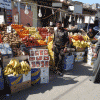
The growth of the agriculture GDP declined sharply from 7.5% to less than 1% since 2003. The price of food is rising and people cannot afford to buy food especially those who suffer from low income in remote and rural areas. Over 90% of the vegetable and fruits are imported.
The reasons behind this are:
- after 2003 Iraq suddenly shifted to a free market without any government plan and support;
- the agriculture production depend on four ministries (Ministry of Agriculture, Ministry of Industry, Ministry of Water & Resources and Ministry of Trade) in addition to the Agricultural Initiative by the PM Al Maliki (failed program). Those five institutions required leadership and vision; however, the top decision makers lacked experience, planning, and management strategies.
Recently, I met and contacted a few senior advisors close to the PM Al Maliki and Members of Parliament. I found that the advisors lacked concern about food security, poverty and unemployment in the country. Creating a fund to restore agriculture production and fighting poverty and unemployment is not on their agenda.
The PM should act urgently to create jobs and stop growing poverty and unemployment. He needs fresh faces and ideas to improve the economy. He must create agricultural working groups, as the agricultural sector absorbs a large unemployed. Agriculture has the potential of providing over one million jobs opportunity. This will attract enormous local & international investments in agribusiness sectors across Iraq (read my articles in Iraq business news).
GoI suggested a budget of 105 billion dollar for this year. Tensions and hunger are rising and within a few years we may see hunger driven revolution upcoming in the south of Iraq that will have a negative impact on GoI. Any increase in monthly oil production MUST consider those who live in poor conditions. About 9 million people currently live under the poverty line ($2 per day). If the current situation continues without socioeconomic development, poverty will rise by 30% by the end of the PM presidency in 2014.
Posted in Agriculture Comments Off on Agriculture: Iraq’s Best Chance for Decreasing Poverty, Hunger and Unemployment