



Kirkuk Oil Flowing, but Locals Never See Any Money
Posted on 31 January 2016 .
This article was originally published by Niqash. Any opinions expressed are those of the author, and do not necessarily reflect the views of Iraq Business News.
Where Are The Petrodollars? Kirkuk Oil Flowing Fast, But Locals Never See Any Money
The province of Kirkuk exports millions of barrels of oil per month. But nobody knows where the money is going - and as a result, local protesters say they will try to stop oil exports soon.
The northern city of Kirkuk and its surrounds are well known for their oil producing abilities. And locals know that thousands of barrels of oil are being extracted and exported from their area. But nobody seems to be seeing any kind of revenues from that oil.
The Kirkuk authorities say they have received none of Iraq’s “petrodollars” for almost two and a half years.
This is how the system should work: An agreement between Baghdad and the semi-autonomous northern region of Iraqi Kurdistan says that the Kurdish should send their oil, and the oil from Kirkuk, through the Kirkuk-Ceyhan pipeline, which transports crude from Iraqi Kurdistan to Turkey.
Revenues from these exports are supposed to go to Iraq's central State Organization for Marketing of Oil, or SOMO, and from there it should be distributed back to Iraqi Kurdistan and other provinces, as a portion of the federal budget. In Iraqi Kurdistan’s case it is supposed to be 17 percent of the federal budget.
However this has not been happening in the agreed upon way for some time now.
“Kirkuk isn’t receiving its fair share because of the ongoing conflicts between Erbil and Baghdad,” says Ahmed al-Askari, a Kurdish member of the provincial council in Kirkuk who also heads the council’s oil and gas committee.
“We are not happy about this or about the Iraqi Kurdish policies on this. We don’t know how much oil is being exported and we know that Baghdad isn’t giving Kirkuk its rightful share of the federal budget. For some of 2013 and all of 2014 Baghdad didn’t send us any money. In 2015 Kirkuk’s oil was sold directly by the Iraqi Kurdish government. Neither group of authorities is telling us who has our oil money,” he complains.
Posted in Iraq Oil & Gas News Comments Off on Kirkuk Oil Flowing, but Locals Never See Any Money

Can Exporting Natural Gas Save Iraqi Kurdistan?
Posted on 17 January 2016 .
This article was originally published by Niqash. Any opinions expressed are those of the author, and do not necessarily reflect the views of Iraq Business News.
A Pipeline In The Pipeline: Can Exporting Natural Gas Save Iraqi Kurdistan?
Beginning 2016 Iraqi Kurdistan will begin to build a new natural gas pipeline to Turkey. But analysts say if they use the same policies they do for oil, the pipeline will make things worse, not better.
Thanks to recent geo-political conflicts, the oil pipeline between the semi-autonomous region of Iraqi Kurdistan and the region's neighbour, Turkey, is becoming more important than ever. And this in turn has apparently made both Turkey and Iraqi Kurdistan decide to build a gas pipeline too.
Officials from the two capitals, Ankara and Erbil, have been discussing building such a pipeline to bring gas from Iraqi Kurdistan to Turkey, and then from there, onto Europe, for some time.
Turkey is increasingly concerned that the Russians will stop supplying them with gas, given the latest conflicts between them after Turkey shot down a Russian fighter jet in a disputed area. And Iraqi Kurdistan continues to labour under Iraq's financial crisis; the region desperately needs new sources of income.
The Iraqi Kurdish Ministry of Natural Resources note that their region contains around 3 percent of the world's reserves of natural gas. If the Kirkuk region, currently under the control of Iraqi Kurdish military thanks to the security crisis, is eventually annexed to the Iraqi Kurdish region too, then that number jumps to 6 percent. Given this huge amount of natural gas and the current political and economic crises, a gas pipeline looks like an increasingly useful and lucrative project for both parties.
Posted in Iraq Oil & Gas News Comments Off on Can Exporting Natural Gas Save Iraqi Kurdistan?

Weekly Security Update, 08 - 14 July 2014
Posted on 15 July 2014 .
By Anne-Laure Barbosa at Constellis Consulting
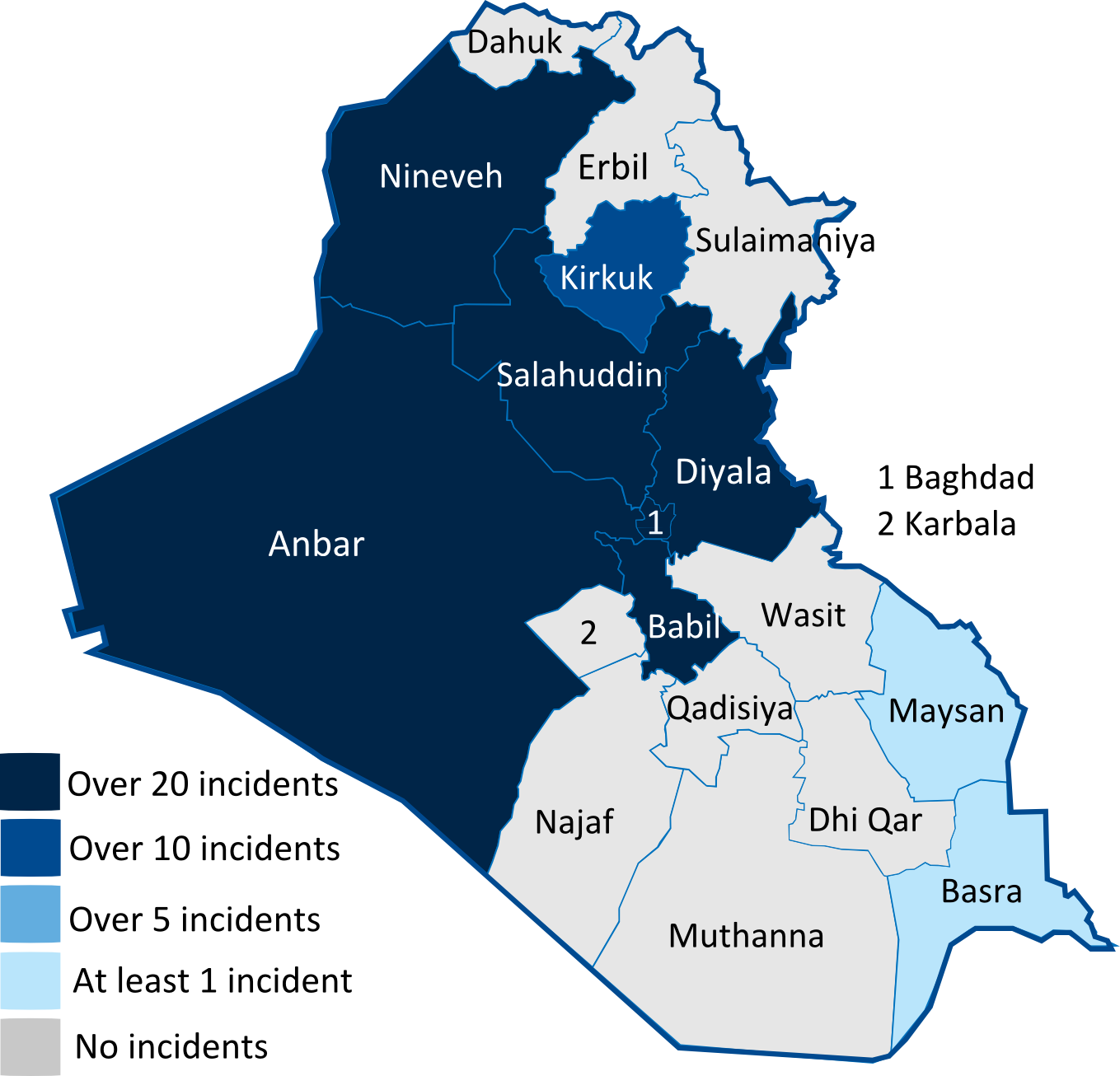 On 15 July, Iraqi MPs took the first formal step toward forming a new government, by electing Salim al-Juburi, a Sunni lawmaker, as the new speaker of parliament. Negotiations between the main parliamentary blocs had been in gridlock since the April elections failed to produce a majority, with sessions adjourned or boycotted by the main protagonists. This vote comes as central authorities face mounting pressure from the international community to form a government capable of addressing the root causes of the ISIS insurgency. Despite these movements, the nomination of a parliament speaker is tempered by the fact that the designation of a new Prime Minister, who concentrates most decision-making powers, is unlikely to bring a similar consensus among the competing factions. The participation of the Kurdish factions in the electoral process also demonstrates that the Kurdish leadership remains cautious and currently seems determined to exploit opportunities available within the existing political framework. The next step toward forming a government is the election of the President, expected to be a Kurd, and which should ensure the continued involvement of Kurdish blocs in the Iraqi political process. Meanwhile, the KRG continued to take steps toward economic autonomy. On 11 June, Peshmerga forces seized control of production facilities at the Kirkuk and Bai Hassan oil fields, expelling Iraqi employees. The nomination of Juburi hardly reflected progress on the ground however, with the ISF counter-offensive launched in the North in a bid to re-take Tikrit failing to produce the expected results. Tribal alliances on the ground have the potential to shift rapidly and their negotiation will be key to the ISF to making permanent gains in ISIS-controlled territories.
North
Most of the violence reported in the North remained concentrated in northern Salahuddin, where ISF units are attempting to regain control of Tikrit. Additional hotspots for violence include southern areas of Kirkuk and northern districts of Diyala, with firefights between ISF and ISIS reported in Muqdadiyah. On 14 July, the ISF attempted to re-take control of the Amreli area of eastern Tikrit, following a two-week long counter-offensive on the Baathist stronghold. Although the ISF appears to have consolidated its positions in the outskirts of Tikrit and is now able to launch regular assaults on the area, claims that the Iraqi Army has managed to expel insurgents from Tikrit are an overstatement and the town is expected to remain disputed over the next weeks. In a possible attempt at alleviating the pressure on Tikrit, ISIS launched an assault on Dhululiya in the southeast of Samarra, and reportedly controls 40 percent of the town after two days of ongoing clashes. The rest of the town is controlled by local tribes and the ISF does not currently have a presence there, though units are expected to reach the area in the coming days. As appears to be demonstrated by ongoing reports from the ground, the concentration of military resources on Tikrit may lead to further ISIS gains south of Samarra. Meanwhile, the lack of local support for Iraqi forces in Tikrit is unlikely to lead to a major breakthrough, though an escalation in direct fighting between Iraqi troops and ISIS fighters is expected.
Central
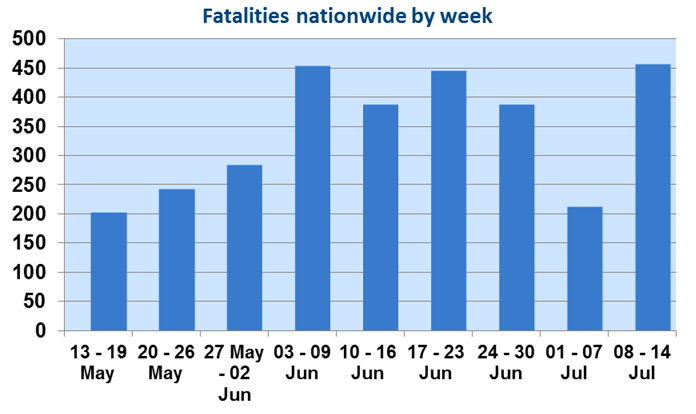
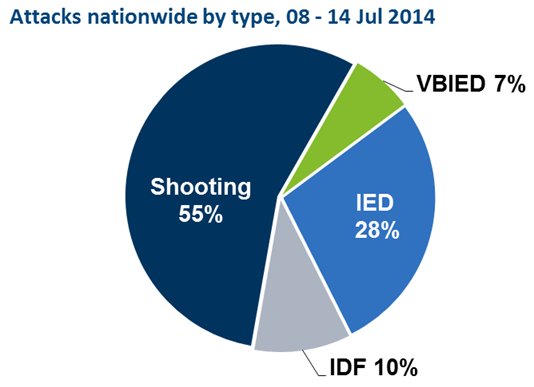 As assessed in previous reports, the situation in central provinces remained stagnant this week, with most ISF operations on the western front focussed on targeting neighbourhoods of Fallujah, and major interactions between Iraqi soldiers and ISIS reported in Haditha and Ramadi. On 13 July, an assault organised by ISIS fighters and supported with military vehicles, was met by forces consisting of ISF, volunteers and tribal elements. The attack resulted in dozens of casualties. Meanwhile, levels of violence in Baghdad remained consistent with previous weekly averages, with attacks involving car bombs relatively scarce and confined to the outer borders of the capital, failing to inflict heavy losses. Eastern districts remained the most exposed to ISIS violence. On 12 June, unidentified gunmen stormed a residential complex in the capital’s Zayuna neighbourhood and killed over 30 civilians. The attack, which targeted apartments allegedly used as a brothel, may have been staged by Shia militias, whose role has become increasingly active in the capital following the collapse of armed forces in the North. Stagnating dynamics on the ground mean that the nature and frequency of attacks will remain similar over the next weeks.
South
The concentration of military resources in the North continued to provide ISIS cells with opportunities to strike areas south of Baghdad. Levels of violence in Babil continued to increase in frequency, demonstrating a continued commitment to weaken Baghdad’s southern belt. On 09 July, a VBIED struck Hillah’s northern neighbourhood of Jaza’ir, followed by the detonation of two additional car bombs in Mahawil district, northern Babil, killing at least 11 people. Ongoing ISF operations in the North have impacted on ISIS tactics, with attacks on Babil seen as a means to alleviate the pressure currently put on ISIS positions on the northern frontline. South-eastern provinces remain assessed as a low priority for insurgents, who are already engaged on multiple fronts across the country. The upcoming Shia festival celebrating the martyrdom of Imam Ali on 19 July nonetheless has the potential to trigger militant assaults on civilians, as pilgrims are expected to converge on Karbala over the next days.
Posted in Weekly Security Update Comments Off on Weekly Security Update, 08 - 14 July 2014

Kurds Seize Oilfields, Leave Cabinet
Posted on 12 July 2014 .
By John Lee.
Kurdish politicians officially suspended their participation in the Iraqi government on Friday, as forces under their control seized two oilfields in northern Iraq.
Prime Minister Nouri al-Maliki has appointed temporary replacements for the five Kurdish ministers of the cabinet.
Kurdish forces took over the Bai Hassan and Kirkuk oilfields near Kirkuk; an oil ministry spokesman in Baghdad described the takeover as dangerous and irresponsible.
(Source: Gulf Today)
(Picture: Iraqi Cabinet)
Posted in Iraq Oil & Gas News, Politics, Security Comments Off on Kurds Seize Oilfields, Leave Cabinet

KRG Statement on Kirkuk Oil Fields
Posted on 12 July 2014 .
KRG statement on recent events at oil facilities and infrastructure in Makhmour district
This morning, members of the Kurdistan Regional Government (KRG) and Kirkuk Oil Protection Forces moved to secure the oil fields of Bai Hassan and the Makhmour area, after learning of orders by officials in the federal Ministry of Oil in Baghdad to sabotage the recent mutually-agreed pipeline infrastructure linking the Avana dome with the Khurmala field.
The nearby Bai Hassan field and the other fields located in Makhmour district are now safely under KRG management. The KRG expects production at these fields to continue normally. Staff at the North Oil Company that previously operated these fields have been informed that from tomorrow they will be expected to cooperate with KRG management. Those who do not want to do so can leave.
The new pipeline linking Khurmala with Avana was designed and constructed with the express purpose of facilitating export from the Makhmour, Avana and Kirkuk area fields through the KRG pipeline network to help increase revenues for Iraqis, at a time of great need and at a time when most of the Iraq-Turkey pipeline is under ISIS control.
The new infrastructure was built and paid for by the KRG, working in full cooperation with officials and engineers at North Oil Company. However, the KRG learned on Thursday that some officials in the federal Ministry of Oil gave orders to a number of NOC staff to cease their cooperation with the KRG and to dismantle or render inoperable the valves on the new pipeline.
The Avana and Makhmour fields have been unable to export since March because the main Iraq-Turkey pipeline has been damaged by terrorist attacks. The main Iraq pipeline lies mostly within territory recently surrendered by the federal government to ISIS.
Posted in Iraq Oil & Gas News, Security Comments Off on KRG Statement on Kirkuk Oil Fields
Weekly Security Update
Posted on 15 August 2012 .

By Gary Sandiford, Olive Group’s Dubai based assessments manager. Olive Group is a leading provider of security and technology solutions and has operated continuously in Iraq since 2003.
Overview
Olive Group's Iraq statistics are drawn from multiple sources, including media reporting and direct liaison with in country assets. Included within the statistics are a minority sub-set of serious incidents which may not be purely attributable to insurgent/terrorist groups, such as murder, kidnappings and organised crime activities.
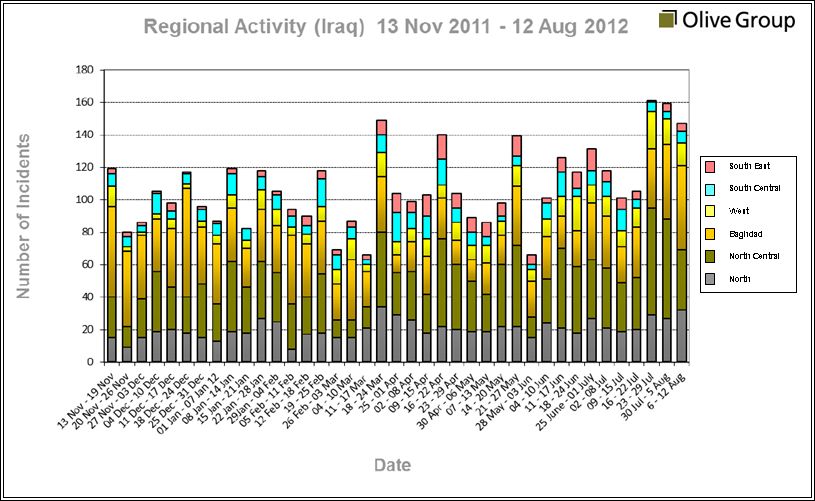
The total number of reported incidents in Iraq for the period 6 – 12 August 2012 was 147. This is lower than last week’s figure of 159, but still significantly above the 2012 weekly average of 109. The figures possibly indicate that Sunni extremists are able to maintain their high operational tempo for an extended period, though is not possible to exclusively attribute the recent elevated figures to a stronger Sunni insurgency. The Northern regions (less the KRG) and Baghdad recorded a high number of smaller incidents with a few high profile attacks also reported. The West and North Central regions both experienced slight reductions, again with fewer high profile attacks, likely due to increased security operations. Once again activity levels in the South Central and South East regions were subdued.
Posted in Weekly Security Update Comments Off on Weekly Security Update
Iraq Plans to more than Double Northern Oil Output
Posted on 15 February 2012 .
Iraq aims to more than double oil production in its northern region by the end of 2014, according to a report from AFP.
Hamid Abdelrizak al-Saadi, general manager of the North Oil Company, said the planned increases for various fields would bring the total to about 1.3 million bpd, from a current level of about 600,000 bpd.
He said the plan for the company, which is in charge of oil and gas fields in Kirkuk, Anbar, Salaheddin and Nineveh provinces, involves increasing production at a number of fields:
- the Kirkuk field, from 280,000 bpd to 600,000 bpd;
- the Bai Hassan field, also in Kirkuk, from 195,000 bpd to 250,000 bpd;
- the Jambur field in northern Kirkuk, from 36,000 bpd to 80,000 bpd;
- the Ajeel field in Salaheddin province, from 25,000 bpd to 35,000 bpd; and,
- the Hamrin field in Salaheddin, from between 20,000 and 25,000 bpd to 60,000 by the beginning of 2013.
There is also a project for Angolan company Sonangol to develop the two fields of Qayara and Najmah in Nineveh province, south of Mosul, so they produce 230,000 bpd in the next three years.
(Source: AFP)
Posted in Iraq Oil & Gas News Comments Off on Iraq Plans to more than Double Northern Oil Output

Federal Oil and Gas Law: Viability, Coherence and Functioning Perspectives
Posted on 20 December 2011 .
By Ahmed Mousa Jiyad. Any opinions expressed are those of the author, and do not necessarily reflect the views of Iraq Business News.
Mr Jiyad is an independent development consultant, scholar and Associate with Centre for Global Energy Studies (CGES), London. He was formerly a senior economist with the Iraq National Oil Company and Iraq’s Ministry of Oil, Chief Expert for the Council of Ministers, Director at the Ministry of Trade, and International Specialist with UN organizations in Uganda, Sudan and Jordan. He is now based in Norway (Email: [email protected]).
Introduction.
The meetings between the federal and KRG delegations held in Baghdad in the last days of October 2011 resulted in an agreement to base their discussion on the February 2007 version of the federal oil and gas law-FOGL.
Detailed, thorough and article-by-article assessments of the February 2007 draft of the law have been done and published by known Iraqi oil professionals, including this writer. The consensus among them indicates the draft suffers from many very serious flaws that ought to be addressed, revised, and redrafted. Moreover, essential and fundamental provisions are, by now, have been overtaken by events that render them outdated, irrelevant and dysfunctional.
What is needed then a very serious look into every article and the entire proposed law from substantive, format and operational aspects to insure its viability, coherence and proper functioning. It would be a grave mistake to consider the “law” as “political deal” since all had learned that most if not all political deals, in Iraq, are easily forgotten and short live!
This intervention aims to shed light on the most important issues and matters of concerns, which should be taken into considerations during the process of negotiating and finalizing a proposed draft of this law.1
-
Time factor effects
Many very important developments have taken place since February 2007, which makes it imperative to revise seriously various articles in the law since these provisions have been overtaken by events and thus became almost obsolete or redundant.
First: Among these developments are the bid rounds concluded by the MoO that led to concluding long term service contracts. These have generated many major consequences, which have direct implications on the proposed law.
Second: All major oilfields (except few such Kirkuk, Bai Hassan, East Baghdad among others) have been already contracted for re-development and/ or development with IOCs involvement. Consequently, there could be no need to offer any of the remaining fields for IOCs in whatever way or method. These remaining fields could be legally (by this proposed law) earmarked for INOC (to be reinstated), as suggested below.
Third: The concluded service contracts with IOCs, if implemented as envisaged, together with the production from other fields would bring Iraq’s production and export capacities to very high and unprecedented levels, even at partial success of half the contracted production targets. The implications is that there are no compelling reasons for Iraq to expand the production capacities any further at least in the next 15-20 years. The law may suggest a moratorium on any “new” development of oil fields for no less than 15 years. Moreover, the law ought to emphases the proper development of the contracted fields in the most optimum way to ensure the constitutional principle of “highest benefits to the Iraqi people”. Accordingly, the field development plans (initial and final) are of paramount importance that they should be formulated by technically competent petroleum team, approved by and constantly monitored by petroleum central authority;
Fourth: All the bid rounds were based on a service contract type and modality. The law should clearly extend support and preference to this type of contracting by making it mandatory to use this type of contracting. To prevent any misinterpretation it might be advisable to have a specific article in the law to make it unlawful and unconstitutional to conclude Production Sharing Contract- PSC in petroleum upstream sub-sector. The law ought to prohibit PSC in any phase of exploration, or development and production activities, in compliance with constitutional basic principles of collective ownership of petroleum resources and the best interests of the Iraqi people.
Fifth: The service contracts have already established significant milestones that are superior to those envisaged under February 2007 version of this law regarding, interalia, fiscal regime, conservation measures particularly those relating to gas utilization, good vs. best international business practices, dispute settlement modalities etc. Accordingly, good number of articles in this proposed law need revision on the lights of what actually have been concluded and evolved since February 2007.
Sixth: The relationship between this law and the proposed laws for the Ministry of Oil, INOC, Revenue Sharing and finally the General Commission for Observing the Allocation of Federal Revenue have to be well coordinated and considered to ensure harmony and coherence.
Posted in Ahmed Mousa Jiyad 2 Comments

Hydrocarbon Reserves in Iraq
Posted on 19 October 2011 .
By Dr Thamir Uqaili
Dr Uqaili is E&P Consultant and CEO of Petroconsult Canada & Associates. He has BSc in Oil Technology and PhD in Petroleum Engineering form the Imperial College in addition to MSc in Water Resources Technology from Birmingham University. Dr Uqaili worked in over ten countries including some 35 years in Iraq, in the hydrocarbon upstream sector and has been concentrating on Iraq during the last 10 years
Background
The ministry of oil, last year declared that Iraq has about 142 Billion B recoverable oil reserves (P1) compared to the old official figure of 112 BB, without giving details where the increase came from. Information obtained from personal source in the Ministry suggested that the increase was due to upgrading oil in place in W Qurna and possibly Zubair fields.
Such increase should be based on new seismic data acquisition and reservoir delineation by wells that were not achieved by then.
This article discusses what increase of the reserves is likely to be according to a detailed reassessment done by the author, noting that more reserves are expected as outcome of Bid Round-4 in addition to the likely revision of reserves in the known fields and discoveries.
A review is also made on the optimum production plateaus of the Iraqi Fields taking into consideration the reservoir limits and achievable size of work on ground.
Sources of reserves upgrade
The main sources for the extra reserves are from the increase in:
- Oil in place of W Qurna-2 whether in the producing reservoirs or discovered but undeveloped reservoirs
- Oil in place in Majnoon Field due to delineation of the northern extension
- Hydrocarbon in place in other discovered reservoirs but not delineated yet. These are awarded fields of Bid Rounds-1, 2 and 3; and those still with the national operators
- Hydrocarbon in place as result of Bid Round-4
- Recoverable reserves of the known fields and discoveries by revising the Recovery Factors ‘RFs’ as result of better reservoir management and applying EOR techniques
- Hydrocarbon in place as result of deep drilling especially in the southern part of Iraq
- Discoveries in new blocks or exploration by Iraq’s Oil Exploration Company ‘OEC’
Posted in Iraq Oil & Gas News Comments Off on Hydrocarbon Reserves in Iraq