


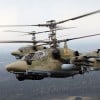
Iraq to Receive Russian Military Helicopters
Posted on 27 June 2013 .
By Ali Abel Sadah for Al-Monitor. Any opinions expressed are those of the author, and do not necessarily reflect the views of Iraq Business News.
On June 18, an Iraqi military source confirmed that the air force command will receive “Alligator” combat helicopters from Russia in the coming period.
In a statement to Al-Monitor, the source, a senior Iraqi army officer, said that "the aircraft will be of the Ka-52 [pictured] and Mi-28NE models from the French Le Bourget Air Show.”
The source, who spoke on condition of anonymity, explained, “The Iraqi air force command will get a new source of strength with the acquisition of this model of helicopter.”
The source continued, saying, “The new Russian aircraft, especially the Ka-52, are distinguished by their ability to lead a squadron of helicopters and play the role of the command post, which defines and assigns the goals of the squadron’s helicopters.”
The source added that the Ka-52 “does not have less technical and combat characteristics than the US AH-64 Apache helicopters.”
This statement came one day after a Russian news agency published information on the completion of a purchase agreement between the Iraqi Ministry of Defense and the Russian government, dating back to 2011.
Iraqi Prime Minister Nouri al-Maliki had visited Moscow to hold negotiations for an arms deal. Yet, it was immediately halted after suspicions of corruption against officials close to Maliki.
Posted in Security Comments Off on Iraq to Receive Russian Military Helicopters

Gazprom Considers More Work in Iraq
Posted on 26 June 2013 .
By John Lee.
Gazprom has said that it is interested in working further in the oil and gas sector in Iraqi Kurdistan.
Following a meeting in St. Petersburg between the Russian company's Chairman, Alexei Miller [Alexey Miller] (pictured), and KRG President Massoud Barzani, Gazprom issued a statement saying, "in particular, the parties discussed the progress with interaction in oil and gas field exploration, development and operation".
Gazprom Neft, the oil subsidiary of Gazprom, is in the process of exploration activity in the Garmian and Shakal blocks in the southern regions of the Kurdish territories.
(Source: UPI)
Posted in Iraq Oil & Gas News Comments Off on Gazprom Considers More Work in Iraq

Oil Companies in Kurdistan - Complete List of Top Oil Companies
Posted on 25 June 2013 .
Erbil Governorate has compiled and published a list of the top oil companies in Kurdistan [Note: This list was originally compiled and published by Marcopolis - Ed.].
[NEW: An updated list can now be found by clicking here - Ed.]
Listing them by country:
USA
- Exxon Mobil
- Chevron
- Aspect Energy
- Marathon Oil Corporation
- Hillwood International Energy
- Hunt Oil
- Prime Oil
- Murphy Oil
- Hess Corporation
- HKN Energy
- Viking International
Canada
- Forbes and Manhattan
- Western Zagros Resources
- Talisman Energy Inc
- NIKO Resources
- Ground Star
- Shamaran
Posted in Iraq Oil & Gas News 14 Comments

Russia Starts Fulfilling $4.2bn Iraqi Arms Order
Posted on 03 June 2013 .
By John Lee.
UPI reports that Russia has started fulfilling a contract to send attack helicopters and short-range air defense systems to Iraq.
Sergei Chemezov (pictured), Chief Executive Officer of Russian Technologies (Rostec), was quoted by state news agency RIA Novosti as saying:
"The contract is being implemented, the production (of ordered equipment) has started."
Iraq cancelled a $4.2-billion contract with Russia in 2012 following allegations of corruption, though the terms of the deal were renegotiated in early 2013.
Russia's weapons trade has come under scrutiny because of an ongoing relationship with the Syrian military.
(Sources: UPI, RIA Novosti)
Posted in Iraq Industry & Trade News, Security Comments Off on Russia Starts Fulfilling $4.2bn Iraqi Arms Order

Iraq Buys 250,000t of Wheat from Russia
Posted on 03 June 2013 .
The Iraqi Grain Board has reportedly bought 250,000 tons of wheat from Russia.
Aswat Al Iraq says the purchase was made following a bid to buy 500,000 tons of wheat, which was closed last week.
According to Russia Today News Agency, the shipments will be made between 1st and 31st July, 2013, and delivered in August-September.
Iraq bought the wheat in four shipments from four trading companies, at costs of $318.82, $319.69, $325.15 and $328 per ton, including shipping.
Iraq is expected to lose 25-30% of its wheat production this year due to heavy rains in south of the country.
(Source: Aswat Al Iraq)
Posted in Agriculture Comments Off on Iraq Buys 250,000t of Wheat from Russia

Eni to Cut Zubair Output Target
Posted on 02 June 2013 .
By John Lee.
Eni has reportedly reached agreement with the Iraqi Ministry of Oil to cut the final production target at Zubair oil field to 850,000 bpd.
Iraqi Oil Minister Abdul Kareem Luaiby [Elaibi] told reporters that he has agreed to the drop from the original target of 1.25 million bpd, and that Eni has agreed to maintain the new level of production for 15 to 20 years.
Russia's Lukoil had already struck a deal to reduce the target for West Qurna-2 to 1.2 million bpd, instead of the earlier-agreed 1.8 million bpd.
BP and Shell are also pursuing talks with the Iraqi oil ministry to reduce final production targets of the Rumaila and West Qurna-1 oil fields respectively.
(Source: Dow Jones)
Posted in Iraq Oil & Gas News Comments Off on Eni to Cut Zubair Output Target

Turkey Puzzled by US Stance on Exxon-KRG Oil Deal
Posted on 30 May 2013 .
Turkish officials are dismayed hearing about US concerns that Turkey’s decision to sign an agreement with ExxonMobil in northern Iraq is perceived as a threat to Iraq’s unity.
Noting that it is ExxonMobil, a US company, that is going to do the exploration work in the Iraqi Kurdistan Regional Government's (KRG) area, the Turkish side is curious why the Obama administration would want Turkey — a country that is more than 80% dependent for its energy needs on outside sources — to turn its back on newly rising opportunities in its neighborhood that will help it to diversify its energy portfolio, while giant US oil and gas companies are exempt from such criticism.
According to the Turkish side, it is primarily these giant oil companies that decide how and when these hydrocarbon reserves will come on the market, and that when they make their move it is best to be on board from the beginning. As ExxonMobil took a step in that direction by exploiting the northern Iraqi resources, Turks are saying that it is not even serious to paint Turkey as a country attacking Iraq’s territorial integrity.
“We have a fast developing economy and industry. We have a large population and we don’t have our own homegrown energy resources to match our needs to keep up with the growth,” a Turkish official told Al-Monitor. “ So what it is exactly that the United States wants us to do — that we don’t work with Russia, Iran and Iraq! So, who should we buy our energy from?”
The Wall Street Journal, however, reported on May 14, “US officials fear setting a precedent to let regional governments strike independent resource deals could destabilize [Iraqi Prime Minister Nouri al-] Maliki’s government during a time when sectarian violence in Iraq is mounting.”
The Wall Street Journal also went on to write:
"'Our position on energy trade from Iraq has been consistent and remains unchanged: The United States doesn’t support oil exports from any part of Iraq without the appropriate approval of the federal Iraqi government,' said Caitlin Hayden, a spokeswoman for the National Security Council."
Turkish officials, however, argue that if the Obama administration is worried about rising sectarian conflict in Iraq, they should point fingers at themselves and take responsibility as the former occupier of the country — but not blame Turkey for anything that goes wrong in Iraq. “The problem is in Baghdad, not in Ankara,” one Turkish official told Al-Monitor.
The signing of the agreements does not mean that these resources will be available for consumption on the market tomorrow. It is going to take time, and much can change in Baghdad’s relations with the Iraqi Kurds before then. “We are just watching out for our best interest.”
Tulin Daloglu is a contributor to Al-Monitor's Turkey Pulse. She has also written extensively for various Turkish and American publications, including The New York Times, International Herald Tribune, The Middle East Times, Foreign Policy, The Daily Star (Lebanon) and the SAIS Turkey Analyst Report. On Twitter: @TurkeyPulse
Posted in Iraq Oil & Gas News 1 Comment

Education - the Most Powerful Weapon of All
Posted on 28 May 2013 .
By Madeleine White, educationalist, writer and Head of Strategic Partnerships, Whizz Education.
"Education is the most powerful weapon which you can use to change the world."
- Nelson Mandela
I have seen many weapons in the last few days. A meat cleaver, brandished by a blood-covered young man in Woolwich, London - caught on a homemade video celebrating the horrific killing of a young soldier in the name of religion. Words as weapons on banners in Iraq, brandished by tens of thousands of Iraqis who want to see the creation of a separate Sunni sovereign region. In this month’s blog I therefore want to add a weapon that empowers everyone equally – that of education.
Of course our received expectation as to what education should be is based on children being taught in bright shiny classrooms, by teachers who always smile and know everything. It is nice, lovely, kind and caring and always successful, leading to great jobs. Knowledge is easily passed on and flows like a stream from a tap that is shiny and ever-available. There is no dirt, hunger, hardship or discrimination…
This kind of idealisation will never be realised. In a world full of anger, hunger and hate it is also utterly irrelevant. To serve the needs of individuals, communities and nations education must instead be disruptive. It needs to challenge existing ideas and structures. It is not static or complete in itself – instead it is dynamic and alive. Education is a way of transmitting the nature of human thought, helping individuals become aware of themselves but also transmitting a fundamental sense of regional, national and global consciousness.
The internet of course speeds the whole thing up. In fact, we could liken the high speed, high tech world we inhabit much of the time to a fourth dimension, beyond the other three that currently exist on the ‘physical’ world. If the internet provides the environment I would like to argue that Educational Technology providers create the tools that enable people to reach and shape this new dimension. Therefore, if we are to use education as a weapon, we must recognise the real battlefield and so embrace technology and new teaching ideas and techniques – making use of all the things that can help us as part of our arsenal.
Posted in Iraq Education and Training News, Madeleine White 1 Comment

Building the Educational Pipeline in Kurdistan
Posted on 25 April 2013 .
By Madeleine White, educationalist, writer and Head of Strategic Partnerships, Whizz Education.
As I have mentioned previously, education is never just about a school building. A school is a function or a service, set within a suitable building that is able to support people to reach their full potential. In order for this to happen there are many stakeholders. These include funders such as corporations who benefit from the right kinds of skillsets to drive forward their innovation and productivity. It includes government as strategists, able to connect the needs of all participants and of course also includes the wider community – parents, organisations, smaller business and employers.
My theme this month therefore is one of connection and sharing. Schools are a central point of connection for many communities. The three short stories I am focusing on below are designed to focus on what schools actually mean and indeed how they are the base-line for skills, connections and ideas that allow a young person to reach their full potential – serving individual, community and national need in the process.
Building schools
The Kurdistan Regional Government of Iraq (KRG) is set to announce the results of January’s Expression of Interest Request for provision 2000 school buildings in Erbil, Sulaimaniya, Dohuk and Garmian. The focus is to be on building 250 furnished schools in each of the two initial years and the remainder of the total number of 2,000 furnished schools to be distributed over the remaining 10 years.
The results are due to be announced in May, so opportunities for education providers to become involved when the builders have been announced are potentially huge and of course come back to the question of what education is actually trying to achieve.
Educational service providers such as Whizz Education will be looking to explore how to make the educational pipeline meaningful – allowing educational technology to drive progress by aligning the measures and reports with the wide access the cyber environment is able to provide in order to support learning and teaching needs. It could be argued for example that this kind of a shared, collaborative learning environment prepares young people and their communities for exactly the kind of skills required to serve future national and employer need and should thus be integral to school provision. These contributions and ideas are crucial if the progamme is to serve the needs of long term human capacity development.
Posted in Iraq Education and Training News, Madeleine White Comments Off on Building the Educational Pipeline in Kurdistan

Rosneft Sets Sights on Iraq
Posted on 25 April 2013 .
By John Lee.
Russian news agency RT reports that Rosneft is considering a joint venture with ExxonMobil in Iraq.
Company President Igor Sechin (pictured) told reporters:
"We will work with anyone who offers good terms, we'll work with ExxonMobil too."
An Iraqi oil ministry delegation will visit Moscow on 10th May to discuss the deal.
(Sources: RT, Reuters)
Posted in Iraq Oil & Gas News Comments Off on Rosneft Sets Sights on Iraq