



Baker Hughes to help Capture Gas at Iraq's Southern Oil Fields
Posted on 22 September 2021 .
By John Lee.
Iraq's South Gas Company (SGC) has announced a project to capture gas at the Nasiriyah and Garraf [Gharraf] oil fields, in partnership with the American company Baker Hughes.
Instead of flaring, the gas will be used to increase electricity generation, while reducing the environmental impact of oil production.
The project will also help reduce Iraq's dependence on gas imported from Iran.
(Source: Ministry of Oil)
Posted in Iraq Oil & Gas News Comments Off on Baker Hughes to help Capture Gas at Iraq's Southern Oil Fields
Iran "Appoints Special Envoy" on Iraq Petroleum Issues
Posted on 22 September 2021 .
By John Lee.
Iran's has reportedly appointed a special representative for petroleum issues involving Iraq.
According to ABNA24, Seyyed Abbas Beheshti will coordinate with the National Iranian Gas Company (NIGC) and the Central Bank of Iran to accelerate payments of arrears.
It adds that Iraq owes Iran nearly $6 billion for imports of natural gas to produce electricity.
(Source: ABNA24)
Posted in Iraq Oil & Gas News 1 Comment
UNDP Restores Essential Services in Western Anbar
Posted on 19 September 2021 .
Six new facilities providing basic services to 230,000 residents in western Anbar have officially opened thanks to a partnership between the United Nations Development Programme (UNDP) in Iraq, the Governorate of Anbar, and the international community.
The facilities, completed under UNDP's Funding Facility for Stabilization (FFS), were inaugurated as part of a UNDP Iraq visit to Heet, Haditha, Anah, Rawa, Qaim and Rummanah led by Resident Representative Ms. Zena Ali Ahmad. They included:
- Al-Mohamadi Municipality Building, Heet (funded by USAID)
- Al-Baghdady Municipality Building, Heet (funded by USAID)
- Al Khasfa Water Treatment plant, Haditha (funded by the Government of Sweden)
- Rawa Municiapilty building (funded by USAID)
- Al Qaim Electricity Substation (funded by USAID)
- Al-Aseel Primary School, Rummanah (funded by USAID)
The mission commenced with a meeting between UNDP and Anbar Governor H.E Ali Farhan to discuss UNDP's support to the province as well as remaining needs. Visits to other completed projects under FFS including Haditha Public library (funded by the Government of Iraq), Anah Municipality Building (funded by the Government of Finland), and Al Qaim Vocational Training Centre (funded by the Government of Canada) and an oasis agricultural project (also funded by Canada) were also included.
Additionally, a meeting with the Al Qaim Local Peace Committee supported by UNDP Iraq under its Social Cohesion programme was held, with discussions focusing on the sustainable reintegration of returned IDPs including families with a perceived affiliation to the Islamic State of Iraq and the Levant (ISIL).
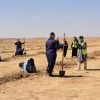
Future areas of collaboration were also explored, with a site visit to discuss potential livelihood projects in the productive sector on land owned by Haditha's Department of Agriculture, and a stop by the Haditha Women's Cultural Centre to better understand the specific needs of local women. The mission concluded with a visit to an ongoing livelihood project funded by Canada which employs 200 workers - including women - to plant 15,000 olive seedlings (high olive oil trees), 2,000 palm seedlings (Zahddi trees) and build five wells.
"It's great to see cities in western Anbar so lively again. Essential services are up and running, shops and traders are open for business and people are out and about. The area was one of the first to be taken by ISIL and the last to be liberated, and I am proud that UNDP Iraq, in partnership with the Government of Iraq and the international community has completed 200 stabilization projects in the area, collectively benefiting more than 800,000 Iraqis," says Ms. Ali Ahmad.
"Western Anbar has always been a priority area for UNDP and will continue to be as we work tirelessly alongside the Anbar Governorate and local community leaders to support the return of remaining IDPs. I'd like to extend my deepest appreciation to our donors - particularly our longstanding partners USAID who funded five out of the six new facilities we inaugurated. USAID has made generous contributions to western Anbar, and to stabilization in Iraq generally. I would also like to express my gratitude for the strong partnership with the federal government and local authorities, which enables us to implement projects and ensure their sustainability in the most effective way," she added.
UNDP Iraq's FFS was established in 2015 at the request of the Government of Iraq with support from the member states of the Coalition to Defeat Da'esh (ISIL), to facilitate the return of displaced persons by rehabilitating critical services and infrastructure, provide short and medium-term employment, provide capacity support for municipalities and foster social cohesion across the liberated areas of Anbar, Diyala, Kirkuk Ninewa and Salah Al Din.
To date, $1.4 billion has been mobilized from the international community, with 2,944 projects completed, supporting more than 14 million Iraqis. Another 563 projects are currently underway.
(Source: UN)
Posted in Agriculture, Iraq Public Works News Comments Off on UNDP Restores Essential Services in Western Anbar

Expanding Basic Services to Poor Neighbourhoods in Basra
Posted on 17 September 2021 .
The European Union supports UN-Habitat to expand basic services to poor neighbourhoods in Basra City
The last 18 months have highlighted the importance of access to safe potable water, sanitation, waste management, and hygienic conditions to prevent and protect human health during disease outbreaks.
Nearly 1.8 billion people world-wide live in inadequate housing, in overcrowded conditions with lack of access to clean water. The absence of basic services leaves families with increased exposure to disease outbreaks, including COVID-19.
On 13 September, UN-Habitat, in cooperation with the European Union, brought together the Governor's Assistant for Administrative Affairs, Governor's Assistant for Labor and Social Affairs Departments and Head of DOLSA, the Head of Basra Municipality and representatives from the directorates of Water, Sewage, Planning, Physical Planning, Electricity, Labour and Social Affairs, Health and Environment to discuss upgrading under-serviced neighbourhoods in Basra city, within which some of the poorest families in Basra live as well as provide vocational training and waste management solutions.
The purpose of the meeting was to confirm two of the three neighbourhoods within which UN-Habitat will work for the coming three years. The committee has agreed on the general approach to the project and two of the three locations, Al-Ehrar and Al-Kubyah neighbourhoods, and a third will soon be identified.
Mr. Arab Al-Jabri, Governor's Assistant for Labor and Social Affairs Departments and Head of DOLSA said in his opening remarks:
"With the help of this organisation, we can find solutions for these crises, creating work opportunities, in addition to other problems. We are calling on the local authorities, and Water, Municipality, Environment, Health, to help them move forward in their aim. We wish them success in elevating the problems, most important the unemployment among the young, the housing crises, and infrastructure. We hope all Directorates respond to their needs."
In her opening remarks, Ms. Barbara Egger, Head of Cooperation for the European Union Delegation to Iraq, said:
"Through this project, the European Union is providing critical urban planning support to help the governorate of Basra, in consultation with the people of Basra, to oversee, prioritize, plan and implement priority interventions for improved service delivery and generation of employment.
"The ownership and leadership of the Basra Governorate, Basra municipality and various technical directorates is key, and we continue to count on sustained close collaboration. We look forward to the next steps in implementation and to the continued focus on sustainability and community engagement.''
UN-Habitat has worked in Basra for many years, both through normative and operational projects. In 2007, UN-Habitat supported the development and implementation of new laws, policies and programme for solid waste management.
More recently, in 2019, UN-Habitat implemented a pilot project in Al Qibla informal settlement to improve living conditions and in 2020, conducted a comprehensive urban assessment of Basra City and published the Basra Urban Profile. One of the key findings of the Basra Urban Profile shows that upgrading of basic services in Basra would considerably reduce environmental problems faced in the city.
Mr. Wael Al-Ashhab, Head of UN-Habitat Iraq, said during the meeting:
"Under this project, UN-Habitat will implement a number of activities that contributes to improve the overall living conditions and environment in Basra city. We very much look forward to working very closely with our counterparts in Basra Governorate, Municipality, and relevant Directorates and count on your support to ensure success of this very important project."
Mr. Moeen Saleh Al-Hassan, Governor's Assistant for Administrative Affairs, said at the close of the meeting:
"I reiterate my appreciate to the European Union for their time and effort and welcome any project by the European Union. We thank the European Union for working in Basra, and we will work together to ensure the success of the project."
The United Nations Human Settlements Programme (UN-Habitat) would like to thank the European Union for supporting the project titled "Increasing Access to Employment Opportunities for Vulnerable Urban Population in Basra City in Response to the COVID-19 Crisis". This project will provide support for vulnerable populations in underserviced neighbourhoods in Basra City which aim to increase access to employment opportunities in basic services and waste management sectors for unemployed youth, women and vulnerable urban population.
(Source: UN)
Posted in Iraq Public Works News Comments Off on Expanding Basic Services to Poor Neighbourhoods in Basra

Sustainable Energy Solutions: New Projects Launched
Posted on 13 September 2021 .
Supporting Iraq's Local Economic Development through Sustainable Energy Solutions - New Projects Launched
Three innovative projects aimed at promoting sustainable energy solutions were launched today in partnership with the European Union and the United Nations Development Programme (UNDP) in Iraq and the governorates of Erbil, Sulaymaniyah, and Duhok.
The projects, which were designed by the individual governorates based on their strategic plans, come at a time where many governorates in the Kurdistan Region of Iraq (KRI) face environmental sustainability challenges, and are seeking sustainable alternative sources of energy, in line with their commitment to reducing Greenhouse Gas (GHG) emissions according to the developed Sustainable Energy Action Plan (SEAP) in 2018, under Supporting Recovery and Stability in Iraq Through Local Development programme, funded by the EU and implemented by UNDP.
- The project to be implemented in Erbil project will include the installation of solar panels for water pumps in 45 rural areas, as well as 100 solar water heaters in farms to be used for agricultural production. These will reduce costs for production.
- In Sulaymaniyah, conventional streetlamps that consume a large amount of electricity due to the usage of high-pressure lamps, will be replaced with 10,000 energy efficient LED lamps that will result in a significant reduction of governorate's energy bill.
- In Dohuk, the governorate is turning its attention to the enormous potential of solar power and will install a mini solar park with capacity of up to 2 Mw. This will be the first introduction of solar supply in Iraq and will also support a potential Public Private Partnership (PPP) and serve as a bankable pilot for major future investments in the project.
Ms. Zena Ali Ahmad, Resident Representative of UNDP in Iraq said:
"Providing renewable energy solutions to the Kurdistan Region of Iraq is critical to addressing many of its environmental challenges. These projects are the first initiatives for the region, pioneering its transition from traditional sources of power to clean energy, and showcases the individual governorates' commitment to a cleaner, greener Iraq."
The Ambassador to the European Union to Iraq, Mr. Ville Varjola, mentioned:
''The launch of three projects is the result of committed and innovative work under the leadership of the Governor of Erbil, Governor Dohuk and Governor of Sulaymaniyah to address local priorities but in parallel to take steps towards green economy and reduction of CO2 emissions.
"Both are high priorities for Iraq as well as for the EU cooperation with Iraq. I congratulate these achievements and look forward to speedy implementation to the benefit of the people of Erbil, Dohuk and Sulaymaniyah.''
Mr. Omed Xoshnaw, Governor of Erbil:
"This project enhances our governorate's efforts in adapting alternative and advanced methods to generate electricity, such as solar energy. The project, supported by the United Nations Development Programme and funded by the European union, aims at benefiting from natural resources and advance the development of power generation, development of agriculture sector, and encourage farmers to increase local production in the region.
"This project is a new confirmation to the importance and the effectiveness of the partnership between the Governorate of Erbil and UNDP and the coordination with local communities and private sectors."
Dr. Haval Abubakir, Governor of Sulaymaniyah:
"This project was nominated according to Sulaymaniyah (Slemani) Governorate's Strategic Plan for Renewable Energy and Environment, approved by European Union and UNDP, in cooperation with UNDP, Planning and Electricity Directorates in the governorate.
"It is an important project for lighting the main streets, reducing electricity consumption and CO2 emission, saving huge expenses for the public treasury, providing job opportunities and contemporary development for the governorate, directly benefiting citizens."
Mr. Ali Tatar, Governor of Duhok:
"We appreciate the active role of UNDP to serve the people of Duhok, from refugees and internally displaced people to the local communities for years.
"We are particularly grateful for the initiation of the first project on renewable energy, which is the solar power project in our governorate that will protect and sustain a healthy environment"
The projects reaffirm the governorates' commitment to developing clean energy solutions, in addition to UNDP's and the EU's continuous support to projects that address climate change and a green economy in Iraq, under Supporting Recovery and Stability in Iraq Through Local Development programme, funded by the EU and implemented by UNDP.
(Source: UN)
Posted in Construction & Engineering In Iraq Comments Off on Sustainable Energy Solutions: New Projects Launched

Khor Mor gets $250m Financing from DFC
Posted on 09 September 2021 .
Pearl Petroleum, the consortium led by Dana Gas and Crescent Petroleum of the UAE, has signed a $250 million financing agreement with the U.S. International Development Finance Corporation (DFC) to support the gas expansion works currently under way at the Khor Mor gas plant in the Kurdistan Region of Iraq (KRI).
DFC is the development finance arm of the U.S government and proceeds from the 7-year DFC financing will support an increase in gas production capacity by 50% to 690 million standard cubic feet (scf)/day to meet rising demand for clean natural gas for electricity generation and industry in the KRI. The total project cost is $630 million and the remaining financing has already been secured through a regional bank facility and the EPC contractor.
The KM-250 project is the first stage of a two-train expansion project at Khor Mor that aims to boost total production capacity to approach 1 billion scf/day. Work resumed in April 2021 after onsite construction was halted last year due to the COVID pandemic and is currently on track for completion by April 2023.
Total investment by Pearl Petroleum at Khor Mor to date exceeds US$2.1 billion with total cumulative production of over 341 million barrels of oil equivalent (boe) in natural gas and liquids. The uninterrupted supply of gas to power plants in Erbil, Chemchemal and Bazian has resulted in significant fuel cost savings and economic benefits for the Kurdistan Region and Iraq as a whole.
The gas produced to date has enabled emissions savings of 42 million tonnes of CO2 by displacing diesel fuel in power generation in the KRI, thereby making a major contribution to reducing greenhouse gas emissions and local air pollution in the region as well as supporting the transition to better energy sources to tackle global climate change.
Between 2018 and 2021, the Khor Mor Gas Plant also benefitted from a 45% production increase through an optimization of the facility bringing current total production to 106,000 barrels of oil equivalent per day (boepd). The project is today the largest regional private sector upstream gas operation in Iraq.
Mr. Majid Jafar (pictured), CEO of Crescent Petroleum and Board Managing Director of Dana Gas, commented:
"This financing agreement with DFC underscores the importance of developing the natural gas resources in the KRI to support regional economic development and growth. Despite the global challenges presented by the COVID pandemic, we have continued to maintain our record of uninterrupted operations and even managed to grow production. The DFC agreement is a testament to our successful track record and further highlights the potential of these resources and the bright future for the KRI."
Dr. Patrick Allman-Ward, CEO of Dana Gas, added:
"With our partners in Pearl Petroleum we are proud to be further developing the gas sector of the Kurdistan Region of Iraq, delivering expanded supply of cleaner energy, and supporting local economic development. This agreement underscores our continued confidence in the region and its long-term prospects."
Mr. Dev Jagadesan, Acting CEO of DFC, said:
"DFC's investment in the Khor Mor expansion will substantially increase access to energy for people all across the Kurdistan Region of Iraq. This highly developmental project represents the United States' continuing investment in the KRI."
In April 2007, Dana Gas and Crescent Petroleum entered into an agreement with the KRG for exclusive rights to appraise, develop, produce, market, and sell petroleum from the Khor Mor and Chemchemal fields in the KRI. Production from a newly built plant at Khor Mor began just 15 months later, in October 2008, an industry record. In 2009, Pearl Petroleum was formed as a consortium with Dana Gas and Crescent Petroleum as the majority shareholders, and with OMV, MOL, and RWE joining the consortium subsequently with a 10% share each.
Full-time staff at the operation number over 500, with over 85% local staff, including many in senior management positions. The companies have implemented a corporate social responsibility program to support local communities with equipment and supplies to deal with the COVID pandemic such as ventilators, sanitizers and protection equipment, in addition to a pledge to donate 100,000 vaccines to be administered in those local communities. This is in addition to ongoing support with local education, health and power supply as well as humanitarian aid for persons displaced from conflict zones as well as orphans. These initiatives assist the local communities in improving their standard of living, health, well-being, security and stability and the development of human capital.
(Source: Dana Gas)
Posted in Iraq Oil & Gas News Comments Off on Khor Mor gets $250m Financing from DFC

TotalEnergies signs $10bn New Deals in Iraq
Posted on 06 September 2021 .
TotalEnergies, the Iraqi Ministries for oil and electricity, and the country's National Investment Commission (NIC) have signed, in the presence of the Prime Minister of Iraq, major agreements covering several projects in the Basra region, designed to enhance the development of Iraq's natural resources to improve the country's electricity supply.
Iraq, a country rich in natural resources, is indeed experiencing electricity shortages while it faces a sharp increase in demand from the population.
TotalEnergies, with the support of the Iraqi authorities, on the one hand will invest in installations to recover gas that is being flared on three oil fields and as such supply gas to 1,5 GW of power generation capacity in a first phase growing to 3 GW in a second phase, and, on the other hand, will also develop 1 GWac of solar electricity generation capacity to supply the Basra regional grid.
These agreements include:
- The construction of a new gas gathering network and treatment units to supply the local power stations, with TotalEnergies also bringing its expertise to optimize the oil and gas production of the Ratawi field, by building and operating new capacities.
- The construction of a large-scale seawater treatment unit to increase water injection capacities in southern Iraq fields without increasing water withdrawals as the country is currently facing a water-stress situation. This water injection is required to maintain pressure in several fields and as such will help optimizing the production of the natural resources in the Basra region.
- The construction and operation of a photovoltaic power plant with a capacity of 1 GWp to supply electricity to the grid in the Basra region.
These projects represent a total investment of approximately $10 billion (100% share).
Patrick Pouyanné, TotalEnergies' Chairman and CEO, said:
"These agreements signal our return through the front door to Iraq, the country where our Company was born in 1924. Our ambition is to assist Iraq in building a more sustainable future by developing access to electricity for its people through a more sustainable use of the country's natural resources such as: reduction of gas flaring that generates air pollution and greenhouse gas emissions, water resource management and development of solar energy.
"This project perfectly illustrates the new sustainable development model of TotalEnergies, a multi-energy Company which supports producing countries in their energy transition by combining the production of natural gas and solar energy to meet the growing demand for electricity. It also demonstrates how TotalEnergies can leverage its unique position in the Middle East, a region where the lowest-cost hydrocarbons are produced, to gain access to large-scale renewable projects."
(Sources: TotalEnergies, Ministry of Oil)
Posted in Iraq Industry & Trade News, Iraq Oil & Gas News Comments Off on TotalEnergies signs $10bn New Deals in Iraq

Al-Sadr Reverses Decision to stay Out of Iraqi Elections
Posted on 02 September 2021 .
By Hassan Ali Ahmed, for Al Monitor. Any opinions expressed here are those of the author(s) and do not necessarily reflect the views of Iraq Business News.
Muqtada al-Sadr reverses decision to stay out of Iraqi elections
After his withdrawal from October elections due to public anger against the ministers of health and electricity - both loyal Sadrist officials - the head of the Sadrist movement, Muqtada al-Sadr, decides to participate in the vote after all.
Posted in Politics, Security Comments Off on Al-Sadr Reverses Decision to stay Out of Iraqi Elections

PowerChina to Develop 2GW of Solar Power in Iraq
Posted on 26 August 2021 .
By John Lee.
Iraq has signed an "agreement of principles" with state-owned PowerChina (Power Construction Corporation of China) to build a 2,000-MW solar power station.
The Director General of the Investments and Contracts Department at the Ministry of Electricity, Mrs. Maha Hamoudi Abdul-Jabbar, signed on behalf of the Iraqi side, while the Deputy General Manager of PowerChina, Mr. Li Dzhi, signed for the Chinese side.
The first phase of the project will have a capacity of 750 MW.
(Source: Govt of Iraq)
Posted in Iraq Industry & Trade News Comments Off on PowerChina to Develop 2GW of Solar Power in Iraq

Iraq's Ministry of Electricity gets a Re-Brand
Posted on 26 August 2021 .
By John Lee.
The Iraqi cabinet has agreed to change the name of the Ministry of Electricity to the Ministry of Electricity and Renewable Energy.
A draft law enacting the change will be referred to the House of Representatives (parliament).
(Source: Govt of Iraq)
Posted in Iraq Industry & Trade News, Politics Comments Off on Iraq's Ministry of Electricity gets a Re-Brand