



Top 10 Dinar Articles from July
Posted on 03 August 2025 .
The following were the ten most read dinar-related articles on Iraq Business News for the month of July:
- IMF Comments on Iraqi Dinar Exchange Rate
- Donald Trump and the "Great Iraqi Dinar Revaluation"
- IMF Explains Iraq's Exchange Rate Arrangement
- Counterfeit Iraqi Dinars: Central Bank Hosts Workshop
- Iraqi Dinar Prospects: Reality Check After Six Months of Trump
- Iraqi Dinar Q&A: RV Prospects Two Weeks on from Airstrikes on Iran
- Trump & Crypto: Will Bitcoin's Success Translate to the Iraqi Dinar?
- Iraq Reduces Foreign Debt Liabilities
- The Iraqi Dinar Revaluation Scam: False Hope, Financial Deception
- Iraqi Dinar Q&A: Dinar Revaluation (RV) and Israeli Airstrikes on Iran
For more information on the Iraqi dinar, check out IBN's Dinar Page here: https://www.iraq-businessnews.com/the-dinar-page/?swcfpc=1
Posted in Iraq Banking & Finance News Comments Off on Top 10 Dinar Articles from July
Beyond Tariffs: Building a Win-Win Relationship with the US
Posted on 02 August 2025 .
By Ahmed Tabaqchali for the Atlantic Council. Any opinions expressed here are those of the author(s) and do not necessarily reflect the views of Iraq Business News.
Beyond tariffs: Building a win-win relationship between the US and Iraq
Iraq was among the countries that received a letter from US President Donald Trump on July 9th advising its prime minister that Baghdad's trading relationship with Washington was far from reciprocal-and thus its exports to the United States would be subject to a 30 percent tariff starting August 1.
This is lower than the initial rate of 39 percent that the Trump administration announced on "Liberation Day" back in April, but higher than the revised 10 percent base rate that applied to all countries when the Trump administration paused "Liberation Day" tariffs for ninety days, allowing room for negotiations that expired in July.
Click here to read the full report.
To browse our comprehensive library of reports on Iraq, click here.
Posted in Iraq Industry & Trade News, Politics Comments Off on Beyond Tariffs: Building a Win-Win Relationship with the US

Iraq Reduces Foreign Debt Liabilities
Posted on 31 July 2025 .
By John Lee.
Iraq's state-owned Rafidain Bank has announced that it has "completed" 87 percent of its foreign debt obligations through high-level legal and financial negotiations, significantly reducing the country's external liabilities.
As part of Iraq's adherence to the Paris Club Agreement and with direct Cabinet approval, the bank concluded major settlements with Dutch and French creditor companies. The most notable was under Cabinet Resolution No. 403 of 2025, which settled three Dutch lawsuits with a waiver exceeding 90 percent of the claimed amounts in favour of the bank.
Additionally, the bank achieved key legal victories in Turkey and Lebanon, recovering over $2.8 million in assets. According to a statement from Rafidain, this highlights the competence of Iraq's legal apparatus in defending state interests abroad.
Rafidain Bank confirmed it is pursuing final settlements to close the remaining debt portfolio, aiming to bolster Iraq's sovereign credit rating and reinforce global confidence in its fiscal governance.
See also:
Govt Denies Destruction of 62 Trillion Iraqi Dinar
Trump & Crypto: Will Bitcoin's Success Translate to the Iraqi Dinar?
Top 10 Dinar Articles from July
(Source: Rafidain Bank)
Posted in Iraq Banking & Finance News Comments Off on Iraq Reduces Foreign Debt Liabilities
Iraqi Dinar Prospects: Reality Check After Six Months of Trump
Posted on 29 July 2025 .
By Guest Blogger. Any opinions expressed are those of the author(s), and do not necessarily reflect the views of Iraq Business News.
Iraqi Dinar Prospects: Reality Check After Six Months of Trump
Six months into Donald Trump's return to the presidency, the Iraqi dinar finds itself at a crossroads between economic fundamentals and persistent speculation. Whilst the currency's boosters continue to proclaim imminent revaluations, the reality on the ground tells a rather different story-one of mounting pressures on Iraq's economy that suggest further weakening, not strengthening, of the dinar.
The Numbers Don't Lie
Market projections indicate potential slight depreciation, with the exchange rate possibly reaching around 1,318 IQD per USD by the end of 2025. This represents a continued weakening from current levels, reflecting the deteriorating economic conditions that have emerged during Trump's first six months in office.
More optimistic forecasts suggest modest improvements, with the USD/IQD exchange rate might improve from 1,276.640 in March 2025 to 1,217.448 by December 2025, though even these projections show only marginal strengthening that would hardly satisfy those expecting dramatic revaluations.
The gulf between these professional forecasts and the expectations of dinar enthusiasts could not be starker. More than half of respondents expected the Iraqi dinar to revalue by at least 1,000x in the first 100 days of Trump's term -- a prediction that has been thoroughly debunked by events.
Economic Fundamentals Under Pressure
The fundamental drivers of currency value paint a concerning picture for the dinar's prospects. The current account is expected to weaken considerably in 2025 primarily due to declining oil export revenues. The deterioration in the external position is projected to weigh on foreign reserves.
Iraq's foreign currency reserves, whilst still substantial, are showing signs of strain. Iraq's foreign currency reserves are sufficient to finance 13 months of imports, despite a recent decline in coverage, according to the Central Bank. The Central Bank of Iraq (CBI) revealed that the country's foreign exchange reserves declined in May 2025, marking a concerning trend as oil revenues continue to fall.
The IMF's assessment is particularly sobering, noting that Iraq's vulnerabilities have increased in recent years due to a large fiscal expansion, precisely at a time when the government's main revenue source-oil exports-faces sustained pressure from both price declines and geopolitical disruptions.
Trump's Policies: A Double-Edged Sword
Leading Iraqi economists have warned that Trump's policies could actively harm the dinar. A leading Iraqi economist has predicted that US President Donald Trump's pressure to reduce oil prices will harm the Iraqi economy, and could lead to a devaluation of the Iraqi dinar.
This assessment reflects the reality that Iraq remains overwhelmingly dependent on oil revenues, which constitute roughly 90% of government income. Any sustained pressure on oil prices-whether through Trump's energy policies, sanctions on Iran affecting regional markets, or broader geopolitical tensions-directly undermines the fiscal position that underpins the dinar's stability.
Trump's renewed "maximum pressure" campaign against Iran has created additional complications. The removal of sanctions waivers that previously allowed Iraq to import Iranian energy has forced Baghdad to seek more expensive alternatives, further straining the government's finances and potentially requiring drawdowns of foreign reserves that support the dinar's exchange rate.
The Revaluation Delusion Persists
Despite six months of evidence contradicting their expectations, dinar revaluation theorists show little sign of abandoning their beliefs. The lack of any statement, policy, or indication from Trump regarding the Iraqi dinar has been met with increasingly creative explanations from supporters of the theory.
The fundamental misunderstanding underlying these expectations appears to be the belief that currency revaluations are political decisions that presidents can simply decree, rather than market-driven responses to economic fundamentals. The comparison some make to Kuwait's dinar post-liberation ignores the vastly different economic circumstances and structural reforms that accompanied that currency's strengthening.
Looking Forward: Modest Hopes, Harsh Realities
The most optimistic realistic scenario for the dinar involves gradual stabilisation rather than dramatic appreciation. This would require Iraq to successfully diversify its energy imports away from Iran, maintain political stability, and weather the current period of reduced oil revenues without excessive drawdowns of foreign reserves.
However, several factors work against such optimism:
Fiscal Pressures: With oil prices well below budgeted assumptions and production facing constraints, Iraq's government faces mounting pressure to either cut spending or increase borrowing-both of which could weaken confidence in the dinar.
Regional Instability: Trump's unpredictable approach to Middle Eastern policy creates ongoing uncertainty that typically undermines emerging market currencies like the dinar.
Structural Dependencies: Iraq's overwhelming reliance on oil exports leaves it vulnerable to external shocks, whether from market conditions, sanctions, or regional conflicts.
The Reality Check
For those holding Iraqi dinars in expectation of massive revaluations, the first six months of Trump's presidency have delivered a harsh reality check. Professional market forecasts suggest, at best, modest movements in the exchange rate-nothing approaching the transformative gains that speculators expect.
The economic fundamentals that determine currency values-fiscal position, foreign reserves, trade balance, and political stability-all point towards continued pressure on the dinar rather than the dramatic strengthening that revaluation theorists predict.
Iraq's path to currency stability lies not in presidential proclamations or speculative theories, but in the hard work of economic diversification, institutional reform, and fiscal discipline. Until these fundamentals improve, the dinar's prospects remain constrained by the same structural challenges that have defined Iraq's economy for decades.
The lesson from Trump's first six months is clear: currencies reflect economic realities, not political fantasies. The Iraqi dinar's future depends on Iraq's economic performance, not on the whims of foreign presidents or the hopes of speculative investors.
For more information on the Iraqi dinar, check out IBN's Dinar Page here: https://www.iraq-businessnews.com/the-dinar-page/?swcfpc=1
See also:
Iraqi Central Bank Reduces Supply of Dinars
Trump & Crypto: Will Bitcoin's Success Translate to the Iraqi Dinar?
Posted in Iraq Banking & Finance News 5 Comments

Trump & Crypto: Will Bitcoin's Success Translate to the Iraqi Dinar?
Posted on 19 July 2025 .
By Guest Blogger. Any opinions expressed are those of the author(s), and do not necessarily reflect the views of Iraq Business News.
Trump's Policies and Cryptocurrency: Will Bitcoin's Success Translate to the Iraqi Dinar?
The relationship between political leadership and financial markets has rarely been as pronounced as it is today with cryptocurrency. Since Donald Trump's return to the presidency in January 2025, Bitcoin has experienced remarkable gains, prompting investors to wonder whether this success might extend to other alternative investments like the Iraqi Dinar, where some people expect a significant dinar revaluation. However, the fundamental differences between these assets reveal why Bitcoin's trajectory under Trump's administration is unlikely to be replicated by the Iraqi Dinar.
Bitcoin's Meteoric Rise Under Trump's Pro-Crypto Policies
Bitcoin has demonstrated extraordinary performance since Trump's re-election, with the cryptocurrency surging approximately 60% since November 2024 and reaching heights of $111,000. This dramatic increase can be attributed to several specific policy initiatives and strategic decisions by the Trump administration.
The foundation of Bitcoin's success lies in Trump's complete reversal from his previous skeptical stance toward cryptocurrency. During his campaign, Trump promised to make America "the crypto capital of the planet," and his administration has delivered on this promise through concrete legislative and regulatory actions. In March 2025, Trump signed an executive order establishing a Strategic Bitcoin Reserve and U.S. Digital Asset Stockpile, signaling the federal government's commitment to cryptocurrency adoption.
The administration's approach has been systematically supportive of the cryptocurrency industry. Congress recently passed the first major crypto legislation in U.S. history, providing regulatory clarity that has been long sought by the industry. This regulatory framework has reduced uncertainty and encouraged institutional investment, contributing to Bitcoin's price appreciation.
Trump's appointees reflect this pro-crypto stance, with one in five top administration picks holding cryptocurrency assets, some worth millions of dollars. This alignment between policy and personal investment demonstrates the administration's genuine commitment to cryptocurrency adoption rather than mere political rhetoric.
The Iraqi Dinar: A Fundamentally Different Asset
The Iraqi Dinar operates in an entirely different economic and political ecosystem from Bitcoin. While Bitcoin is a decentralized digital asset that responds to global market forces and regulatory changes, the Iraqi Dinar is a sovereign currency tied to Iraq's economic fundamentals and monetary policy decisions.
Current exchange rate data shows the Iraqi Dinar trading at approximately 1,310 dinars per U.S. dollar as of July 2025, representing minimal fluctuation over the past year. The International Monetary Fund projects an average exchange rate of 1,300 dinars per dollar for both 2025 and 2026, indicating expectations of stability rather than dramatic appreciation.
The Central Bank of Iraq has successfully transitioned to a new trade finance system managed by commercial banks, which has contributed to exchange rate stability. However, this stability is precisely what differentiates the Dinar from Bitcoin-the Iraqi currency is managed to maintain purchasing power rather than to serve as a speculative investment vehicle.
Why Trump's Crypto Policies Won't Impact the Dinar
Several fundamental factors explain why Trump's cryptocurrency-friendly policies cannot replicate Bitcoin's success with the Iraqi Dinar:
- Regulatory Jurisdiction: Trump's policies directly impact assets under U.S. regulatory authority. Bitcoin, as a global digital asset traded on U.S. exchanges and held by U.S. institutions, falls within this sphere of influence. The Iraqi Dinar, however, is governed by Iraq's Central Bank and monetary policy, which operates independently of U.S. cryptocurrency regulations.
- Asset Classification: Bitcoin is treated as a digital commodity and investment vehicle, making it responsive to regulatory changes that affect investor sentiment and institutional adoption. The Iraqi Dinar functions as a national currency with exchange rates determined by economic fundamentals such as oil revenues, trade balances, and monetary policy decisions.
- Market Dynamics: Bitcoin's price appreciation stems from increased institutional adoption, regulatory clarity, and speculative investment driven by Trump's supportive policies. The Iraqi Dinar's value is tied to Iraq's economic performance, oil exports, and regional stability-factors largely unrelated to U.S. cryptocurrency policy.
- Investment Infrastructure: The cryptocurrency ecosystem has developed sophisticated trading platforms, custody solutions, and financial products that respond rapidly to policy changes. The Iraqi Dinar lacks this infrastructure for speculative investment, with most transactions occurring through traditional foreign exchange channels focused on trade and remittances rather than investment.
Economic Realities and Market Projections
Financial forecasts for the Iraqi Dinar suggest continued stability rather than dramatic appreciation. Market projections indicate potential slight depreciation, with the exchange rate possibly reaching around 1,318 IQD per USD by the end of 2025. These projections reflect expectations of gradual economic adjustments rather than the explosive growth seen in Bitcoin.
Iraq's economy remains heavily dependent on oil revenues, which are calculated based on the exchange rate of 1,300 dinars to one dollar in the federal budget. This dependency on commodity prices and the government's fiscal management creates a fundamentally different value proposition from Bitcoin's technology-driven and adoption-based appreciation.
The Broader Investment Landscape
The contrast between Bitcoin and the Iraqi Dinar illustrates a broader principle about how different asset classes respond to political and regulatory changes. Bitcoin's success under Trump's administration demonstrates the power of regulatory clarity and institutional support for emerging asset classes. The cryptocurrency's decentralized nature and global trading infrastructure make it particularly responsive to positive policy developments.
Traditional currencies, even those from developing economies, operate within established monetary systems designed for stability rather than speculation. The Iraqi Dinar's role as a medium of exchange and store of value for Iraq's economy necessitates careful management to prevent the volatility that investors seek in alternative assets.
Conclusion
While Trump's pro-cryptocurrency policies have created a favorable environment for Bitcoin's remarkable performance, these same policies cannot produce similar results for the Iraqi Dinar. The fundamental differences between a decentralized digital asset and a sovereign currency mean that each responds to entirely different sets of economic and political factors.
Bitcoin's success under Trump's administration reflects the power of regulatory support and institutional adoption in driving speculative asset prices. The Iraqi Dinar's stability reflects the careful monetary management required to maintain a functioning national currency. Investors considering whether Trump's policies might benefit the Iraqi Dinar should recognize that the two assets exist in fundamentally different economic ecosystems, with success metrics that are not only different but often contradictory.
The lesson for investors is clear: while political leadership can significantly impact certain asset classes, the specific characteristics of each investment determine how it responds to policy changes. Bitcoin's technological foundation and speculative nature make it responsive to regulatory developments, while the Iraqi Dinar's role as a national currency requires it to prioritize stability over explosive growth.
For more information on the Iraqi dinar, check out IBN's Dinar Page here: https://www.iraq-businessnews.com/the-dinar-page/?swcfpc=1
Posted in Investment, Iraq Banking & Finance News 1 Comment
Iraq "Exempt from US Tariffs on Oil Exports"
Posted on 13 July 2025 .
By John Lee.
The Ministry of Trade has confirmed that Iraq's oil exports to the United States will not be affected by the newly announced 30-percent U.S. tariff, which was introduced by President Donald Trump to address the trade deficit with Iraq.
Trade Ministry spokesperson Mohammed Hanoun said that oil exports are exempt from the new duties, meaning the majority of Iraq's exports to the U.S. remain unaffected.
According to the state-run Iraqi News Agency (INA), Hanoun said that non-oil exports from Iraq to the U.S. are currently minimal, and any impact from the tariffs would be indirect-mainly through potential downward pressure on global oil prices, which could affect government revenues.
(Source: INA)
Posted in Iraq Industry & Trade News Comments Off on Iraq "Exempt from US Tariffs on Oil Exports"

Trump's Looming Tariffs could Target 4 MENA Countries
Posted on 12 July 2025 .
By Adam Lucente for Al Monitor. Any opinions expressed here are those of the author(s) and do not necessarily reflect the views of Iraq Business News.
From Iraq to Algeria, Trump's looming tariffs could target 4 MENA countries
The United States has a trade deficit with Iraq, Algeria, Libya and Tunisia, according to the US government, prompting the president to send them letters warning of new tariffs.
Click here to read the full article (subscription required).
Posted in Iraq Industry & Trade News Comments Off on Trump's Looming Tariffs could Target 4 MENA Countries

US Sanctions Iraqi-British National for Smuggling Iranian Oil
Posted on 06 July 2025 .
By John Lee.
The U.S. Department of the Treasury's Office of Foreign Assets Control (OFAC) has announced sanctions targeting networks involved in transporting and purchasing Iranian oil, including a group of companies led by Iraqi businessman Salim Ahmed Said.
The U.S. alleges that Said's network smuggled Iranian oil disguised as, or blended with, Iraqi oil, generating substantial profits while benefiting Iran's Islamic Revolutionary Guard Corps-Qods Force (IRGC-QF), which is designated as a Foreign Terrorist Organization.
Several vessels engaged in the covert delivery of Iranian oil were also sanctioned, as the U.S. continues to crack down on Iran's so-called "shadow fleet" of tankers. The actions aim to increase economic pressure on Tehran and disrupt its access to revenue that could fuel destabilising activities.
Treasury Secretary Scott Bessent stated, "While Iran has had every opportunity to choose peace, its leaders have chosen extremism. Treasury will continue to target Tehran's revenue sources and intensify economic pressure."
The latest designations were made under Executive Orders 13902 and 13224, which target key sectors of the Iranian economy and entities supporting terrorism. The U.S. Department of State also announced sanctions on six entities and four vessels for significant transactions involving Iranian petroleum products, under Executive Order 13846.
More background on this story can be found here.
Full statement from the U.S. Department of the Treasury:
Treasury Targets Diverse Networks Facilitating Iranian Oil Trade
Today [3rd July 2025], the U.S. Department of the Treasury's Office of Foreign Assets Control (OFAC) is taking action against networks that have collectively transported and purchased billions of dollars' worth of Iranian oil, some of which has benefited Iran's Islamic Revolutionary Guard Corps-Qods Force (IRGC-QF), a designated Foreign Terrorist Organization. Among the entities sanctioned today is a network of companies run by Iraqi businessman Salim Ahmed Said (Said) that has profited from smuggling Iranian oil disguised as, or blended with, Iraqi oil. Treasury is also sanctioning several vessels engaged in the covert delivery of Iranian oil, intensifying pressure on Iran's "shadow fleet."
"As President Trump has made clear, Iran's behavior has left it decimated. While it has had every opportunity to choose peace, its leaders have chosen extremism," said Secretary of the Treasury Scott Bessent. "Treasury will continue to target Tehran's revenue sources and intensify economic pressure to disrupt the regime's access to the financial resources that fuel its destabilizing activities."
Today's action is being taken pursuant to Executive Order (E.O.) 13902, which targets those operating in certain sectors of the Iranian economy, including Iran's petroleum and petrochemical sectors, as well as the counterterrorism authority E.O. 13224, as amended. It marks the eighth round of sanctions targeting Iran's oil trade since the President issued National Security Presidential Memorandum 2, directing a campaign of maximum pressure on Iran.
Concurrently, the Department of State is designating six entities and identifying four vessels pursuant to E.O. 13846 for having knowingly engaged in a significant transaction for the purchase, acquisition, sale, transport, or marketing of petroleum or petroleum products from Iran.
IRAN-IRAQ OIL SMUGGLING NETWORK
Iraqi-British national Salim Ahmed Said (Said) runs a network of companies that have been selling Iranian oil falsely declared as Iraqi oil since at least 2020. Said's companies use ship-to-ship transfers and other obfuscation techniques to hide their activities. Said's companies and vessels blend Iranian oil with Iraqi oil, which is then sold to Western buyers via Iraq or the United Arab Emirates (UAE) as purely Iraqi oil using forged documentation to avoid sanctions. This allows the oil to be sold on the legitimate market and helps Iran evade international sanctions on its oil exports.
Said has bribed many members of key Iraqi government bodies, including parliament. He has reportedly paid millions of dollars in kickbacks to these officials in exchange for forged vouchers allowing him to sell Iranian oil as if it originated from Iraq.
Said is being designated pursuant to E.O. 13902 for operating in the petroleum sector of the Iranian economy.
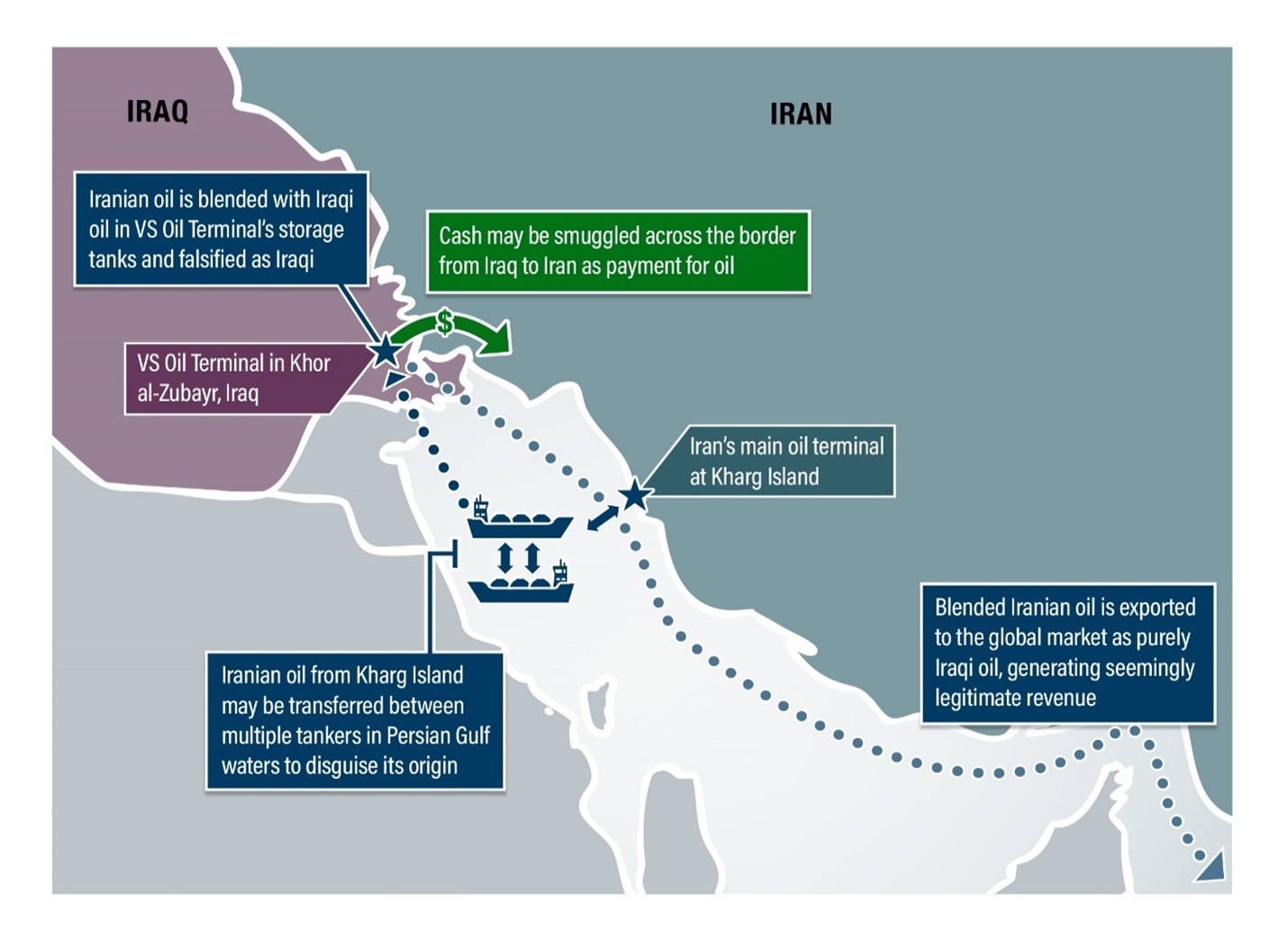
Said controls UAE-based company VS Tankers FZE (VS Tankers), despite avoiding formal association with the company. Formerly known as Al-Iraqia Shipping Services & Oil Trading FZE (AISSOT), VS Tankers has smuggled oil for the benefit of the Iranian government and the Islamic Revolutionary Guard Corps (IRGC). For example, in 2020, AISSOT reportedly brokered a deal to transport Iranian oil via Iraqi pipelines to be blended and sold as Iraqi oil.
VS Tankers-affiliated ships have assisted Iranian oil exporters in blending Iranian oil with Iraqi to obscure the oil's origins by engaging in ship-to-ship transfers with vessels known to be affiliated with Iranian oil activities. VS Tankers currently claims several oil tankers as part of its fleet, one of which recorded four ship-to-ship transfers with the U.S. sanctioned, Barbados-flagged CASINOVA (IMO 9280366) in April 2024 while located in the Persian Gulf near the mouth of the Shatt al-Arab river, which marks the border between Iraq and Iran. VS Tankers has served as the operator, manager, and beneficial owner of the Marshall Islands-flagged crude oil tanker DIJILAH (IMO 9829629) since 2019.
VS Tankers is being designated pursuant to E.O. 13902 for operating in the petroleum sector of the Iranian economy. DIJILAH is being identified pursuant to E.O. 13902 as property in which VS Tankers has an interest.
In 2023, Said expanded his business holdings to include VS Oil Terminal FZE (VS Oil), which, though registered in the UAE, has its physical presence in Khor al-Zubayr, Iraq. VS Oil manages six oil storage tanks where Iranian oil is dropped off to be mixed with Iraqi oil. Vessels carrying Iranian oil also conduct ship-to-ship transfers with vessels carrying Iraqi oil in the vicinity of VS Oil's terminal facilities, and the blended oil is ultimately authenticated by complicit Iraqi government officials. Vessel tracking data shows that multiple oil tankers known to transport Iranian petroleum products on behalf of U.S.-sanctioned Iranian oil and petrochemical broker Triliance Petrochemical Co. Ltd. and Iranian military front company Sahara Thunder have visited VS Oil. VS Oil employees smuggle hard currency into Iran via cars and trucks, some of which carry millions of dollars each, as payment for oil.
VS Oil is being designated pursuant to E.O. 13902 for operating in the petroleum sector of the Iranian economy.
Said also owns UAE-based VS Petroleum DMCC, formerly Ikon Petroleum DMCC, and Rhine Shipping DMCC (Rhine Shipping) which, in 2022, were implicated in blending Iranian oil to sell as Iraqi oil. Rhine Shipping was also previously exposed as the manager of the U.S.-sanctioned oil tanker MOLECULE, formerly named BABEL, which loaded oil in the Persian Gulf from an Iranian tanker that had turned off its location transponder to obfuscate the transaction. OFAC subsequently sanctioned the MOLECULE for its role in shipping Iranian oil as part of the network of Iran-backed Houthi financial official Sa'id al-Jamal.
Said also owns United Kingdom-based companies The Willett Hotel Limited and Robinbest Limited.
VS Petroleum DMCC, Rhine Shipping, The Willett Hotel Limited, and Robinbest Limited are being designated pursuant to E.O. 13902 for being owned or controlled by, directly or indirectly, Said.
Shadow fleet actors
Iran's shadow fleet enables the regime to transport its petroleum to generate revenue. Iran relies on non-sanctioned vessels to conduct ship-to-ship transfers and receive Iranian oil from sanctioned vessels before shipping the Iranian-origin cargo to buyers in Asia.
The National Iranian Tanker Company (NITC) uses Singapore-based Trans Arctic Global Marine Services PTE. LTD. (Trans Arctic Global) to arrange piloting services for NITC vessels transiting through the Strait of Malacca. Trans Arctic Global has enabled NITC to transport tens of millions of barrels of Iranian oil through the Strait of Malacca for eventual ship-to-ship transfers to vessels waiting in the Singapore Eastern Outer Port Limits.
Trans Arctic Global is being designated pursuant to E.O. 13902 for operating in the petroleum sector of the Iranian economy.
The Cameroon-flagged VIZURI (IMO 9197909), Comoros-flagged FOTIS (IMO 9306548), and Panama-flagged THEMIS (IMO 9264570) and BIANCA JOYSEL (IMO 9196632), have collectively shipped tens of millions of barrels of Iranian oil and other petroleum worth billions of dollars.
Since mid-2023, the VIZURI has completed multiple shipments of Iranian oil and transported millions of barrels of Iranian oil. Panama-flagged liquified petroleum gas carrier (LPG) FOTIS has transported millions of barrels of Iranian LPG and other petroleum to multiple locations. Panama-flagged THEMIS, which was sanctioned by the United Kingdom on May 9, 2025 for transporting Russian oil, has also transported Iranian oil.
Seychelles-based Egir Shipping Ltd, and Marshall Islands-based Fotis Lines Incorporated and Themis Limited are the respective owners of the VIZURI, FOTIS, and THEMIS. Egir Shipping Limited, Fotis Lines Incorporated, and Themis Limited are being designated pursuant to E.O. 13902 for operating in the petroleum sector of the Iranian economy. VIZURI, FOTIS, and THEMIS are being identified as blocked property in which Egir Shipping Ltd, Fotis Lines Incorporated, and Themis Limited, respectively, have an interest.
Panama-flagged BIANCA JOYSEL has transported more than ten million barrels of Iranian oil since mid-2024, conducting ship-to-ship transfers with sanctioned vessels owned by the U.S.-designated NITC, including the AMOR and STARLA.
British Virgin Islands-based Betensh Global Investment Limited And Dong Dong Shipping Limited owns the BIANCA JOYSEL. Betensh Global Investment Limited And Dong Dong Shipping Limited is being designated pursuant to E.O. 13902 for operating in the petroleum sector of the Iranian economy. BIANCA JOYSEL is being identified as blocked property in which Betensh Global Investment Limited And Dong Dong Shipping Limited has an interest.
IRGC-QF oil Sales
The IRGC-QF has used the Al-Qatirji Company to facilitate oil sales to customers around the world, generating hundreds of millions of dollars of revenue for the IRGC-QF. The Cameroon-flagged ELIZABET (IMO 9216717), which has impersonated a separate vessel, the S TINOS, loaded a cargo of Iranian oil off the coast of Malaysia in August 2024 via ship-to-ship transfer. The cargo had originally been loaded at Kharg Island, Iran, by the ROMINA (IMO 9114608), a vessel previously identified for its role in transporting Iranian petroleum for the Al-Qatirji Company. Seychelles-based White Sands Shipmanagement Corp. is the ship manager, operator, and technical manager of the ELIZABET.
The AI-Qatirji Company transported approximately two million barrels of Iranian oil on the Cameroon-flagged ATILA (IMO 9262754) in support of the U.S.-sanctioned Sa'id al-Jamal network. The ATILA received the oil in a ship-to-ship transfer with the sanctioned vessel ARMAN 114. The Iranian oil carried by the ATILA was disguised as Malaysian oil. Seychelles-based Grat Shipping Co Ltd is the manager, operator, and owner of the ATILA. OFAC designated Sa'id al-Jamal pursuant to E.O. 13224, as amended, on June 10, 2021, for having materially assisted, sponsored, or provided financial, material, or technological support for, or goods or services to or in support of, the IRGC-QF.
The Al-Qatirji Company has also used the Palauan-flagged GAS MARYAM (IMO 9108099) to transport Iranian petroleum products in support of the IRGC-QF. Liberia-based Dima Shipping & Trading Company is the manager, operator, and owner of the GAS MARYAM.
White Sands Shipmanagement Corp, Grat Shipping Co Ltd, and Dima Shipping & Trading Company are being designated pursuant to E.O. 13224, as amended, for having materially assisted, sponsored, or provided financial, material, or technological support for, or goods or services to or in support of the Al-Qatirji Company. The ELIZABET is being identified as blocked property in which White Sands Shipmanagement Corp. has an interest, the ATILA as blocked property in which Grat Shipping Co Ltd has an interest, and the GAS MARYAM as blocked property in which Dima Shipping & Trading Company has an interest.
SANCTIONS IMPLICATIONS
As a result of today's action, all property and interests in property of the designated or blocked persons described above that are in the United States or in the possession or control of U.S. persons are blocked and must be reported to OFAC. In addition, any entities that are owned, directly or indirectly, individually or in the aggregate, 50 percent or more by one or more blocked persons are also blocked. Unless authorized by a general or specific license issued by OFAC, or exempt, OFAC's regulations generally prohibit all transactions by U.S. persons or within (or transiting) the United States that involve any property or interests in property of blocked persons.
Violations of U.S. sanctions may result in the imposition of civil or criminal penalties on U.S. and foreign persons. OFAC may impose civil penalties for sanctions violations on a strict liability basis. OFAC's Economic Sanctions Enforcement Guidelines provide more information regarding OFAC's enforcement of U.S. economic sanctions. In addition, financial institutions and other persons may risk exposure to sanctions for engaging in certain transactions or activities involving designated or otherwise blocked persons. The prohibitions include the making of any contribution or provision of funds, goods, or services by, to, or for the benefit of any designated or blocked person, or the receipt of any contribution or provision of funds, goods, or services from any such person.
Furthermore, engaging in certain transactions involving the persons designated today may risk the imposition of secondary sanctions on participating foreign financial institutions. OFAC can prohibit or impose strict conditions on opening or maintaining, in the United States, a correspondent account or a payable-through account of a foreign financial institution that knowingly conducts or facilitates any significant transaction on behalf of a person who is designated pursuant to the relevant authority.
The power and integrity of OFAC sanctions derive not only from OFAC's ability to designate and add persons to the Specially Designated Nationals and Blocked Persons List (SDN List), but also from its willingness to remove persons from the SDN List consistent with the law. The ultimate goal of sanctions is not to punish, but to bring about a positive change in behavior. For information concerning the process for seeking removal from an OFAC list, including the SDN List, or to submit a request, please refer to OFAC's guidance on Filing a Petition for Removal from an OFAC List.
(Source: U.S. Department of the Treasury)
Posted in Iraq Industry & Trade News, Iraq Oil & Gas News, Security Comments Off on US Sanctions Iraqi-British National for Smuggling Iranian Oil

MEI: Iraq "tries to Assert State Authority during Crisis"
Posted on 29 June 2025 .
By Robert S. Ford for The Middle East Institute. Any opinions expressed here are those of the author(s) and do not necessarily reflect the views of Iraq Business News.
Iraq tries to assert state authority during crisis
The Iraqi government has long navigated a path between maintaining political ties with its Iranian neighbor and Tehran's allies inside Iraq on the one hand, and preserving its security relationship with the United States on the other.
Unsurprisingly, it quickly welcomed US President Donald Trump's June 23 Israel-Iran cease-fire agreement.
Posted in Politics, Security Comments Off on MEI: Iraq "tries to Assert State Authority during Crisis"

Petrel submits Proposal re Relinquished Block from 4th Licensing Round
Posted on 23 June 2025 .
By John Lee.
Irish-based Petrel Resources last week issued unaudited preliminary results for the year ending 31 December 2024.
The company, which announced a fundraising in March, said that it has submitted a proposal to undertake contractor obligations on a relinquished block from Iraq's 4th Bid Round, and has also prepared an updated development plan for the Merjan oil field. The company said it sees opportunities in recovering flared gas and liquids.
Full statement from Petrel Resources:
Highlights
Market overview
- 2024 set consumption records for oil and LNG consumption, but oil prices fell in early 2025 due to the 'Trump tariff war' triggering fears of reduced demand.
- Uncertainty increases risk and delays investment decisions.
- Available fiscal terms, however, reflect the boom conditions between 2003 and 2014 rather than current market conditions. States have been slow to update contractual terms to align interests, which deters development.
- Oil explorers are not yet attracting strong investor interest in western markets. Majors buy shares back and issue dividends rather than invest the c. $610 billion necessary to supply future demand.
Assets overview
- In Ghana, ratification discussions with the Ghanaian authorities on Tano acreage have re-commenced - though acreage adjustments are likely, and governance remains an issue.
- In Iraq, there may be early opportunities to recover gas and liquids currently being flared.
- Petrel submitted a proposal to undertake contractor obligations on a relinquished Block from the 4th Bid Round [Block 8].
- An updated Merjan oil field development proposal has been prepared.
- Iraqi oil output was c.4 million barrels daily in Spring 2025, with export growth constrained by contractual terms and OPEC+ agreements.
- Petrel seeks direct negotiations, where possible, rather than bid rounds, which are expensive and high risk, thus inappropriate for juniors.
Outlook
The board is considering expansion opportunities in oil & gas, and energy-related projects worldwide. Our group participates in the EU Commission's Critical Resource Minerals' Initiative, which offers attractive diversification given current market conditions. We offer an established record and potentially high liquidity and capital appreciation for the right story. As investors re-focus on 'hard industries' and cash flow, this is a time of opportunity.
Recent months remind investors of some eternal truths: market uncertainty has increased, amid armed conflict and trade wars. Western dependence on Chinese processing of Critical Resource Minerals means that efforts to reduce dependence on fossil fuels will not reduce exposure to distant sources and supply chains.
Policy-makers have discovered the limits of their bold dreams of a Green transition: energy costs have risen rather than fallen. The new technologies bring new headaches: electricity storage turns out to be prohibitively expensive for grid-scale coverage. EVs continue to penetrate markets but are price-competitive only in China. But developed economies prefer to protect their automotive sectors rather than import cheap Chinese EVs. In such policy myopia lies the roots of the next oil boom.
Like all previous energy transitions, Green sources turn out to be additive to rather than replacing traditional, reliable fuels - which will continue to dominate the 21st century:
During 2024/25 there were a serious of close-calls, power failures, and brown-outs globally, culminating in the Iberian black-outs of April 2025. These were not the routine power failures common in the global south, or planned "load-shedding" in South Africa.
These power failures were caused by over-dependence on intermittent renewable generation, allied with inadequate investment in legacy grids designed for centralised, reliable world-scale plants fuelled traditionally by coal, and then increasingly by nuclear and natural gas. The failure was not that of renewable generation per se, since hydro-power or geothermal generally provide reliable supplies.
The problem was with unpredictable intermittent generation, which produces Direct Current, rather than Alternating Current, and consequently does not deliver significant inertia to protect against periodic interruptions. Battery storage, is expensive and would require vast quantities of Critical Resource Minerals to adequately back a grid up. Traditional storage methods such as hydro are available for only a small percentage of demand. It turns out that the intermittent renewable generation on which the "Green transition" relies is only suitable for up to 30% of demand which is the natural surplus in electrical systems. Beyond that point, costs and risks soar.
This means that Natural Gas will continue to dominate electrical generation, both directly, and as essential back-up for the reliability modern economies require. In price-sensitive markets, coal will continue to dominate. Nuclear power is also an effective solution, but involves bureaucratic planning requirements, up-front costs, and is opposed politically in some developed societies.
Consumption data bear this out: recent years have seen record demand for oil and even coal. LNG is now 55% of total traded gas, helped by malicious damage to pipelines and the time needed to extend more gas pipelines to Asian consumers.
Markets are always transitioning, which is why an average 3.75% global economic growth translates into only 2.1% energy consumption growth due to greater efficiencies. But every energy transition in history has added new fuels rather than substituted them. Legislators are unlikely to achieve what market forces cannot.
And yet there has been a dramatic under-investment in reliable energy exploration & development since 2014. This is also true even of those Critical Resource Minerals necessary to fuel the new industries, which include Copper and Nickel as well as Lithium, Cobalt and the other 50-odd minerals.
To maintain adequate oil & gas supplies the world needs about $610 billion of investment (depending on materials' costs and rig-rates), but the industry invests only c.$360 billion - much of it in existing properties and basins of super-majors and National Oil Companies. There has been little frontier exploration since 2015. Most of the developing world is starved of investment. Instead, producers prefer to issue dividends and buy shares back.
Part of the reason is that politicians also display myopia about how to deliver effective exploration. Risk-investors require a risk-adjusted rate of return. The higher the uncertainty, the more return investors require. Best results are achieved by aligning interests, and linking taxes to profits, rather than requiring up-front payments, or royalties.
Formal bid rounds, involving up-front fees, qualification criteria designed for majors, and limited upside, are not how you expedite projects, keep cost control and optimise reservoir recovery. That is why Petrel prefers direct negotiations, where possible, after which we can bring partners via farm-ins.
But our industry is cyclical, and majors' caution offers opportunities for independents - who have always pioneered new approaches, from offshore drilling to fracking. So far, the emerging supply constraints have not filtered through to exploration & development. But when they do, there will be a sharp reversal in sentiment, rewarding those farsighted enough to develop attractive acreage ripe for exploitation.
We have received several approaches offering new oil & gas exploration projects but also in Helium and other energy-related projects. So far, all prospects have fallen short on legal title, price expectations, or financing terms. There is no value for Petrel shareholders in over-paying.
Petrel is an EU company, and our involvement in the EU Commission's Critical Resource Minerals' "Team Europe" has fostered relationships with industrial buyers, financing institutions and key decision-makers. There are surprisingly few juniors able to swim in all these seas.
In the meantime, there is market interest in Petrel's strong shareholder following and liquidity - especially at times of intense news-flow. Accordingly, we continue to explore expansion opportunities.
Financing
There are contrarian investors keen to fund the right project. As during the pandemic and previous times of turbulence, directors and their supporters are open to covering working capital needs, and are prepared to participate in any necessary, future fundings.
(Source: Petrel Resources)
Posted in Iraq Oil & Gas News 1 Comment