


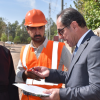
Cash-for-Work Project in Halabja
Posted on 05 December 2018 .
Cash-for-Work project in Halabja paves a safer and easier road to school for local children
42 host community members, IDPs and refugees employed to restore roads and walkways that will enable safe access to schools and markets for families in Halabja.
To neighbours in the communities of Azadi and Sirwan, in northern Iraq, paved roads mean much more than improved accessibility for cars. Once loose dust and rock, the road network connecting homes and markets posed a hazard for children during the regions season of heavy rainfall.
“They had to put those plastic bags and boots which was especially difficult for the kids to go to school,” described 15-year-old Shahad, an IDP from Baghdad.
“Especially in this area in winter we have a high rate of rainfall. And the land here was agricultural land before – so when it rains, it becomes mud, also posing health-hazards for pedestrians,” added Mr. Omed Noori Hama-Salih, Supervising Engineer, Municipality of Sirwan Subdistrict.
UNDP’s Iraq Crisis Response and Resilience Programme (ICRRP) recently supported a project that would enable the Governorate of Halabja to restore this essential basic service.
Following the launch in September, 42 individuals (host community members, internally displaced people (IDPs) and refugees) received temporary employment opportunities to work on the project as engineers, labourers and administrative support.
This project is one of 28 that were made possible with generous funding from the Federal Government of Germany, supporting the construction and restoration of critical services such as sewerage, electricity, water and roads for some 680,000 people across the Sulaimaniyah & Halabja Governorates and Raparin & Garmiyan Administrations, in the Kurdistan Region of Iraq.
In Azadi and Sirwan, IDPs, refugees and host community members are working together to improve the road and walkway networks for the benefit of all 1,500 community members. “In the past years, this was muddy and all children could not go to school easily and people could not go to do their services and visit market, but now when it will be paved of course it will ease our lives,” said Mr. Othman Aziz, a resident since 1978. “We consider that we will be having a new life because then our kids can go to school easily and our families will have an easy and nice access road to go and run their daily lives.”
Since 2014, Halabja Governorate has become host to more than 653 refugees and 7,177 IDPs, leaving their homes to find safety and security. Today, the pressure to ensure the provision of basic infrastructure and services is intensified by severe financial crisis, ultimately affecting the quality of life in the region for the host communities, as well as the IDPs and refugees they host.
In Azadi and Sirwan, IDPs, refugees and host community members are working together to improve the road and walkway networks for the benefit of all 1,500 community members. “In the past years, this was muddy and all children could not go to school easily and people could not go to do their services and visit market, but now when it will be paved of course it will ease our lives,” said Mr. Othman Aziz, a resident since 1978.
“We consider that we will be having a new life because then our kids can go to school easily and our families will have an easy and nice access road to go and run their daily lives.”
Since 2014, Halabja Governorate has become host to more than 653 refugees and 7,177 IDPs, leaving their homes to find safety and security. Today, the pressure to ensure the provision of basic infrastructure and services is intensified by severe financial crisis, ultimately affecting the quality of life in the region for the host communities, as well as the IDPs and refugees they host.
(Source: UNDP)
Posted in Construction & Engineering In Iraq, Iraq Education and Training News, Iraq Public Works News Comments Off on Cash-for-Work Project in Halabja

Ahmed Mousa Jiyad: Preview of a Special Issue on Iraq
Posted on 03 December 2018 .
By Ahmed Mousa Jiyad, Iraq/ Development Consultancy & Research, Guest Editor IJCIS-SI, Email: mou-jiya(at)online.no.
2018 is, in more than one aspect, rather an important year; It commemorates the 60 anniversary of 14 July revolution 1958; it registers thirty years of ending the eight years long Iran-Iraq war; it counts fifteen years of the country’ invasion by the Anglo-American lead troops; it also marks a ten year period of grand opening of the petroleum sector to foreign companies; it witnessed the almost end of the “triple shocks” that paralyzed the country and finally, it testifies a minor change of the dysfunctional democracy and plaguing Kleptocracy.
This is the “Introduction” I wrote, as the Guest Editor, for the special issue of the academic International Journal of Contemporary Iraqi Studies-IJCIS, due for release before year ends (by Intellect Books, UK)*
14 July 1958 revolution is still vivid in the memories of many of us who actually witnessed and lived that day and what followed to date. Much has been written about July Revolution during the six decades since that day, but for 2018 two important observations worth making.
First, despite a relatively short tenure of General Abd al-Karim Qasim government (14 July 1958 to 8 February 1963) its record of social economic and development achievements were not matched by achievements of all regimes since Qasim’ assassination, particularly those of post 2003. An article published on the local akhabaar news-site[1] lists most of Qasim achievements, which should make every post 2003 politician, decision maker, parliamentarian, minister among others feel ashamed.
Second, Iraq witnessed during July this year a popular mobilizations in all southern oil producing provinces protesting against lack of employment, deteriorated standard of living, insufficient basic social services especially electricity and safe drinking water and condemning the corruption in the country. In a way, July-September 2018 popular protest vindicates July 1958 revolution achievements comparative to the apparent failures of all post 2003 governments.
Thirty years ago Iran-Iraq war ended; a war that caused too much death, devastation, sufferings and pushed Iraq on the brinks of degeneration; further wars and sever comprehensive sanction led eventually to invading the country.
American and British troops invaded the country in 2003, toppled Sadam régime and, again, brought too much death and destruction but with dismantling most state institutions, inflict serious blows to social fabric and institutionalized sectarianism and ethnicity. Over these 15 years, much of oil export revenues were the target of an unprecedented cronyism and corruption, mostly Kleptocracy (defined here as formalized corruption by formal entities and influential political groups and oligarchy) with meager, if any, of actual economic and social development as manifested by spreading July 2018 demonstrations that left many dead, injured and good number of arrests.[2]
The security situation in Basra deteriorated dramatically on 4 September when the number of killed demonstrators rose to 9 with many more injured on both sides i.e. the demonstrators and security forces, and a number of local government building set on fire.[3] By 7 September number of fatalities in Basra increased to 15 dead and 190 injured with more building including private, foreign consulate and offices of some political parties put ablaze.[4]
Post 2003 democracy was basically confined to national and provincial elections, which were run on regular intervals, but none was without accusations, irregularities and corruption practices. National election of May 2018 has been the most challenged and precarious among them all. Election results were not approved until three months after the election day even with recounts and involvement of High Judicial Council and the Federal Supreme Court-FSC; the term of the parliament ended on 30 June and the new parliament remains in limbo and was not convened and thus nominating the heads of the presidencies was delayed and the same applies to forming the new government.
FSC approved the recounted results on 19 August 2018 indicating the start of the constitutional process for forming the new government. The new parliament was finally convened, amid rather a different and also divisive political landscape post 2003, on 3 September. Not until 16 September the election of the president of the parliament was elected and on 2 October Dr. Barham Salih was elected the president of the republic- representing serious setback for Barzani’s party- and on the same day Salih asked Adil Abdul Mahdi, a pro privatization, the Kurds and IOCs, to form the government within 30 days!
Provincial elections are scheduled for year ends unless they are impacted by the negative environment that tarnished the latest recent national election; the current political confused order would suggest strongly the likelihood of postponing the provincial election to further date. But these too were and could be subject to even more irregularities with influential forms within sectarianism, tribalism and religious personality cult. Moreover, the aftermath of July demonstrations could effectively impacts holding, the process and the outcome of the elections.
The local parliamentary election in Kurdistan Region in Iraq was held over 28-30 September and again with different contested claims on its transparency, credibility and results.
2018 marks ten years of the big-push strategy or grand opening of the upstream petroleum for foreign investment and direct involvement that validates, initially, the school of thoughts that invasion was all about oil but the actual development questions that validation. The big-push strategy began by converting a production sharing agreement, was concluded during Sadam’ era when Iraq was under the severest sanction in history, into a long term service contract.
That conversion sets the main premises of a hybrid model contract that was adopted through four major bidding rounds. However, upstream petroleum since the cabinet shift of August 2016 witnessed a departure from previous practices by the return of deals concluded behind closed doors, lack of transparency and adoption of a net revenues sharing model contract that gives IOCs much more a share than offered under the previous four bid rounds.
2018 witnessed the beginning of the end of the triple-shocks i.e., low oil prices, Da’esh presence and retaking Kirkuk back from KRG seizure.
Da’esh (or ISIS/ISL) began by controlling Mosul in mid-2014 then moved to many parts of other governorates particularly Kirkuk, Salahuldeen, Dayala, Al-Anbar and came close to Baghdad. That caused untold destruction, killing, internal displacement and threatened the security and integrity of the country. The military operations to defeat Da’esh drained serious part of the annual state budgets in addition to officially estimated $100 billion reconstruction requirements.[5]
What made the situation even more alarming and drastic are the dramatic decline in oil prices and the prevailed motion of “lower for longer” that coincided with Da’esh attacks. Iraq oil export prices per barrel declined from $102.61 in June 2014 to $22.21 in January 2016 then improved gradually to exceed $74 during September 2018.
Further deterioration in Iraq financial situation was caused by the cessation of Kirkuk oil export when KRG took control of the province’s oil facilities. Though that seizure ended during the fourth quarter of 2017, export from Kirkuk still on hold at the time of writing.
The work on this special issue took eighteen months of concerted efforts, follow-up and back and forth communication involving all editorial colleagues, publisher’s team, anonymous reviewers and contributors. Well-deserved sincere and wholehearted words of thanks and appreciation are due to all of them.
Ahmed Mousa Jiyad provides review of the development of the Iraqi petroleum sector during the period 2008-2018 as post 2003 period witnessed grand opening of the sector for International Oil Companies- IOCs, particularly for upstream sub-sector. The article argues that, analytically and empirically, a sub-sector focused policy impacts, negatively, the development in that sub-sector, in the sector itself and on the sector’s contribution to the development of the national economy. The outcomes would exacerbate structural imbalances, vulnerabilities to external factors and increase dependency on oil revenues, which prohibits desirable structural change, diversification and transformation.
He also highlights the presence and impacts of the “triple shocks” combined with the prospect of “lower-for- longer” oil price that prevailed almost a year ago, contributing to continue deepening the fiscal crisis of the state and elevated the “fear-factor” among Iraqi decision makers. That, with apparent human, systemic and institutional capacity-gaps limitations resulted in Iraq giving important concessions to IOCs without having tangible benefits in return.
Juman Kubba asserts that Iraq, over the past fifteen years, took huge leaps backwards. Thus, she argued it is very important for politicians, historians, experts and judicial bodies to analyse what happened, why it happened, who is responsible and how to hold them accountable. But what is more important now is to ensure that Iraqi society recovers from the calamities of the past fifteen years as well as the preceding thirty years; and that the country’s resources are used to serve Iraqis and provide them with good living conditions and never again be wasted and dissipated. Accordingly, here article focuses on the pathway of healing Iraqi society from the aftermath of decades of war, poverty and immense suffering.
Restoring good education and healthcare is the first step on the pathway of healing and recovery. Also, neutralizing and reversing several dangerous post conflict societal problems that have arisen over the years such as traumatized war children, war injured young men, drug abuse among youth and alarming increase in neoplastic disease just to name a few. Given the weakness of the government, corruption, and contradictions between legislation and jurisdiction, one must consider new non-traditional approaches to solving these problems; a few are presented in the article. The success of any future government should be measured by how much it can ameliorate the essential life sustaining services for ordinary citizens.
Monetary policy and particularly the role of the Central Bank have important function in the development of the country. Debating this issue, our late colleague Muwafaq Hassan Mahmood addresses four topics; the first offers an empirical examination of the performance of the banking sector during the period 2010-2015; the second discusses banking sector reform requirements; The third topic will shed light on: i) the environments under which the Iraqi banking industry operates highlighting the limitations and obstacles that impedes the sector’s growth and ii) the investment environment and whether it's an attractive for the business community to invest and doing businesses in Iraq. Finally, he examined the CBI’s dollar window impacts on the banking industry.
Human skills, systemic and institutional capacity gaps impact the performance of the petroleum sector and these have been the subject of international cooperation between Iraq and other entities e.g., countries, organizations and even companies. Usama Karim article focuses on one of such initiatives i.e., the establishment of the European Iraqi Energy Centre-EUIEC. He argues that knowledge acquisition and development leading to such endeavour is a process that takes long time and much resources needing meticulous planning. This process can be facilitated by the use of expertise and technology transferred by international companies and their networks engaged in ramping up energy production in Iraq.
EUIEC has four components, however, the article elaborates on the research component but Karim suggests that the final EUIEC organization, structure and facilities integrating all its components will require further efforts from the consultants, lead stakeholders and experts in setting up such complex endeavour building up on preliminary results from this study.[6]
Greg Muttitt article reviews what is now known about discussions of oil that took place during the invasion planning and execution, based on documents that have been released in the fifteen years since.
He examines the nature of the strategic objectives, how the US and UK governments planned to achieve them, and how they decided to talk about them in public. Reflecting on this evidence will allow us to revisit the question: was oil a major reason for the war and invasion of Iraq?
Federalism, an outcome of the regime change brought by the 2003 invasion and was enshrined in 2005 Constitution, needs fixing. Since 2003, Luay al-Khatteeb argues, Iraq’s experiment with federalism has in many ways benefitted Iraq, though, he asserts, functioning federalism was never given a chance to be tested in Iraq as there are various factors that have contributed to hinder the formation of a Federal Iraq. Thus, because implementation has been imperfect, it has not solved Iraq’s fundamental economic flaws, which promote the waste of oil revenues, promote oil revenue dependence and allow for local level corruption to flourish. This situation can still be remedied, he argued, but that requires time and may take generations to materialise.
Omar Eljoumayle article summarises his PhD dissertation in economic development of contemporary Iraq. The article traces the role of institutions, institutional policies and how the rapid and frequent institutional changes have driven the Iraqi economy for decades. Though applying the New Institutional Economic-NIE to Iraq expands the range of choices of institutions that could be examined, the choices have been narrowed down by revolving around three central issues: agriculture, oil and wars. The picture painfully presented is one of abrupt and instantaneous institutional changes, through which institutions were repeatedly subject to reshuffle and facing changing circumstances. Consequently these changes have severely affected the path of economic development in Iraq.
The book review part of this volume covers to recently published, in Arabic, important books: one on Iraq’s nuclear program and the other on the Iraqi economy.
While it gives me a great professional scholarly satisfaction to be the guest editor for this issue I regret to report that our colleague and contributor, Muwafaq Hassan Mahmood, passed away on 28 June 2018. Despite his illness and he and I knew he would be not with us for long, Muwafaq (Abu Rand) was very determined and enthusiastic to deliver his article and honors his commitment before leaving us. I have known Abu Rand since mid-sixties and his early departure was indeed a devastating painful loss. My colleagues, Professor Tareq Ismael (Calgary, Canada) and Professor Bill Haddad (California, USA), and I convey our wholehearted condolences to his family, friends and colleagues and we sincerely thank Muwafaq for his contribution to this special issue.
Ahmed Mousa Jiyad,
Guest Editor, IJCIS-SI,
Norway
4 October 2018
*Jiyad, Ahmed Mousa, Introduction, IJCIS, Volume 12, number 3, 2018 (forthcoming)
[1] 1958 revolution the 60th anniversary (Performance of Qasim in akhabaar http://www.akhbaar.org/home/2018/7/246337.html (in Arabic) accessed 14 July 2018
[2] As on 22 July the Iraqi Human Rights Commission announced 13 dead, 729 injured, including 460 from security forces, 757 arrested temporarily and release later and 91 government and private buildings and vehicles were damaged. http://www.akhbaar.org/home/2018/7/246645.html accessed 23 July 2018.
[3] As reported by IOR, 5 September 2018
[4] http://www.akhbaar.org/home/2018/9/248576.html Accessed 8 September 2018
[5] On Da’esh effect, Kuwait conference and cost of reconstruction see , $100 billion for reconstruction https://www.iraq-businessnews.com/2018/02/12/video-iraq-seeks-100bn-for-post-is-reconstruction/
[6] Actually, I was the leader of a team that prepared the “Formulation study for the EU-Iraq Centre for Economic Partnership and Business Cooperation (DCI-ASIA part)”, which was commissioned and funded by the European Commission-EC during the period January-June 2012. The study resulted in formulating and recommends the establishment of EUIEC with four major components: Research, Training, Energy Debate and Business Cooperation. The EC adopted our proposal and started the implementation in 2014 through the Service contract notice “Iraq-Baghdad: ICI+ — EU–Iraq energy centre (EUIEC) 2014/S 074-126988”
Mr Jiyad is an independent development consultant, scholar and Associate with the former Centre for Global Energy Studies (CGES), London. He was formerly a senior economist with the Iraq National Oil Company and Iraq’s Ministry of Oil, Chief Expert for the Council of Ministers, Director at the Ministry of Trade, and International Specialist with UN organizations in Uganda, Sudan and Jordan. He is now based in Norway (Email: mou-jiya(at)online.no, Skype ID: Ahmed Mousa Jiyad). Read more of Mr Jiyad’s biography here.
Posted in Ahmed Mousa Jiyad, Iraq Oil & Gas News Comments Off on Ahmed Mousa Jiyad: Preview of a Special Issue on Iraq

Gas Imports from Iran Interrupted
Posted on 28 November 2018 .
By John Lee.
Gas exports from Iran to Iraq have reportedly been interrupted as authorities in Iran repair pipeline damage caused during a recent earthquake.
The gas is used for electricity generation, with the cut reducing available power by 2,500 megawatts (MW).
Supplies are expected to be restored over the coming days.
(Sources: Iraq Oil Report, Reuters)
(Picture: Iran-Iraq gas pipeline during construction. Picture credit: Shana)
Posted in Iraq Industry & Trade News, Iraq Oil & Gas News Comments Off on Gas Imports from Iran Interrupted

GE, Standard Chartered, TBI close $600m Financing
Posted on 27 November 2018 .
By John Lee.
General Electric (GE), Standard Chartered Bank and the state-run Trade Bank of Iraq (TBI) are reported to have jointly closed a $600-million financing agreement to fund the ambitious electricity project 'Power Up Plan' in Iraq.
According to Trade Arabia, the project will be implemented in two phases, providing more than 2 gigawatts (GW) of new power, and ensuring continuity of supply of up to 6.7 GW to Iraq's grid.
The financing arrangement is said to be the largest bespoke Letter of Credit (LC) confirmation and discounting transaction of its kind in the region.
(Source: Trade Arabia)
Posted in Iraq Banking & Finance News, Iraq Industry & Trade News Comments Off on GE, Standard Chartered, TBI close $600m Financing

Iraq to remove Impediments to Infrastructure Investment
Posted on 26 November 2018 .
By John Lee.
Iraqi President Barham Salih has told an international conference in Rome that Iraq will remove any impediments to Iraqi and foreign private sector companies, as well as international financial institutions, donor countries and sovereign wealth funds, to invest in major infrastructure projects in the country.
He added that these projects may include deep port facilities in Basra, a highway network, new railways, airports, industrial cities and dams, and irrigation projects in the Nineveh Plain, Garamian, Erbil, as well as land reclamation in the south.
The following is the full text of the speech delivered by His Excellency President Barham Salih at the Conference of the Mediterranean Dialogues on Thursday afternoon, November 22, 2018:
Excellencies,
Distinguished Guests,
First of all, I’d like to thank the Italian Ministry of Foreign Affairs and ISPI for organizing this conference and the opportunity to address this distinguished audience. I also want to thank His Excellency President Sergio Mattarella and His Excellency Prime Minister Giuseppe Conte for their kind invitation to Italy.
Many may say there is nothing unique about the present day Middle East — we are living through yet another phase of conflict— as we have been plagued by conflict and powers struggles for much of our contemporary history.
However, the military defeat of DAESH and the formation of a new government in Baghdad may well represent a turning point not only for Iraq, but also potentially for the wider Middle East. Iraq has been the epicenter for change in Middle East- for millennia, Iraq has often been the catalyst, the precursor regional order— or disorder!
I dare say that there is now an opportunity to reorient Iraq’s trajectory and propel the country towards prosperity and stability. This will require embarking on fundamental internal reforms, both political and economic.
As such, Iraq is in need of an internal dialogue to address the underlying structural flaws at the crux of the post-2003 political order. Iraqis are indignant at years of conflict and the failure to deliver services. Restoring basic services like water and electricity, reconstruction of the devastated communities by the war with DAESH and repatriation of our IDPs to their homes is an urgent challenge. Corruption and abuse of public funds undermine the viability of the Iraqi state and sustains the cycle of conflict and terrorism. It is imperative to dry up the swamp of corruption.
The defeat of ISIS was undeniably a monumental challenge and impressive success for Iraqi armed forces— the Army, Police, Hashd Al Shabi mobilized by the fatwa of Ayatollah Sistani and Peshmerga forces fought side by side and have become battle hardened. In this context, we are grateful for the help rendered by our allies in the international coalition, led by the United States and which comprised many nations including our generous host Italy. The task ahead is to enhance our defense and intelligence capabilities, integrate our armed forces within the framework of our national defense institution and affirming accountability of all armed forces to the state.
There remain issues of contention between the Kurdistan Region and federal government— time to resolve these issues in a fundamental way through adhering to the constitution. There is renewed hope as the our new PM Dr Adil Abdul Mahdi and the Kurdistan leadership have pledged to move on to resolve these outstanding issues. The recent agreement to resume oil exports from Kirkuk to Ceyhan is a welcomed gesture in this context.
However, ending the crises that plague Iraq also require a reconstruction of the current political order to restore citizen trust in the government. A reformed political order must be based on the protecting constitution, the civil state that strengthens civic values, supports the role of women and their rights, and ensures a commitment to human rights.
A most important and consequential challenge for Iraq today is economic reform and regeneration. Iraq is endowed with immense natural resources, water and fertile land— and an indispensable geopolitical position that can become the hub for regional trade and economic integration. Yet decades of war, sanctions, conflicts, economic mismanagement and corruption have tuned Iraq into an extreme rentier state. This is unsustainable— we are today a 38 million population, and increasing at a rate of one million each year— youth unemployment is rampant— this is a profound security, social and development challenge.
The new government, led by Adil Abdul Mahdi, a pragmatic reformer and economist, is pursuing an ambitious economic restructuring agenda based on empowering the private sector and promoting investment. The unity of Iraq and its security is crucially dependent on strengthening infrastructure links within Iraq and with the neighborhood. This is imperative to bind the country together and to promote common interests with the neighbors and to ensure job opportunities for our youth.
Iraq will be eliminating impediments to Iraqi and foreign private sector companies, as well as international financial institutions, donor countries and sovereign wealth to invest in major infrastructure projects. These projects may include deep port facilities in Basra, a highway network, new railways, airports, industrial cities and dams, and irrigation projects in the Nineveh Plain, Garamian, Erbil, as well as land reclamation in the south. Similar experiences can be seen in Thailand, Vietnam and India, which attracted investment funding from sovereign wealth funds in Japan, China and the Gulf.
In addition to local economic growth, these projects could also contribute to regional economic prosperity. Iraq is an important strategic hub that joins the Arab world with Iran and Turkey and connects the economies of the Gulf and Europe. These could connect the countries of the region so that Iraq could become the heart of a new Silk Road to the Mediterranean.
But for Iraq to succeed and stabilize, it requires a regional order that can embrace and nurture its stability. Iraq has been the domain for regional power struggles— the rivalry over Iraq, and within Iraq, among regional and global actors have sustained and deepened Iraqi crisis. For the last forty years, Iraq has been moving from a war to a war, sanctions and terrorist onslaught and condemned to en ever deepening cycle of crises. This is got to end. It is time Iraq’s stability and prosperity is turned into a common intertest in the neighborhood. Iraq is an important country in the Arab world— This Arab anchor for Iraq is vital economically and politically, and we are emphatic about fully developing our relations with our Arab and Gulf neighbors. Our relations with Iran is also important, we share a border of 1400 km, and much social and cultural bonds — and it is in our national interest to promote good relations with Iran and alike with our northern neighbor, Turkey, which is undeniably an important economic geopolitical actor.
I just come back from a tour to our neighbors in Kuwait, UAE, Jordan, Iran and Saudi Arabia— our message was that Iraq is adamant to protect its independence and sovereignty— our priority is economic regeneration and jobs for our youth— and that we want Iraq’s stability, sovereignty and prosperity to be shared interests for the neighborhood. I made the point that Iraq’s prospects for success is real, but remains precarious, so it should NOT be burdened with further tensions and escalations in the neighborhood. The Middle East needs a regional order based on shared security interests in the face of violent extremists and also rooted in economic collaboration and integration. As in the past, sovereign Iraq with its geopolitical, cultural and economic relevance can be a catalyst for such an order.
I am sure many of you will consider this as too ambitious— perhaps mere wishful thinking. Europe did it after two devastating World Wars— many other regions of the world have moved away from decades of conflict. We must pursue this agenda for our region with vigor and determination— it is primarily our responsibility in the region— and our people deserve better. However, legions of unemployed youth, millions of IDPs in camps— poverty and conflict are the incubators for terrorism, extremism and yes immigrants fleeing our fertile an rich lands to come to the shores of Europe— this should also be shared global interest— certainly a European interest.
This conference theme is about youth and women empowerment. The agenda of reform in Iraq, and the vision for a durable regional order in the Middle East, is what will defeat violent extremism through providing education, meaningful job opportunities for our youth and prioritizing human development as a core aim for our governments and for the global powers.
Thank you.
(Source: Office of the Iraqi President)
Posted in Construction & Engineering In Iraq, Iraq Industry & Trade News, Politics, Security 2 Comments
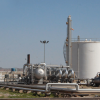
30% Gas Production Increase at Khor Mor Field
Posted on 22 November 2018 .
Dana Gas and Crescent Petroleum Announce 30% Gas Production Increase in Kurdistan Region
Dana Gas, the Middle East's leading publicly-listed regional natural gas company, and its partner Crescent Petroleum, have announced achievement of a 30% increase in production capacity at the Khor Mor field in the Kurdistan Region of Iraq, which the companies jointly operate on behalf of Pearl Petroleum.
This increase delivers much-needed gas supply to fuel power plants in the region, and marked a major milestone as the companies commemorate 10 years of continuous production in the region in a special ceremony with the Kurdistan Regional Government in Erbil.
The expansion at the Khor Mor gas processing plant consisted of a series of plant additions and modifications to de-bottleneck throughput, raising output capacity from 305 MMscfd of natural gas to 400 MMscfd, with over 15,000 barrels per day of condensate.
The Plant, which began operating in 2008, supplies natural gas from the Khor Mor field by pipeline to power plants in the towns of Chemchemal and Erbil, and will soon supply a new plant in Bazian. The Khor Mor Plant also produces LPG and NGL, which are sold and trucked to the local markets.
Under a Gas Sales agreement signed in January 2018 with the KRG Ministry of Natural Resources, Pearl Petroleum will sell the additional quantities of gas to supply the power stations with affordable, environmentally favourable fuel, and further enhance electricity supplies.
The plant expansion comes online as Pearl celebrates a decade of production in the KRI. At a ceremony in Erbil attended by Kurdish Regional Government Prime Minister Nechirvan Barzani, Minister of Natural Resources Dr. Ashti Hawrami, and other senior officials, Board Members and senior executives from the companies commemorated the partnership between the companies and the KRG in delivering progress and improved services to the people of the region over the past decade.
Total investment in the Kurdistan Gas Project to date exceeds $1.4 billion with total cumulative production over 250 million barrels of oil equivalent (boe), which has resulted in over $20 billion of fuel cost savings and economic benefits for the Kurdistan Region and Iraq as a whole. Further investment is underway to expand production to 900mmscfd per over the coming 3 years, together with associated liquids.
Mr. Majid Jafar, CEO of Crescent Petroleum and Board Managing Director of Dana Gas, commented:
"This production increase marks an important milestone as we also commemorate ten years of continuous production, and the beginning of a new chapter of expansion in operations and production which will see a further investment of over $600 million over the coming few years and a more than doubling of production again.
"The gas we have produced has led to significant fuel savings and social and economic value for the economy, and we hope to grow this in the years to come from the significant resources of these world class fields, for the benefit of the Kurdistan Region and all of Iraq."
Dr. Patrick Allman-Ward, CEO of Dana Gas, added:
"Despite many challenges over the past ten years we are proud to have maintained our production levels and operations and now with the settlement of all past receivables last summer and continuous payments since then, we look forward to significantly growing production to meet the growing demand for gas and electricity in the Kurdistan Region and Iraq as a whole."
In August 2017, Pearl Petroleum reached a full and final settlement with the KRG of the arbitration between them, including receiving $1 billion in cash from the KRG for past receivables and committing to expand their investment and operations in the region.
These expansion plans include a multi-well drilling program now underway in both the Khor Mor & Chemchemal fields, as well as installation of additional gas processing and liquids extraction facilities.
Operation full-time staff numbers are over 600 with over 80% local staff, and training programmes to increase this figure further. In addition, the companies has contributed to local communities with support for local power generation, education and healthcare facilities, as well as support programmes for internally displaced people in Iraqi.
The Kurdistan Gas Project was established in 2007 as Dana Gas and Crescent Petroleum entered into agreement with the Kurdistan Regional Government (KRG) for exclusive rights to appraise, develop, produce, market, and sell petroleum from the Khor Mor and Chemchemal fields in the Kurdistan Region of Iraq (KRI).
Production from the newly built plant in Khor Mor began 15 months later, in October 2008, an industry record. In 2009, Pearl Petroleum was formed as a consortium with Dana Gas and Crescent Petroleum as shareholders, and with OMV, MOL, and RWE joining the consortium subsequently with a 10% share each.
(Source: Dana Gas)
Posted in Iraq Oil & Gas News Comments Off on 30% Gas Production Increase at Khor Mor Field
Iraq Exemption from US Sanctions on Iran Energy
Posted on 08 November 2018 .
Iraq Granted Exemption from US Sanctions on Iran’s Energy Exports
Iraq will continue to have access to the energy it needs from Iran to generate and supply electricity, Brian Hook, the special representative for Iran at the US State Department, said.
“Iraq has been granted an exemption” to the energy sanctions the US has re-imposed on Iran, Hook said Monday on a media conference call without providing details.
Iraq is still importing natural gas and electricity from neighboring Iran and has set up a bank account to process payments in Iraqi dinars, according to two Iraqi government officials, who asked not to be identified because they’re not authorized to speak to media, Bloomberg reported on Tuesday.
Iraq’s central bank officials said in August that the country’s economy is so closely linked to Iran that Baghdad would ask Washington for permission to ignore some US sanctions.
Iraq imports crucial supplies from its neighbor including gas for power stations.
(Source: Tasnim, under Creative Commons licence)
Posted in Iraq Oil & Gas News Comments Off on Iraq Exemption from US Sanctions on Iran Energy
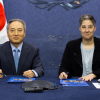
Korean Support helps Stabilize Newly Liberated Areas
Posted on 04 November 2018 .
The Government of the Republic of Korea and the United Nations Development Programme (UNDP) signed partnership agreement today for USD 5M million to support stabilization and recovery in newly liberated areas in Iraq.
Korea’s contribution will be channelled through UNDP’s Funding Facility for Stabilization (FFS) which finances fast-track initiatives in areas retaken from ISIL. This is Korea’s fifth contribution since 2015 to FFS.
Based on priorities identified by the Government of Iraq and local authorities, FFS helps quickly repair essential public infrastructure, boosts the capacity of local government, and provides short-term employment through public works schemes.
“Since Iraq was declared free from ISIL, significant progress across the country has been made – schools and hospitals have reopened, bridges are functioning, and water and electricity networks are up and running,” says UNDP Resident Representative for Iraq, Marta Ruedas.
“But we still have a long way to go – a number of key areas are in desperate need of stabilization efforts. We are very grateful to the Republic of Korea for this generous contribution. It comes at exactly the right time,” she adds.
H.E. the Korean Ambassador to Iraq, Mr. Song Woong-Yeob, said, “The Iraqi people have achieved a great victory in the war against ISIL, and have also exerted enormous efforts to stabilize and rehabilitate the affected area by the violence of the terrorist group. As a responsible member of the international community and a close friend of Iraq, the Republic of Korea is deeply committed to supporting the stabilization and recovery efforts in Iraq, and I firmly believe that our continuing support will contribute to laying the foundation for peace and prosperity in Iraq.”
UNDP’s Funding Facility is implementing over 2,800 projects in key areas of Anbar, Salah al-Din, Diyala, Kirkuk and Ninewa.
(Source: UNDP)
Posted in Construction & Engineering In Iraq Comments Off on Korean Support helps Stabilize Newly Liberated Areas

S Korea wins $500m Deal for Electricity in Iraq
Posted on 01 November 2018 .
By John Lee.
South Korea's STX Marine Service has reportedly won a contract to restore and operate diesel-fueled electric power plants in Iraq.
According to Yonhap, the company said the US$500-million deal will see it four 900-megawatt electricity generation units over five years.
It calls for 100 South Korean engineers to be dispatched by STX, along with the hiring of 500 local workers.
The company said work started on 1st July.
(Source: Yonhap)
Posted in Iraq Industry & Trade News Comments Off on S Korea wins $500m Deal for Electricity in Iraq
New Funds from US for UNHCR Iraq
Posted on 01 November 2018 .
UNHCR, the UN Refugee Agency, warmly welcomes the generous 2018 contributions from the Government of the United States of America, which reached a cumulative total of US$ 128.8 million for Syrian refugees and internally displaced Iraqis.
With the support of donors like the United States, UNHCR can continue to provide assistance to the millions of people who are still in need in Iraq.
While the country recovers from conflict, the needs of Iraqis diversify. Even as cities are rebuilt and communities begin to flourish, approximately two million people, many of them extremely vulnerable, are still displaced.
An essential component of the protection of displaced people is voluntary, safe, and sustainable return, which in turn is at the heart of the recovery and stabilization of Iraq. Sustainable return is an important step on the road to peace and stability.
Cities like Mosul and Ramadi were heavily damaged during the conflict. Restoring these cities is an immense task, and the work is far from over. In parts of West Mosul, Sinjar, the Ninewa Plains, and Anbar, rubble is not yet cleared of explosives and services like water and electricity are not fully functional. In such instances, conditions for sustainable return are not yet met. It is of the utmost importance that assistance for displaced Iraqis continues to avoid premature returns to these areas, which could result in further displacement.
At the same time, the communities hosting displaced people also face increased hardship, and resources are stretched. Without ongoing support, many among the displaced and hosting population would struggle to make ends meet. U.S. Ambassador Douglas Silliman commented: “The United States is deeply committed to providing life-saving humanitarian assistance to refugees in Iraq and Syria… [The U.S. Government] contribution will assist those who are not yet able to return home voluntarily, safely, and with dignity.”
“A year since the end of large-scale fighting in Iraq, our work is far from over,” said Bruno Geddo, UNHCR Representative in Iraq. “The wounds inflicted by years of conflict on people and communities will take a long time to heal. Major efforts are underway by the authorities, UN agencies and partners to support displaced Iraqis as they return. Rebuilding Iraq is not just about bricks and mortar, but the coming together of cohesive and inclusive communities, which will take time. With the extraordinary support of donors like the United States, UNHCR will continue to stand with the people of Iraq until the job is done.”
(Source: UN)
Posted in Iraq Public Works News, Security Comments Off on New Funds from US for UNHCR Iraq