


Russia's Gazprom to Develop Nassiriyah Oilfield
Posted on 08 February 2024 .
By John Lee.
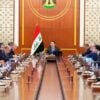
The Iraqi Cabinet has agreed to invite Russia's Gazprom to develop the Nassiriyah oilfield as a single contract.
While described in a statement from the Prime Minister's office as an "integrated development project", to be offered as a "single bid", it is not immediately clear if this is the originally proposed Nassiriya Integrated Project, which had reportedly been dropped following years of consideration. This would have included a major refinery.
The statement said:
"This decision exempts it from the justifications outlined in Article (3/Sixth) of the Government Contracts Implementation Instructions (No. 2 of 2014) and the accompanying standard documents."
It added:
"The Ministry of Oil will bear the responsibility for the accuracy, validity, and integrity of the contractual procedures."
(Source: Media Office of the Prime Minister)
Posted in Iraq Oil & Gas News, Politics Comments Off on Russia's Gazprom to Develop Nassiriyah Oilfield
Iraqi Airways cancels Flights between Baghdad and Moscow
Posted on 02 February 2024 .
By John Lee.
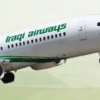
Iraqi Airways has announced that its scheduled flights between Baghdad and Moscow are cancelled, effective from 3rd February until further notice.
According to Iraq's Ministry of Transport, the cancellation is due to what it describes as, "operational reasons with the Russian side."
Passengers with reservations are advised to contact the airline for a refund.
(Source: Ministry of Transport)
Posted in Iraq Transportation News Comments Off on Iraqi Airways cancels Flights between Baghdad and Moscow

Iran's Non-Oil Exports to Iraq Up 30%
Posted on 19 January 2024 .
From Tasnim, under a Creative Commons licence. Any opinions expressed are those of the author(s), and do not necessarily reflect the views of Iraq Business News.
A member of the Iran-Iraq Joint Chamber of Commerce said that $6.2 billion worth of non-oil goods were exported from Iran to Iraq in the first eight months of the current Iranian calendar year (started March 21, 2023), registering a 30% hike compared to the same period in 2022.
Given the considerable increase in the bilateral trade exchanges, it is predicted that the country's export of products to Iraq will hit a new record of $10 billion by the yearend (to end March 20, 2024), Hamid Hosseini stated.
Speaking in an interview with IRNA, he pointed to some problems in the field of supplying currency in Iraq and said despite such issues, the trend of Iranian exports to this Arab country is on an upward trajectory.
Hosseini pointed out that about $775 million worth of products are currently exported from Iran to Iraq monthly.
Iraq is still considered Iran's second export target market, he stated.
Noting that Iraq banned the use of foreign currencies in its transactions as of the beginning of 2024, he said domestic importers of goods should provide their currencies at a higher rate.
He called on responsible officials to take effective measures to remove the trade barrier between the two countries in line with spurring trade and economic activities.
Earlier, the deputy governor of the Central Bank of Iran (CBI) for international relations affairs said offshore rial will become operational within the next few months to help economic activists do their transactions with any country in the national currency.
The offshore rial will be launched in neighboring Iraq and Afghanistan due to the extensive social relations and also the Russian Federation due to the finalization of a bilateral monetary pact, Mohsen Karimi added.
Posted in Iraq Industry & Trade News Comments Off on Iran's Non-Oil Exports to Iraq Up 30%

Fly Baghdad Banned from flying in EU
Posted on 02 December 2023 .
The European Commission updated the EU Air Safety List, the list of airlines that are subject to an operating ban or operational restrictions within the European Union, because they do not meet international safety standards. Ensuring the highest level of air safety for Europeans and all other travelling passengers is at the very heart of the Commission's aviation safety policy.
Following the latest update, Fly Baghdad has been included on the List. The basis for this decision is safety concerns identified by the European Union Aviation Safety Agency (EASA). These led to the decision not to grant Fly Baghdad a Third Country Operator (TCO) authorisation.
The update also reflects the decision to maintain the ban on air carriers certified in Nepal, in view of continued safety concerns identified during an assessment visit to Nepal on 11-15 September. However, the Nepal Civil Aviation Authority's proactive engagement and ongoing efforts to enhance its safety oversight capacity, were duly acknowledged during the EU Air Safety Committee meeting.
Following this update, a total of 129 airlines are banned from EU skies:
- 101 airlines certified in 15 States (Afghanistan, Angola (with the exception of 2 airlines), Armenia, Congo (Brazzaville), Democratic Republic of the Congo, Djibouti, Equatorial Guinea, Eritrea, Kyrgyzstan, Liberia, Libya, Nepal, São Tomé and Príncipe, Sierra Leone and Sudan), due to inadequate safety oversight by the aviation authorities from these States;
- 22 airlines certified in Russia, as well as 6 individual airlines from other States, based on serious safety deficiencies identified: Air Zimbabwe (Zimbabwe), Avior Airlines (Venezuela), Blue Wing Airlines (Suriname), Iran Aseman Airlines (Iran), Fly Baghdad (Iraq) and Iraqi Airways (Iraq).
Two additional airlines are subject to operational restrictions and can only fly to the EU with specific aircraft types: Iran Air (Iran) and Air Koryo (North Korea).
This update to the EU Air Safety List is based on the unanimous opinion of Member State aviation safety experts, who met in Brussels on 14 to 16 November 2023 under the auspices of the EU Air Safety Committee. This Committee is chaired by the European Commission with support from EASA. The European Parliament's Transport Committee also supports the update. Decisions under the EU Air Safety List are based on international safety standards, and notably the standards decreed by the International Civil Aviation Organization (ICAO).
(Source: EU)
Posted in Iraq Transportation News Comments Off on Fly Baghdad Banned from flying in EU

Russia "Takes Control of Iraq's Biggest Oil Discovery for 20 Years"
Posted on 30 November 2023 .
By Simon Watkins for the OilPrice.com. Any opinions expressed are those of the author(s), and do not necessarily reflect the views of Iraq Business News.
Russia Takes Control of Iraq's Biggest Oil Discovery for 20 Years
The Eridu field - part of Iraq's Block 10 exploration and development region - is the biggest oil find in Iraq in the last 20 years, and Russia wants to control all of it, alongside its chief geopolitical ally, China.
Posted in Iraq Oil & Gas News, Politics, Security 1 Comment

Tabaqchali: Assessing the Risks of a Wider Middle East Conflict
Posted on 07 November 2023 .
By Ahmed Tabaqchali, Chief Strategist of AFC Iraq Fund.
Any opinions expressed are those of the author, and do not necessarily reflect the views of Iraq Business News.
Assessing the Risks of a Wider Middle East Conflict
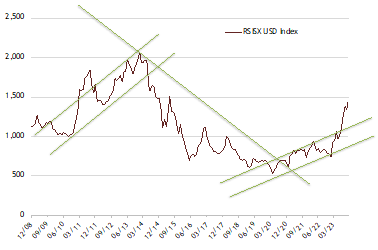
The market, as measured by the Rabee Securities US Dollar Equity Index (RSISX USD Index), was down 3.4% in October, and up 73.3% for the year. After a scorching four-month run in which the RSISX USD Index was up 43.7%, the market was ready for a pull-back. However, when it came, the pull-back was both short and shallow.
Average daily volume for the month was down by 22.2% versus that of the prior four months, while the market was in a range of up 2.0% to down 4.3%, with the declines driven by buyers holding back on chasing stocks as in the prior months.
These muted activities were reversed on the last day of October, with the banking sector resuming its momentum, which continued into the first few days of following month. By the end of the fifth trading day of November, the market had erased its October losses and is now higher than September's close (chart below).
While a few days do not make a month, the return of the banking sector's momentum and market leadership supports the investment thesis for the banking sector and the recent fundamental developments that gave it a boost, as discussed in "Banks to Fuel the Market's Next Phase" - especially in the current context in which global markets are assessing the risks of a wider Middle East conflict.
Rabee Securities US Dollar Equity Index
 (Source: Rabee Securities, AFC Research, data as of November 7th)
A wider Middle East conflict that would destabilise the region with repercussions for the world economy have been the subject of intense media coverage and extensive analysis over the last few weeks (*). Consequently, the current flurry of the U.S.' diplomatic initiatives aims to avoid such a conflict, and reinforces the ongoing behind-the-scene activities of the countries in the region, working with the main world powers in seeking to contain the conflict. It's difficult to forecast how the ongoing Gaza invasion and conflict containment initiatives will unfold over the coming weeks, however, the contours of an-emerging post-conflict world order, irrespective of its conclusion, are becoming increasingly clear.
The sharply contrasting responses of the West versus those of the Global South, to the unprecedented humanitarian crisis that is unfolding in Gaza, have crystalised the divide between them that materialised post the invasion of Ukraine. This divide is solidifying an emerging unbalanced multi-polar world in which power is diffused unequally between multiple powers, as was evident from the Global South's responses to the West's sanctions on Russia following the invasion of Ukraine. Most notably, in the diversion of Russian oil and gas from Europe to Asia and the subsequent changed supply-demand dynamics of energy markets, with their ongoing implications for the global economy that extend far beyond these markets.
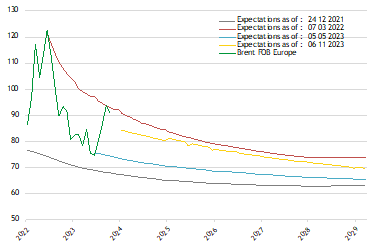
In the meantime, oil markets, as measured by Brent crude futures contracts, are discounting elevated oil prices (yellow line-chart below) that are very close to those that they were discounting immediately following the invasion of Ukraine (red line-chart below). The key difference between the two is that the latest expectations are at the end of two weeks of back-to-back oil price declines in which oil markets have begun to discount a contained conflict, and which were reinforced by events that lowered the fears of a wider Middle East conflict. As such, there are not a great deal of supply-hit fears built into these expectations, and so they are a realistic indication of the near-term price expectations of this emerging unbalanced multi-polar world.
Market Expectations for Future Oil Prices
As measured by Brent Futures Contacts (USD per barrel)
(Source: Wall Street Journal, AFC Research, data as of November 6th)
The current environment has implications for the risk-reward profile for investments in Iraq's equity market. On the risk part of the equation, the potential escalation of the ongoing invasion of Gaza into a wider Middle East conflict could threaten the relative stability that has marked Iraq over the last few years, irrespective of its distance from the conflict or of the non-existent possibility that it would be drawn into it as a combatant. While on the reward part of the equation, the changed geopolitical landscape of a multi-polar world is very positive for Iraq's economic outlook, given its extreme leverage to oil prices. Current expectations of Brent crude prices of USD 83 per barrel (/bbl) in 2024, and USD 79/bbl in 2025, would provide the government with the wherewithal to follow through with its expansionary three-year budget for 2023-25. The budget's sizeable liquidity injections into the non-oil economy should drive economic growth that would feed into meaningful growth in corporate profits, which in turn would sustain the market's current rally, as discussed here last month.
Notes:
(*) Foreign Policy Podcast featuring Kim Ghattas and Steven A. Cook on the chances of a broader conflict, 3rd November 2023. https://foreignpolicy.com/podcasts/foreign-policy-live/regional-reverberations-from-israels-war-on-hamas/
Please click here to download Ahmed Tabaqchali's full report in pdf format.
Mr Tabaqchali (@AMTabaqchali) is the Chief Strategist of the AFC Iraq Fund, and is an experienced capital markets professional with over 25 years' experience in US and MENA markets. He is a Visiting Fellow at the LSE Middle East Centre, Senior Fellow at the Institute of Regional and International Studies (IRIS), and a Senior Non-resident Fellow at the Atlantic Council. He is also a board member of Capital Investments, the investment banking arm of Capital Bank in Jordan.
His comments, opinions and analyses are personal views and are intended to be for informational purposes and general interest only and should not be construed as individual investment advice or a recommendation or solicitation to buy, sell or hold any fund or security or to adopt any investment strategy. It does not constitute legal or tax or investment advice. The information provided in this material is compiled from sources that are believed to be reliable, but no guarantee is made of its correctness, is rendered as at publication date and may change without notice and it is not intended as a complete analysis of every material fact regarding Iraq, the region, market or investment.
Posted in Ahmed Tabaqchali, Investment Comments Off on Tabaqchali: Assessing the Risks of a Wider Middle East Conflict
Lukoil Extends Contract at Iraq's West Qurna 2 Oilfield
Posted on 02 November 2023 .
By John Lee.
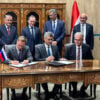
Russian oil firm Lukoil has signed an agreement extending its contract at Iraq's West Qurna 2 oilfield by 10 years, taking it to 2045.
Full statement from Lukoil:
The representatives of PJSC LUKOIL and Basra Oil Company signed a Supplementary Agreement to the contract on the development and production of oil at the West Qurna-2 field. The singing took place in Baghdad. The agreement provides for better conditions and prolongation of the service contract for 10 years (until 2045), investments into further development of the project, and gradual doubling of the field's output with plateau level reaching 800 thousand barrels per day. This will result in an increase in the economic efficiency of the West Qurna-2 project.
The field development plan envisages bringing new multi-well pads into production, commissioning oil treatment facilities and complex gas treatment facilities for the Yamama formation, construction of export pipelines and water flooding units, as well as expansion of the tank battery.
The development of the West Qurna-2 project under the Supplementary Agreement will promote creation of new jobs for Iraqi citizens. Under the agreement LUKOIL also aims to construct social infrastructure facilities for the locals.
The conclusion of the Supplementary Agreement is a next step in the long-term strategic partnership between LUKOIL and the Ministry of Oil of Iraq, as well as confirms the parties' commitment to continue their joint work on the development of the energy sector of the country.
(Source: Lukoil)
Posted in Iraq Oil & Gas News Comments Off on Lukoil Extends Contract at Iraq's West Qurna 2 Oilfield
Iraqi Oil Minister meets with Gazprom Officials in Russia
Posted on 14 October 2023 .
By John Lee.
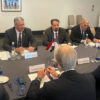
During his official visit to the Russian Federation, Deputy Prime Minister for Energy and Oil Minister, Hayan Abdul Ghani, met with Alexander Dyukov, Chairman of Gazprom Neft's Board of Directors, along with other company officials. The Russian Ambassador to Iraq, Elbrus Kutrashev, also attended the meeting.
The discussions primarily revolved around bilateral cooperation prospects and the development of joint projects aimed at enhancing Iraq's oil and energy industry.
According to a statement from Iraq's Ministry of Oil, this collaboration serves mutual interests. Among the attendees were Ali Maaraq, the Ministry's Deputy for Distribution Affairs, Hamdan Awijil, Ministry Advisor, and Hussein Kazem Laibi, General Director of the Maysan Oil Company (MOC).
Representing Gazprom Neft were Vadim Yakovlev, Deputy General Director, Renat Bakitov, Executive Director of Gazprom in Iraq, Vyacheslav Nikonurov, Head of International Relations, and Konstantin Abramov, International Relations Officer.
This meeting took place during the official visit of the Deputy Prime Minister for Energy and Oil Minister to the Russian Federation. It underscores the commitment to enhancing cooperation between Iraq and Russia in the energy and oil sectors.
Gazprom Neft operates the Badra oilfield in Wassit province, in eastern Iraq.
(Source: Ministry of Oil)
Posted in Iraq Oil & Gas News Comments Off on Iraqi Oil Minister meets with Gazprom Officials in Russia
Iraqi PM meets with Putin in Moscow
Posted on 11 October 2023 .
By John Lee.
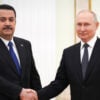
Iraqi Prime Minister, Muhammad Shiaa Al-Sudani, arrived in Moscow on Tuesday for a meeting with the President of the Russian Federation, Vladimir Putin, as part of his official visit to the country.
According to a statement from the Media Office of the Iraqi Prime Minister, the meeting included discussion of the development of the oil industries sector and the presence of Russian oil companies in Iraq.
The Kremlin said in a statement:
"The energy sector is certainly the main aspect of our collaboration. Our largest companies operate rather successfully in your country. Our companies have invested a total of about $19 billion, and our collaboration, already quite effective in this area, is only going to expand.
"We coordinate our work within the OPEC + format, and we are doing this rather successfully in order to stabilise the situation on global markets. On the whole, we are enjoying much success, and I hope that we will continue working in this manner moving forward."
(Sources: Media Office of the Iraqi Prime Minister, The Kremlin)
Posted in Investment, Iraq Industry & Trade News, Iraq Oil & Gas News, Politics, Security Comments Off on Iraqi PM meets with Putin in Moscow

Russian Business Leader discusses Opportunities in Iraq
Posted on 05 October 2023 .
By John Lee.
Dr. Qahtan Taha Khalf, the Ambassador of the Republic of Iraq in Moscow, met with Alexey Repik, the President of Business Russia, on Tuesday.
Business Russia describes itself as "an All-Russia Public Organization which represents the interests of private non-resource businesses - local industry leaders."
During the meeting, they discussed ways to enhance trade and industrial relations, explore investment opportunities, and increase trade between the two countries.
Additionally, they addressed the Development Road Project and the potential for leveraging the expertise of leading Russian companies in residential complex construction.
(Sources: Ministry of Foreign Affairs, Business Russia)
Posted in Iraq Industry & Trade News, Politics, Security Comments Off on Russian Business Leader discusses Opportunities in Iraq