



Iraq's Asiacell appoints US-based firm for Data Governance
Posted on 29 January 2023 .
By John Lee.
Mobile phone service Asiacell has reportedly appointed US-based LigaData to implement a new Data Governance Framework and Data Governance Center of Expertise.
According to a press release, the partnership will enable more innovative digital services for Asiacell's 17 million subscribers and significantly improve the organization's return on investment from existing data infrastructure.
Asiacell is the Iraqi subsidiary of Qatari mobile telecoms group Ooredoo.
(Source: Zawya)
Posted in Iraqi Communications News Comments Off on Iraq's Asiacell appoints US-based firm for Data Governance
Gulf Cup: Iraq draws closer to Arab Neighbours
Posted on 05 January 2023 .
From Amwaj Media. Any opinions expressed are those of the author(s), and do not necessarily reflect the views of Iraq Business News.
Gulf Cup gives Iraq chance to draw closer to Arab neighbors
Iraq is about to embark on a new chapter in its sporting history. From 6th-19th January, Basra will host the 25th edition of the Arabian Gulf Cup (AGC), a biennial football tournament amongst Gulf Arab states.
Iraq will be the venue of a major international football competition for the first time since it both hosted and won the AGC in 1979.
Eight regional teams-Bahrain, Iraq, Kuwait, Oman, Qatar, Saudi Arabia, the United Arab Emirates, and Yemen-will participate in the tournament.
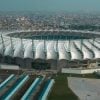
Matches will take place at the Basra International Stadium and the Al-Minaa Olympic Stadium (pictured), venues with capacities of 65,000 and 30,000 spectators respectively.
The full article can be viewed here (registration required).
Posted in Leisure and Tourism in Iraq, Politics Comments Off on Gulf Cup: Iraq draws closer to Arab Neighbours
Partners voice Support for Iraq at Conference in Jordan
Posted on 22 December 2022 .
Joint communiqué/Baghdad Conference for Cooperation and Partnership 2022
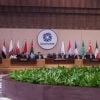
In light of the decision taken at the conference held in Baghdad on 28 August 2021, and at the invitation of His Majesty King Abdullah II, in coordination with His Excellency President Emmanuel Macron of the French Republic and His Excellency Prime Minister Mohammed Shia al-Sudani of the Republic of Iraq, the Hashemite Kingdom of Jordan hosted the Baghdad Conference for Cooperation and Partnership in its second round at the Dead Sea on 20 December 2022.
Participants in the conference expressed appreciation to the Hashemite Kingdom of Jordan for hosting the conference. Jordan and Iraq also thanked the French Republic for its role in coordinating the launch of the conference and participating in two rounds.
The participants reaffirmed the continuation of efforts to build on the outcomes of the first round of the Baghdad Conference and step up cooperation with Iraq, in support of its security, stability and sovereignty, as well as its democratic and constitutional processes, in addition to its efforts to promote dialogue as the means to resolve regional differences. They also underscored their solidarity with Iraq in the face of all challenges, including terrorism, over which Iraq, through great sacrifices and with international and regional cooperation, achieved a historic victory. The participants reaffirmed their condemnation of extremism and terrorism in all its forms.
The participants renewed their support for Iraq in its efforts to bolster the Constitution, the rule of law, and good governance, while building institutions capable of proceeding on the path towards further progress, reconstruction, safeguarding achievements, and meeting the aspirations of its people.
The participants stressed their support for Iraq's efforts to achieve comprehensive development, and working with it to build economic integration, by cooperating across a multitude of sectors, including energy, water, electric connectivity, food and health security, transportation, infrastructure and climate action.
In this context, the participants highlighted the importance of the trilateral cooperation framework between Jordan, Egypt and Iraq, and the joint economic projects agreed on through this mechanism, including electric connectivity projects. They also stressed the importance of joint projects between members of the Gulf Cooperation Council and Iraq in the fields of electric connectivity and transportation, as well as other regional projects that contribute to economic integration, development, and building bridges with global markets, while reflecting positively on the entire region.
In addition, the participants stressed that holding a conference in its second round underlines keenness on supporting Iraq's central in expanding regional economic cooperation and building bridges of dialogue to end tensions and establish cooperation regional relations of mutual benefits. The participants also reaffirmed that achieving economic development and succeeding in regional cooperation projects require building constructive regional ties on the basis of good neighbourliness and non-intervention in the internal affairs of states, as well as respecting international law, and cooperating in maintaining security and stability, countering terrorism, and achieving prosperity.
The participants reviewed the ramifications of regional and international crises on Iraq and the region, stressing that overcoming these crises requires comprehensive regional cooperation, and serious and efficient economic and political approaches that serve mutual interests, support the development process in Iraq, and contribute to regional development.
Furthermore, the participants stressed the importance of holding the third round of the conference, which was launched through Iraqi-French organization, with the participation of the Hashemite Kingdom of Jordan, the United Arab Emirates, the Islamic Republic of Iran, the Kingdom of Bahrain, the Republic of Türkiye, the Kingdom of Saudi Arabia, the Sultanate of Oman, the State of Qatar, the State of Kuwait, the League of Arab States, the Organization of Islamic Cooperation, the Gulf Cooperation Council, the United Nations, and the European Union. The participants agreed to hold the third round of the conference next year, on a date and in a location to be determined through consultations among them.
The Hashemite Kingdom of Jordan expressed appreciation for the active participation of heads of Arab and friendly states, in addition to foreign ministers and representatives of regional and international organizations, welcoming the genuine keenness to bolster cooperation in light of challenges that have made joint systematic action an urgent necessity for safeguarding mutual interests, and an efficient means towards fulfilling the aspirations of peoples to build a more secure, stable and prosperous future.
(Source: French Ministry for Europe and Foreign Affairs)
Posted in Investment, Iraq Industry & Trade News, Politics, Security Comments Off on Partners voice Support for Iraq at Conference in Jordan
Gulf Bridge routes Internet Connection through Iraq
Posted on 03 November 2022 .
By John Lee.
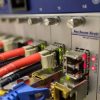
Qatar-based cloud, connectivity and content enabler Gulf Bridge International (GBI) has reportedly updated the 'North Route' of its subsea cable meshed smart network, connecting the Gulf to Europe through Iraq.
According to Zawya, this improves route diversification and enhances the resilience of internet connectivity to and from the region.
It says it will also help the region prepare to meet the expected increase in internet traffic related to the soccer World Cup, which will start this month in Qatar.
(Source: Zawya)
Posted in Iraq Industry & Trade News, Iraqi Communications News Comments Off on Gulf Bridge routes Internet Connection through Iraq

Qatar to Open Consulate in Erbil
Posted on 13 October 2022 .
By John Lee.
The Iraqi Cabinet has adopted the recommendation of the Ministry of Foreign Affairs regarding the opening of a Qatari general consulate in Erbil.
Iraq reserves its right to open an Iraqi consulate in Qatar in the future, according to the principle of reciprocity.
(Source: Iraqi Cabinet)
Posted in Iraq Industry & Trade News, Politics Comments Off on Qatar to Open Consulate in Erbil
Iraq Stock Market Report
Posted on 30 September 2022 .
Advertising Feature
Rabee Securities Iraq Stock Exchange (ISX) market report (week ending: 29th August 2022).
Please click here to view a table of listed companies and their associated ticker codes.
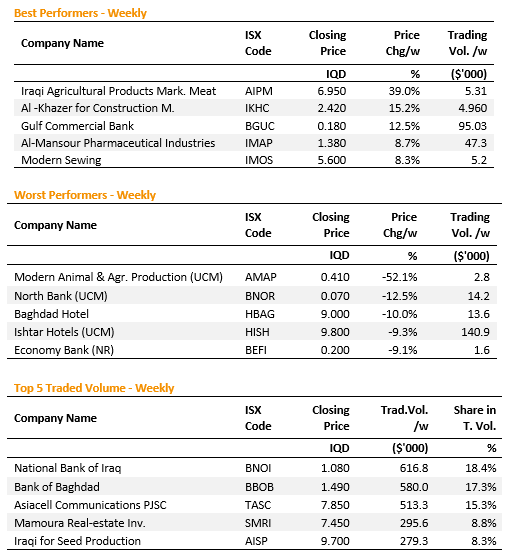
The RSISX index ended the week at IQD964 (+2.5%) / $845 (+2.9%) (weekly change) (+5.0% and +5.0% YTD change, respectively). The weekly trading volume was IQD5.0 bn ($3.4 mn).
ISX Company Announcements
- Qatari mobile telecoms group Ooredoo is planning to sell its portfolio of transmission towers, which includes those owned by its Iraqi subsidiary Asiacell (TASC). Media sources suggest that this will be done on a sale-and-leaseback basis, and that the portfolio may be split by country. (Iraq Business News)
- Moody's has assigned first time local currency long-term/short-term deposit ratings of B3/NP for National Bank of Iraq (BNOI), and foreign currency long-term/short-term deposit rating of Caa1/NP. All long-term deposit ratings carry a stable outlook. Deposit ratings takes into consideration the Moody's expectation of high level of support from the parent bank, Capital Bank of Jordan. BNOI's Caa1 foreign currency deposit rating is capped by the country's foreign currency ceiling. NBI's caa2 BCA reflects Moody's expectations that the bank will maintain its strong funding profile and liquid buffers, supported by relatively solid risk management and corporate policies in line with the parent's practices. These strengths are balanced by weak levels of capitalization pressured by rapid asset growth, volatile bottom-line profitability and high borrower and deposit concentrations which could increase the bank's vulnerability at times of stress, notably in a difficult operating environment. (Moody's)
- Kuwait Finance House (KFH) has acquired 97.3% of Bahrain's Ahli United Bank (AUB) at a value of $10.9 bn (KWD 3.4 bn), according to a statement issued Sunday by SICO, an asset manager that acted as the cross-listing advisor on the deal. AUB is the major shareholder at Commercial Bank of Iraq (BCOI) with 80.3% share. (Forbes Middle East)
- Subscription on the remaining shares of Ready-Made Clothes (IRMC) (by the public) from the capital increase to IQD3.2 bn through 100% rights issue started on Sep. 26.
- Stocks that resumed / will resume trading:
- Original shares of Modern Animal and Agricultural Production (AMAP) resumed trading on Sep. 25 after holding its AGM (Sep. 15) in which they discussed and approved 2021 annual financial statements and decided to increase the capital to IQD20.5 bn through 400% rights issue and approving amending the name of the company by adding an activity of "Trade and Industry of Foodstuffs".
- Asia Al Iraq Islamic Bank for Investment (BAIB) resumed trading on Sep. 26 after being suspended from trading for its AGM (Sep. 20) in which they discussed and approved 2021 annual financial statements.
- Gulf Insurance and Reinsurance (NGIR) resumed trading on Sep. 26 after holding its AGM (Sep. 18) in which they discussed and approved 2021 annual financial statements.
- Baghdad for Packing Materials (IBPM) resumed trading on Sep. 28 after holding its AGM (Sep. 26) in which they discussed and approved 2021 annual financial statements.
- Stocks that were suspended / will be suspended from trading:
- ISX will suspend trading of Al-Ataa Islamic Bank for Investment & Finance (BLAD) starting Oct. 13 due to the AGM that will be held on Oct. 18 to discuss and approve 2021 annual financial statements.
https://www.facebook.com/RabeeSecurities
Posted in Investment Comments Off on Iraq Stock Market Report

Asiacell to sell Mobile Phone Transmission Towers
Posted on 27 September 2022 .
By John Lee.
Qatari mobile telecoms group Ooredoo is planning to sell its portfolio of transmission towers, which includes those owned by its Iraqi subsidiary Asiacell.
Media sources suggest that this will be done on a sale-and-leaseback basis, and that the portfolio may be split by country.
According to Reuters, Morgan Stanley is advising on the sale.
The full statement from Ooredoo is as follows:
"In line with its evolved strategy to shift towards an asset-light model, Ooredoo Q.P.S.C. (QSE: ORDS) ("Ooredoo") today announced that it is preparing for a potential carve out of its tower portfolio to extract optimal value from its infrastructure and create more value for customers and shareholders.
"The company's tower portfolio comprises about 20 thousand towers spread across the countries where it operates. This transaction will allow the company to work on a deal that is suitable for target markets, attract third tenant business and create efficiencies.
"As part of the process, Ooredoo will explore strategic options that will unlock significant capital and maximise value for shareholders."
(Sources: Ooredoo, Mobile Europe, Reuters)
Posted in Investment, Iraqi Communications News Comments Off on Asiacell to sell Mobile Phone Transmission Towers

Qatar signs Grid Interconnection agreement with Iraq
Posted on 02 August 2022 .
Qatar Fund for Development (QFFD) cooperates with the Gulf Cooperation Council Interconnection Authority (GCCIA) to develop the Gulf electricity interconnection system and connect it to the southern Iraq network.
QFFD signed an agreement with the Gulf Cooperation Council Interconnection Authority to develop the Gulf electricity interconnection system and to connect it to the southern Iraq network.
This agreement aims to contribute to cover part of the demand for electricity and fulfilling its need, as well as improving the performance and stability of the electricity network in the southern region of the Iraq Republic.
By constructing a new transformer substation with a capacity of about 400 KV in the Wafra area in Kuwait and connecting it to the Gulf electricity interconnection system to the Iraqi electricity network thorough Al-Faw electricity transformer station in southern Iraq.
On this occasion, His Excellency Mr. Khalifa bin Jassim Al-Kuwari, Director General of Qatar Fund for Development, said:
"Together, in partnership with he Gulf Cooperation Council Interconnection Authority, we seek to extend electricity to our brothers in southern Iraq. As electricity support will play a fundamental and pivotal role in strengthening the vital basic sectors and supporting them to complete Its work, such as the health sector, which will in turn provide health services to a large number of patients, in addition to strengthening the educational sector such as schools and universities. This initiative will have a pivotal role in the economic contribution and infrastructure development."
His Excellency the CEO of the Gulf Electricity Interconnection Authority, Eng. Ahmed bin Ali Al-Ibrahim, that the electrical connection has achieved economic savings for the GCC countries of nearly 3 billion dollars since the full operation of the project, while avoiding any major interruptions in the Gulf networks since the start of operation in 2009, which has a significant impact on the continuity of electricity and its great impact on society and The economic and industrial sector in the GCC countries.
The project is being implemented by the GCC Electricity Interconnection Authority, which owns and manages the Gulf electrical interconnection network, and it is one of the most important infrastructure link projects approved by the Gulf Cooperation Council.
Among the benefits achieved by the project are reducing the required reserve in each country, mutual coverage in case of emergency, benefiting from the surplus, and reducing the cost of producing electric power among the GCC countries. Network connectivity operation.
The authority considers that the signing of the interconnection agreement with the electricity network in southern Iraq, which coincided recently with the Jeddah Summit for Security and Development on July 15, 2022, is one of the most important strategic projects in the GCC countries, which will start implementation work during the month of August, hoping to operate the connection with the summer of 2024.
It is worth noting that the Gulf Electricity Interconnection Project achieved its most important strategic objectives of enhancing energy security and raising the level of reliability and safety for the Gulf electrical systems, and its success in avoiding the GCC electricity networks for any partial or total interruption by 100% by providing instant support by transferring the required energy through the network The electrical connection directly, as more than (2,500) support cases have been supported since its operation.
(Source: Qatar Fund for Development)
Posted in Iraq Industry & Trade News Comments Off on Qatar signs Grid Interconnection agreement with Iraq
Prime Minister: Iraq is finding its Own Footing
Posted on 14 July 2022 .
By John Lee.
Writing in Foreign Policy, Iraqi Prime Minister Mustafa al-Kadhimi says that after leaning heavily on the United States, Iraq is finding its own footing.
Original article (subscription required):
On Biden's Middle East Visit, He Will See a New Iraq at the Table
Summary of the main points of the article, according to the Media Office of the Prime Minister:
Arabic: here;
English, below (via Google Translate):
When US President Joe Biden arrives in the Middle East this week, he will arrive in a region facing many challenges, such as terrorism, food security, and climate change. But the Middle East today is a region facing these challenges with a group of leaders seeking positive change.
I will represent a recovering Iraq that stands with greater confidence on the international stage stronger than it has been since President Biden's last visit in 2016, or even more than when we met in the Oval Office last year.
The United States has had a significant role in supporting Iraq over many years, and we are grateful for the help and sacrifices that Americans have made to support us. Today, Iraq is drawing its own path, locally, regionally and internationally.
What I hope Mr. Biden will realize after our meeting in Saudi Arabia on Friday is my personal determination, and the determination of the Iraqi people to solve Iraq's problems through Iraqi solutions.
Iraq is now a multi-party and multi-ethnic constitutional democracy. Yes, we are still in the protracted process of forming a new government after the elections last fall. The formation of the government took a long time, which has indeed frustrated many inside and outside Iraq.
I share that sentiment, but I am also proud of the state's ability to continue to serve Iraqi citizens, protect our natural resources, and play a leading role in regional initiatives that advance prosperity and security.
Nearly two decades have passed since the elections were called, which is a great evidence of the extent to which democracy has been entrenched in Iraq after more than three decades of Saddam's brutal dictatorship; This is a success story that cannot be overlooked.
The political difficulties that result from the elections are an example of the confused conditions that democracy sometimes produces, and confirm the need to consolidate the principles of democracy in Iraqi public life, and to ensure its sustainability in a way that is not limited to the ballot boxes.
The path towards a successful democracy requires time, will and leadership. With our two feet after the expulsion of ISIS from our land, today we can look towards better prospects, as our country is no longer a passive member of the international community; We are now active at the regional and international levels, including the initiative to host the multilateral summit aimed at strengthening regional cooperation and stability.
Last year, Iraq hosted the Baghdad Conference for Cooperation and Partnership with the leaders of Jordan, the United Arab Emirates, France, Qatar, Kuwait, and Egypt, with the participation of ministers from Turkey, the Islamic Republic of Iran, and Saudi Arabia.
The conference discussed security, economic, and environmental issues whose solutions require goodwill, sincere participation, and cooperation between states, through these and other initiatives, we were able to play a positive role in the region.
This is evidence of my government's commitment to spare no effort to achieve stability in our country and the region. While we seek to de-escalate tensions by bringing the various parties together, we also strongly support respect for each country's sovereignty and the need for non-interference in the internal affairs of other countries.
Our relationship with the United States has changed for the better, and while our historical cooperation revolved around security and combating terrorism, the relationship is now expanding to include other no less important societal challenges, such as: economy, energy, climate change, environment, health, education, and culture.
With progress made by Iraq, our strategic dialogue with the United States has also progressed, and the transition from the American combat role to another broad-minded form has taken place with a deepening of relations outside the security framework.
Our partnerships with the United States Agency for International Development and other American institutions provide us with influential support and technical expertise in our journey to build our country.
The main motive for this growth in the relationship was the Iraqi national need to invest in the repercussions of regional stability, economic development, environmental security, solutions to climate change, and food security.
Geographically, Iraq is located in the hottest regions in the world, and the most affected by climate changes, and concern about dust storms, high heat waves, drought, and lack of water supply has become the prevalent among our people compared to the terrorist threat.
But Iraq remains an important producer of oil at the international level, with huge reserves that are not fully explored, but this economic artery increases our environmental challenges.
Therefore, we are working quickly to invest gas that burns in oil fields, and we want to convert our strong sunlight into electrical energy that can support the development of our industries, and create jobs for our young generations.
Iraq has a lot to offer the region, whether in terms of economic integration, free trade opportunities or the stability of energy markets.
We have built bridges of important relations with countries such as: Jordan, Egypt, and the Gulf Cooperation Council, and we have begun to see tangible results for this improvement in relations in various forms, including the development of electrical interconnection with our Gulf neighbors as well as Jordan, the pivotal regional state.
At the end of last year, we completed the payment of the dues to the State of Kuwait, which resulted from the disastrous invasion carried out by Saddam in 1990.
There are problems that need to be addressed, foremost among which is that we, the Iraqis, strengthen the state's authority and control over the spread of uncontrolled weapons.
The problem of recovering weapons after they fell into the wrong hands suffered from the most powerful countries; In order to protect their democracies, and address them in Iraq will require Iraqi solutions that are sustainable and require strategic patience inside Iraq and from our partners.
The United States and our other international partners should look at and deal with the Iraqi issue from the perspective of the progress we have made, as well as should.
(Sources: Foreign Policy, Media Office of the Prime Minister)
Posted in Iraq Industry & Trade News, Politics, Security Comments Off on Prime Minister: Iraq is finding its Own Footing

Iraq to sign Double Taxation Agreements
Posted on 14 April 2022 .
By John Lee.
The Cabinet held its weekly meeting on Tuesday under the chairmanship of Prime Minister Mustafa Al-Kadhimi.
Following discussions, the Cabinet authorised the Ministry of Finance to negotiate and initialize a draft agreement for the avoidance of double taxation and the prevention of tax evasion on income and capital, between Iraq and Jordan, Sri Lanka, Slovakia, Qatar, Pakistan and Romania.
(Source: Govt of Iraq)
Posted in Iraq Industry & Trade News, Politics Comments Off on Iraq to sign Double Taxation Agreements