


When will Iraq's envisioned Industrial Cities fire up?
Posted on 25 June 2021 .
From Amwaj Media. Any opinions expressed are those of the author(s), and do not necessarily reflect the views of Iraq Business News.
When will Iraq's envisioned industrial cities fire up?
The previous Iraqi government headed by Adil Abdul Mahdi (Oct. 2018-May 2020) concluded a number of ambitious agreements to establish joint industrial cities with neighboring Jordan, Iran, and Saudi Arabia.
The Council of Representatives in 2019 also passed a law to facilitate the construction and operation of such endeavors.
However, it seems that work on these cities has not seen significant progress since.
Posted in Construction & Engineering In Iraq, Iraq Industry & Trade News, Politics Comments Off on When will Iraq's envisioned Industrial Cities fire up?

Iraq Stock Market Report
Posted on 04 June 2021 .
Advertising Feature
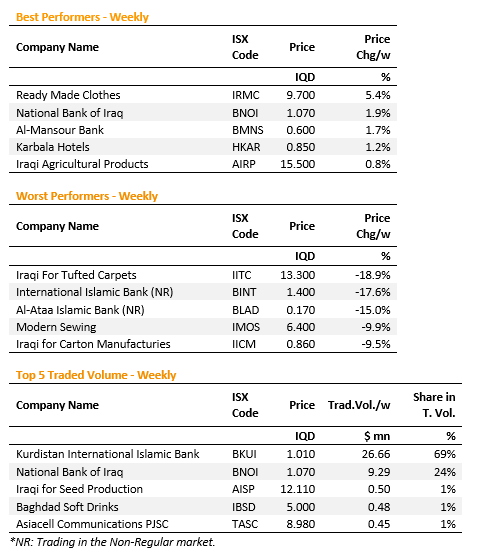
Rabee Securities Iraq Stock Exchange (ISX) market report (week ending: 3rd June 2021).
Please click here to view a table of listed companies and their associated ticker codes.
The RSISX index ended the week at IQD896 (-2.3%) / $775 (-1.7%) (weekly change) (+23.5% and +16.9% YTD change, respectively). The number of week traded shares was 54.8 bn and the weekly trading volume was IQD57.6 bn ($38.4 mn).
ISX Company Announcements
- Cross transactions: 39.6 bn shares of Kurdistan International Islamic Bank (BKUI) on Jun. 2, which represents 9.9% of BKUI's capital. 12.4 bn shares of National Bank of Iraq (BNOI) on May 31, which represents 4.96% of BNOI's capital.
- ISX will suspend trading of Al-Ameen Estate Investment (SAEI) starting Jun. 23 due to the AGM that will be held on Jun. 28, to discuss and approve 2020 annual financial statements and elect new director of the board members.
- ISX will suspend trading of Al Mansour Bank (BMNS) starting Jun. 21 due to the AGM that will be held on Jun. 24 to discuss and approve 2020 annual financial statements.
- The Saudi Fund for Development (SFD) has signed an export financing agreement with the National Bank of Iraq (BNOI), a subsidiary of the Capital Bank Group, to provide credit facilities worth $10 mn to Iraqi importers who seek to import Saudi products and services. The step will help strengthen trade relations between the two nations. The agreement was signed in Amman, Jordan, in the presence of Saudi Fund for Development CEO Sultan Abdulrahman Al-Marshad, and Basem Khalil Al-Salem, Chairman of the Board of Directors, Capital Bank, along with senior officials from both sides. (Zawya)
- The period for submitting annual financial statements for the year 2020 and the statements for the first quarter of the year 2021 has been extended to Jun. 10 without penalty.
- The trading of Asia Al Iraq Islamic Bank (BAIB) was transferred from the non-regular market to the normal system starting Jun. 1.
https://www.facebook.com/RabeeSecurities
Posted in Investment Comments Off on Iraq Stock Market Report
Saudi signs $10m Export Financing Deal with NBI
Posted on 01 June 2021 .
SFD signs a $10 million export financing agreement with the National Bank of Iraq
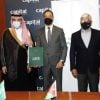
The Saudi Fund for Development (SFD) has signed an export financing agreement with the National Bank of Iraq (NBI), a subsidiary of the Capital Bank Group, to provide credit facilities worth $10 million to Iraqi importers who seek to import Saudi products and services. The step will help strengthen trade relations between the two nations.
The agreement was signed in Amman, Jordan, in the presence of Saudi Fund for Development CEO Sultan Abdulrahman Al-Marshad, and Basem Khalil Al-Salem, Chairman of the Board of Directors, Capital Bank, along with senior officials from both sides.
Under the agreement, SFD will provide a $10 million revolving line facility to the National Bank of Iraq to finance 100% of Saudi exports to Iraq with a repayment period of up to 36 months, depending on the type of imports and the nature of the trade transactions.
SFD CEO Sultan Abdulrahman Al-Marshad said:
"This agreement reflects the strong ties between the Kingdom and Iraq, and our mutual desire to increase cooperation across several sectors. It is part of an ongoing $1.5 billion that the Saudi government allocated to support reconstruction and development projects in Iraq.
"Supporting stability in countries seeking to achieve sustainable economic and social development is one of the main priorities of the SFD, and through this agreement, we seek to achieve prosperity for both nations.
"The agreement with the National Bank of Iraq is consistent with the Kingdom's aim to diversify its national economy and increase its non-oil exports, will open new markets for Saudi producers, and it will stimulate the Iraqi commercial and financial sector."
Chairman of the Board of Directors of Capital Bank Basem Khalil Al-Salem welcomed the new trade relations. Said Al-Salem:
"The role of SFD in supporting and financing development projects in Iraq reflects the historical relationship between our two nations and Saudi Arabia's ongoing commitment to Arab economic integration throughout the region.
"This line of financing will expand trade between Iraq and Saudi Arabia by providing credit facilities for Iraqi investors to import Saudi products and services at competitive prices. It will also increase transport links between our two nations and stimulate the financial and commercial sectors."
The agreement is the first in an ongoing program of economic regeneration between SFD and the National Bank of Iraq.
(Source: SFD)
Posted in Iraq Banking & Finance News, Iraq Industry & Trade News Comments Off on Saudi signs $10m Export Financing Deal with NBI

Saudi Arabia to Rehabilitate Ibn Al-Khatib Hospital in Baghdad
Posted on 17 May 2021 .
By John Lee.
The Saudi embassy has announced that King Salman bin Abdulaziz will fund the rehabilitation of Ibn Al-Khatib Hospital in Baghdad, as a gift to the Iraqi people.
A fire at the hospital last month killed at least 82 people, and left more than 100 injured.
Saudi Arabia will also take critically ill victims of the fire and provide them with medical care in the Kingdom's hospitals at King Salman's expense.
(Source: SPA)
Posted in Construction & Engineering In Iraq, Healthcare, Politics Comments Off on Saudi Arabia to Rehabilitate Ibn Al-Khatib Hospital in Baghdad

Can Iraq play the role of a Bridge in the Gulf?
Posted on 01 May 2021 .
By Katherine Harvey and Bruce Riedel, for The Brookings Institution. The opinions expressed are those of the author, and do not necessarily reflect the views of Iraq Business News.
Can Iraq play the role of a bridge in the Gulf?
There has been a gradual thaw in the relationship between Saudi Arabia and Iraq since 2015, and a number of notable developments have taken place in recent months.
Last November, the Arar border crossing - the principle crossing between the two countries - was opened for the first time in 30 years.
In late March, during a trip to Riyadh by Iraqi Prime Minister Mustafa al-Kadhimi, the two countries signed a number of agreements covering economic and cultural relations.
Most importantly, the kingdom committed to a substantial increase in investment in Iraq: up to $3 billion, from a current total of about $500 million.
Then, less than 10 days after Kadhimi's trip, according to reports, his government hosted direct talks between the Saudis and their regional rival, Iran. The talks reportedly focused on Yemen.
Posted in Politics, Security Comments Off on Can Iraq play the role of a Bridge in the Gulf?

Jiyad: Iraq, and the China-Iran Cooperation Program
Posted on 14 April 2021 .
By Ahmed Mousa Jiyad.
Any opinions expressed are those of the author, and do not necessarily reflect the views of Iraq Business News.
Iraq and the China-Iran Comprehensive Cooperation Program
The China-Iran Comprehensive Cooperation Program (CICCP) was signed on 27 March 2021; two days later the CICCP's direct impacts on Iraq began emerging and one of such impacts seems to benefits both Iraq and Iran!!
A few days ago I completed a detailed preliminary assessment of CICCP document. The assessment was written in Arabic entitled "China-Iran Comprehensive Cooperation Program: Tactically Important Strategically Impacting if Implemented", it was circulated widely and posted on many websites.
The assessment uses composite methodology of three researches approaches (Text analysis, SCOR (Strength, Challenges; Opportunities and Requirements) and facts/evidence based) and comprises an introduction, three parts and concluding remarks. Part one provide brief review of CICCP document structure: preamble, articles, annexes, effective date and term of the deal, coordinating and supervising authorities. Part two, provides detailed assessment of eight fundamental topics/ areas of cooperation, from the perspectives of the political economy of bilateral relations and geopolitical considerations. Part three provides the direct official reactions to CICCP from Iraq, USA, Arab Gulf States/Saudi Arabia and Russia.
The political economy perspectives are related to the following basic issues: The first relates to the nature of bilateral relations in terms of sovereign independence or dependency and hegemony; the second is whether the principle of "mutually beneficial" is also equitable; the third concerns the structuring of the Iranian economy on whether the deal will eventually deepens the dependence on the export of raw materials, oil and gas, or introduces the required and desirable structural changes horizontal, vertical and knowledge-based levels; and the fourth is about the financial and banking independence, monetary and currency issues pertaining to funding investments and trade exchange.
The geopolitical considerations were addressed at four levels, starting from the domestic (national for both countries), continental (Asian from China to Syria), regional (West Asia / Middle East) and international levels.
The assessment argues that the timing of signing and announcing CICCP is tactically motivated and important, while its proper and timely implementation could be a game-changer and thus strategically impacting; but, as usual, reality seldom coincides with expectations.
This brief intervention focuses on the direct current evidenced impacts on Iraq. Interested readers are kindly invited to read the Arabic version of my detailed initial assessment through the web-links mentioned at the end of this article.
In a remarkable speed and substance CICCP has already prompted both Iraq and the US to react!
First; after the current prime minister, Mustafa al-Kadhimi, denied, rather harshly, in a press conference on November 18, 2020, the existence of an Iraq-China agreement by saying, 'You know there is no China agreement, why are you promoting these lies?', he returned to authorize, on March 30 - that is, only three days after the signing of CICCP, "to start implementing the Chinese agreement"!!
While I do not find it necessary, now, to discuss what has happened between Iraq and China since the government of Haider al-Abadi, I find it useful to remember the statement by the Prime Minister's Financial Affairs Adviser, Dr. Modhir Muhammad Saleh, on March 29, 2021, that the "Iraq-China agreement" became effective on October 18, 2020, and then he affirmed the "cooperation framework agreement ... and the final accounting and oil annexes were signed on September 23, 2019." So why has not been published to this day any official document on this agreement / cooperation framework agreement, nor any of its annexes or memoranda of cooperation/ understanding related to it!!??
But there is a document at the Ministry of Finance entitled "Export Credit Insurance Cooperation Framework" between the China Export & Credit Insurance Corporation and the Iraqi Ministry of Finance) dating back to May 11, 2018 (that is, before the date of the agreement signed by former Prime Minister Adel Abdul Mahdi) !!!!
It is worth mentioning that 2021 State Budget Law includes a few infrastructure projects worth 1.803 trillion Iraq Dinnar to be funded, presumably by the above mentioned 2018 framework; since there is no new framework agreement officially published by the Ministry of Finance, nor approved by the Council of Ministers, nor legislated by the House of Representatives/ the Parliament. Moreover, even if such agreement is ratified and activated it utilization will be differed to future state budget for 2022 or even 2023 because of the national election scheduled for October this year.
Apparently, CICCP was a wakeup call for the Iraqi government but it is in reality too late for 2021 budget funding.
But on the other hand, the Iraqi Premier rushed for quick visits to Saudi Arabia and the UAE, immediately after signing CICCP; is there a relationship between the two events? Time will only tell!!!!
Second, among direct reactions by the US administration and as far as Iraq is concerned relates to Iraq-Iran interests. Just two days after signing the CICCP the U.S. renewed and extended the Iraqi exemption from the practices of maximum US pressure on Iran from 45 to 120 days; a waiver to avoid penalties for buying natural gas and electricity from Iran. This exception entails two positive consequences for both Iraq and Iran: the first is to ensure the continued supply of Iranian gas to generates electricity; this what the Iraqis suffer from its shortages especially the heated summer is on the doorstep, and the second is that Iraq pays Iran's accumulated dues for importing gas and electric power (which constitutes about a third Iraq's production of electricity) as the total of those receivables were mentioned in the 2021 budget, about 1688 billion Iraqi dinars.
Third, another important reaction by the US administration was its quick decision to hold a new round of strategic dialogue with Iraq; the discussions began on April 7, and mainly relate to the issue of US forces remaining in Iraq and the Strategic Framework Agreement signed in December 2008. (This agreement and related matters face strong opposition and many important, influential, legal and judicial challenges, especially after the Trump administration assassinated two leading heavy weight individuals, Abu Mahdi Al-Muhandis (Iraq) and General Qassem Soleimani (Iran), on January 3, 2021 near Baghdad airport).
It is worth noting that energy cooperation is one of the eight topics included in the said strategic framework agreement. Evidence suggests that the previous round of the Iraqi-American Committee for the Coordination of Cooperation in the Field of Energy, which was held, virtually remotely, on January 18 of this year was brief and did not include any important issues or noticeable impacts or new achievements. Hence, it did not attract attention from domestic or external media. Even the two ministries, i.e, Oil and Electricity, that should be directly involved, hardly mentioned anything on their websites on that latest meeting. Will CICCP invigorate Iraqi-American cooperation for the benefit of the energy sector in Iraq?? Who knows, will see!!!
Click here to download the full report in pdf format.
Mr Jiyad is an independent development consultant, scholar and Associate with the former Centre for Global Energy Studies (CGES), London. He was formerly a senior economist with the Iraq National Oil Company and Iraq's Ministry of Oil, Chief Expert for the Council of Ministers, Director at the Ministry of Trade, and International Specialist with UN organizations in Uganda, Sudan and Jordan. He is now based in Norway (Email: mou-jiya(at)online.no, Skype ID: Ahmed Mousa Jiyad). Read more of Mr Jiyad's biography here.
Posted in Ahmed Mousa Jiyad, Iraq Oil & Gas News, Politics Comments Off on Jiyad: Iraq, and the China-Iran Cooperation Program
Will Kadhimi deliver Gulf Investment to Iraq?
Posted on 03 April 2021 .
By Mustafa Saadoon, for Amwaj Media. Any opinions expressed are those of the author(s), and do not necessarily reflect the views of Iraq Business News.
Will Kadhimi deliver Gulf investment to Iraq?
Prime Minister Mustafa Al-Kadhimi has paid his first official visit to Saudi Arabia as he continues his efforts to further cooperation with Iraq's Gulf neighbours.
Posted in Investment, Politics Comments Off on Will Kadhimi deliver Gulf Investment to Iraq?
Iraqi PM makes first visit to Saudi Arabia
Posted on 02 April 2021 .
By Ali Mamouri for Al-Monitor. Any opinions expressed are those of the author(s), and do not necessarily reflect the views of Iraq Business News.
Iraqi prime minister makes first visit to Saudi Arabia
Iraqi Prime Minister Mustafa al-Kadhimi made his first visit to Saudi Arabia in an effort to enhance ties between the two countries.
Posted in Investment, Iraq Industry & Trade News, Politics, Security Comments Off on Iraqi PM makes first visit to Saudi Arabia
$3bn Saudi Fund for Investment in Iraq
Posted on 01 April 2021 .
By John Lee.
Iraqi Prime Minister Mustafa Al-Kadhimi visited Riyadh on Wednesday on his first official visit to Saudi Arabia.
A session of talks was held between the Prime Minister and His Royal Highness Prince Muhammad bin Salman bin Abdulaziz Al Saud, which dealt with cooperation between the two countries.
The two sides agreed on the following:
- Establishing a joint Iraqi-Saudi fund, the capital of which is estimated at three billion dollars, as a contribution from the Kingdom of Saudi Arabia in promoting investment in economic fields in the Republic of Iraq, for the benefit of the Saudi and Iraqi economies, with the participation of the private sector on both sides.
- Cooperation in the fields of energy and renewable energy and activating and accelerating the joint action plan under the umbrella of the Saudi-Iraqi Coordination Council, with the need to continue cooperation and coordination of positions in the petroleum field, within the scope of work of the Organization of Petroleum Exporting Countries (OPEC), and the (OPEC+) agreement, with full commitment to the requirements of the agreement, the compensation mechanism, and all the decisions that have been agreed upon to ensure the stability of the global oil market
- Completing the electrical interconnection project due to its importance for the two countries.
- Enhancing coordination in the field of mutual support within the framework of multilateral diplomacy.
- Enhancing investment opportunities for Saudi companies and inviting them to expand their activities in Iraq and in various fields, and in reconstruction efforts.
Bilateral agreements were signed that included:
- an agreement to avoid double taxation;
- an agreement for cooperation in the field of development planning for economic diversification and private sector development;
- a cooperation agreement between the Saudi Contractors Authority and the Iraqi Contractors Union for the reconstruction of Iraq; and,
- an agreement for financing Saudi exports to Iraq.
Two memoranda of understanding and cooperation were also signed:
- a memorandum of understanding between the Iraqi Media Network and the Saudi Radio and Television Authority; and,
- a memorandum of cooperation between the King Abdul Aziz House in the Kingdom and the National Library and Archives in the Republic of Iraq.
(Source: Office of the Iraqi Prime Minister)
Posted in Construction & Engineering In Iraq Comments Off on $3bn Saudi Fund for Investment in Iraq
Iraq aims for "Prosperous Economic Zone" with Jordan, Egypt
Posted on 17 March 2021 .
By John Lee.
Prime Minister Mustafa al-Kadhimi has spoken of creating a "New Mashreq", to harness the broad common interests between Iraq, Jordan and Egypt in order to create a prosperous economic zone that will benefit all countries in the region and in which Iraq would play a major role.
Addressing staff at the headquarters of the Foreign Ministry in Baghdad, the Prime Minister said that, "Iraq also has multifaceted relations with the Kingdom of Saudi Arabia and with all other Gulf countries, and that the Iraqi government is proceeding with several investment projects with these countries in various sectors including agriculture, industry and energy."
He also pointed out that Iraq concluded a rail link agreement with Iran, which will connect Iraq with northern China and create new economic opportunities.
The Prime Minister added that Iraq must continue with this approach, face internal and external crises, and work to resolve them through multi-track diplomacy that responds to the developments of the new world.
"We have a comprehensive vision for resolving conflicts and building peace, and we call on internal and external parties to play it, and to move together towards achieving a comprehensive and lasting peace" concluded Prime Minister Al-Kadhimi.
(Source: Govt of Iraq)
Posted in Investment, Iraq Industry & Trade News, Politics Comments Off on Iraq aims for "Prosperous Economic Zone" with Jordan, Egypt