



Market Review: "Market Roars Back to Life"
Posted on 05 March 2021 .
By Ahmed Tabaqchali, CIO of Asia Frontier Capital (AFC) Iraq Fund.
Any opinions expressed are those of the author, and do not necessarily reflect the views of Iraq Business News.
Market Review: "Market Roars Back to Life"
The market, after January's 9.3% sell-off, resumed the rally that was ignited by the 22.6% devaluation of the Iraqi Dinar (IQD) against the USD in late December, ending February with a bang! The market, as measured by the Rabee Securities RSISX USD Index, ended the month up 25.7%, and is up 14.1% for the year.
February saw a resumption of the trends that drove the index's rally of 8.7% (in local currency terms) in the immediate aftermath of the currency's devaluation, in which both daily turnover and foreign buying increased meaningfully month-on-month.
However, the crucial difference this time is that these trends lasted the whole month, and their momentum was sustained throughout. Average daily turnover, excluding block transactions, increased 189% over the prior month and 145% over the average of the prior 12 months (first chart below). A similar pattern, but less dramatic, was the resumption of foreign buying in both absolute terms and as a percentage of total buying (second chart below).
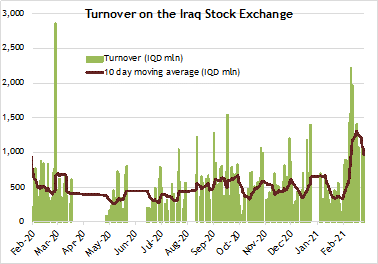
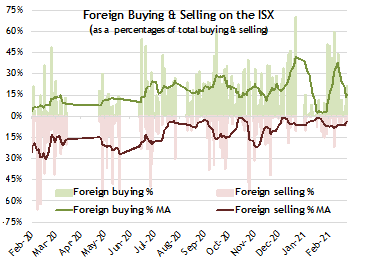
(Source: Iraq Stock Exchange (ISX), AFC Research, data as of February 25th)
While foreign buying in the leading names in the banking, consumer, and telecom sectors initiated the rally, it was local buying that extended and sustained it throughout the month. In particular, the Bank of Baghdad (BBOB) was up 69.2%, Baghdad Soft Drinks (IBSD) was up 30.7%, and AsiaCell (TASC) was up 24.6% - these three stocks accounted for over 90% of the index's gain and for the bulk of the daily turnover in the market.
Among the banking sector, BBOB's rally was joined by the low-priced Gulf Commercial Bank (BGUC) in which 4 successive increases in the minimum trading increment resulted in a 21.4% increase in BGUC. Other leading banks lagged significantly, such as Mansour Bank (BMNS) which was up 5.3%, the National Bank of Iraq (BNOI), up 2.4%, and the Commercial Bank of Iraq (BCOI), up 2.3%. While IBSD was joined by Al Mansour Pharmaceuticals (IMAP), up 15.2%.
The initial post-devaluation rally in late December and the strong follow-through in February suggests that that the market is primed for a rally following a brutal seven-year bear market - that even after its February gain, the market, as measured by the Rabee Securities RSISX USD Index, is still down by over 63% from its 2014 high.
The market's narrow breadth notwithstanding, the fact that the gains were made by the leading names in their respective industries is promising for the rally's continuation. For such a continuation to be sustainable, it should unfold over the next few months and come with a broadening of market breadth as other stocks begin to contribute to the market's recovery from its deep downturn. However, this recovery's pace is likely to be uneven with plenty of zigs and zags along the way.
It was argued here, post the currency's devaluation that:
"While the devaluation is an adverse event, the reaction of the equity market and the increased foreign participation indicates that the change is positive for equities. While the missing pieces of Iraq's re-rating are many and will take time to materialize, this positive reaction to the devaluation suggests that the event might start the process of Iraq's re-rating - which from a long-term perspective is positive for the equity market."
One of these missing pieces is the role that oil prices play in the foreign perception of Iraq contributing to foreign fund inflows, and more significantly, the role oil prices play in driving Iraq's economy and thus corporate profits.
Oil prices by the end of February staged a remarkable recovery of over 300% from the depths of the price collapse last April, in which the COVID-19 induced worldwide lockdown magnified an earlier crash in prices brought on by the price war between Russia and Saudi Arabia. This recovery was driven by the reversal of these same forces to hopes of a successful COVID-19 vaccination roll-out, and by extra production cuts over two-month of a further 1 mln barrels a day by Saudi Arabia, bolstering the remarkable cohesion of the OPEC+ agreement to cut oil production by an estimated at 12% of world oil supply last April 2020 - an agreement driven by self-interest and commercial logic just as was argued here last March soon after the initiation of the price war that:
"... while both combatants on paper have the resources to wage the price war, yet the effects of the 2014 price-war on both were profound which led to an unimaginable alliance in the first place. Given that effects of a new price war will be equally profound, it seems logical that political considerations will ensure that such war does not last, and that just as political reasons led to the price war, that subsequent ones will end it."
The availability of more than one effective vaccine for the COVID-19 pandemic bolsters the potential for a synchronised developed world economic recovery in the second half of 2021 and into 2022 - a recovery supported by unprecedented worldwide fiscal stimuli to the global economy, as well as continued adherence of OPEC+ to the production cuts - cuts that should last into year-end with a potential extension into 2022. This combination would argue for Brent crude prices to average in the range of USD 50-60 per barrel in 2021, and a range of USD 60-70 per barrel in 2022 - a case more promising than, but which nevertheless builds on the case made here in April 2020 that:-
"The known nature of the virus precludes a return to full normalcy when global lockdowns are expected to ease from mid-summer onwards. Combined with the unknown nature of the new normal as the world learns to deal with and ultimately contain the virus, the return to a pre-virus oil demand picture is unlikely within the next 12 months. But, in six to nine months demand for oil should recover from the extreme lows of April and trend upwards to a small drop from base-line demand by year end.
However, with a return to some sort of post-lockdown normalcy in early 2021, low oil prices should stimulate demand, and coupled with the massive worldwide fiscal stimuli to the global economy should begin to recover. Following a time-lag, as demand absorbs the stored supply, the supply-demand picture should be tilted in supply's favour, and oil prices will trend higher - likely to a price range of USD 45-55 per barrel for Brent crude."
Brent Crude Prices 2016-2021
(USD per barrel)
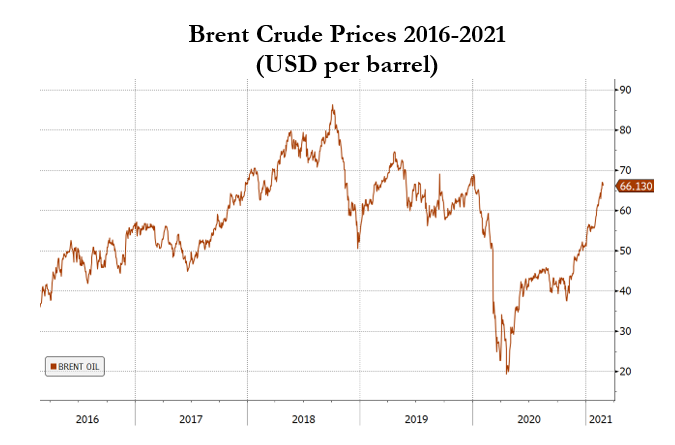 (Source: Bloomberg, data as of March 1st, 2021)
Such a scenario is extremely positive for Iraq and its equity market given the country's extreme dependence on oil revenues, which historically constituted over 90% of government revenues. Given the dominance of the economy by the state - as the largest formal employer, and through its direct and indirect control of the largest economic activities - means that higher oil revenues will feed into increased consumer spending and to a revival in said economic activities.
Such a revival will sustain the recovery in economic activities that have returned to levels meaningfully above those that prevailed just before the nationwide lockdown last March, as seen from Google mobility data (below chart). In particular, activities in the crucial sectors of retail and grocery have recovered to between 20-60% above the levels that prevailed pre-lockdown. The sharp decline at the end of February is due to the new rolling lockdowns from Friday's to Sunday's, cutting the workweek to four days, in response to the emergence of a potential new wave of the pandemic.
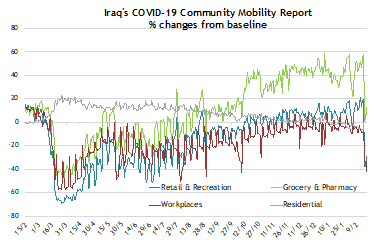
(Baseline is the median, for the corresponding day of the week, during January 3rd - February 6th 2020,
Source: Google, data as of February 21st)
Please click here to download Ahmed Tabaqchali's full report in pdf format.
Mr Tabaqchali (@AMTabaqchali) is the CIO of the AFC Iraq Fund, and is an experienced capital markets professional with over 25 years' experience in US and MENA markets. He is a non-resident Fellow at the Institute of Regional and International Studies (IRIS) at the American University of Iraq-Sulaimani (AUIS), and an Adjunct Assistant Professor at AUIS. He is a board member of the Credit Bank of Iraq.
His comments, opinions and analyses are personal views and are intended to be for informational purposes and general interest only and should not be construed as individual investment advice or a recommendation or solicitation to buy, sell or hold any fund or security or to adopt any investment strategy. It does not constitute legal or tax or investment advice. The information provided in this material is compiled from sources that are believed to be reliable, but no guarantee is made of its correctness, is rendered as at publication date and may change without notice and it is not intended as a complete analysis of every material fact regarding Iraq, the region, market or investment.
Posted in Ahmed Tabaqchali, Investment 2 Comments
Freedom House: Iraq rated "not free"
Posted on 04 March 2021 .
By John Lee.
Iraq continues to be listed as "not free" in Freedom House's latest Freedom in the World index.
Scoring 29 points from a possible total of 100, Iraq does, however, rank considerably better than neighbouring Iran (16), Saudi Arabia (7), and Syria (1). Jordan scores better with 34, while Turkey also comes in ahead with 32.
The Freedom in the World index, which has been published since 1973, assesses the condition of political rights and civil liberties around the world.
(Source: Freedom House)
Posted in Politics Comments Off on Freedom House: Iraq rated "not free"
GCC Stresses Importance of Electrical Interconnection Program
Posted on 08 February 2021 .
The Foreign Minister Receives Secretary General of Gulf Cooperation Council of Arab States to Discuss Gulf Investment in Iraq
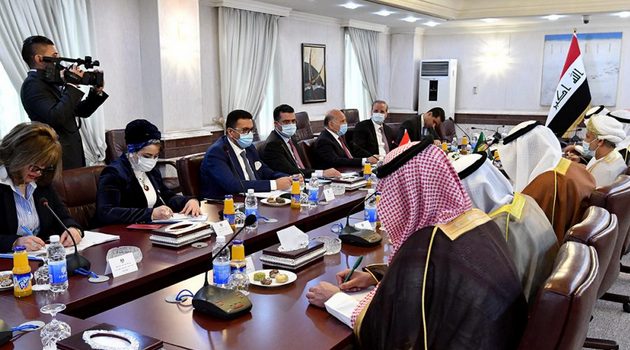
Iraq's Foreign Minister Mr. Fuad Hussein has this week discussed investments in Iraq with the Secretary-General of the Gulf Cooperation Council, Dr. Nayef Al-Hajraf.
During the meeting, issues of concern to the Gulf Cooperation Council and Iraq were also discussed, as the Minister welcomed the results of the Al-Ula summit and the return of normal relations between the Kingdom of Saudi Arabia and Qatar, indicating that the natural relations between countries in the region effects positively the Gulf countries and Iraq.
The two sides also discussed economic issues with the Gulf states, and the issue of electrical interconnection and the war against terrorism in addition to preparations for holding early elections in Iraq, and cooperation and coordination in building good relations with regional countries.
On his part, the Secretary General of the Gulf Cooperation Council, Dr. Nayef Al-Hajraf, stated that the Cooperation Council is keen to strengthen relations with Iraq, pointing out that the electrical interconnection program is one of the most important projects that will benefit all.
Mr. Al-Hajraf stressed that the stability of Iraq has positive outcome for the security of the region, and that the Gulf states support the stability of Iraq in its war against terrorism and drying up its sources, indicating that the Iraqi government is capable of extending the law.
(Source: MOFA)
Posted in Investment, Iraq Industry & Trade News Comments Off on GCC Stresses Importance of Electrical Interconnection Program
Saudi-Iraqi Business Forum Launched; New Projects Announced
Posted on 09 December 2020 .
By John Lee.
Prime Minister Mustafa Al-Kadhimi received a delegation of Saudi officials and business people in Baghdad on Monday.
Among the visitors was the Saudi Minister of Commerce, Acting Minister of Media, and Chairman of the Saudi-Iraqi Coordination Council, Dr. Majid bin Abdullah Al-Qasabi.
The delegation included businessmen representing 22 Saudi companies.
During the meeting, they discussed issues of common interest between the two countries, and ways to support and enhance them in all fields.
The two sides also signed an agreement to establish a metal silo to store wheat in Al-Diwaniya province, and a hospital in Al-Saqlawiya, Anbar province.

(Source: SPA)
Posted in Agriculture, Healthcare, Investment, Iraq Industry & Trade News, Politics Comments Off on Saudi-Iraqi Business Forum Launched; New Projects Announced
Najaf launches Road Project with Saudi Arabia
Posted on 03 December 2020 .
By John Lee.
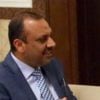
The Governor of Najaf governorate has announced a new road project linking the governorate with Saudi Arabia.
Luay Al-Yassiry (pictured) is quoted as saying that the project will include the paving a 239-kilometer road, and the building of border outlets and areas for trade.
The first phase of the project includes paving 20 kilometres of the road, with the construction of a 288 metre-long bridge in Wadi Hasab.
The Arar border crossing linking Iraq and Saudi Arabia reopened last month following a 30-year closure.
(Source: Middle East Monitor)
Posted in Construction & Engineering In Iraq, Iraq Industry & Trade News Comments Off on Najaf launches Road Project with Saudi Arabia
Reopening of Border to drive Saudi Investment in Iraq?
Posted on 01 December 2020 .
By Adnan Abu Zeed for Al Monitor. Any opinions expressed here are those of the author(s) and do not necessarily reflect the views of Iraq Business News.
Will reopening of border crossing drive Saudi investment in Iraq?
The recent reopening of the Iraqi border crossing of Arar with Saudi Arabia in a bid to enhance trade exchange between the two countries coincided with talks about the Saudi agricultural investment project in Iraq.
Posted in Agriculture, Investment, Iraq Industry & Trade News, Iraq Transportation News Comments Off on Reopening of Border to drive Saudi Investment in Iraq?
Int'l Architectural Competition to Rebuild Al-Nouri Mosque
Posted on 23 November 2020 .
UNESCO launches an international architectural competition to rebuild Al-Nouri mosque
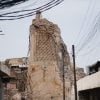
UNESCO calls on talents around the world to participate in an exclusive International Architectural Competition for the reconstruction and rehabilitation of the Al-Nouri Mosque Complex, funded by the United Arab Emirates (UAE), in the Iraqi city of Mosul.
Joining the initiative "Revive the spirit of Mosul" is a unique opportunity to change the lives of the people of Mosul and help them rebuild their city after Daesh's occupation.
The competition calls for a conceptual design, which includes the conservation of the standing structures of the prayer hall and its integration into the new buildings, as well as the rehabilitation of some historical buildings and their integration into the new designs, including the landscaping design of the entire site.
By creating new spaces dedicated to the community - for education, social and cultural activities - the project envisions a space to serve community in ways which go beyond its principal religious function.
The competition opens on 16 November. There will be an open call for proposals based on an anonymous design submission which is open until 26 March 2021. The winner will be announced next spring.
An international jury composed of 9 members and 2 alternate members will select the winning designer and the four runners-up. The jury and its alternate members, in alphabetical order, are: Ms. Howayda Al-Harithy(Saudi Arabia), Mr. Ahmed Yousef Al-Omari (Iraq), Ms. Raya Ani (Iraq), ), Mr. Xavier Casanovas(Spain), Ms. Amel Chabbi, (United Arab Emirates), Ms. Shahira Fahmy (Egypt), Mr. Dominique Perrault (France), Mr. Wang Shu, (China), Ms. Marina Tabassum (Bangladesh), Ms. Shadia Touqan, (Palestine), Mr. Jerzy Uścinowicz, (Poland).
A worldwide outreach campaign will invite architects, engineers and students from around the world to submit a design proposal for the Al-Nouri Mosque Complex. It is especially important to encourage the people of Iraq to participate in their own history-making and reconstruction.
"The reconstruction and rehabilitation of this important historical complex sends a strong signal of resilience and hope, as a first step towards social cohesion and reconciliation in post-conflict Iraq," stated UNESCO Director-General, Audrey Azoulay.
"Indeed, historical sites and monuments arepowerful symbols of belonging, community, and identity, whose rehabilitation will facilitate Moslawis in recovering their memory of their vibrant and emerging city". Since its construction in the second half of the XII Century, The Al-Nouri complexhas been a core site in the life and development of the city of Mosul.
"The launch of this architectural competition is an opportunity for world talents to participate in rebuilding the Al-Nouri Mosque and the Al Hadba minaret. This means restoring respect for Iraq's heritage and more specifically, Mosul's heritage," said the Minister of Culture of Iraq, Hasan Nadhem. "It is about rebuilding the people's memory and restoring the damage that Da'esh left behind."
"The International Architectural Design Project Competition for the design of the Al Nouri mosque complex was born out of our firm belief that a project of this importance must ensure wider community participation," said UAE's Minister of Culture and Youth, Noura bint Mohammed Al Kaabi. "Al Nouri mosque and its magnificent Al Hadba minaret embody the civilizational essence of Mosul and Iraq. As a witness the rich history of Mosul, this place of worship represents values and principles that define us as human beings."
"Rebuilding Al-Nouri Mosque and its minaret is more than about rebuilding stones," said the President of the Sunni Waqf of Iraq, Saad Kambash. "It is about telling the story of all the people who defied death to give space for hope and let humanity live on".
Beyond the restoration and reconstruction of historical landmarks, the initiative includes:
- The rehabilitation of historical fabric of the Old city of Mosul
- The revival of the city's cultural life
- Strengthening the educational system and ensuring quality education for all.
(Source: UNDP)
Posted in Construction & Engineering In Iraq, Tenders Comments Off on Int'l Architectural Competition to Rebuild Al-Nouri Mosque
Iraq-Saudi Border Crossing Reopens after 30 years
Posted on 19 November 2020 .
By Al Monitor staff. Any opinions expressed here are those of the author(s) and do not necessarily reflect the views of Iraq Business News.
Iraq-Saudi border crossing reopens after 30 years
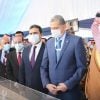
The Arar border crossing linking Iraq and Saudi Arabia has reopened for trade after a 30-year closure, Iraq's border authority said Wednesday.
The Saudi-Iraqi border crossing was closed in the 1990s after Saudi Arabia severed ties following Iraqi leader Saddam Hussein's invasion of neighboring Kuwait.
The crossing has remained closed, with exceptions made for Iraqis to cross to Mecca for the annual hajj pilgrimage.
Click here to read the full story.
(Picture: Iraqi Ministry of Foreign Affairs)
Posted in Iraq Industry & Trade News, Iraq Transportation News Comments Off on Iraq-Saudi Border Crossing Reopens after 30 years
PM encourages Saudis to Invest in Iraq
Posted on 16 November 2020 .
By Mustafa Saadoun for Al Monitor. Any opinions expressed here are those of the author(s) and do not necessarily reflect the views of Iraq Business News.
Iraq, Saudi Arabia agree to boost ties
Iraqi Prime Minister Mustafa al-Kadhimi had a virtual meeting Nov. 10 with Saudi Crown Prince Mohammed bin Salman, to discuss Saudi investments in Iraq.
Kadhimi has encouraged the Saudis to increase their investments in Iraq.
Posted in Investment Comments Off on PM encourages Saudis to Invest in Iraq
What can Iraq Gain from Kuwait and Saudi Arabia?
Posted on 14 September 2020 .
By Antonino Occhiuto, for the Italian Institute for International Political Studies (ISPI). Any opinions expressed are those of the author(s) and do not necessarily reflect the views of Iraq Business News.
What Can Iraq Gain from Kuwait and Saudi Arabia
At first glance, managing and developing ties with Iraq's neighbours seems to be only one among the many challenges that Baghdad's new Prime Minister, Mustafa Al-Kadhimi, is facing.
However, as Iraq struggles amid economic turbulences, political divisions and the resurgent terrorist threat posed by Daesh, Kuwait and Saudi Arabia's involvement in the country appears increasingly important.
Posted in Security Comments Off on What can Iraq Gain from Kuwait and Saudi Arabia?