



TotalEnergies signs $10bn New Deals in Iraq
Posted on 06 September 2021 .
TotalEnergies, the Iraqi Ministries for oil and electricity, and the country's National Investment Commission (NIC) have signed, in the presence of the Prime Minister of Iraq, major agreements covering several projects in the Basra region, designed to enhance the development of Iraq's natural resources to improve the country's electricity supply.
Iraq, a country rich in natural resources, is indeed experiencing electricity shortages while it faces a sharp increase in demand from the population.
TotalEnergies, with the support of the Iraqi authorities, on the one hand will invest in installations to recover gas that is being flared on three oil fields and as such supply gas to 1,5 GW of power generation capacity in a first phase growing to 3 GW in a second phase, and, on the other hand, will also develop 1 GWac of solar electricity generation capacity to supply the Basra regional grid.
These agreements include:
- The construction of a new gas gathering network and treatment units to supply the local power stations, with TotalEnergies also bringing its expertise to optimize the oil and gas production of the Ratawi field, by building and operating new capacities.
- The construction of a large-scale seawater treatment unit to increase water injection capacities in southern Iraq fields without increasing water withdrawals as the country is currently facing a water-stress situation. This water injection is required to maintain pressure in several fields and as such will help optimizing the production of the natural resources in the Basra region.
- The construction and operation of a photovoltaic power plant with a capacity of 1 GWp to supply electricity to the grid in the Basra region.
These projects represent a total investment of approximately $10 billion (100% share).
Patrick Pouyanné, TotalEnergies' Chairman and CEO, said:
"These agreements signal our return through the front door to Iraq, the country where our Company was born in 1924. Our ambition is to assist Iraq in building a more sustainable future by developing access to electricity for its people through a more sustainable use of the country's natural resources such as: reduction of gas flaring that generates air pollution and greenhouse gas emissions, water resource management and development of solar energy.
"This project perfectly illustrates the new sustainable development model of TotalEnergies, a multi-energy Company which supports producing countries in their energy transition by combining the production of natural gas and solar energy to meet the growing demand for electricity. It also demonstrates how TotalEnergies can leverage its unique position in the Middle East, a region where the lowest-cost hydrocarbons are produced, to gain access to large-scale renewable projects."
(Sources: TotalEnergies, Ministry of Oil)
Posted in Iraq Industry & Trade News, Iraq Oil & Gas News Comments Off on TotalEnergies signs $10bn New Deals in Iraq
Iraqi Cabinet Approves TotalEnergies' Projects
Posted on 27 July 2021 .
By John Lee.
The Iraqi cabinet has approved the agreement between the Ministry of Oil and French company TotalEnergies to implement four major energy projects in the country:
- Plants to collect and refine associated natural gas at the fields of Artawi [Ratawi], West Qurna 2, Majnoon, Tuba [Subba] and Lahais [Luhais]. This will include a Central Gas Complex at Artawi;
- Development of the Artawi field;
- The integrated seawater project [Common Seawater Supply Project (CSSP)?], which the ministry has been trying to implement for more than ten years; and,
- A 1,000MW solar energy plant.
The project was originally agreed in March.
(Source: Govt of Iraq)
Posted in Iraq Industry & Trade News, Iraq Oil & Gas News 3 Comments

The Demise of ExxonMobil in the Iraqi Petroleum Sector
Posted on 29 April 2021 .
By Ahmed Mousa Jiyad.
Any opinions expressed are those of the author, and do not necessarily reflect the views of Iraq Business News.
The Demise of ExxonMobil in the Iraqi Petroleum Sector
A recent announcement by the Ministry of Oil (MoO) confirms months of speculation regarding ExxonMobil exiting one of the world's super-giant oilfields, i.e. West Qurna 1 (WQ1).
Ten years ago this highly recognized IOC had golden opportunity to operate three giant oilfields in the southern Iraq with a combined production plateau of 6.275 million barrels daily (mbd); an opportunity unavailable anywhere in the world, but now this company exiting the country empty-handed!!
Why was that? What went wrong? Who is to blame? Should any lessons be learned from this failed venture and what are the implications for Iraq as well as for ExxonMobil?
This article attempts to answer briefly the above questions and provide background review that could help in understand the complexity of the circumstances that contributed to and led to this eventuality.
ExxonMobil back in Iraq
IOCs comeback to Iraqi upstream petroleum began in earnest immediately after 2003 invasion.
ExxonMobil was one of too many IOCs that concluded Memorandum of Understanding/ Cooperation- MoU/C with MoO in 2004. That MoU/C was signed on 27 October 2004, renewed twice and remained valid until end of 2008; it comprises conducting seven joint studies and training. The joint studies includes: phases 1 &2 for the development of Zubair Oilfield; Seismic and evaluation study for exploration (old) block 12; Database; Model Tender Document for exploration block 12; Rehabilitating Oil Training Center in Baghdad; Balad Oilfield; Deep drilling program for South Rumaila. Also, ExxonMobil committed to provide training for 129 MoO employees, totaling 1068 working days, during 2005 and 2006.
When MoO decided to hold the first bid round, ExxonMobil was one of seven American companies that were qualified, among 35 IOCs, for participating in the bid round that was held on 29 and 30 June 2009.
ExxonMobil formed three consortia and submitted bids for three oilfields but won nothing during the two days of the competition.
The first consortium with Petronas for Rumaila oilfield; eventually BP/CNPC won when they reduced their remuneration fee to the threshold stated by MoO;
The second consortium with Shell and Petronas for Zubair oilfield competing with three other consortia: Eni/Sinopec/Occidental/Kogas; CNPC/BP; Gazprom/ ONGC/ Turkish Petroleum. The third consortium with Shell for West Qurna1 oilfield competing with four other consortia: CNPC/Petronas/Japex; Lukoil/Conoco; Total; Repsol/StatoilHydro/Maersk.
None won during the biding event.
In October 2009, ENI accepted the MoO' maximum remuneration fee and agreed to expel Sinopec from its consortium, because Sinopec agreed, days after the biding event, to a C$8.3bn (US$7.2bn) takeover of Addax, which had a stake in the KR TaqTaq field. Hence, ENI consortium secured the Zubair contract.
As for WQ1 it was a totally different story.
Early October 2009 a BBC Monitoring report quoted Lukoil boss Vagit Alekperov had said, "We have let it be known to Iraq's Oil Ministry that the consortium of Lukoil and ConocoPhillips is ready to enter into direct talks concerning the West Qurna-1 project on the terms that were announced earlier by Iraq's Oil Ministry,"
Probably, ExxonMobil found itself left behind and empty-handed from the first bid round since BP/CNPC won Rumaila; ENI lead consortium secured Zubair and now Lukoil and ConocoPhillips conceding to MoO terms regarding WQ1. Moreover, ExxonMobil had no intention to participate in the second bid round to be held in December 2010.
All the above prompted ExxonMobil/Shell, four weeks after Lukoil and ConocoPhillips announcement, to present similar acceptance of MoO terms regarding the maximum remuneration fee.
The Ministry favoured ExxonMobil/Shell by not considering Lukoil/ConocoPhillips offer promptly, and when ExxonMobil/Shell made their offer it was selected; presumably due to suggested production plateau target-PPT differential that tilted towards ExxonMobil/Shell!!! The Cabinet approved the award of WQ1 to ExxonMobil/Shell on 25 January 2010.
But ExxonMobil negotiated secretly with KRG after the company secured WQ1 contract with the federal ministry and it had signed the second amendment to the contract on 18 August 2010 adding 500kbd to an already high PPT at a higher remuneration fee of $2/b.
ExxonMobil-KRG secret negotiation led to signing six production sharing agreements on 18 October 2011, though it knows of the blacklisting policy by the federal ministry of oil, i.e, ignoring and disregarding the federal government imposed policy.
Contracts with KRG add insult into injury since three of these contracts are related to exploration blocks and fields that fall within the "disputed territories"; these are Bashiqa, Al Qosh and Qara Hanjeer, the other three are Arbat East, Pirmam and Betwata.
That unwise and puzzling move by ExxonMobil led to excluding it from leading the Common Seawater Supply Project-CSSP; reducing its Participating Interest in WQ1 (through the Third Amendment of the contract dated 28 November 2013) and blacklisting it from any future upstream projects such as Nassiriya Integrated Project-NIP.
That unwise action was writing on the wall that had in fact commenced the demise of this giant IOC in the Iraqi upstream petroleum.
The position of ExxonMobil in WQ1 weekend further when Shell exited WQ1 after it had exited Majnoon oilfield in June 2018.
ExxonMobil attempted a comeback to Iraqi petroleum, by exploiting the naivety and narcissism of a former Minister of Oil, Jabbar Luaibi, through Southern Iraq Integrated Project- SIIP. He and ExxonMobil were close to trap Iraq in an Odious Contract. The Ministry of Oil was cautioned of the detrimental consequences of such a contract and luckily for Iraq that contract was dismissed.
The rise and fall of ExxonMobil in KRI was even more dramatic despite the fact that KRG offered lucrative production sharing agreements. Media sources' report that ExxonMobil had conducted geological studies that doubted the existence of enough reserves in most of these blocks. Such results prompted Exxon to relinquish three of its six blocks: Betwata in 2015, and Qara Hanjeer and Arbat East in 2016.
Of Exxon's six blocks, Bashiqa may be the most promising. However, in 2017, it transferred half of its 80 percent interest in this block - along with operatorship - to DNO and early this year it agreed to sell 32 percent to DNO, which practically and effectively ends ExxonMobil involvement in this block. Finally, ten years on with no much progress in AlQosh and Primam.
ExxonMobil adventure in Kurdistan Iraq ended, mostly, miserably!
To sum up, in that first biding round the company had three valuable opportunities and, analytically and legally, it and its partners could have won all three super-giant oilfields (Rumaila, Zubair and WQ1) with a combined production plateau of 6.275 million barrels daily-mbd against a combined minimum PPT proposed by MoO of 2.758 mbd; it won nothing during the bidding event!!!!!!!!!.
Instead, ExxonMobil sought a divisive course of action in the domestic Iraqi politics by concluding ill-fated PSAs with KRG; was that due to lack of vision, or geopolitical nativity or arrogance that still reflects a "Seven Sisters" mentality, or a hidden political agenda aiming at disintegrating the country; who knows!!!!!
What went wrong with ExxonMobil and its economic model?
Many views argued that the fiscal terms of the Iraqi long term service contract-LTSC for WQ1 are tough enough that eradicate the Internal Rate of Returns-IRR of the economic model which the IOC premised its final investment decision-FID on it.
This might be partially true as the comparative analysis of LTSC with other types of contract, particularly the production sharing contracts-PSCs indicates the "Government take" are higher under the LTSC than the PSCs. This, from international energy political economy perspectives is good for Iraq and, moreover, that corresponds with the Iraqi constitutional provision that calls for "develop the oil and gas wealth in a way that achieves the highest benefit to the Iraqi people" (Article 112, Second)
Nevertheless, contractually and analytically LTSC for WQ1is identical in structure, contents and fiscal terms, except the particularities of WQ1 oilfield, to all LTSCs for the brown fields offered under the first bid round, i.e, Rumaila, Zubair and the 3 Missan oilfields- Buzurgan, Abu Ghrab and Faqa. This leads one to question why ExxonMobil finds the fiscal terms unfavorable while other IOCs continue in the redevelopment of the oilfields.
It took almost one year to prepare for the first bid round and the final text of the LTSC was thoroughly examined by all qualified IOCs for that bid round. Logically and imperially, all IOCs should have formulated their economic model and bid on what the LTSC offers. It is rather surprising to claim, ten years later, that the offered fiscal terms do not match with the company economic model!!
The economic model of any IOC is its own making; reflecting its vision, its global profile, strategic positioning, strengths, and stakeholder/shareholder's interests among other things. Accordingly, the level of IRR is the fiscal measure upon which the FID premised. Majors or Big Oil usually have high IRR, due to their international profile , their integrated structure across the value chain of petroleum industry and the "opportunity cost" of a particular investment.
IRR under LTSC fiscal terms depends mostly and directly on: production level, capital cost-investment, cost recovery and remuneration fee; indirectly it depends on oil prices through the term of "deemed revenues" provision that impact the quarterly cost recovery and remuneration fee entitlement.
Oil price fluctuates, and nothing new about that at all; its fluctuation like a "Yu-Yu" is more normal and usual than otherwise. Iraqi oil export price averaged at $53.19 a barrel during the 12 months period November 2008-October 2009; the time that IOCs considered oil prices in their economic model. During the period from July 2008 to March 2021 Iraqi oil export price averaged at $69.55 a barrel; hence the argument that IRR eradication was attributed to oil prices and, accordingly on cost recovery and remuneration fee is not convincing.
What remains is the impact of oil production level on IRR value. Oil production levels have implications and direct impact on capital cost, cost recovery and remuneration fee, and hence on IRR.
For WQ1 the MoO requests a minimum plateau target of 600kbd during the first bid round. ExxonMobil presented 2.325mbd, i.e., nearly four folds what MoO had envisaged!! Moreover, soon after signing the contract ExxonMobil requested adding further 500kbd leading to higher plateau target at 2.825mbd.
ExxonMobil should have known that such unreasonable unattainable plateau target within the contracted timeframe weakens the logical premises of its economic model and the assumed IRR; it was a problem of its own making and shed much doubt about the validity and soundness of its model not the LTSC stringent fiscal terms.
However, Amendment 4, signed on 19 February 2014, to WQ1 contract, provides further relieves from the terms of the contract such as reducing the plateau target, performance factor and R-Factor among others that provide significant fiscal incentives to WQ1 consortium.
All the above refutes the argument that put the blame squarely on the terms of the contract in the deteriorating IRR and ExxonMobil economic model.
Even if one, for the sake of the argument, accepts for a while the tough terms of WQ1 contract, what about ExxonMobil economic model for KRG' PSCs!!
All commentators and oil experts agree that KRG' PSCs provide lucrative terms for the benefits of the IOCs. Why then ExxonMobil fails measurably there too?
Was that demise due to wrongly-premised economic model or "inside-misguidedness"!! Media sources revealed that Ali Khedery, a former American diplomatic advisor in Iraq who subsequently joined Exxon as director of public and government affairs for ExxonMobil Kurdistan Region of Iraq Limited (EMKRIL), Exxon's KRG-focused subsidiary, "had facilitated the negotiations that brought the company to Kurdistan." Was ExxonMobil victimized by its own staffer!!!!???
ExxonMobil Exit and MoO Options
Contractually, to exit WQ1, ExxonMobil should invoke the termination Article 8 in WQ1 service contract, particularly sub-article (8.2) and, therein, sub-article (8.1 (c)). If ExxonMobil wishes to assign its rights and obligations, as it seems doing so far, it should comply with the provisions of Article 28-Assignment.
Available information indicates that the company launched the contractually exiting process in January by sending a formal letter to notify MoO it had found prospective buyers; ExxonMobil and MoO had three months, until 28 April, to agree on a course of action.
The ministry has three options: the first is to accept the prospective buyers found by ExxonMobil; 20 percent to CNOOC and 12.7 percent to PetroChina-CNPC. This means increasing CNPC participating interest to 45.4% and increase China position in WQ1 to 65.4%.
The second option is to find another American company to acquire ExxonMobil share; this what the Ministry has publically announced and it seems to favour Chevron, but Chevron was reportedly not hugely encouraged to invest in WQ1. (But again Chevron was blacklisted by the Ministry due to the company' involvement in KRG oilfields, though such blacklisting was revoked, unofficially, during the time of former minister Jabbar Luaibi. He paving the way for this company to enter the upstream petroleum through direct backdoor. By the way the Iraqi team in MoU/C with Chevron 2004-2008 was chaired by Jabbar Luaibi).
The third option is to acquire ExxonMobil share by the Ministry through Basra Oil Company-BOC or any other national companies affiliated under the Ministry. This option is similar to what was done when Occidental - Oxy relinquished its participating interest in Zubair oilfield
In any of these options, the Ministry should extract a "capital gain tax-CGT" from the total value of the sold share. The Iraqi tax authority decides the CGT rate, the estimation equation and the compounding rate to arrive at the present values taking into consideration three related variables: the value of the sold share (minus) the present value of the invested capital (plus) the present value of the recovered invested capital (cost recovery).
In my article written almost twelve years ago assessing the first bid round I wrote the following: "What is rather surprising is the somewhat weak contribution of the American oil companies. While they topped the 35 qualified IOCs with 7 companies, only three had participated in the bidding. Were they expected to capitalise on the American military presence and political pressure to have guaranteed access to the Iraqi oil? Or they simply have their own capacity, technical and financial limitations? Or Iraq is not on their strategic priority screen? Or they are trapped in a mind-set of own making that centred on production sharing agreements and "reserves booking"? Or they are not used to this type of open bidding and transparency, and they prefer behind closed doors deals? Only time would provide the satisfactory answer." (MEES 52:33 17 August 2009)
Any lessons learned, Ministry of Oil????????
Click here to download the full report in pdf format.
Mr Jiyad is an independent development consultant, scholar and Associate with the former Centre for Global Energy Studies (CGES), London. He was formerly a senior economist with the Iraq National Oil Company and Iraq's Ministry of Oil, Chief Expert for the Council of Ministers, Director at the Ministry of Trade, and International Specialist with UN organizations in Uganda, Sudan and Jordan. He is now based in Norway (Email: mou-jiya(at)online.no, Skype ID: Ahmed Mousa Jiyad). Read more of Mr Jiyad's biography here.
Posted in Ahmed Mousa Jiyad, Iraq Oil & Gas News Comments Off on The Demise of ExxonMobil in the Iraqi Petroleum Sector
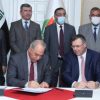
Iraq signs 4 Major Energy Deals with Total
Posted on 30 March 2021 .
By John Lee.
Iraq's Ministry of Oil has signed an agreement of principles with the French company Total for four major energy projects in the country:
- Plants to collect and refine associated natural gas at the fields of Artawi [Ratawi], West Qurna 2, Majnoon, Tuba [Subba] and Lahais [Luhais]. This will include a Central Gas Complex at Artawi;
- Development of the Artawi field;
- The integrated seawater project [Common Seawater Supply Project (CSSP)?], which the ministry has been trying to implement for more than ten years; and,
- A 1,000MW solar energy plant.
(Source: Ministry of Oil)
Posted in Iraq Oil & Gas News Comments Off on Iraq signs 4 Major Energy Deals with Total
No End In Sight To Basra’s ‘Poisoned Water’ Crisis
Posted on 07 October 2019 .
This article was originally published by Niqash. Any opinions expressed are those of the author, and do not necessarily reflect the views of Iraq Business News.
By Saleem al-Wazzan.
Drinking water in Basra has been found to contain a disastrous cocktail of bacteria, as well as too much salt. Although multiple causes for this are clear, officials don’t seem to be able to solve the problem.
“The hospital corridors were crowded and the beds all full, so people were lying in the corridors,” Basra student, Jassem Ali, recalls. “The emergency ward was also full and sometimes there were two people in the same bed. Medicine was also in short supply.”
But Ali isn’t talking about a war zone – he is recounting his experiences at a local hospital after he fell ill, thanks to drinking the local water. Ali was vomiting and had terrible diarrhoea, simply from drinking from the local supply. He couldn’t eat anything for a week, he said, because he couldn’t hold it in.
The hospital he was in had run out of drips for patients – the drips delivered nutrients and liquids directly to the bloodstream because like Ali, most people couldn’t eat anything. So many patients were having to try and drink the necessary nutrients.
His is not the only story like this. Local woman, Saja Hussein, says she doesn’t even use the water to brush her teeth now. She thinks she became ill from washing her hair and showering. While in the emergency ward, she saw another woman die, after vomiting continuously for hours. “I was so shocked,” she says. “I cannot forget her face, even now.”
It is suspected that poisoned water in this area has caused intestinal diseases in up to 118,000 people. It’s also one of the reasons why locals were protesting so violently – around 22 were killed and over 600 injured - in Basra, in the summer of 2018.
There are all kinds of causes for Basra’s increasingly poisoned water – most of them are well known. Mahkram Fadhil, an engineer at Basra’s water authority, believes that not enough fresh water is being released in the Shatt al-Arab waterway. Usually fresh water from two large contributing rivers – the Euphrates and the Tigris – flushes out the river basin, which discharges into the sea. But the construction of large dams in upriver nations like Turkey, Iran and Syria, has led to a reduction of sweet water feeding into the basin and meant that the water here gets saltier, due to encroaching seawater.
“And the problem is that all the water sources used by our water purification stations depend on the Shatt al-Arab,” Fadhil explains. “The increasingly high salinity and the pollutants thrown into the waterways make it even worse.”
There’s also a lack of funding. “Since 2013, the department has lacked the money to provide chlorine for sterilization or to repair the older plants,” Fadhil noted.
There are 12 main water purification and pumping stations in Basra and dozens more smaller ones, up to an estimated 300 or so. Many are older, with some having been built decades ago and nearly all of them rely on water from the Shatt al-Arab. Others were built after 2003 but have never been fully operational, or operational at all, for reasons unknown. Even if they were all working to capacity though, it would be difficult for the plants to produce enough water – they can help to purify the water but they cannot desalinate it.
The locals and local businesses are far from blameless. Often there are no real legal deterrents to prevent factories from spewing pollution into the local waterways. Locals usually don’t pay their water bills either – it’s very hard to police the non-payers and most houses don’t have water meters anyway.
Samples of contaminated water were sent for testing, says Shukri al-Hassan, a marine science lecturer at Basra University. “The results confirmed the presence of all kinds of serious bacterial contamination, including cholera, E-Coli and giardia, among others.”
This nasty cocktail of bacteria was in samples from rivers branching off the Shatt al-Arab and reached right into the basin itself. This is despite the fact that the water samples were collected during the flood season, when the Shatt al-Arab’s levels are at their highest. However extra water didn’t seem to be enough to flush out the contaminants, al-Hassan noted, indicating just how serious and potentially long term this problem is.
Unfortunately, al-Hassan added, very few of the officials who read about these results appeared to care much about them. “I don’t think that the issue of water quality or pollution is high on anyone’s agenda,” he told NIQASH. “We haven’t really seen any moves to resolve this issue.”
According to government sources though, there is plenty going on. Reports suggest that there are hundreds of service-related projects underway, with a total budget of over US$3 billion. Of course, as always in Iraq, locals doubt whether the authorities can actually make some of these projects happen, given the fact that corruption and inefficiency is endemic.
Somewhat ironically there’s also a positive economic side to Basra’s water problems. It has given rise to thriving private sector specializing in water desalination and purification. There are thought to be around 200 such businesses – however most are not regulated or supervised for standards and cleanliness.
Local lawyer Hassan Salman says he bought a bottle of water provided by one of these private factories, only to find that it seemed to contain some sort of algae or fungi. He told NIQASH that he’d like to file a lawsuit against the responsible factory but that this is almost impossible, because there are so many factories and a lot of brands putting falsified labels on their water products.
Basically what Basra needs are some serious long-term strategies, local activist Haider Salam suggests. That could involve the construction of a major desalination plant for making water potable, getting rid of inefficient old plants that no longer provide safe water and the building of new networks and pipelines.
“But local and central governments never think this way,” he argues. “Their focus is always on more urgent but also more temporary issues.”
Posted in Agriculture, Construction & Engineering In Iraq, Iraq Public Works News Comments Off on No End In Sight To Basra’s ‘Poisoned Water’ Crisis
Oil Ministry's “Odious Contract Trap” with ExxonMobil
Posted on 19 August 2019 .
By Ahmed Mousa Jiyad.
Any opinions expressed are those of the authors, and do not necessarily reflect the views of Iraq Business News.
The Ministry of Oil and the “Odious Contract’ Trap” with ExxonMobil’ Consortium
Talks have intensified recently about the continuation of negotiations between the Ministry of Oil (MoO) and ExxonMobil/CNPC consortium that might lead to the signing of a contract for the "South Iraq Integrated Project (SIIP)" at an estimated cost of $53 billion and a duration of 30 years, but no official confirmation or indications on the fundamental contractual provisions that were agreed on and those still pending.
In the light of the available information, material evidence, actual examples, international geopolitical considerations and comparative analysis, a detailed evidence-based research and Report* was done on the project and related negotiation.
The report on SIIP’ possible contract comprises:
- A necessary introduction and caveat;
- Political and geopolitical implications of ExxonMobil behavior and its apparent link to the “deep state” based on many evidences that actually and factually had negative consequences on oil projects, for example, in Russia and in Iraq.
In Russia, ExxonMobil caused a delay of almost four years in the development of the Pobeda oil discovery in the Kara Sea when ExxonMobil withdrew, in late 2014, from its deal with Rosneft due to imposing US sanctions on Russia.
Iraq had three bad experiences with this company in recent years. The first, when ExxonMobil negotiated secretly and concluded, against declared government policy, deals with KRG in 2011 soon after the company secured West Qurna 1 contract through first bid round with the federal ministry.
That move led to excluding ExxonMobil from leading Common Seawater Supply Project (CSSP), reduce its Participating Interest in WQ1 and blacklisting it from any upstream project.
The second and third bad experience occurred this year when the company evacuated, unilaterally and without government consent, all its foreign staff from WQ1. All these three incidents caused tremendous damage to Iraqi economic interest.
- Potential strategic risks, of an enormous scale, on SIIP that could be generate from the growing deterioration of the American-China relations as evidenced from the blacklisting of two major state oil companies, i.e. Zhuhai Zhenrong Corp and Sinopec. US escalating tension against Iran adds further geopolitical risks;
- Analyses of what would be SIIP contract was premised on what was reported by national and international sources that are originally based on information given by unnamed Iraqi officials. That was due to the absence of clarity and lack of transparency of the ministry regarding essential contractual terms and conditions.
Based on the analyses and findings of the report, I am compelled to clearly alert and strongly, frankly and loudly warn both the Prime Minister and the Minister of Oil of the danger of pushing Iraq into a "trap of an odious contract” and by specifying ten of its most grave risks and disadvantages:
- ExxonMobil, as the consortium leader, is granted a monopoly position that allows the company directly controlling all vital oil projects in southern Iraq, and thus the entire national economy, for thirty years;
- It poses a multiplicity of major threats to national security and economic interest due to what can be called contractually-connected high strategic and geopolitical risks, since SIIP comprises many critical and vital projects such as Common Seawater Supply project-CSSP (for water injection), pipelines, storage tank-farms, export facilities, gas processing units and two oilfields;
- It contravenes the fundamental premises of the Iraqi Constitution because the contract requires “mortgaging/ reserving/ booking” two oilfields, with a combined plateau production of 500kbd, exclusively for the two foreign oil companies, i.e. ExxonMobil and CNPC, for the entire term of the contract- 30 years;
- It offers “Profit-Sharing Contract”, which, in reality, represents the monetary side of a “Production Sharing Contracts”, which, is impermissible by the Constitution;
- The announced astronomical cost (of $30bilion) increased already by $11billion in less than ten weeks while negotiating!;
- It offers all rent (windfall) resulting from oil price increases exclusively to the two foreign companies, nothing for Iraq!;
- It prevents SOMO (the only State Oil Marketing Company) from performing its role in marketing crude oil from the “mortgaged” two oilfields; this contravenes established policy, undermines annual state budget laws and weakens almost 50 years of SOMO’s function;
- It reduces the “national efforts” in the development of oilfields, thus, contradicting declared Ministry policy, weakens Iraq’s flexibility to comply with OPEC decisions through “swing fields”;
- Inconsistent with the regulations for tendering and contracting government projects;
- It lacks both transparency and competitiveness.
Therefore, I suggested to the Ministry of Oil not to continue on wasting time and causing further delays: it should officially declare that it is not in Iraq's economic interest and national security to award SIIP to ExxonMobil-CNPC (and for this matter to any one consortium) and end, immediately, all and any related negotiations.
In the event that the Ministry of Oil and/or the Government insist on going ahead with this Odious Contract with ExxonMobil-CNPC, it becomes inevitable to refer the matter to the Federal Supreme Court to invalidate the contract on the bases of incompatibility with the Constitution; for eradicating the highest interest of the Iraqi people, including future generations (principle of inter-generational equity) and for returning Iraq to what looks like abhorrent concessions of the, colonial, past.
*A brief of the original Arabic text of the entire report was circulated widely within many networks and was published by and posted on many websites, and accessible on the following links:
الحذر يا وزارة النفط من "فخ العقد البغيض" مع شركة اكسون موبل
https://www.akhbaar.org/home/2019/8/261291.html
http://www.tellskuf.com/index.php/mq/83987-as174.html
http://www.sahat-altahreer.com/?p=49115
Click here to download the full article in pdf format.
Mr Jiyad is an independent development consultant, scholar and Associate with the former Centre for Global Energy Studies (CGES), London. He was formerly a senior economist with the Iraq National Oil Company and Iraq’s Ministry of Oil, Chief Expert for the Council of Ministers, Director at the Ministry of Trade, and International Specialist with UN organizations in Uganda, Sudan and Jordan. He is now based in Norway (Email: mou-jiya(at)online.no, Skype ID: Ahmed Mousa Jiyad). Read more of Mr Jiyad’s biography here.
Posted in Ahmed Mousa Jiyad, Iraq Oil & Gas News 6 Comments

Hyundai wins $2.4bn Desalination Contract
Posted on 23 May 2019 .
By John Lee.
Hyundai Engineering & Construction has reportedly won a $2.45-billion deal to build a seawater processing facility in Iraq.
South Korean media report that the company signed a letter of intent with Basra Oil Company (BOC) on Wednesday for the 49-month project, which will be capable of supplying 5 million barrels of fresh water per day.
This will help to increase output at Iraq's oil fields.
(Sources: Yonhap, Korea Herald)
Posted in Construction & Engineering In Iraq, Iraq Oil & Gas News 3 Comments

Iraq "close to signing" $53bn deal with Exxon, PetroChina
Posted on 09 May 2019 .
By John Lee.
At its regular meeting in Baghdad on Tuesday, the Iraqi Cabinet received a briefing on negotiations led by Iraq’s Ministry of Oil with ExxonMobil and PetroChina on the Southern Iraq Integrated Project.
In a statement, the government describes the project as "a mega energy and infrastructure scheme consisting of building oil pipelines, storage facilities and a seawater supply project to inject water from the Gulf into reservoirs to increase oil production and Iraq’s export capacity."
According to Reuters, Iraq is close to signing the $53-billion, 30-year agreement, from which it expects to make $400 billion over the life of the project.
It quotes the Prime Minister as saying that it will involve increasing production at the Nahr Bin Umar and Artawi oilfields from around 125,000 barrels per day (bpd) now to 500,000 bpd.
(Sources: Iraqi Cabinet, Reuters)
Posted in Iraq Oil & Gas News 1 Comment
Uneven Development in the Iraqi Petroleum Sector
Posted on 07 April 2019 .
By Ahmed Mousa Jiyad.
Any opinions expressed are those of the authors, and do not necessarily reflect the views of Iraq Business News.
This article may also be downloaded here in pdf format.
Restraining the Game-Changer: A Decade of Uneven Development in Iraq Petroleum Sector*
Abstract and Introduction
The development of the Iraqi petroleum sector during the period 2008-2018 represents, from all related aspects, a distinct phase in the sector and in its role in the national economy.
The petroleum sector comprising three different but interrelated sub-sectors through critical forward-backward linkages: Upstream (including exploration, field development and production); Midstream (pipeline, storage, export terminals) and; Downstream (crude refining, gas processing, petroleum product distribution and petrochemicals).
Though the state has been the dominant actor in petroleum sector development, the post 2003 period witnessed grand opening of the sector for International Oil Companies- IOCs. Different contractual modalities, mostly reflecting the peculiarities and realities of each sub-sector, were proposed or adopted to govern the relations with the IOCs.
Thorough and continuing follow-up and research suggest that most of the evidenced development has taken place in the upstream sub-sector, with heavy IOCs involvement in a significant part of proven oil reserves through most prized oilfields.
But the “triple shocks”, of collapsing oil prices since June 2014 (economic risks) accompanied by Da’esh (security risks) effects and Kurdistan Regional Government-KRG taking-over some of North Oil Company-NOC oilfields (June 2014-October 2017) (political risks) with the prospect of “lower-for- longer” oil price that prevailed almost a year ago, contributing to continue deepening the fiscal crisis of the state and elevated the “fear-factor” among Iraqi decision makers. That, combining with apparent human, systemic and institutional capacity-gaps limitations (business risks), have resulted in Iraq giving important concessions to IOCs without having tangible benefits in return.
Accordingly, the article would argue that, analytically and empirically, a sub-sector focused policy impacts, negatively, the development in that sub-sector, in the sector itself and on the sector’s contribution to the development of the national economy. That indicates to the absence of well thought, coherent and integrated petroleum and energy policy; and to the “indicative non- mandatory” National Development Plan-NDP. The outcomes would exacerbate structural imbalances, vulnerabilities to external factors and increase dependency on oil revenues, which prohibits desirable structural change, diversification and transformation.
The nature of the topic decides the research methodology. Hence, the article is a multi-disciplinary in its approach focusing on the relevant and important economic, legal, institutional, political economy and geopolitical analytical frameworks and aspects. Also, the article offers evidence-based analysis by relying on official, verifiable and crossed-checked data, information and documentation. Time-series and charts for the ten-years covered period are necessary for elaboration but avoided for space restriction.
The article adopts a holistic view by addressing the three interrelated levels of analysis: micro, sectoral and national, excluding KRG. Throughout the article, many questions were posed indicating the need for further scholarly work and research investigation. Finally, because of my constant follow-up and frequent contributions on Iraqi energy and petroleum sector, this article refers heavily to some of my previous works and publications.
This article comprises two parts and concluding remarks: part one identifies and analyzes the most important milestones in petroleum upstream development while part two provides assessment of successes and failures in the petroleum sector.
Part one
Milestones in Upstream Petroleum Development 2003-2018
Since 2003, upstream petroleum subsector is having many milestones with significant direct impacts on the development of the sector-wide and also on the national economy at different degrees. Some of these landmarks constitute, by their own right, a distinct phase and sometimes overlapping. This part addresses the most important landmarks some of them could shape the development of upstream petroleum for, probably, many decades to come.
First: Ministry of Oil MoUs with IOCs[1]
Between 2004 and end 2008 the Ministry of Oil-MoO had concluded some 40 memoranda of understanding-MOUs with IOCs: including majors, independents as well as minors.
The first step was to formulate a standard text for the MoU, which spells out the structure, the terms of reference governing the signed MoU and its duration and renewal if needed. For each MoU there was one “Joint Steering Committee-JSC” comprises three or four representatives from each side; the names and number of the Iraqi side are known while the corresponding information on the IOC side are not. The role and mission of the JSC is to oversee and insure the full and proper implementation of the related MoU.
Each MoU was signed by the MoO while the other party was either a single company or a consortium of companies or an official entity.
One consortium comprising three companies; three consortia each comprising two companies while the rest represent MoUs with single companies. All MoUs were signed with companies except one, which was signed by the Norwegian Ministry of Energy.
The parties to the signed MoUs belong to 23 countries; the USA has the largest participation with 9 companies, followed by Japan and Norway with 4 each, then China, UAE, UK and Canada has 2 each and one company from each of France, Russia, Holland, Ireland, Turkey, Kuwait, Malaysia, Brazil, Indonesia, Austria, Angola, Australia, Spain, Italy, India and South Korea.
One of each MoU objectives is to conduct “Joint Studies” and for each study there was a “Technical Committee”; again the names, positions, specializations and number of the Iraqi side are known while those for IOCs are not provided. The number and coverage of the joint studies are not unified for all MoUs; some has only one joint study, while many have more.
Another important objective is human capacity development; each MoU offers different opportunities for training, workshops on variety of subjects and programs and for academic degrees.
These MoUs provided various opportunities, both serious and visits, for MoO staff and affiliated companies to interact with their international counterparts after decades of relative isolation. For IOCs, MoUs represent unprecedented and invaluable opining of all archives relating to upstream petroleum in the country that helped IOCs to explore where they would be involved and what they could provide to chart their way towards business objectives in Iraq’s upstream petroleum.
Execution and performance of these MoUs are not similar in delivering stated objective and some were terminated when the related IOC signed contracts with KRG without the approval of the federal Ministry of Oil.
Apparently, eventually outcomes did not correspond to IOCs efforts as their actual involvement in upstream project could tell. Two examples could highlight this: the USA had the largest participation with 9 companies in these MoUs, yet only one, ExxonMobil, has only 32% participation interest in one oilfield. On the other side, Russia had only one company that participated in these MoUs, but Russia has now three IOCs with significant participation interests in four oilfields and exploration blocks.
The same valid also on a company level as the cases of Chevron and Kuwait Energy-KE exhibit. For the MoU signed with Chevron, the three Iraqis in the JSC, headed by the current Minister of Oil-Jabbar Allibi (Luaibi), had a record high of convening meetings outside Iraq (between February 2004 and April 2008 they traveled to London 8 times, to Bahrain 5 times and to the USA twice); Chevron organized 44 training activities (in USA, Jordan, Bahrain, Kuwait and Turkey) attended by 741 Iraqis and held 17 workshops (mostly in Amman) with 139 participants. Finally, Chevron was involved in 15 joint studies. Yet, Chevron did not have a stake in MoO concluded contracts as per the bid rounds.
KE MoU, by contrast, was signed in September 2007 and has one year duration only; the JSC held one meeting only in Kuwait in 2007; the company participated in one joint study only and it provided no training or organized a workshop. Yet, the company has stakes in three MoO signed contracts, including the field it participated in its study!
An important outcome of these memoranda of cooperation is their contribution in the formulation and development of the model contracts for the four bid rounds; they helped the formulation of two year technical support contracts-TSCs, which were devised for implementation by the international oil companies during 2008 and 2009. These contracts focus first on halting the production decline of the major oilfields (Rumaila, Zubair, West Qurna1, Missan and Kirkuk), and then increase production by 400 to 500 thousand barrels per day-kbd. MoO pays for both investment requirements and the IOCs fees to achieve that target. Negotiations on these technical support contracts lasted from the fourth quarter of 2007 to mid-2008 without conclusion because of differences on serious issues (Al-Ammedi 2009).
MoO then reduced the duration of the technical support contracts to one year. After that time they would overlap with the timing of bid rounds. The IOCs refused the one year duration as too short for such contracts. Accordingly, the ministry abandoned the contracts to focus on the bidding rounds.
Based on the previous experience with the technical support contracts and the expected bid rounds the ministry began formulating and drafting the model contracts that would constitute the contractual framework governing the relationship with the IOCs (Al-Ammedi 2009a).
Second, the Accelerated Program and the Symposium for Reviewing Iraq Oil Policy
Intense debate inside Iraq during the period September 2008 to April 2009 focused on the desperate state of the upstream sector, especially in the southern part of the country.
A team of nine senior oil professionals including two former oil ministers conducted in depth survey on the status of the upstream sector. The team visited various locations and sites and held intensive discussions with top management and senior staff there during the period 21-31 December 2008. A final and detailed report was presented to the PM on 12 January 2009. Copy of the report was distributed during the Symposium for Reviewing Iraq Oil Policy held in Baghdad February 27-March 1, 2009.[2]
The first recommendation of the said “report” calls to adopt a program aiming at increasing oil production by some 350-500kbd, and the Symposium endorsed such program, to be executed within two years (2009 and 2010). Two days after the Symposium, the Council of Ministers-CoM[3] authorized a committee comprising the PM, his Deputy, the Ministers of Oil, Finance and Planning, and the Legal Advisor of the PM to review the state of the oil industry and decide on the requested mandates and authorities for the MoO and oil producing companies.
Apparently, the accelerated program was primarily drawn by a former Director General-DG of South Oil Co-SOC and oil ministry and CoM advisor Jabbar Allibi. However, Allibi was removed from been in charge of the program.[4]
Allibi removal had in effect derailed the program and considering the fact that the occupancy of DG position of SOC had changed three times, this had contributed to causing further management instability and worsening deterioration of the upstream operations especially in the south.
Not surprisingly, therefore, to observe the continuous fluctuation of oil production and exports causing serious loss in oil revenues and deepening the financial crisis of the country. Based on official data by the MoO compiled by the author, Iraq did not benefit, as it should have been, from high oil prices because its oil export was sharply declined from a total of 58.8 million barrels-mb to 54.4mb to 49.4mb in July, August and September 2008 respectively, at a time when the average price of the exported Iraqi crude was 118.81$/b, 102$/b and 85.30$/b during the same three months period.
The gradual improvement in oil export revenues during 2009 was a reflection of oil prices upward trend more than oil exports, which kept in regular and sharp fluctuation due to technical capacity constraints and security conditions.
But what is more important was the state of the petroleum upstream sector went from bad to worse and the accelerated programme to at least capture the decline and prevent it from worsening have not succeeded in a sustainable way to insure steady levels of oil production and exports, as the above data indicates clearly. One thought suggests it might be a “deliberate neglect” to justify the opening up of the oil sector before foreign investors- the IOCs.[5]
This might and might not be the case. But judging by outcomes, the above figures clearly suggest mismanagement and lack of vision. Instead of proposing “Grandiose” move by offering more than 80% of Iraq’s petroleum reserves through bid rounds, the MoO could have adopted gradual, feasible and achievable approach starting from rehabilitating the upstream sector moving upwards. Evaluation, selection, prioritisation, sequencing and implementations are fundamental ingredients and preconditions for successful development and testimonies for sound and effective federal petroleum policy.
Third: Conversion of the Contract for Al-Ahdab Oilfield
The production sharing “Development and Production Contract”-DPC was signed 4 June 1997, received endorsements at the time from the Iraqi National Council (parliament) when it was first initialled in 1996 and ratification from the cabinet and revolutionary command council in 1997 before it became effective, but remained idle due to UN sanctions.
The MoO decided to renegotiate the terms in 2006 to convert that PSC into a 20 year service contract; formalised it in late August 2008 in Beijing during a visit by Iraqi Oil Minister, Hussein al-Shahristani, approved by the Cabinet on 2 September 2008 leading to the contract signing on 10 November 2008 in Baghdad.[6]
The significance of this conversion takes many aspects: it marks the first IOC to break ground in Iraq's oil sector since the 2003 US-led invasion; it indicates the type of contract (long term service contract-LTSC not PSC) Iraqi government would accept; it provides the terms, conditions and provisions of such contracts; it highlights the importance of bilateral government-to-government relations or “oil diplomacy” and finally, it establishes the basic first version of the model contract that was adopted latter (but with many modifications reflecting a learning curve) for four bid rounds.
Also this contract offered the Parliament a powerful opportunity to have and consolidate its role in approving the contract and thus establishes a precedence; but regretfully that opportunity was missed due to negligence, incompetence or intentional.
Al-Ahdab original PSC of June 1997 was ratified by law[7] and thus the new converted contract becomes legally invalid unless it is either ratified by a new law or the old law be revoked by a law. The Cabinet decided on the latter option, proposed a draft law and referred it to the Parliament.[8] Instead of insisting on ratify the new contract by a new law, and thus consolidate its role in approving all LTSCs, the Parliament[9] agreed, on 27 March 2011, to the government request and approved an abrogation law!
Fourth: The big-push strategy through four bid rounds
By benefiting from the insights of the MoUs, the status of the accelerated program and the successful conversion of Al-Ahdab contract with lessons learned from it, MoO launched what I considered a fast-tempo big-push strategy (Jiyad 2011).
All existing development and production service contracts and exploration, development and production service contracts were awarded through bid rounds except, as mentioned above, the one relating to Al-Ahdab oilfield.
The four bid rounds followed a similar procedure comprising the following steps:
- Announcement of the fields and exploration blocks offered in the round;
- A request for international oil companies to apply for pre-qualification;
- Specification of the parameters for pre-qualification and announcement of the qualifying companies;
- Preparation of a profile and data package for each offered field or block, and sale of that information to the interested qualifying companies;
- Workshops for the companies to discuss the data package and the draft model contract, and to review the bidding process and parameters. These workshops are usually open for the media and attended by senior officials from the ministry. The fourth bid round was attended also by representatives from local authorities in the areas of the offered blocks;
- The holding of bidding events in Baghdad with full publicity and TV coverage, with the bids being opened and announced in public with full competitiveness and disclosure; and
- Approval of each contract by the Council of Ministers.
The Final Tender Protocol-FTP for each bid round specifies the bidding parameters and the formula for calculating the bidding scores. For the first three bid rounds the bidding parameters were the plateau production target and the remuneration fee, while for the fourth bid round there was only one parameter, the remuneration fee.
For all bid rounds MoO accepted the highest scoring bidder provided the remuneration fee proposed by the highest scorer does not exceed the maximum remuneration fee acceptable. This maximum is disclosed only if the highest scorer’s proposed remuneration fee exceeds the maximum, in order to give the bidder(s) concerned the opportunity to revise their proposed fee downward to that of the maximum remuneration fee. MoO did not disclose the maximum remuneration fee it had set on many occasions when the highest scorer’s proposed remuneration fee was lower than that maximum.
In the case of tied bids, whether the remuneration fees proposed are equal to or less than the maximum set, and where the tie is between a consortium and a single company, the consortium bidder is preferred and declared the winner.
Main features of and developments in the model service contracts are briefly analysed below.[10] This analysis of all versions of the model service contracts identifies the nature and main characteristics of the contracts concluded under the four bid rounds, which were considered as “unknown in the oil industry” when they were introduced (Chalabi FJ 2010:258).
First, each bid round has its own “model contract” reflecting the nature of the offered opportunities and the lessons learned from the previous rounds. From negotiation theory and practice- who sets the agenda impacts the outcome. Thus, the Ministry did well by setting the agenda, i.e., the model contract, and asks the IOCs for feedbacks instead of following Terry Adams proposal.[11]
Second, all the contracts have similar structures in terms of equal number of articles, annexes and addenda, except those for the fourth bid round which have more addenda. Almost all the articles are identical or could be considered as common clauses, except those reflecting the specifics of the field or block.
Third, the contracts could be considered as being in a hybrid category of their own since they include components from production sharing contracts and components from conventional service contracts. Among the main features taken from production sharing contracts are: the long duration; the privileges of first/exclusive rights; the payment of a signature bonus; the R-factor as a sliding scale remuneration fee; and restrictions on sovereignty through consensus-based decision-making within the joint management committees. ‘Business risk’ for IOCs relating to the commerciality of petroleum discovery is covered only by contracts relating to bid round four, which is for exploration blocks.
Fourth, all the contracts are premised upon the principle of take-or-pay/now-or-later even when the government decides to exercise its sovereign rights to curtail production.
Fifth, all payments to the international oil companies (costs and the remuneration fee) are denominated in US dollars, not in barrels or barrels of oil equivalent. This implies that any economic rent (windfall) belongs to the Iraqi side, and the international oil companies do not have any claim on rent in the event of oil price increases. The international oil companies benefit from higher oil prices by expediting the recovery of their capital and operating expenditure and by receiving greater volume in remuneration fees through the operation of the payment caps when there are higher revenues. This, however, also calls for the application of the R-factor, which reduces the remuneration fees.
Fifthly, for each of the concluded contracts there is a carried state partner participation interest of 25% (now reduced for some of oilfield offered under bid rounds one and two) with no up-front payment from the Iraqi side. The international oil companies in the consortium cover, proportionately, this participation until they recover it. The model contract for the fourth bid round does not have a state partner participation interest since the risk of exploration is taken on fully by the international oil companies should there be no commercially worthwhile discovery.
New provisions in the model contract for the fourth bid round
The current version of the fourth bid round model contract exhibits many new components, reflecting the still evolving development of the model contracts and the Ministry of Oil’s learning curve in contract formulation.
A pre-development holding period is introduced, subject to certain rather complex provisions, in the event of an oil discovery. The rationale for this is that Iraq has too much oil to manage if all the contracted fields are developed as planned in addition to the existing production from other fields.
Also for the first time there is a transitional state partner. Initially the state partner is Oil Exploration Co, but once the value of the R-factor exceeds 1 then a new state company takes over the role of state partner. This reflects the different phases of the contracts arising from the distinction between the exploration and development phases, and this distinction lead to the removal of the state partner’s 25% interest, as mentioned above.
The third development is the absence of a performance factor, because with only one bidding parameter (the remuneration fee), and therefore no production plateau target, there is no reason to include the performance factor.
An important fourth new element was introduced to reduce the cost-inflating tendencies of international oil companies. A new term, ‘cost production’, is included to reduce the remuneration fee entitlement in such a way as to induce the international oil companies to pursue cost effectiveness and refrain from exaggerating costs.
The fifth new development is related to the application of take-or-pay/now-or-later principle. The contracting Iraqi oil company’s obligation is confined to 80% of the produced gas if circumstances call for application of the take-or-pay/now-or-later principle. It is worth noting the application of this principle remains as it was in the previous bid rounds in the event of an oil discovery.
The sixth new component is provision for dry gas export, subject to a separate contract and marketing arrangement. This is an option for the international oil companies to pursue, but does not constitute an obligation on them. No such option was or is offered for oil.
Another new provision gives the Iraqi oil company the right to terminate the contract if the international oil companies conclude another contract with any regional or provincial authority without Ministry of Oil approval.
The final new development is the establishment of an infrastructure fund to finance infrastructure projects in the province where the contract area is located. During the term of the contract the contractor will pay 10% of the annual budget for the fund.
It is worth mentioning that each signed contract comprises other detailed provisions, annexes and addendums reflecting the particularities of the related field or exploration block.
The Ministry held four bid rounds between June 2009 and May 2012: the first was for the already producing, known as brown, oilfield; the second was for discovered but not developed, known as green oilfield; the third was for free gas fields and the fourth was for exploration blocks. The outcomes of these four bid rounds can be summarized as follows:
- Four contracts covering six oilfields were concluded under first bid round comprising oilfields Rumaila, Zubair, West Qurna 1-WQ1 and Missan (comprising three fields of Abu-Garab, Faqa and Buzorgarn). Their combined proven reserves, at the time of contacting, was 33 billion barrels and their combined contracted production plateau target –PPT was 7.335 million barrel per day-mbd;
- Seven contracts for seven green oilfields were concluded under second bid round comprising West Qurna 2-WQ2, Majnoon, Halfaya, Gharraf, Badra, Najma and Qaiyara. Their combined proven reserves, at the time of contacting, was 33 billion barrels and their combined contracted PPT was 4.765 day-mbd;
- Adding Al-Ahdab oilfield to the above would give a total PPT of 12.3mbd to be reached at end 2017 and sustained for seven year. They have 67billion barrel of proven reserve; constituting 58% of the country proven reserves at that time.
- The number of involved IOCs in the above 14 oilfields was 15 companies from 12 countries including the five permanent members of the UN Security Council.
- Three free gas fields, Akkas, Siba and Mansuriya, were contracted under third bid round with a combined PPT of 825 million cubic feet daily-Mcfd and 11.2 trillion cubic feet. Three IOCs from three countries were involved.
- The fourth bid round was about exploration blocks; four blocks, 8, 9, 10 and 12 were contracted with 7 IOCs from 6 countries.
The decision to go for the bid rounds and their outcomes, especially the first two, had created vibrant, interesting, mobilized and courageous debate on many aspects pertaining to timing, the type and number of the offered oilfields, the type and conditions of the contracts, the feasibility and sustainability of proposed and concluded production targets, the legality premises among others.
Why there were such wide powerful and impacting concerns on these bid rounds?
First, historically, there seems to be a strong association, in the Iraqi conscious, on three nexus of “oil, politics and patriotism” or what is termed, wrongly, in the western business terminology as “resource nationalism”.
Second, there was a prevailing conviction that invasion is “all about oil” and that conviction was consolidated not only by the many and repeated statements in international media; but also by the apparent attention given to oil matters by the occupying forces, by the many MoUs (as discussed above) and by the massive intrusive efforts by US and UK embassies and their preferences regarding related oil issues such as type of contracts, oil law, privatization of INOC.
Third, there was strong resistance “from within” the petroleum sector itself that argued their opposition on national efforts and capacity premises. The most apparent protest came from Basrah Council[12], Basrah professionals[13] and SOC senior staffers.[14]
Fourth, former oil technocrats, experts and professionals, especially those residing outside the country were very active and had crucial role in mobilizing and energizing the debate through their analysis, commentaries and articles (Al-Husseini 2010; Al-Chalabi I 2009; Jiyad 2011; Al-Khayat 2012 among many others),
Moreover, the first bid round came at the height of a heated debate on the ill-fated Draft of Federal Oil and Gas Law[15] and the first announcement of Shell’s Head of Agreement-HOA, that was negotiated and concluded behind closed doors.
Fifth, Oil workers and trade unions were also among the early protestors, but were focused first around Rumaila oilfield, then on Zubair, WQ1 and Majnoon. The Federation of Oil Unions of Iraq and the Federation of Workers Councils and Unions in Iraq have condemned the Ministry's decision to award a foreign consortium the contract to develop Rumaila (Mohammed A 2009); partly on legality grounds and partly for fear of unemployment and, later, for not been properly compensated.
Sixth, ironically, KRG and its related interest groups, individuals or contracted companies had their share in praising KRG PSCs as superior to MoO contracts in serving Iraqi interests!!
Finally, from petroleum industry perspectives they were between two contrasting positions- “crazy” and “game changer”.
Total, then CEO Christophe de Margerie was reported by Reuters (28 October 2009) have said “The 12 million barrels is crazy”.
US Department of Energy, according to Cordesman (2010), “projects Iraq will expand its oil production from 2.4 million barrels per day in 2008 to 2.6 in 2015, 3.1 in 2020, 3.9 in 2025, 5.1 in 2030, and 6.1 in 2035.”
But the executive director (2012) of the International Energy Agency-IEA, Maria van der Hoeven was adamant that “Iraq has a potential as a game-changer” and becoming a “strategic source of world oil supply” in the years ahead (Hill 2013). That takes us to the next milestone.
Fifth: INES and IEA-IEO Support PPT Revision
For the first two bid rounds, the production plateau target was one of two bidding parameters, as mentioned earlier. This prompted IOCs to inflate their production targets to out-bid their competitors. Consequently, plateau levels in all the resultant contracts came out much higher than even the Ministry had envisaged. Hence, euphoria began to surface at the prospect of crossing the threshold of 12.3mbd, and this then became a sacrosanct target for some within the ministry and outside it. But, as mentioned above, many oil professionals doubted the feasibility of attaining these plateaus within the specified timeframe, and questioned the justification of constructing expensive production and export capacities based on these figures.
Initially, MoO and the government were reluctant to the idea of revising down the PPTs[16], however, they became more receptive to the revision of the plateau targets, especially after the finalisation of two thorough studies.
The government and the World Bank agreed to the necessity of having an integrated strategy for the country. Thorough, well researched, intensively debated through more than forty meetings and 18-month study resulted in a final report of the Integrated National Energy Strategy (2013-2030)-INES.[17]
Concurrently with INES, Iraq and IEA cooperated in conducting another study, Iraq Energy Outlook-IEO.[18]
Both studies came to similar conclusions to those expressed by many Iraqi oil professionals on the unattainability and feasibility of the contracted production targets: INES discusses the implications under three (high-13mbd, medium-9mbd and low-6mbd) production plateaus with different commencement timelines and plateau period durations. IEO assesses the consequences under “high”, “delayed” cases and “central scenario” of 6.1mbd by 2020 and reaches 8.3mbd in 2035.
Thus, these studies prompted the Iraqi authorities to consider seriously lowering down their previously contracted production targets and take what that entails by amending the contracts.
Sixth: Lower PPT, More Concessions
Even before the government approves INES[19], MoO under the, then, new Minister Abdul Kareem Luaibi, was already reworking on reducing the production targets; Russian Lukoil was the first to renegotiate its contract, bringing production targets for WQ2 oilfield down from 1.8mbd to 1.2mbd (Osgood 2013).
By September 2014 and based on available brief information, this author compiled, that total production plateau from the amended PPT in the signed contracts would be reduced from over 11 mbd (Old Plateau Target-OPT) to 7.15 mbd (New Plateau Target-NPT) (Jiyad 2014). NPT could be even lower after Shell and Petronas relinquished Majnoon in 2018, WQ2 PPT was reduced for the second time to 800kbd (IOD 2017), and possible Badra reduction.
Reducing production targets is important course of action and has many significant long lasting implications and effects since that requires amending the contracts, which opens the door for renegotiating the terms, conditions and provisions of these contracts; and here lays the catch 22! First, this reduction is, hypothetically and theoretically, advantageous for Iraq. Had Iraq succeeded to attain the contracted plateau production targets (of 12.3mbd) by 2017 it would have by now:
- Have a minimum of 8mbd of idle capacity, considering OPEC production cut enforced since January 2017;
- It would have paid $184.5billion of capital cost, since each 1mbd capacity requires $15 billion initial investment;
- It would have to encore substantial “maintenance cost” for the 8mbd of idle capacity;
- It would have to pay the IOCs the “remuneration fee” for 8mbd of idle capacity according to contractual provision/ condition “Take or pay”;
- There could have been thousands of unemployable oil professionals.
Second, IOCs found this the opportunity they had hoped for to improve the contracts for their benefits. They argued, reducing the PPT impacts negatively the economics of their projects, and thus they should be compensated to maintain their original Internal Rate of Return-IRR.
Our follow-up on this issue indicates a range of IRR between an “absolute minimum” of 8% and “not overly profitable” 17%.[20] But, on the other hand, reducing these “crazy” plateau targets would first give them more time to attain the new targets and, second, would reduce significantly the “up-front” investment requirements; and both have significant fiscal positive implications for IOCs.
Lukoil provides clear example; a reduction of WQ2 PPT from 1.8 mbd to 1.2mbd would reduce investment to $26 billion from $33 billion over the next 10 years.[21] Thus and based on that, the latest reduction in the PPT to only 800kbd would reduce investment requirement by, probably, another $4.7billion.
Moreover, the actual negotiations regarding PPT reduction had resulted into the following gains for the IOCs:
- Reduction of the “State Partner-SP” share in the remuneration fee from 25% to as low as 5% would results in billions of dollars concessions to IOCs from Iraq; we have identified four such reductions. Based on the related new production targets and the resulting increase in IOCs share due to these reductions in SP share our calculation arrives that those IOCs would get an additional $441million a year in their Net Remuneration Fee-NRF (post income tax and SP share). That, over the years of the contracts would result in billions of dollars move from the Iraqi coffers to IOCs.
- Another concession given by the Ministry was the elimination of the R-Factor (which relates remuneration fee to cost recovery). By eliminating the R-factor, IOC gets all its new NRF per barrel even after all capital cost was recovered. This would give IOCs, especially during the plateau production period (which has been prolonged due to plateau reduction), additional millions much more, in magnitude, than the previous concession[22];
- The third concession was the elimination of P-Factor (which is a performance measure linking the payment of remuneration fee proportional to the achieved production target). Elimination the P-Factor could result in two negative consequences for Iraq first, it disincentives IOCs to comply with the new production targets (a forward concern) and second, it relieves the IOC from the penalty for non-performance so far (a backward concern). The magnitude of non-performance so far could be, theoretically, gigantic since all IOCs had not attained the contracted plateau target. To illustrate, MoO had in 2013 informed Shell (the operator of Majnoon) that its consortium had cased Iraq financial losses estimated at $4.6billion for not performing their contractual obligations (Jiyad December 2017).
- Another concession was related to increasing the “natural decline factor-NDF” on the “base-line production-BLP” for the brown fields, i.e., those covered by bid round one. Increasing the NDF would give corresponding proportional increase in the additional oil production that should be attributed to IOCs and, thus, increases its remuneration fee. For example, NDF for Rumaila was increased by 2.5 percentage points starting from 2014 (IEITI 2016), which expedites the deductions for BLP. Our calculations indicate that Rumaila consortium, e.g., BP and CNPC, would gain additional of over $23million per year in their NRF. However, it is not known whether such NDF was applied to all or some of the brown fields.
Third, it should be stated that all these concessions were dealt with in complete secrecy restricted to the Ministry, Energy Committee of CoM and the related IOCs. What was puzzling, though, these revisions occurred while the architect of these contracts, i.e. Shahristani, was still walking in the corridors of power! Why was he so passive?
Apart from what was reported by the business circles, IOCs and professional sources of information, nothing disclosed by Iraqi authorities until the IEITI annual reports provide formal admissions on these changes.
What even more serious and suspicious is while the Ministry offered these significant and long lasting concessions, it got absolutely nothing in return for the country. Moreover, the Ministry had actually and practically lost the leverage over the IOCs to, for example, cope with the impact of low oil prices, as discussed next. But it remains vital to know why that was allowed to happen and how the Minister, i.e., Abdul Kareem Luaibi, was able, in such ease, to cause the country billions of lost revenues?
Seventh: Formal Revisions of the Concluded LTSCs
After 2014 election, a new cabinet installed with Haider Al-Ebad- PM and Adil Abdul Mahdi- Minster of Oil. On the Parliament side, late Ahmed Al-Chalabi became the chairman of the Finance Committee. Politically, Mahdi was a long time senior member of The Islamic Supreme Council of Iraq-TISCI (formerly known then Al-Hakeem party) and Al-Chalabi (Iraqi National Congress-INC) was affiliated with TISCI during the election; the two are known for their opposition to Shahristani, strong support for privatization and inclination towards PSCs. Their position was strengthened by the support they got from the new Minister of Finance, Hoshiar Zebari (KRG).
Soon after the formation of the new government in September 2014 a new powerful and coordinated campaign directed against the LTSC; partly but mostly, political motivations and rivalries and partly unfamiliarity with oil industry in general and the concluded contracts in particular.
The new minister of oil began, in February 2015, a series of statements by first expressing openly his preference for PSC, “Iraqi public,.., needs to be educated about the benefits of PSCs”[23], then continues in discrediting the LTSCs, though, making erroneous claims that actually expose his modest understanding of oil economics and signed contracts.[24]
On the same wave-length advises Hoshyar Zebari, “It is better to move from service contracts with IOCs to production sharing contracts”, asserting “Even the most strong opponents of this now have come to see that these [current technical service contracts] are not beneficial.”[25] His remarks are recycling of those aired by KRG and pro PSCs.
Al-Chalabi, used his parliamentarian position and the opinions expressed by minsters of oil and finance to make further and formal onslaught on LTSC through a formal communication to the Minister of Finance. But, thorough assessment of the data presented in the formal communication proved to be inaccurate with many flaws and wrong interpretation of the signed contracts (Jiyad October 2015).
The same call continued unabated even after the last cabinet reshuffle, which brought current minister, Jabbar Allibi who, a few days after taking the helm of the ministry, stated, “We are opening dialogue to come into acceptable terms that are of benefit to both Iraq and IOCs.”[26] For months latter he said “We are in the process of concluding a consultancy contract,…., to help us in reviewing some of the clauses in the contracts.”[27]
What prompts and enforces such persistent calls for contract revision or conversion?
Following the debates, expressed opinions, statements, information and statistical data and course of events could lead to the following main brief explanations:[28]
- Politicization and personalization of the issue, primarily directed towards Shahristani;
- Unfamiliarity and wrong understanding of types of contracts, especially the comparative assessment of LTSC vs. PSC as evidenced by what Mahdi, Chalabi, Zebari and Allibi among a few others have said;
- Da’esh (Islamic State of Iraq and Greater Syria- ISIL/ISIS) effects since June 2014 after the governorates of Naynaw (Mosul), Salahuldeen and Ramadi were taken by Da’esh; represents serious existential security threats, severely interrupting economic activities including petroleum sector and depleting the country’s meager financial resources;
- KRG seizure of oilfields operated by NOC, leading to depriving the federal treasury of significant stream of revenues; during the entire period between June 2014 and January 2018 export of Kirkuk oil constitutes only 2% of total oil export revenues and 1.9% of the corresponding volume of exports;
- Collapsed Iraqi oil export prices from $102.61/b in June 2014 to lowest floor of $22.21/b in January 2016 before improving gradually to $63.288/b.
The impact of these calls and views was culminated in imposing, by the Parliament, a provision in state budget law for 2016 and then for 2017, obliging the government and the MoO to, “Revising bid round contracts with the aim of amending them to protect Iraq’ economic interests and to increase oil production and reduce expenses and find a mechanism that links cost recovery in accordance with oil prices.”[29]
Obviously, that provision in budget laws indicates the advocates for contract revision are not aware that Iraq, as discussed above, had already gave significant concessions and thus lost vital negotiation power and any revision would entail giving further concessions.
The target to “reduce expenses” is a matter of “skill capacity” of the Ministry staff to insure prudent projects co-management not the contract itself. Moreover, calling for coupling cost recovery with oil price would, legally, economically and practically converting the LTSCs into a “revenue sharing contract”, which works for the IOCs favor as work progress towards the production plateau; Finally, if that occur it will not “protect Iraq’ economic interests”.
Eighth: New Contract Model with More Reliance on the IOCs
When he took office in August 2016, the Minister of Oil pledged to use more “national efforts” and base decisions on “solid sound studies” regrading upstream petroleum projects. By now, he renegades on both; MoO has been working under rather different environment characterized with inconsistency, secrecy, ambiguity, absence of coordination and coherence, inclination towards foreign companies and lack of project feasibility.
Since that reshuffle of August 2016, the MoO has been persistently trying to offer most possible remaining oilfields and exploration blocks to IOCs under new contracts that differ from those adopted by the Ministry in previous four bid rounds.
On 23 October 2016, only two months after the current Minister took the helm of the Ministry, the Ministry offered 12 new discovered but not developed oilfields announced.
The most alarming and absurd components of the announcement are the contractual modality and the process of awarding and contracting. The Ministry asks the IOCs to submit “their own proposals for contractual, commercial and financial terms and conditions..”, and “Bilateral and direct negotiations between the ministry of Oil and the IOCs will be used as a basis for awarding the fields’ development and production contracts to the IOCs after agreement on the terms and conditions of the contracts”.
The above contravenes the experience, the process and the basic premises of the Ministry used at least since the preparation for first bid rounds mid-2008. No model contract; no process timeliness; no final tender protocol; no bidding parameters; no open bidding. Simply, the IOCs state what they want not the other way around as what it should. Elementary negotiation principle implies that those who decides the terms and conditions comes the winner. Even people with no negotiation experience at all do surrender this way! So what was going on at the Ministry, why and who was behind this demise?
A bilateral and direct negotiation is recipe for corruption and bad governance; it is really shocking to see such a retreat from the open and very transparent bidding process to behind closed door bilateral negotiation.
What make the matter even worse and devastating are the human resource skills and capacity gaps, especially in international contract negotiations, implementation, follow-up and monitoring.
Less than three weeks later the offer was postponed for a year due to pressure that questions the rationale for such offering.[30]
MoO reinvigorated rather intensively the direct behind closed door negotiation, with ExxonMobil regarding the package for developing Ratawi and Nahr Bin Omar in oilfields under a new, proposed in November 2016 by the Minister, Southern Iraq Integrated Project – SIIP, which incorporates the stalled Common Seawater Supply Project-CSSP.
The Minister stated that, “[w]ithdrawing this project [CSSP] from ExxonMobil in 2012 was a grave mistake.” (IOR, 2 December 2016). I disagree for the following reasons:
- ExxonMobil was lead company in initial CSSP proposal 2010, but was excluded after the company signed contracts with KRG in conformity with the then and still blacklisting policy of the Ministry;
- The proposed cost of $20 billion was unreasonably high;
- The burden-sharing or IOCs proportional contribution in the cost of project was not endorsed by other IOCs;
- The capacity of the project was based on the contracted PPT, which, as explained above, was reduced dramatically, Thus, had CSSP executed as envisaged initially, it would be significantly idle capacity by now;
- By declaring such a mistake soon before launching discussion with Exxon manifest professional and negotiation naivety because it simply gives your opponent a leverage over yours!..
By first week February 2017 and while the Minister was in the US and after having “[A] dinner with their [ExxonMobil] CEO”, he said, “We have reached a good stage now” indicating the deal will be signed, “Before the end of the year” (IOR, 13 March 2017).
That did not materialize; the Minister declared that no agreement was reached with ExxonMobil and the project, i.e., SIIP, will be offered to other companies if the two sides do not agree by February 2017.[31] The back and forth on this deal was finally ended by announcement in June 2018 that ExxonMobil is out of CSSP / SIIP[32]
Further remarks are due on this deal. First, this project was supposed to be executed jointly with CNPC, but there are no credible and verifiable evidence that suggests the Ministry had conducted any discussion with this company, why?; second, during the entire two years negotiation between the Ministry and ExxonMobil, no information was made available on any essential parameters of the negotiation, what was offered by each side and why was the negotiation reached a stalemate; third, it seems the Ministry has left it to ExxonMobil to propose the type and conditions of the contract then the Ministry would look at that; fourth, it was not known whether there was /is a committee that was charged with negotiating this important project on the Iraqi; fifth, no information is available to indicates that the Energy Committee of the Council of Minister and/ or Oil and Energy Committee of the Parliament had been duly kept informed on all phases and results of the negotiation.
The third example is the latest mass offering of border fields and exploration blocks. In a sudden move the Ministry announced in first week of January 2018 it will hold the fifth bid round on 7 May 2018 and proposing very tight schedule to accomplish the bidding; thus expedite the timing it has previously indicated in its announcement of 27 November 2017. The Ministry provides no clarification on why it decided to hold the round earlier than announced previously.
By offering some 18 onshore brown and green fields and exploration blocks and one offshore area, all grouped under “9 exploration blocks” on the borders with Iran and Kuwait, the Ministry seems to be embarking for yet another grand-opening to IOCs.
26 IOCs were qualified to participate in this round including six already blacklisted by the Ministry from participating in upstream petroleum projects. Thus, it is puzzling to see the Ministry contravenes its own policy; who is behind this obvious chaos?
What causes serious concerns is the complete blackout on the type and components of the contract(s) for this bid round. Moreover, what complicates the matter even more is that IOCs are who will suggest these contracts as stated by the Minister said, "The commercial models, by the companies wishing to invest, will be studied and analyzed then negotiated and select the contract which achieves our objectives”[33]
Leaving the contracts to IOCs discretion is, as discussed earlier, a recipe for disadvantageous imbalanced deal that works against the country’ interests and adoption of the abandoned Terry Adams approach.
Also, due to the tight timetable and known management capacity gaps at the Ministry, the biding process presents serious challenge as there are 9 groups of fields and blocks; 3 or 4 types of contracts and 26 companies eligible to participate in the bid round. Covering areas with two or three different types of already producing (brown) fields with discovered by not developed (green) fields and exploration blocks in a single contract would require the formulation of a complex difficult contract, largely due to the significant differences between the financial terms, contractual provisions and technical and geological requirements of these three covered areas.
Additionally, and this is very important, the contracts of this bid round should reflect the special status and the prioritization of developing fields straddled along borders with Kuwait and Iran, especially with regard to the possibility of joint development through the formula known as “Unitization” of the concerned field. This is in addition to the need for including in the contracts many of the conditions, provisions and practices recognized by international contracts for border fields.
Finally, the timing of the bid round was first set five days prior to the national election on 7 May this year then brought forward to 15 April and later moved it to 25 April! The Ministry announced on 13 April it has delivered the Final Tender Protocol and two Model Contracts to the 14 IOCs that bought the “Data Package”, without mentioning their names and not providing the text of the mentioned documents, as the MoO used to for the previous bid rounds.
The fifth bid round took place on 26 April 2018 in Baghdad and the model contracts were published soon afterwards. The process, the outcomes and the model contracts of this bid round have caused outrage among most known Iraqi oil and economic experts as they expressed their strongest opposition.[34]
Ninth: Shrinking Transparency, Deals Behind Closed Doors and Return of Secrecy
Transparency, in Iraq petroleum sector, is a new concept. Formally and officially it was introduced in the International Compact with Iraq -ICI under benchmark, “Establish and implement mechanisms to ensure transparency of petroleum sector flows” (GoI 2007). Pursuant to ICI obligations, MoO began publishing publicly available reports on production, export, and processing of crude oil and made them available on the Ministry’s website and also to take the necessary steps to joining the Extraction Industries Transparency Initiative-EITI.
Following its undertakings under ICI, the government publicly announced its commitment to work with all stakeholder groups at the 4th EITI Global Conference in Doha, Qatar, in February 2009, and then made formal commitment to EITI at the Iraq EITI (IEITI) launch conference on 10-11 January 2010, when the country was accepted, by EITI as a Candidate.
As a candidate country, Iraq took all necessary actions and fulfilled EITI requirements that led the EITI International Board on 12 December 2012 to announce Iraq as “Compliant” country under the EITI Rules.
Attaining the compliant status seemed to be misunderstood by those at the Ministry, IEITI and others. Having the compliant status was seen as “mission accomplished”; as “permanent membership” in EITI; as “testimony of transparency in the sector”; it is about “oil revenues only” among others.
Hence, a sense of complacency prevailed and each IEITI annual report becoming mostly a copy of the previous one; the National Secretariat of IEITI-NS became more passive, less responsive to external views and non-transparent in its records.
Transparency at the MoO begun shrinking gradually and one month after the current Minister took office he caused serious blow to transparency; most data that used to be posted on regular intervals on the Ministry website since 2008 were suspended from September 2016 and all previous data archives became inaccessible.
But Iraq’s status as a compliant country was subject to “validation” of continued full compliance with EITI rules and standards, which was scheduled in 2017. Accordingly, a team from EITI International Secretariat-EITI-IS visited the country on April 2017 for a fact finding mission and prepared “Initial Assessment”, which found Iraq non-compliant (EITI 2017).
The Validator, Adam Smith International-ASI, agrees with the EITI-IS preliminary assessment but, moreover, downgraded two benchmarks and, thus, makes Iraq’s compliance even weaker.[35]
Apparently, the “Initial Assessment” forced the Ministry to resume posting, on its website starting from July 2017, some data, that was suspended in September 2016. But that was too little too late and EITI suspended Iraq status on October 2017.
Ironically, the Ministry continued on its non-transparent attitude and practices even after the suspension and after the Ministry and Iraqi authorities declared their commitments to EITI and to comply with the needed requirements to regain Iraq status. Examples are many, the one year long negotiation with ExxonMobil regarding SIIP (March 2017-February 2018); with Jinhua, a Chinese company, to develop East Baghdad Oilfield (December 2017); the agreement signed on January, 2018 with the US company Orion to utilize associated gas from Nahr Bin Omar oilfield in Basrah province; the contract/agreement signed with the GE-Baker Hughes US companies in July 2017 related to associated gas from Nassiriyah and Gharraf oilfields in Thi Qar province, among others.
As usual, the Ministry has continued on its direct behind closed doors deals with IOCs without disclosing any vital information on these deals or about the contracts or agreements that were signed. Moreover and worst still, all the above mentioned contracts and agreements were negotiated and concluded without following the usual official contracting procedure that requires public tendering, open bidding and transparent selection. Finally, the Ministry was unable to clarify why associated gas from Gharraf oilfield was contracted to Baker Hughes when the associated gas from this field is already governed by the contract signed with Petronas and its partners!?
The latest manifestation of the Ministry’s non-transparent and secrecy mentality is related to the current fifth bid round. Actually, this anti-transparency mentality contravenes all what was prevailed during the previous four bid rounds.
Regrettably, in reality there has been a clear consistent pattern on shrinking transparency and a return to pre 2003 secrecy of information in the petroleum sector, especially since the last ministerial reshuffle of August 2016; deeds are more revealing than symbolic formal declarations and rhetorical statements!
Part two:
The Balance-Sheet of Successes and Failures
Our evidence-based assessment of the development in the sector-wide petroleum focuses on the fundamental components of the sector. The basic premise is the assertion that the success of a prudence and soundness of petroleum policy could only manifest itself through harmonious, coordinated and timely execution of the main components of the said policy. Further assertion, logically and analytically, follows: a failure of policy at a sector-wide petroleum leads to further dependency of the national economy on oil export and consequently less sustainable development on the macro-levels.
However, this essay focuses on the petroleum sector leaving the sector-macro nexus to other time or to other scholars. Thus, the remaining space of this contribution covers five basic issues: Profile of oil production capacity and performance; Oil export, destinations and new marketing modalities; Refining Structure and the chronic production-demand misalignment; The wasteful continuation of gas flaring; and finally the recent disturbing development regarding regulating the upstream petroleum.
Profile of Oil Capacity and Production
Oil production capacity and actual production in Iraq can be looked at from locational/ provincial or organizational (i.e. National Oil Companies-NOCs) or management (i.e. by National Efforts- NEs or by Joint Management Committees-JMCs with IOCs pursuant to bid rounds) perspectives, though overlapping. However, availability and details of consistent data (especially in continued time series) limit the analysis.
At the commencement of 2018 Iraq production capacity stands at 5mbd[36] and total production at end December 2017 at 4.189mbd[37] (excluding KRG), indicating 16.2% idle capacity. This significant idle capacity, with its negative consequences for cash-needed Iraq, can be attributed to multiplicity of causes, including OPEC cut deal. If this idle capacity comprises some of those covered by the bid rounds, this would entail paying IOCs their corresponding Remuneration Fee in compliance with “take or pay” contractual provisions. It should also have implications for pace and scale of developing capacity further.
Based on our computation of average daily production during the second half of 2017 some 80.4% of total Iraq oil was produced by Basra Oil Company-BOC (including production from Thi Qar province); 10.5% from Missan Oil Company-MOC; 5.2% from Midland Oil company-MidOC (mostly from Wasit province) and 3.9% from North Oil Company-NOC (Mostly from Kirkuk province since production from Kirkuk, Ninawa and Salahuldeen provinces was negatively impacted by Da’esh effects and KRG seizure of some oilfields that are operated by NOC ).
The above indicates that ca. 96% of the country’s oil production during the second half of 2017, i.e., from BOC, MOC and MidOC, involves IOCs, due to the first two bid rounds, and those fields developed by national efforts; but MoO data does not make such distinction and thus we have to make some estimations.
IOCs have been involved, through ten contracts, in ten (twelve) currently producing oilfields, while another two, i.e., Najma and Qayara in Ninawa (Mosul) province have been on hold due to Da’esh effect. Based on the signed contracts and their amendments and published data from formal and industry sources the following methodology was used to estimate oil production resulting from bid rounds and IOCs involvement.
- Base Line Production –BLP, upon signing the contracts, was 1881kbd for oilfields under BR1 and 48kbd for two oilfields only in BR2;
- BLP under BR1 are subject to “Natural Decline Rate-NDR” at constant 5% annually; it was increased to 7.5% from 2014 onward for one oilfield; the cut-off year for computation is 2011. BLP under BR2, though mentioned but contractually was not a counted for since these are “green-fields”;
- The Remaining of BLP-RBLP at end 2017 was calculated for each oilfield under BR1 using its NDR;
- Current Production-CP, at end 2017, for each oilfield was compiled from “latest available” data;
- Net Additional Production-NAP, i.e. due to IOCs involvement, for BR1 oilfields was calculated as follows: NAP=CP-RBLP and for BR2 oilfields: NAP=CP.
Appling the above approach gives the following estimates:
- Total oil current production-CP from the ten oilfields at end 2017 was 3653kbd;
- The remaining base line production-RBLP for oilfields under BR1 at end 2017 was 921.05kbd;
- Net additional production-NAP from IOCs involvement in the ten oilfields at end 2017 was 2731.95kbd;
- Total oil production (excluding NOC and KRG) at end 2017 was 4041kbd, which means oil production from oilfields operated by National Efforts-NF was 388kbd (i.e. 4041-3653)
The above analysis and computation indicate that actual production from the ten oilfields was less than one-third of the originally contracted plateau production that was supposed to be reached at end 2017. But because of the limited development of oil production by national efforts, actual production from the ten oilfields constitutes over 90% of total oil production. Most likely, oil production by national efforts had actually carried the burden of OPEC cut.
Net additional production, which represents the real IOCs contribution, stands at 2.7mbd and this represents 68% of total oil production in the middle and southern Iraq. Also NAP decides the magnitude of two important financial parameters: capital investment that was spent to have such production levels and net remuneration fees; both parameters represent payment to IOCs.
Oil Export, Destinations and New Marketing Modalities
Monthly data on oil exports continued, by State Oil Marketing Company –SOMO, uninterrupted by deliberate anti transparency measures imposed by the current Minister of Oil. Export data are grouped under Kirkuk blend, which is exported through pipeline through Turkey to port of Ceyhan, and Basra blend, exported from export terminals on North Arabian Gulf. Until mid-June 2014 small quantities used to be trucked to Jordan from Kirkuk.
From end June 2008 to end January 2018 Iraq exported a total of 8.8 billion barrels, 90% of which is Basra blend. Kirkuk export, since March 2014, was severely impacted by security conditions, Da’esh effect and KRG actions. In fact SOMO data indicates zero Kirkuk export since October 2015 except minor quantities between September 2016 and July 2017.
During the last ten years Iraq generated an accumulated $626.8billion in oil revenues, 88% of which is generated from Basra blend; indicating 2 percentage points in the price for Kirkuk blend favor reflecting quality and location advantages.
Iraq has three major market destinations: Asia, the Americas and Europe. There has been a dramatic change in markets configuration since 2008, leaning forcefully towards Asian markets at the expense of the Americas. Asian markets had 32% of Iraqi oil compared with 41% for the Americas and 27% for European markets. In 2015 Asian markets share almost doubled to 61%, the Americans down to 9% and the European increased slightly to 30%.
This significant shift towards Asian markets could be attributed to many factors: high growth demand for oil in East Asian economies; refinery configurations in that region could very well process Iraqi crudes-both Basra heavy and Basra light; most IOCs that are involved in the bid rounds and receive their entitlements (for cost recovery and remuneration fees) in crude which is shipped to Asian markets; the serious and continued interruption of Kirkuk crude and finally aggressive pricing and marketing by SOMO to enhance its share in the that market.
It is worth highlighting in this juncture three developments concerning SOMO:
First, from June 2016 onwards SOMO diversified crude grades by launching Basra Heavy, reflecting the increasing magnitude of heavy crudes production due to bid rounds and also protecting the quality of its flagship Basra Light blend. But the monthly export data makes no such distinctions between these two crudes.
Second, on April 2017 SOMO broke with its established policy and began limited spot trading through auction on Dubai Mercantile Exchange-DME. Our monitoring and calculation suggest that between April 2017 and January 2018 SOMO sold 12 shipments of 2 million barrels each equally divided between Basra Heavy and Basra Light. Basra Light shipment generated total premiums worth $2.484 million over the Official Selling Price-OSP and a corresponding $11.242 million from Basra Heavy.
In addition to DME, SOMO began, in February 2018, similar auction through Platts and considering to auction through Argus.[38]
Third, on December 2017 SOMO entered an “agreement of partnership work” with the Russian company Litasco, Lukoil‘s international marketing and trading arm, by establishing a new venture, Lima Energy. The later name now changed into Iraq Petroleum Trading- IPT and becoming one of SOMO’ clients!
However, neither SOMO nor the Ministry provides information on the basic terms of this venture; surprisingly enough the Parliament did not make a move despite the fact that this type of “international agreement” should be subject to its approval!
Refining Structure, Production and Demand Misalignment
The structure of the Iraqi refining sub-sector has evolved, over many decades, in such a way that is currently characterized with multiple core complexes each has some smaller “satellite external” refineries linked, administratively, to it. Each core complex was developed gradually over the years by adding new capacities in the same location (or province) or by modernizing existing capacities or by both: addition and modernization.
Until mid-June 2014 Iraq has a nameplate refining capacity 984-kbd comprising all state owned North Refineries Company-NRC (494kbd); Midland Refineries Company-MRC (220kbd) and South Refineries Company-SRC (270kbd). Baiji refinery (402kbd) is the core complex of NRC; Doura refinery (140kbd) is the core of MRC and Basra refinery (270kbd) is the core of SRC. There are 10 state-owned smaller refineries with total capacity of 232 kbd (23.6%) while the three core complexes have a combined 752kbd (76.4%).
But all that has drastically changed after June 2014 due to Da’esh (ISL/ISIS) effect; most of NRC designed capacity has been extensively damaged, especially in Baiji and Qayara. Consequently, more than one-third of the country’ refining capacity was lost, and might take years and billions of investment to reconstruct it again.
Even before Da’esh effect, the refining sector suffers from two chronic misalignments: the first, actual refinery production is much below the nameplate capacity; indicating low utilization rate and the second, the obsolete technologies produce more of the lower parts of the barrel of products that is not commensurate with demand; leading to production-demand misalignments that has to be increasingly met through imports of expensive petroleum products.
In late 2009 the MoO commissioned many international consulting firms to undertake Front End Engineering and Design-FEED studies for four modern grassroots refineries with a total refining capacity of 890kbd.[39] All refineries were offered for investment through many promotional activities since 2011 but without good results, except a scandalous contract, with technically incompetent and financially bankrupt, for Missan refinery that was signed many years but remains ink on paper to this day!
Also the government decided to execute Karbala refinery and began the work on 2014; but the construction encountered lack of funding and change of prioritization under current Minister of Oil, who discourage state involvement in the refining sector, while the Ministry seems to encourage Iraq state investment in refineries outside the country![40] Was there any such confusion and absent of basic economic principles of prudent petroleum policy??
Under the current minister, the ministry announced repeatedly these and other refineries for private investment without noticeable success, except small, and accordingly technologically inferior, refineries that would deepen the above mentioned misalignment. However, the Ministry announced an award of 300kbd Faw Refinery in Basra province to two Chines companies but without FEED study and no known information or details on the signed contracts.[41]
So far, refining sector remains one of the major failures of petroleum policy, or lack of it, in the country and thus the chronic supply-demand misalignment.[42] It is worth mentioning in this regards that the Ministry has suspended, since September 2017, providing monthly data on the demand on “other oil products”, which constitutes major import item since January 2009![43]
Gas Flaring Continues
Another chronic disappointment that manifest serious policy malfunction is the continued gas flaring and at accelerated rate.
All gas production in the country has been associated with oil production; the more oil is produced the more associated gas is produced as well depending on the gas-oil ratios of the related oilfields.
Monthly statistical data indicates that, on average, gas flaring to total produced associated gas has increased from 51% in 2009 to reach a maximum of 69% in 2015.
The Ministry suspended the publication of these data on September 2016, a month after the current Minister took the helm of the Ministry, and the monthly average of the flared gas for the first eight months of 2016 was down to 64%.
In this regard I would argue that gas flaring is more of apparent policy failure than absence of legal framework.
The establishment of north and south gas industry entities within MoO in 1979 and 1980 intended to “utilize all associated gases available in the fields of Iraq to produce dry Sales gas, LPG, Natural gasoline and Sulphur for domestic needs and for exports. But wars from 1980 to 2003 had interrupted the giant Southern Gas Project [44]
Law 84 of 1985 for Reservation of Hydrocarbon Endowment, which is still valid, forbids, according to Article 8-Second, gas flaring “unless it is not possible to utilize it economically”.
On April 2005 the MoO signed a MoU with Shell and Mitsubishi to conduct a two-stage Comprehensive Gas Plan covering all fields, which was delivered by end 2008. Based on that MoU, MoO and Shell signed on 22 September 2008 a Head of Agreement-HoA to, “establish a joint venture to reduce gas flaring in the South of Iraq and gather and gas for utilization in the domestic and export market (the “South Gas Utilization Project” )”.
The leaking of “confidential” HoA prompted evaluation, criticisms and opposition from many Iraqi professionals, e.g. Jiyad (2009), Merza (2010), Al-Ameer (2011), among others.
The negotiation and finalisation of the HoA lasted longer than anticipated but eventually lead to signing a joint venture establishing Basra Gas company-BGC between South Gas Co (51%) Royal Dutch Shell (44%) and Mitsubishi (5%); BGC was approved by the Iraqi Cabinet on mid-November 2011 and officially announced the commencement of its operations on 1 May 2013.
One direct consequence of BGC was to exclude gas utilisation provisions in the contracts governing Rumaila, WQ1 and Zubair oilfields offered under first bid rounds; while such provisions were included in the contracts for oilfields covered by the second bid round and offering the same remuneration fee for gas on oil-equivalent barrel.
BGC’ first tanker of exports of condensates was on 22 March 2016; almost eight years from signing the HoA, which ironically includes a “Quick Wine Assets” that supposes to “optimization and fast-track procurement of equipment in order to increase gas production before incorporation of the Joint Venture”!!!
The Ministry signed on the World Bank Zero Flaring Initiative by 2030, but the Ministry keeps giving inconsistent indications on when gas flaring would end.[45]
Another policy inconsistency is manifested by three contradictory developments: continued gas flaring, importing Iranian gas and commitment to exporting “surplus” gas to Kuwait (Ministry press office, 21 September 2017)!
But the strangest lack of proper policy understanding is what the Minister has reportedly said, on 2 February 2017, “Gas utilization in the country was impacted by, among other factors, the fluctuation of gas prices in the international markets”. ! Iraq fails to utilize its associated gas for domestic uses, it imports gas from Iran, yet it blames gas prices in the international markets!![46]
The publication of data on gas production, utilization and flaring resumed on July 2017 and based on them the average monthly (July 2017- February 2018) flared gas down again to 56.6% of total of associated gas production.
Much of that reduction in gas flaring was attributed to BGC activities that led to increasing export of condensates and LPG in the first quarter of 2018. Also it was attributed to increased gas utilization form oilfields contracted under the second bid round. For example, gas treatment plant with capacity of 2 million cubic meters daily- mcmd was inaugurated at Buzergan oilfield (CNOOC as Operator) on 2 April 2018 that would supply power plant to produce ca 104MW.[47] Earlier, in December 2017, Russia’s Gazprom Neft, operator of Badra oilfield, launched the commercial operation of a 1.6 billion cubic meters a year capacity gas processing plant at the oilfield, which monetizes at least 95% of the produced associated gas.[48].
But the challenge that would face the Ministry’s efforts to end gas flaring in 2021-22 is of two folds; gas flaring rate is now stands at 56.6% at oil production (excluding KRG) of 4.360mbd and thus much is needed from the Ministry to reduce that rate to zero even at today’s oil production level. Moreover, oil production in 2021-22 will, according to the Minister[49], reach 7mbd, which implies increasing associated gas production by 61% on today’s level.
It should be mentioned at this juncture that the Council of Ministers has approved Resolution 51 of 30 January 2018 mandating the MoO to launch “Supplemental Natural Gas Processing Contracts (SNGPCs) for the processing of associated gas to qualified investors through a competitive and transparent bidding process that adheres to best international standards” no later than 30 June, 2018.[50]
So far, the Ministry has been non-compliant to that Resolution since none of the announced deals and contracts were awarded “through a competitive and transparent bidding process” e.g., Baker Hughes for associated gas in Nassiriya and Garraf oilfield (2 April 2018); Orion Gas Processors to capture and treat gas from Nahr Bin Omar oilfield (9 January 2018).
But the question remains on whether the Ministry could keep its promise for ending gas flaring by 2021-22?
Regulating the Upstream Petroleum
Two legal instruments of particular and direct relevance to upstream petroleum have been under the focus of attention since 2003; these are Federal Oil and Gas Law-FOGL and Iraqi National Oil Company-INOC Law. Many drafts for both laws were proposed and discussed and much has been written about them, particularly since February 2007.
While FOGL, even in its latest version, has practically been overtaken by events, INOC Law was passed recently by the Parliament. But because this law was full of flaws, ambiguities, contradictions, inconsistencies and, above all, contraventions to the Constitution, it prompted strong and wide opposition to the extent that this author has launched formal detailed appeal before the Federal Supreme Courte by highlighting where and why this law is unconstitutional and, thus, should be revoked.
Due to the importance of the law and its highly likely damaging impacts on the petroleum sector and on the Iraqi economy at large, it is imperative and of vital necessity to adopt inclusive and participatory methodology for combating the law. For this purpose I adopted four phases AMTA approach: Awareness, Mobilization, Teaming-up and Action.
Awareness phase aims at highlighting what is seriously wrong with the law by providing preliminary evaluation of the law and then further specific with economic evaluation on how this law could violate the constitution, weaken INOC itself and contribute to the disintegration of the country. Articles in Arabic and English were shared widely and posted on many websites.
Mobilization phase began by calling upon Iraqis, collectively or individually, to protest the law and file “open” appeal to the Federal Supreme Court; two articles in Arabic were shared and posted on 26 and 27 March respectively.
The call aims at prompting the citizens to know their constitutional rights and empower them with the knowledge base to act as was enshrined in the constitutional article 93.
Team working phase began when many oil professionals, lawyers, civil society organization, politicians, parliamentarians and media sources among others supported the idea of appealing to FSC.
A small group of Iraqi oil professionals was assembled in Baghdad to maintain contacts with the lawyers and follow-up the matter inside the country especially with media sources and events organization. Two fundamental steps were done: the first is to prepare a draft of detailed appeal against the law on article-by-article base and the second is to provide the lawyers with “Power of Attorney” by the plaintiffs.
Action phase began with many different actions such as writing articles, organise meetings and roundtable debates and a group of Iraqis abroad launched on 4 April an online-campaign against the law.[51]
All components of the AMTA approach are ongoing and continue until this atrocious law is revoked. Increasing number of articles and positions in support of the appeal are evident in the Iraqi media and among the professional networks.[52]
Two colleagues from Baghdad with legal team made the formal appeal before the Federal Supreme Court and the process is moving forward.
On its side, the Council of Ministers-CoM asked the Ministry of Oil on what the Ministry has taken regarding the implementation of the said law and also to provide its opinion on the appeal against the law and which articles in the said law the ministry would appeal against.[53] The Ministry formed a 12-man committee but focusing on the implementation matters with no mention of the appeal issue![54]
Much of the future development of upstream petroleum, prospect of INOC itself and the integrity of the country, I would argue, hinge on revoking or radically amending this law. Time will only tell!
Another issue of particular and critical importance is the legality and constitutionality of KRG’PSCs and its independent export of oil without the consent of the federal government. The latter appealed to Federal Supreme Court-FSC many years ago, but KRG resisted appearance before FSC. However, the comparative power shift post the untimely referendum on independence and the collapse of Da’esh had forced KRG to attend before FSC. Accordingly, FSC, on 27 June 2018, listened to the filed case by the Ministry of Oil against KRG and gave lawyers of both sides until 4 August this year to present additional documents and evidences pertaining to Kurdistan region's independent oil policy, and set the next hearing for 14 August 2018.[55]
Concluding Remarks
NDPs post 2003 have become increasingly indicative documents with all ministries are non-accountable for adhering to the targets of the NDP or complying to what was included in that plan. A logical consequence of such lack of sound and coherent national planning perspectives is the continued structural imbalance and reliance heavily on commodity export, i.e., crude oil. And with the absent of meaningful structural diversification (both vertical and horizontal) the state “oil dependency” increases, “rentierism ” consolidates, vulnerability to external shocks and leverages enhances and, consequently, sustainable socio-economic development derails significantly.
Similarly, there was no white-paper for coherent and coordinated petroleum policy that integrates the three sub-sectors; all major policies and actions were mostly “Minster-base” even if there were plans or strategies as the case of INES signifies. Over the last 15 years, decision makers, i.e., ministers of oil were mostly motivated by “scoring achievements through contracting” instead of “delivering results and outcomes”. That is why upstream petroleum attained less than half its contracted levels with almost no progress on refining and gas flaring continues unabated.
The political economy of relationship between IOCs and the host developing country, e.g. Iraq can be assessed through the contents of the contracts and their implementations. The foregoing analysis clearly demonstrate a deteriorated condition for Iraq; while the original signed contracts were for the Iraqi interests, the revisions of these contracts and the concluding the recent ones (of April 2018) have shifted the balance towards IOCs interests.
Considerations of and data on cost, effectiveness and payment to IOCs are hardly made on regular intervals, on time and with full disclosure. Hence, there seems to be deliberate persistent efforts to prevent proper and comprehensive economic analysis and assessment. On the other hand, the Ministers and senior officials at the ministry use to make unsubstantiated and mostly contradicting statements on these matters.
It seems that all the above occurred under conditions of lack of transparency, absent of good governance and a return to secrecy with many important deals are concluded behind closed doors, particularly with the American companies, and without the usual economic justification or feasibility assessment. This bad unproductive and questionable style of management had prevailed especially since the last cabinet shift of August 2016.
All the above, and as highlighted throughout the article, deserves further attention and investigations through serious academic and professional research works.
*Originally published on International Journal of Contemporary Iraqi Studies, V12:3, 2018
References
Adam Smith International- ASI (2017), Validation of Iraq.
Al-Ameer, Fouad Qasim (2011), The Solution: Reject HoA (in Arabic).
Al-Ammedi, Abdul Mahdi H,(2009), “Cooperation Policies with IOCs”, presentation made before the Symposium for Reviewing Iraq Oil Policy, Baghdad, Iraq, 27 February to 1 March 2009 (in Arabic).
Al-Ammedi, Abdul Mahdi H,(2009a), “Service Contracts”, presentation made before Symposium for Reviewing Iraq Oil Policy, Baghdad, Iraq, 27 February to 1 March 2009 (in Arabic).
Al-Chalabi, Issam (2009), “Iraq’s Oil Export Outlets” (2009) 52(48) MEES.
Al-Forat News (2018), Baghdad, Iraq, in Arabic. 27 June.
Al-Husseini, Sadad (2010), “Perspective: Assessing Iraq’s Oil Expansion” in Energy Compass (Energy Intelligence Group Inc, 5 March).
Al-Khayat, Faleh HM (2012), “Iraq oil output to hit 6.2 million b/d by 2017”, 370 Platts Energy Economist.
Alwaqee Aliraqia (2016), State Budget Law 1 for 2016, Article 38, nr. 4394, 18 January.
Alwaqee Aliraqia (2017), State Budget Law 44 for 2017, Article 48-first, nr. 4430, 9 January.
Chalabi, Fadhil J (2010), Oil Politics Oil Myths – Analysis and Memoir of an OPEC ‘insider’ (IB Tauris).
Cordesman, Anthony H.(2010), ‘Iraq: ‘Mission Accomplished’ Mark II.’ Aug 20, 2010. CSIS-Center for Strategic & International Studies- Washington, D.C. http://csis.org/publication/iraq-mission-accomplished-mark-ii Accessed 11 February 2018.
Council of Ministers (2013), Integrated National Energy Strategy 2013–2030, Baghdad, June.
EITI (2017), Validation of Iraq: Report on initial data collection and stakeholder consultation. Norway. https://eiti.org/sites/default/files/documents/iraq-_2017_validation_initial_assessment_final_draft_asi_comments.pdf Accessed 23 February 2018.
Government of Iraq-GoI (2007), A Shared Vision A Mutual Commitment, The International Compact with Iraq, 2007 Mid-Year Progress Report, Released at the United Nations in New York, 20 July.
Hill, Patrice (2013), “Iraq’s flood of ‘cheap oil’ could lock world markets”, The Washington Times, 3 February 2013. http://www.washingtontimes.com/news/2013/feb/3/iraqs-flood-of-cheap-oil-could-rock-world-markets-/#ixzz2KS7TiLBe Re-accessed 11 February 2018.
IEA (2012), Iraq Energy Outlook-World Energy Outlook Special Report, Paris, October.
IEITI- Iraqi Extractive Industries Transparency Initiative (2016), Annual Report 2015, Baghdad, Iraq. The annual report was prepared by KPMG for IEITI.
International Oil Daily-IOD (2017), 1 December.
Jiyad, Ahmed Mousa (2009), Iraqi-Shell Gas Deal: who occupies the driver’s seat? Posted on Energy Intelligence http://www.energyintel.com/PubHome.asp?publication_ID=112, also reposted on IOF http://www.iraqoilforum.com/wp-content/uploads/2009/05/ahmad-musa-jiyad-iraqi-shell-gas-deal-who-occupies-the-drivers-seat.pdf
Jiyad, Ahmed Mousa (March 2010), “Remuneration Fees Are Measured In Cents, Not Dollars.” MEES v53 nr 11, 15 March.
Jiyad, Ahmed Mousa (2011),“Oil upstream development: the feasibility of a fast-tempo, big-push strategy”, 5(1) International Journal of Contemporary Iraqi Studies pp11-46 (IJCIS) (Intellect Books, UK);
Jiyad, Ahmed Mousa (September 2014), The New Oil Production Targets- New Terms and Implications. Posted on Iraq Business News- IBN, 8 September, https://www.iraq-businessnews.com/2014/09/08/the-new-oil-production-targets/
Jiyad, Ahmed Mousa (March 2015), Remarks on Recent Statements from the Ministry of Oil. Posted 3 March 2015 on https://www.iraq-businessnews.com/2015/03/03/remarks-on-recent-statements-from-the-ministry-of-oil/ the Arabic translation was done by and posted on http://www.iraqicp.com/index.php/sections/objekt/26001-2015-03-09-21-25-03
Jiyad, Ahmed Mousa (April 2015), PSCs – wrong idea, wrong time. Energy Economist-Platts, Issue 402- April 2015.
Jiyad, Ahmed Mousa (May.2015), $14.4bn Compensation to IOCs: How Accurate or Possible? (With two feedbacks from the Ministry of Oil). https://www.iraq-businessnews.com/2015/04/05/14-4bn-compensation-to-iocs-how-accurate-or-possible/
Jiyad, Ahmed Mousa (October 2015), The Finance Committee of the Iraqi Parliament: The Need for More Accuracy and Better Transparency, https://www.iraq-businessnews.com/2015/10/20/parliamentary-finance-cmte-the-need-for-more-accuracy-transparency/
Jiyad, Ahmed Mousa (2017), Iraq, in: Pereira, Eduardo G and Talus, Kim (co-edit), Upstream Law and Regulation, A Global Guide, 2 edition. Glob Law and Business Ltd. Gomer Press, UK. Pp. 673-698.
Jiyad, Ahmed Mousa (January 2017), “Iraqi Refining: Reality Check and Policy Thoughts for Consideration”. Posted on 24 January on IBN website: https://www.iraq-businessnews.com/2017/01/24/iraqi-refining-reality-check-and-policy-thoughts-for-consideration/
Jiyad, Ahmed Mousa (December 2017), Developing Majnoon Oilfield by National Effort-Important Move in the Right Direction, posted on IBN 26 December 2017 https://www.iraq-businessnews.com/2017/12/26/majnoon-development-plan-important-move-in-the-right-direction/ the Arabic version posted on Al-Akhbaar 22 December 2017 http://www.akhbaar.org/home/2017/12/238430.html
Joint Organisation Data Initiative- JODI, https://www.jodidata.org/oil/database/country-by-country-review.aspx
Iraq Oil Report-IOR, various issues
Mackey, Peg (2011), Iraq Set to Rework Oil Contracts as it Rethinks Output Target, IOD, 6 May, London.
MEES (2018), Vol 61, Issue 25, 22 June
Merza , Ali (2010), Notes On Pricing In The Heads Of Agreement On Natural Gas In Southern Iraq, 29 January, http://www.mees.com/cms/2010/01/notes-on-pricing-in-the-heads-of-agreement-on-natural-gas-in-southern-iraq/ Accessed 12 February 2010.
Mohammed, Aref (2009), Iraq's weakened unions fight foreign oil firms. Reuters, 13 July.
Osgood, Patrick (2013), “New energy strategy aims to streamline oil sector”, Iraq Oil Report-IOR, 28 March.
Petroleum Intelligence Weekly-PIW (2012), Middle East's Transition Offers Little for IOCs, 15 October.
Sharushkina, Nelli (2012), Gazprom Neft Eyes New Projects in Iraq, IOD, 3 February, St.Petersburg.
CONTRIBUTING DETAILS
Ahmed Mousa Jiyad is an independent development consultant and scholar. He is founder and owner of Development Consultancy & Research; Norway; Energy Senior Expert mandated by the European Commission; accredited Expert on Extractive Industry Governance by UNDP; Associate of the (former) Centre for Global Energy Studies- CGES, London; Affiliated Expert with European Geopolitical Forum (Brussels); Global Energy Associate with Brussels Energy Club (Brussels); Senior Country Analyst for the PRIX- Index on Political Risk and Oil Exports (Oslo); Blogger Expert for Iraqi Business News-IBN (UK); Senior Associate with Mannara Consulting (UAE); Contributor to and Guest Editor of the academic International Journal of Contemporary Iraqi Studies-IJCIS (UK/USA/Canada); MEES and Energy & Geopolitical Risks; Oil, Gas and Energy Law-OGLE, among others. He has been, and still is, professionally cooperating with many Iraqi, regional and international companies, organisations, institutes, media, civil society organisations and variety of other entities.
Jiyad studied and graduated with BSc in Economics (Univ., of Baghdad), High Diploma in Planning (Univ., of Birmingham, UK), MSc in Development Studies (Univ., of Bath, UK) and MA in Law & International Affairs (Fletcher School of Law and Diplomacy: Tufts and Harvard universities, USA); in addition to attending numerous professional courses.
He has over 40 years of extensive international professional and academic experience working with governments, local governments, academic institutions, private sector, NGO and international organisations in Iraq, UK, USA, Norway, and, with UN organizations, in Poland, former Czechoslovakia, Hungary, Uganda, Sudan and Jordan.
While in Iraq (1968-88) he was a Lecturer at Almustansiriya University; Senior Economist with Ministry of Oil and INOC; Chief Expert and Director at the Ministry of Trade; Chief Expert and Head of Commission with the External Economic Relation Committee- Council of Ministers. During 1975-88 he had actively participated in negotiating major oil projects and contracts, financial agreements, project financing and bilateral economic and technical cooperation agreements. He left Iraq to the US in July 1988 as Fulbright Hubert H. Humphrey Visiting Fellow.
Jiyad is active scholar with regular participation in international conferences, workshops, seminars and related events. He has written and publishes widely since 1976 on energy and other developmental issues, and he is regular contributor to academic, professional and industry journals and periodicals; most of his contributions and publications, in English and Arabic, can be found online, mostly on https://www.iraq-businessnews.com/category/oil-gas/ahmed-mousa-jiyad/ ; http://www.akhbaar.org/home/search/?sq=Ahmed%20Mousa%20jiyad
He is Iraqi-Norwegian citizen, born in Iraq 1945, and lives in Norway since October 1989. He can be reached at: [email protected] and his mailing address: Skreia 19, 5725 Vaksdal, Norway.
https://orcid.org/0000-0002-0946-9898
[1] This part of the article was based on data and information from 40 detailed Excel spreadsheets, each summarizes one MoU.
[2] I was invited to attend the Symposium, and was co-moderator of the Oil Policy Working Group.
[3] In its meeting Nr. 8 dated 3 March 2009. See http://www.goi-s.com/view.224/. Accessed on 9 February 2010.
[4] For detailed testimony see his interview with Ruba Husari for Iraq Oil Forum-IOF in Dubai dated 11 May 2009, posted 20 May on http://www.iraqoilforum.com/?cat=7 Accessed 21 May 2009.
[5] For example Issam Challabi, in his statement dated 27 September 2008 on the proposed deals including the HoA with Shell provides details suggesting deliberate neglect; Direct email communication.
[6] Based on information from MEED, 3 September 2008 and International Oil Daily-IOD, 12 November, 2008
[7] Law Nr. 21 of 1997 published in Alwaqee Aliraqia nr. 3683 dated 18 August 1997 ratifying the Development and Production Contract and the Memorandum of Understanding related to Al-Ahdab oilfield signed in Baghdad on 4 June 1997 between MoO and CNOC and CNI, represented by Alwaha Company.
[8] Council of Ministers-CoM Meeting, nr. 8 dated 23 February 2010.
[9] http://www.parliament.iq/Iraqi_Council_of_Representatives.php?name=articles_ajsdyawqwqdjasdba46s7a98das6dasda7das4da6sd8asdsawewqeqw465e4qweq4wq6e4qw8eqwe4qw6eqwe4sadkj&file=showdetails&sid=4343 Accessed 27 March 2011.
[10] This part borrowed heavily from Jiyad (2017).
[11] The proposal was that Adams would consult with IOCs and academics as to ‘the desired features of a model contract”. More on this see Greg Muttitt article- No blood for oil, in this volume.
[12] Basrah Provincial Council held two extraordinary meetings on 24 and 28 June 2009 to debate the first bid round.
[13] Speaker of the House, Iyad Alsammari, met, on 22 October 2009, with delegation from oil professional in Basrah. They outlined and explained the main flaws of the contracts related to the bid rounds and their disadvantages to Iraq from technical, economic and legal angles. Alsammari asserts in the meeting that the Parliament has the rights and responsibilities to go thoroughly through any of such contract. Press Office for the Parliament president, 22 October 2009.
[14] SOC staff held many meetings resulted in drafting and forwarding formal letter to the Minister of oil proposing the further development of the brown oilfields by national efforts through EPC conventional service contracts. See, Letter To Iraqi Oil Minister From The General Manager Of South Oil Company, MEES, Vol. LII, No 25, 22 June 2009
[15] See, Open Letter from Iraqi Oil Experts to the Parliament (regarding draft oil and gas law), 5 March 2007 http://www.iraq-enterprise.com/oillaw/AmmanMeeting17FebruaryE.htm Last accessed 15 February 2010.
[16] Iraq’s, then Deputy Prime Minister for Energy, Hussain al-Shahristani, said that Iraq does not plan to lower its target for oil production of 12 mbd or to re-negotiate contracts with oil firms over their plateau targets.
https://www.iraq-businessnews.com/2011/05/09/shahristani-denies-rumours-of-reduced-oil-target/ Accessed 12 May 2011.
[17] To that end they signed an agreement on 11 January 2010 leading in a contract, financed jointly, that was signed on 1 July 2010 with an international consulting firm, Booz & Company, selected in competitive bid. A Jul. 17-18 Baghdad symposium was convened to launch the study and help ministries formulate the most expedient approach. See, Council of Ministers (2013): INES has seven elaborated appendixes but they are not in the printed and distributed document.
[18] IEA, Iraq Energy Outlook-World Energy Outlook Special Report, Paris, October 2012. This author was among the participants in the high-level workshop held in Istanbul- May 2012 and a peer reviewer of the Report.
[19] The Council of Ministers approved INES, based on its Executive Summary, at its meeting on 16 April 2013 by its Order No. 157 of 2013.
[20] See, for example, Mackey, Peg (2011), Sharushkina, Nelli (2012) and PIW (2012).
[21] Nefte Compass, 14 March 2013.
[22] For discussion on and calculation of R-factor see, Jiyad (March 2010).
[23] MEES, Vol. 58. No. 08, 20 February 2015.
[24] This author had debated these statements extensively; for detailed debate, see, Jiyad: (May 2015), (April 2015) and (March 2015).
[25] IOR, 2 April 2015.
[26] IOR, 22 August 2016
[27] IOR 2 December 2016
[28] There is good deal of details concerning these and other explanations, but space considerations limit our coverage.
[29] The same text appears in State Budget Laws, see, Alwaqee Aliraqia (2016; 2017). Author translation from Arabic.
[30] https://oil.gov.iq/index.php?name=News&file=article&sid=718 Accessed 10 November 2016.
[31] http://www.alliraqnews.com/modules/news/article.php?storyid=69623 Accessed 25 December 2017.
[32] MEES, Vol 61, Issue 25, 22 June 2018
[33] http://oil.gov.iq/index.php?name=News&file=article&sid=1768 Accessed 28 November 2017.
[34] See http://www.akhbaar.org/home/2018/5/243940.html posted on 9 May 2018
[35] Adam Smith International (ASI), UK, was appointed as the independent Validator to evaluate whether EITI-IS’s work was carried out in accordance with the Validation Guide of EITI. The EITI-IS ’s Initial Assessment was transmitted to ASI on 16 July, 2017, giving also copy to IEITI-NS; ASI draft Validation Report, sent to the International Secretariat on the 10 August 2017. ASI (2017), Validation of Iraq. https://eiti.org/sites/default/files/documents/asi_validation_report_iraq_first_draft_v1.pdf Accessed 23 February 2018.
[36] As stated by the Minister of Oil at "Kuwait International Conference for the Reconstruction of Iraq", http://www.akhbaar.org/home/2018/2/240670.html Accessed 13 February 2018.
[37] https://oil.gov.iq/index.php?name=Pages&op=page&pid=113 Accessed 24 February 2018.
[38] SOMO’ Energy News Brief, issue 1 March 2018, https://docs.google.com/viewerng/viewer?url=http://somooil.gov.iq/images/DALAL/1-3.pdf Accessed 9 March 2018.
[39] These are Missan, Kirkuk and Ninawa refineries at150kbd each; Karbala at 140kbd and Nassiriya at 300kbd. http://www.moo.oil.gov.iq/studies/STUDIES/projects.html Accessed 4 March 2018.
[40] For example the recent information that Iraqi state is acquiring a stack in the Moroccan SAMIR refiner, see http://www.shafaaq.com/ar/Ar_NewsReader/62919d13-e251-4ff1-ba14-afbe01212f01 accessed 21 April 2018
[41] https://oil.gov.iq/index.php?name=News&file=article&sid=1846 Accessed 29 January 2018.
[42] For further detailed analysis on these issues see Jiyad (January 2017).
[43] On this latest move on data manipulation by the Ministry see monthly data provided by the Joint Organization Data Initiative- JODI.
[44] http://sgc.oil.gov.iq/date_co.php and http://ngc.oil.gov.iq/en_index.htm Accessed 14 April 2018.
[45] Initially it was end 2018, then the Minister was reportedly said, on 16 September 2017, that gas flaring will ceased by end 2019 (http://newsabah.com/newspaper/133572 Accessed 17 Sept 2017, then he said, on 2 April 2018, before end 2021 (http://www.akhbaar.org/home/2018/4/242541.html Accessed 2 April 2108.
[46] As reported on Almustaqila on 2 February 2017
[47] https://oil.gov.iq/index.php?name=News&file=article&sid=1913 Accessed 3 April 2018.
[48] https://www.iraq-businessnews.com/2017/12/06/gazprom-neft-commissions-new-gas-plant-at-badra/ Accessed 7 December 2017.
[49] See http://www.akhbaar.org/home/2018/2/240670.html Accessed 13 February 2018.
[50] This resolution was related to approving a roadmap proposed by the Ministry in 26 November 2017 for the amended Work Plan regarding the World Bank Loan Requirements.
[51] http://ehamalat.com/Ar/sign_petitions.aspx?pid=1002 - the number of cite visitors exceeds 37000 (at 30 June 2018)
[52] For the text of the appeal in Arabic and other articles written by this author on both laws since 2007 can be accessed through the following links: http://www.akhbaar.org/home/search/?sq=Ahmed%20Mousa%20jiyad; https://www.iraq-businessnews.com/category/oil-gas/ahmed-mousa-jiyad/
[53] CoMs’ official communication number 19333 dated 28 May 2018.
[54] See IOR, 20 June 2018
[55] See IOR, 28 June 2018 and Al-Forat News (in Arabic), 27 June 2018, Baghdad, Iraq.
Mr Jiyad is an independent development consultant, scholar and Associate with the former Centre for Global Energy Studies (CGES), London. He was formerly a senior economist with the Iraq National Oil Company and Iraq’s Ministry of Oil, Chief Expert for the Council of Ministers, Director at the Ministry of Trade, and International Specialist with UN organizations in Uganda, Sudan and Jordan. He is now based in Norway (Email: mou-jiya(at)online.no, Skype ID: Ahmed Mousa Jiyad). Read more of Mr Jiyad’s biography here.
The full article can be downloaded in pdf format here.
Posted in Ahmed Mousa Jiyad, Iraq Oil & Gas News Comments Off on Uneven Development in the Iraqi Petroleum Sector
Petroleum Policy Proposal for the New Govt
Posted on 21 October 2018 .
By Ahmed Mousa Jiyad.
Any opinions expressed are those of the authors, and do not necessarily reflect the views of Iraq Business News.
Petroleum Policy Proposal for the New Government: Contents, Justifications and Indicators
Petroleum (oil & gas) sector remains, in the next four years as it has been in previous eight decades, the basic pillar for the Iraqi economy.
Thus, it is preferable, if not imperative and mandatory, that the next government presents coherent, well-defined policy, with clear objectives and effective means that demonstrates it serves the national interest. Based on such a policy, the government will be monitored, evaluated and hold accountable periodically according to indicators that are measurable, comparable and verifiable.
This essay aims to present a proposal for why and how the new Iraqi government should have a well-defined petroleum policy document-PPD and what such document comprises; a proposal that helps in monitoring, analysing and evaluating actions and activities of the new government in the sector-wide petroleum.
The essay covers the most important and vital issues that PPD should cover: Structure and governance of the petroleum policy; its main components and indicators (the longest and detailed part in the proposal); Federal Oil and Gas Law; National Oil Company Law; Relation with KRG; Transparency retreat in the oil sector; Corruption problems in the sector; Oil smuggling; Organic linkage between petroleum policy and the general economic and development policy of the government; and finally Futile duplication of the past.
Also the essay emphasises the important role that Iraqi petroleum experts and specialists in undertaking independent, professional and timely monitoring, analysing and evaluating of the PPD at all its phases.
The preparation of this proposal is based on continuous follow-up and use of official information, indicators and standards in the international oil industry. Emphasis was given to practical operational aspects; evidence-based approach not unrealistic assumptions or theoretical abstractions; and starting from the notion that petroleum policy constitutes an obligation to be implemented by the new government, not a guiding document or formality requirements to approve the new cabinet.
First: Petroleum Policy: structure and governing framework
None of the previous governments had or submitted specific Petroleum Policy Document-PPD; this time it must be different. So far, there seems to be a “new” political equation: the prime minister designate requested, and granted, a free-hand in forming his cabinet; in return, he will be responsible for presenting and executing his “government programme”. Both, the cabinet and the programme are subject to parliamentary approval. Hence, the government will, and should, be under scrutiny and accountable for executing the approved programme and, accordingly, its commitments regarding petroleum (oil and gas) would constitute its petroleum policy.
- It is preferable that petroleum policy be presented as a separate document- PPD in its own right (or what is usually called a White Paper) or within the government program. It may be referred to in the government program but then outlined in details later in a specific document;
- Since the government program (prepared by the executive branch) is subject to the approval of the legislature (i.e. the parliament), then PPD must be subject to the same approval process and requirements;
- The PPD should cover the activities of the three basic sub-sectors of the petroleum sector: The first includes exploration, development and production activities for oil and gas (Upstream); the second includes activities related to storage and tank farms, pipelines, pumping stations and export facilities (Midstream); the third covers crude oil refineries, gas industries and petrochemical (Downstream). It should be noted, though, that petrochemical industry falls within downstream sub-sector, but in Iraq it falls within the functions and mandate of the Ministry of Industry and Minerals-MIM not the Ministry of Oil-MoO.
- PPD should have sets of important measures and quantitative indicators or thresholds that are measurable and verifiable covering all the activities of the oil sub-sectors mentioned above in addition to descriptive indicators. This effectively means:
First, identify and quantify the baseline-indicators at the beginning of PPD implementation (e.g. first December 2018 or January 2019);
Second, targets indicators (estimated at three levels: minimum, possible and ambitious) that the government is committed to achieve on an annual basis;
Third, financial, human, institutional and legal requirements needed for realization of these goals;
Fourth, potential challenges and risk mitigation categorized on the basis of their likelihood of occurrence (high, likely and unlikely) and their impacts (very effective, moderate, not effective).
- Since the government will be hold accountable before the parliament for implementing its oil policy, this requires that both authorities should have active role and a specific task for "following-up and monitoring" the implementation of PPD at least once a year. In performing this role, the Energy Committee in the General Secretariat of the Council of Ministers is responsible for "follow-up" the implementation of the oil policy by the MoO, while Oil and Energy Committee in Parliament has the task of "monitoring/ oversight" the implementation of the Government/MoO’ PPD.
Monitoring and follow-up reports be presented, discussed and published periodically as a binding and agreed-upon coordination action between the two authorities; different from the parliamentary controversial practices known as "summons".
- The policy is to be reviewed and evaluated on the base of the indicators and thresholds already detailed in the PPD and the above-mentioned "follow-up and monitoring" reports. In case of significant failure or deviation (compared with the minimum values of the adopted indicators), this might justify or recommend a call for vote of no-confidence measures against the entire government or dismissal of the Minister of Oil.
Second: Components, Contents and Indicators of PPD
It is possible, but actually necessary and practical, to determine the most important parts of the PPD in each of the three sub-sectors of the petroleum sector; these are discussed now.
- Exploration, Development and Production (Upstream sub-sector)
In this sub-sector, PPD includes the following:
- Enact voluntary moratorium on developing any new oilfield except for the border fields (as discussed below) at least during the term of the new government. Similarly, no producing, discovered but not commercially developed or newly discovered oilfield be award to IOCs during the next four years.
The premises for such moratorium are:
- According to MoO’ official data and information, Iraq's oil production reached 4.460 million barrels per day (mbd) during August 2018 and the production capacity could exceed 5 mbd at the end of this year and could reach 8 mbd by 2025;
- As the new government is limited by four years, it can add 1.5 mbd more and thus should focus efforts to arriving at about 6.5 mbd by or before the end of its constitutional term;
- Oilfields contracted during first and second bid rounds can achieve the required increase, especially the final stages of development to reach plateau production in the contracts of those fields begins or completed during the term of the government;
- There is no indication that international oil market, OPEC market share and Iraq quota within OPEC compel Iraq to have production capacity beyond 6.5 mbd during the next four years;
- In the event that a rate above 6.5 mbd is needed, the development activities of these oilfields could be "accelerated" within the limits of 8 mbd first and then reinstate the contracted plateau production targets fully or partially as recent information indicates to such eventuality;
- Earmark any development of oilfields, not contracted before August 2016 and those discovered to date or in the future, exclusively by the National Effort-NE, but with the support of known service companies when necessary and through conventional services contracts, i.e., not through contracting IOCs or licensing rounds.
The justifications for this restriction and focus on the national efforts are:
- Most important oilfields classified as big, giant and supper giant have been already awarded to IOCs to the extent that almost 50% of Iraq (excluding KRG) proven oil reserves are now contracted to IOCs;
- National effort activities are crucial pillars for the development of human, institutional, knowledge and organizational capacities in this vital sub-sector of the Iraqi oil industry.
- Iraqi workers and staff are the backbone for executing national effort activities. Thus, expanding national effort activities could first, contribute, modestly at the start though, in address unemployment problem among young people technically qualified as evidenced by the demonstrations in southern provinces since last July; second, expedite the development of “Iraqi human capital” by extensive training to address skills and human capacity gaps;
- As claimed by the Ministry of Oil (though without providing credible and verifiable evidence) the cost of development through national effort is much less compared to those carried out by the IOCs;
- Certainly, "decision-making" is exclusively Iraqi under the national effort, while it requires "unanimity by Joint Management Committee-GMC", which include IOCs, in each field under licensing rounds;
- Location, work procedures and activities of the national effort are local, while IOCs offices are located outside Iraq. Thus, this undermines their transparency and, thus, requires extra efforts, by the Iraqi authorities, to verify the credibility and accuracy of costs claimed by IOCs. Available evidences suggest that has been a source of contentions and disagreements between MoO and IOCs, which had its bearings on the projects themselves.
- Focus on and give priority to end Associated Gas Flaring
Latest statistical information, for August 2018, from MoO indicates 60.4% of total produced associated gas was flared in the southern provinces (Basra, Maysan and Dhi Qar). As for all Iraq (excluding Kurdistan), it exceeds 56%.
Since associated gas flaring represents a blatant waste of an important economic resource in addition to the enormous environmental damage at the time Iraq imports gas from Iran, oil policy of the new government must include and ensure the follows:
- Compel IOCs contracted under second bid round to fully comply with their contractual obligations, particularly paragraphs relating exclusively to the maximum benefit from associated gas;
- No exemption of any of these companies from their contractual obligations through contracting gas matters, by MoO, to other companies outside the consortium that was originally contracted to develop these oilfields (case in point is what happened recently regarding gas in Gharraf oilfield);
Such action by MoO is highly questionable on legal and cost premises. Relieving related IOCs from their contractual obligation to treat associated gas means giving further concessions and represents a costly overstepping on Iraqi interest.
And by offering that task to another company under totally different contract with, most probably, terms favourable to the new companies would only exacerbates further losses for Iraq. Such eventuality becomes highly probable since these new contracts were negotiated and concluded behind closed doors and their texts have not been disclosed publically and transparently.
But if gas treatment were taken without the consent of the originally contracted IOCs, that could constitute a breach of contract by the MoO, which could compel the concerned contracted party i.e., IOCs to invoke the international arbitration clause that may result in substantive claim for compensation that Iraq has to pay, if warded by ICC in Paris.
- Full implementation of the instructions by the General Secretariat of the Council of Ministers on this subject as codified in Recommendation No. 51 of 2018 relating to the work-plan on the requirements of the World Bank loan in this area;
- Determine reduction threshold of associated gas flaring commensurate with the need to expedite the implementation of Iraq obligations under the World Bank initiative known as "Zero routine gas flaring by 2030”;
- Commitment of the government, especially the ministries of oil and electricity, to provide gas required to generate electricity in specific quantities and timelines (preferably on monthly base)
- Sovereign Border Fields-SBF’ development has special importance and sensitive because of the possibility for joint development through "Unitization" approach with the neighbouring countries, particularly Kuwait and Iran.
International experience tells, unitization modality has many advantages in developing these fields attributing to many rationales, economic and operational considerations and prudent management of oil reservoirs.
In anticipation of high probability of adopting unitization with neighbouring countries, oil policy document should include the following:
- Any activity relating to the development of these fields should be limited to the national effort exclusively until a unitization development agreement is reached with the concerned State i.e., Iran and Kuwait;
- In the case the concerned State accelerates the development of the border field unilaterally then Iraqi side should give priority to the development of the Iraqi side of that field;
- The Iraqi government takes the initiative in urging the neighbouring countries (especially Iran and Kuwait for the time-being) to finalize all necessary agreements for the commencement of important border fields’ actual development through the widely practiced internationally of unitization agreements.
- The last (fifth) bid round.
After a comprehensive evaluation of the contracts and results of this round by a group of well-known Iraqi oil experts, they concluded that these contracts serve the interests of foreign oil companies at the expense of the Iraqi national interest. That also contravenes the principle of achieving "the highest benefit to the Iraqi people" enshrined in the Constitution.
For the above reasons, the current government has not ratified any of these contracts and the next government should;
- Do not approve these contracts and returns them back to the MoO unratified;
- Since most of the contracts of this round relate to border fields and exploration blocks, then their development has to be considered through unitization approach.
- The government refrains from and prohibits negotiating with foreign companies and concluding agreements and contracts with them behind closed doors without transparency and without disclosing the text of these contracts. Also the next government should not ratify any of these contracts which were not ratified before October 2, 2018.
The reasons for this prohibition are:
- As the next government will be responsible for implementing its “government program”, the verification of the program implementation requires full transparency and disclosure and this is not possible when negotiations and contracts are confidential;
- It cannot be ascertained that contracts signed in secrecy achieve "the highest benefit for the Iraqi people" affirmed by the Constitution;
- International experience shows that when business contracts are concluded in secrecy or are not fully transparent, there is something important that the contracting parties want to conceal. Consequently, international evidences indicate to strong correlation between contracts’ lack of transparency and corruption;
- Since everyone recognizes the widespread corruption in Iraq, especially among leaders and decision makers at all levels, the lack of transparency in the negotiation and signing of contracts in the oil sector inevitably lead to corruption, and there are too many accusations in this area;
- Iraq has an international obligation with EITI to disclose, publish and make these contracts accessible to the concerned public to ensure that these contracts serve the interest of the citizen.
- The next government undertakes to accelerate the implementation of the long-delayed Common Seawater Supply Project (CSSP) as soon as possible, especially the first phase of the project with National Effort participation of no less than 51% in the construction work.
The justifications are based on the following:
- Since 2010 the MoO has been discussing with some international oil companies about this vital project and it is about time to commence earnest action i.e., the implementation;
- Water must be injected to sustain oil production and compensate for the decrease in the natural pressure of the reservoir. This requires the injection of large quantities of water in proportion to oil production from the concerned fields;
- Since the development of oilfields contracted under first bid round (Rumaila, West Qurna 1, Zubair and the three Maysan fields– Buzergan, Fakkah and Abu Garab) enter or complete the final development phase during the term of the next government, Iraq could in fact face very awkward situation for the following reasons: These fields constitute the backbone of oil production in Iraq. Because they have been producing for many decades, their reservoir pressure is decreasing rapidly and at high rates, which means there is urgent need for water inject. Moreover, implementation and completion of water injection project takes several years.
- The need for water injection is not confined to the above brown fields; green fields of second bid round too need such facility, especially Halfaya and West Qurna 2, Majnoon and Gharraf; the same applies to Al-Ahdab oilfield;
- For cost considerations, acquiring operational and technical experience and the possibility of implementing the project in two or more phases in the future, it is preferably involve the national efforts by no less than 51% in the execution of this project.
- Refrain from calling for renegotiation contracts of the four licensing rounds.
PPD of the new government ought to states clearly the futility of renegotiating the contracts of the first four licensing rounds. This position is based on the following arguments:
- Most specialized studies proved the service contracts of those four bid rounds give Iraq the best financial return compared to any other contracts, especially production sharing contracts-PSCs concluded by KRG;
- Any renegotiation will surely give IOCs unique opportunity to obtain further concessions that could inflict huge financial damage to Iraq's interest during the duration of the contracts;
- The former Minister of Oil, Abdul Karim Luaibi, gave significant concessions to the oil companies without Iraq getting anything in return; hence Iraq lost many powerful arguments and thus erodes its negotiating strengths;
- The final phase of developing the fields, under contracts of the first and second licensing rounds, will be commenced or completed during the period of the new government; this means reaching the beginning of the plateau production stage, which means high percentage of the capital costs for the bulk of developing these oilfields was recovered and consequently any renegotiation of these contracts or change their terms would only serve the interest of the IOCS at the expense of Iraq, a further flagrant violation of the Constitution.
- In the light of the above, the oil policy document should clearly state the preference of service contracts before PSCs, as well as asserting that any form of PSCs and revenue/profit sharing contracts contravenes the principles of the Constitution.
Such assertion implies and could leads to:
- Allow MoO to focus and devote efforts to monitor the implementation of the development of the concerned oilfields within the contractual terms and effective control of the development costs to ensure reaching the plateau production targets;
- Provide stability and certainty necessary for productive contractual relations between the IOCs and the Iraqi producing companies contracted with them;
- Block attempts to convert existing service contracts into PSCs;
- Prevents adopting or call for adopting any form of PSCs or contracts based on returns/profits sharing for the development of fields not currently contracted.
- Restrict exploration activities to National Efforts only and when necessary in cooperation with foreign companies under limited technical services contracts. This recommendation is based on the following:
- According to official statistics of the Ministry of Oil, proven oil reserves are currently stands at 153 billion barrels. If we assume that production by the end of this year is 5 million barrels per day-mbd, then reserves/production ratio is more than 84 years;
- There is very high probability that this proven reserve would increase significantly after the completion of the development phase of the oilfields under licensing rounds and the completion of exploration contracts, implying there is enough time to enhance petroleum reserves;
- The confinement of exploration activities to the national effort only constitutes very important incentive to develop technical, knowledge and technological capabilities of the Iraqi cadres rather than relying entirely on foreign companies.
- Intensify the development of Iraqi manpower, address skills gaps and expand the use of advanced information technology. Why?
- Rapid and intensive development of Iraqi human resources in various related petroleum activities is one of the most important requirements for the development of the oil industry, which suffers from many skills and knowledge gaps;
- Under the contracts of the first four licensing rounds IOCs allocate a total of $62.2 million annually (this amount has dropped to slightly now because of the withdrawal of some IOCs) for human resources capacity development. These annual funding are non-recoverable and thus must be used in full, effectively and efficiently;
- It is assumed that the use of these annual amounts to increase Iraqi staff contribution in the advanced positions and leadership in the management of these fields and also to increase the share of Iraqis working in those fields no less than 85% as established in the signed contracts;
- Finally, it is necessary to provide a detailed annual disclosure of how these funds were used, their results and actual impacts in raising and developing performance, efficiency and bridging various skills and knowledge gaps, both human and systemic in the upstream sub-sector.
II-Pipelines, Storage and Export Outlets and Installations (Midstream sub-sector)
As mentioned earlier, the development of some of the oilfields contracted under first and second licensing rounds begins or reaches the final stages, which means increase oil production towards their plateau levels; this requires further necessary capacities of pipelines, storage and locations of tanks-farms, warehouses and oil export facilities, among others.
Accordingly, PPD should state accurately and quantitatively the following indicators:
- Currently total available capacities (i.e., before the new government assumes its functions officially) for pipelines, storage and export facilities of crude oil (baseline survey indicators);
- Projects currently under construction and their timelines of completion of pipelines, storage and crude oil export facilities (baseline survey indicators);
- The target capacities committed by the new government to achieve and the timeliness of pipelines, tanks and crude oil export facilities (target indicators);
- The above target indicators should not include those located within the areal limits for the oilfields established under the contracts when such facilities are within the contractual obligations of the concerned IOCs;
For Iraq’ domestic economic development considerations, the next government should commit that no state owned company, wholly or partly, establishes, buys or owns, in whole or in part, any storage capacities outside Iraq;
For reasons of national security, the next government pledges not to privatize any of the crude oil export facilities in the Arabian Gulf and not to offer any new facilities associated with crude oil export to private investment, whether Iraqi or non-Iraqi;
The government should work to achieve "export flexibility" through multiplicity of export outlets, especially the rehabilitation and activation of Kirkuk pipeline through Turkey; through Syria- when security conditions improved and Jordan. And that the government should seriously consider feasible alternatives - both economically and strategically - to intensifying access to Asian markets by sea or by pipelines through Iran.
SOMO, Iraq’s only oil marketing company, occupies an important and critical position that goes beyond, in real terms and economic role, the oil sector to the entire Iraqi economy. Thus, petroleum policy document should include the following:
- Providing and ensuring the necessary operational flexibility for SOMO; this helps SOMO carry out its "marketing" function efficiently and effectively according to market requirements and conditions, on one hand, and the crude-mix (depending on API, sulphur content, etc.), market destination, oil lifting as per payment in kind to IOCs in relation to upstream development projects, strategic positioning, among others;
- SOMO should not involve in activities outside its primary marketing mission and function without the approval of the government and parliament. The most important of these activities are characterized by high risk or speculation or may result in losses or financial burdens or international obligations; examples of these activities are "spot trading", "hedging", " profits sharing" and "possession of physical assets e.g., storage capacities outside Iraq";
- Compel SOMO to comply with all standards and requirements of transparency and disclosure of all its activities, and to publish comprehensive monthly reports.
- Oil refining and gas processing (Downstream Sub-sector)
Refining sector and gas processing suffer from many well-known chronic problems. The new government must carefully diagnose and determine what it will do to address them in its petroleum policy document- PPD, especially since the studies and statistical information indicate large and chronic gaps between refinery configuration, i.e., the quantity and quality of domestically produced petroleum products, and local demand patterns.
Iraq has to import large quantities of petroleum products to fill supply-demand deficit caused by the outdated refineries and used technology. The most important evidence of this is the proportion of fuel oil production, which during the first half of this year accounted for 45% of the total production of Iraqi refineries. What is urgently needed should be highlighted in the PPD is a set of quantitative indicators on what the Ministry of Oil should undertake as follows:
- Specify the designed and actual operational capacities of each of the currently operating refineries and indicating the quality and quantity of all petroleum products produced therein (baseline indicators);
- Disclosing the quantity, quality and value of all exported and imported petroleum products at end of third quarter 2018 (baseline indicators);
- Determine the design capacities and expected operational capacities of the new refineries that will be constructed during the term of the government and the quality and quantity of all petroleum products to be produced by these new refineries (target indicators);
- The new government firmly commits itself to complete the construction of Kerbala refinery during the period of its mandate and give this grassroots refinery a priority to complete it as soon as possible;
- The government is committed not to offer or accept, under Refinery Investment laws, the construction of any new refinery that does not comply with the minimum standard- European standards No. 5;
- The Government shall emphatically refrain from purchasing or participating in the purchase, construction or participation in the construction of any refinery outside Iraq;
- The government undertakes not to allow any form of competition between the Ministries of Oil and Industry and Minerals in the field of petrochemical industries because this causes serious damage to the Iraqi economy and waste of efforts and financial resources (such as the case of the FAO refinery, which was offered without FEED studies and its impact on Nebras petrochemicals project). The Ministry of Oil is responsible for the refining sector while the Ministry of Industry and Minerals is concerned with the petrochemical industries;
- Terminating Maysan Investment Refinery contract, offered, suspiciously, several years ago to Satarim- a financially bankrupt non-qualified technically and non-specialized in terms of experience company. So far, no material evidence that suggest and any progress in construction of this refinery!
- Stop boring repetition of re-announcing many new refineries for investment, for which FEED studies have not been prepared (refineries such as Wasit, Diwaniyah and Muthanna); none of these had attracted any serious investors, indicating apparent lack of interest in these refineries. Therefore, the new government should not wait any further and commit itself to start the construction of at least one modern refinery of those which Iraq paid millions of dollars to many international consulting companies to prepare feasibility and FEED studies for them. Alternatively, the government should technologically upgrade some of currently operating refineries. Otherwise, Iraq will continue importing oil products, estimated at an annual cost up to three billion dollars (though the Ministry of Oil does not publish detailed and regular information on the quantities, values and sources of all imported oi products);
- Urge Basra Gas Company-BGC to accelerate the development of its production capacity to reach the level of production specified in the contract and commensurate with the increase of associated gas from oilfields, Rumaila, West Qurna 1 and Zubair. This in turn will contribute to reducing gas flaring on the one hand and increase export revenues of liquefied gas and condensates produced by BGC.
- As BGC is a joint company owned by the Iraqi government through the South Gas Company-SGC by 51% of its shares; therefore, PPD should determine BGC production capacity during the term of the new government.
- Finally, BGC should also publish information about the locally marketed products that have been exported and the revenues generated.
Third: Federal Oil and Gas Law-FOGL
There are at least four drafts for this law, all of which have become obsolete and un-implementable. Therefore, the next government has two alternatives: either abandon all existing drafts of the law or introduce a new draft law that is completely and radically different from any of the old versions of the law. If the second alternative is chosen, the 10-year experience with the above four versions suggests that this requires intensive, complex and long efforts and may do not work in the end.
Fourth: Iraqi National Oil Company-INOC Law
The appeal against this law submitted to the Federal Supreme Court-FSC by Iraqi citizens proved that the formal submissions (presented on 3 October, 2018) to FSC by the legal representatives of the Prime Minister and the Ministry of Finance confirm the unconstitutionality of many articles of INOCs law.
These formal submissions together with the appeal request may convince FSC to accept the challenge of the law, wholly or partially. Hence, the new government has two options: Either completely disregard this law or introduce a new draft law that is fundamentally and completely different from the law being contested.
But, it is rather strange, unfortunate and a move to impose a fait accompli on the next government, the cabinet decided, 9 October 2018 to nominate the current oil minister as the chairman of INOC, while the appeal is still before the FSC!! Moreover, that decision prompted the “Chairman” of INOC to issue directives on 18 October that were revoked, by him, on 20 October due to sever criticisms, by many including this writer (http://www.akhbaar.org/home/2018/10/250241.html), exposing the shallow premises of these directives and their highly possible detrimental consequences.
Fifth: The relationship with KRG
The relationship between the federal government and KRG has a long, complex and difficult history since 2003. In view of the evidence and known positions, it is expected that the new government will attempt to solve the problems related to the oil issue with the Kurdistan Regional Government, but it must also insist on preserving the supreme national interest, which was raised during the past years and still can be summarized as follows:
- The unconstitutionality and illegality of all contracts signed by KRG with many IOCs (note that this is the subject of a lawsuit filed with the FSC by the Ministry of Oil against KRG many years ago; currently waiting for experts witnesses for professional opinion)
- Restrict all oil exports to SOMO and consider any export of crude oil outside SOMO smuggling and illicit trade (this is what all previous federal governments, including the current one, have officially stated);
- SOMO should continue boycotting any company or oil tankers that transport or buy smuggled Iraqi oil through KRG (this is what SOMO has done);
- Never allow the control of KRG on any oil and gas fields that are belonging to the northern federal oil and gas companies (NOC and NGC) (and this is what was achieved after the defeat of Daesh and the restoration of control by the federal authority on Kirkuk at the end of last year);
- Not to allow KRG authorities to undertake (or conclude agreements with foreign companies for) any exploration or development activity in the shared or disputed areas (and this is a declared position of the federal government);
- The Ministry of Oil should not deal with and blacklist any foreign oil company currently or in the future involve in any exploratory or developmental activity in the Kurdish region (this prohibition is still in force despite the current oil minister violating it in favour of a UAE company for reasons that must be investigated officially);
- The Ministry of Oil should continue on its arbitration case that it submitted to the International Chamber of Commerce in Paris against the Turkish companies and government for violating international agreements signed between the two countries, especially those relating to Kirkuk-Ceyhan oil pipeline (Iraqi Oil Ministry estimates winning the lawsuit and with significant compensation award);
- Oblige KRG to fully comply with the provisions mentioned in the federal budget laws since 2004 concerning the settlement of receivables of oil export revenues and others by KRG to the Federal Ministry of Finance (as mentioned in the annual budget laws and detailed in reports by the Supreme Auditing Board);
- The demonstrations in Basra and other southern oil-producing provinces will not allow the new government giving KRG more than what it entitles on population basis and providing that KRG delivers all oil produced in the region to the federal government to be exported by SOMO (the new government should not ignore demonstrators sentiment particularly when raised a banner reading " Basra Oil for Basra”);
- Finally, Iraq cannot and should not bear all the burden of OPEC decisions when reducing production. It is assumed that Iraq's relationship with OPEC occupies important space in the oil policy of the new government.
But on the other hand, there are many factors and considerations that may lead us to believe that the new government does not implement or succeed in implementing the above tasks for the following reasons:
- The role of what is known as "weighted and influential personalities", that has good relations with Kurdish leaders, in the internal political landscape and the relationship between the two governments. For example, if Adel Abdul Mahdi becomes a Prime Minister his positions (as a friend of the Kurdish people as Massoud Barzani calls him) and his well-known views could compel him to oppose all or some of the above components of the oil policy of his government;
- Election results, held a few days ago, in the Kurdish region are still subject to disagreement and opposition, and there is considerable scepticism about their transparency and credibility, which means that their results will not be recognized and could inevitably affect both the parliament and the composition of the provincial government.
- The election of the President of the Republic of Iraq has deepened the divide and tensions within the "Kurdish House" and may push KRG (dominated and controlled by Barzani family) to harden their positions with the federal government;
- Absent transparency and the fate of oil export revenues continue to be pursued by KRG despite the "formal" reports that were issued before the elections in the region;
- KRG debt accumulation and the practices of “mortgaging” future oil sales had gradually pushed KRG into "debt trap" and KRG might use it debt as negotiation issue with the federal government;
- The improvement in international oil prices may make KRG feel it is not anymore under "financial pressure", thus reducing the need for quick resolution of outstanding issues mentioned above with the federal government.
Sixth, Transparency Shrinking in the Oil Sector
As the PPD covers many topics and includes a wide range of indicators for goals that the new government commits itself to accomplish, the document requires to adopt and determine all quantitative and descriptive standards of transparency in the extractive sub-sector and the rest of petroleum sector, which MoO must implement and comply with them fully.
The core standards of transparency are availability, accessibility, regularity, accuracy and comprehensiveness of data, information, contracts, financial flows, activities, achievements, negotiations and concluded agreements, MoUs and alike, among others.
The above should cover all entities, departments and companies of the Ministry of Oil and foreign companies contracted with, as far as it relates to projects in Iraq. Moreover, MoO is committed to follow-up the consequences of the dissemination of such information from opinions, studies and reports.
Seventh: Problems of Corruption in the Oil Sector and Oil Smuggling
It is not new to say that corruption has become a widespread and institutionalized phenomenon in Iraq and in the MoO where there is a large number of explicit or implicit accusations and sometimes even with names and sums indicating the involvement of senior officials in the Ministry. But it is rather strange to observe that no official in the ministry or its companies, who have been charged or suspected of corruption, has taken legal action against those who accused them!!
There have also been increasing cases of “stealing” oil and oil products from pipelines leading to known a phenomenon of "oil smuggling", especially in the province of Basra with the involvement of officials in such illegal activities.
Because of the negative and catastrophic effects of various forms of corruption and oil smuggling on this sector and on the national economy, PPD of the new government must take a decisive, clear and strong position to combat and eliminate these negative phenomena and identify means and indicators to assess its performance.
Eighth: The Organic Relationship Between Petroleum Policy and the Broader Economic and Development Policy of the New Government
Because the Iraqi economy is structurally dependent largely, if not entirely, on the oil sector, oil policy has an effective impact on the economic development policy of the country as a whole. Reconstruction, debt repayment and provide basic needs and services, that previous governments have failed to provide, make it imperative on the new government to coordinates and integrates fully and effectively its petroleum policy with the national development plan.
However, National Development Plan (NDP) 2018-2022 is, as its predecessors, indicative and non-binding, while the government program is binding according to which the new government will be assessed and held accountable. This practically means what matters is the details of the government program, its consistency and harmony of various policies, tools and entities responsible for implementing the program.
Ironically, the parliament has voted, recently, to create a new parliamentary “Committee for Strategic Planning”, while the government’ NDP is only indicative and without any strategic vision, let alone planning!!
Ninth: Avoid Duplication and Populism
The current government program (2014-18) on petroleum focused only on "increasing oil and gas production to improve financial sustainability" in brief very general terms without quantitative indicators that can be used to measure performance.
But the tasks of the new government should be detailed and their implementation is measured by many indicators with credible verification. Hence, the new government should avoid copy & paste the “format” of previous government programme relating to the petroleum sector.
At the same time, Iraq should not be seen as a testing ground for utopian ideas that are not well thought out and are not economically and socially feasible and move away from populist ideas and practices. The demonstrations in the southern provinces clearly indicate the gravity of the situation; deeds more are needed than word and results matter most than promises.
Tenth: The Role of Iraqi Petroleum Experts and Economists
In the light of the importance of oil policy, as outlined above, and its effective impacts on the Iraqi economy it becomes extremely important that all faithful Iraqis who are keen on preserving the interest of the country and the good use of its petroleum wealth, especially oil experts and specialists and economists, to stand together firmly and forcefully to follow-up, remain vigilant and expose all attempts to harm or compromise the interests of the Iraqi people; hard and challenging times are ahead of us, unfortunately!
* Arabic earlier version of this essay has been circulated widely and posted on many websites and e-media, http://www.akhbaar.org/home/2018/10/249826.html
Norway
21 October 2018
Mr Jiyad is an independent development consultant, scholar and Associate with the former Centre for Global Energy Studies (CGES), London. He was formerly a senior economist with the Iraq National Oil Company and Iraq’s Ministry of Oil, Chief Expert for the Council of Ministers, Director at the Ministry of Trade, and International Specialist with UN organizations in Uganda, Sudan and Jordan. He is now based in Norway (Email: mou-jiya(at)online.no, Skype ID: Ahmed Mousa Jiyad). Read more of Mr Jiyad’s biography here.
Posted in Ahmed Mousa Jiyad, Iraq Oil & Gas News 1 Comment