



Security Update 20 June 2014
Posted on 20 June 2014 .
By Anne-Laure Barbosa at Constellis Consulting

ISIS related violence in the last 48 hours
Baiji
Iraqi security forces have reportedly recaptured the refinery, after tribal sheiks helped negotiate a rebel withdrawal from the area. ISIS rebels regrouped into the town of Baiji, which they now appear to control completely. The situation remains fluid and reporting largely disrupted in northern areas of Salahuddin province.
Tal Afar
Though rebels claim they have seized most of Tal Afar airport, south of the district, the town remains under government control and the eastern frontline effectively secured by Kurdish Peshmerga forces. Fighting continues in western areas of the district, between Tal Afar and Mosul, with reports of air strikes hitting the area.
Kirkuk
Accounts of fighting were reported in the town of Hawija between Peshmerga forces and ISIS insurgents who control the area, causing several casualties. These clashes follow a Kurdish attempt to move into al-Multaqa, 20km south of Kirkuk.
Samarra
The village of al-Mutasim, 22km to the south-east of Samarra, has reportedly been cleared of ISIS fighters by the Iraqi Army. Following the northern ISIS offensive, ISF forces regrouped in Samarra to block the insurgents’ advance on Baghdad, and launch counter-offensive operations against ISIS positions. Meanwhile, an Iraqi helicopter involuntarily killed a civilian when they fired rockets on the town of Dhuluyiyah, between Samarra and Baqubah. Dhuluyiyah is one of the closest points to Baghdad reached by insurgents.
The village of al-Mutasim, 22km to the south-east of Samarra, has reportedly been cleared of ISIS fighters by the Iraqi Army. Following the northern ISIS offensive, ISF forces regrouped in Samarra to block the insurgents’ advance on Baghdad, and launch counter-offensive operations against ISIS positions. Meanwhile, an Iraqi helicopter involuntarily killed a civilian when they fired rockets on the town of Dhuluyiyah, between Samarra and Baqubah. Dhuluyiyah is one of the closest points to Baghdad reached by insurgents.
Political developments
Baghdad
Washington announced the U.S. government was sending up to 300 military advisers to Baghdad in support of Iraqi troops, ruling out sending soldiers on the ground. Though American authorities have sought to downplay claims that insurgents were threatening Baghdad, targeted air strikes remain an option if the situation was to worsen.
Karbala
Shia cleric Ali al-Sistani called for a new and effective government in Iraq, in a veiled criticism against current Prime Minister Nouri al-Maliki. Iraq is still in the process of forming a government, after elections held on 30 April failed to produce a parliamentary majority. Maliki’s Shia-majority coalition emerged first of the polls with 92 out of 368 seats.
Posted in Weekly Security Update 2 Comments

Security Update 19 June 2014
Posted on 19 June 2014 .
By Anne-Laure Barbosa at Constellis Consulting

ISIS related violence in the last 48 hours
Southern Kirkuk
The village of Bashir remained the scene of clashes between Kurdish forces and ISIS fighters, who are still battling over control of the area. The fighting on Wednesday left at least nine policemen and Peshmergas dead, and 28 injured.
Tal Afar
The situation remains fluid in Tal Afar, which is still the scene of tribal fighting. The main fighting areas moved beyond Tal Afar however, relieving the district of air strikes on Thursday. The main frontlines now appear to be further south towards Tikrit and Baiji, where ISF operations intensified and attracted ISIS assets.
Mosul
ISIS have reportedly largely handed over control of Mosul to local tribes and former Baathist officers. Kurdish forces appear to have brokered a truce with ISIS and now control Kurdish areas of the city, which remain peaceful.
Baiji
Between 250 and 300 workers were allowed to leave after local sheiks brokered a brief truce in fighting at the Baiji refinery. The rest of the 15,800 workers had been evacuated on Tuesday after the government shut down the facility in anticipation of the attack. Accounts differ as to which force holds the refinery, the government claim the ISF is still in control despite TV channels showing an ISIS flag on one refinery building. Military helicopters continued to strike ISIS positions surrounding the refinery on Thursday.
Tikrit
While Tikrit remains under insurgent control, accounts of shootings and explosions were reported by civilians. Iraqi forces continued to shell the city, hitting one of Tikrit’s largest mosques. The number of casualties is unknown. The ISIS takeover has not completely disrupted activity in the city; insurgents reportedly promised hospital workers wages against continued service delivery.
Samarra
While unconfirmed, rockets reportedly landed near the Askari shrine in Samarra, injuring 14 people. The main frontline remains located about 3km north to Samarra. ISIS have resorted to IDF in an attempt to weaken ISF positions in the city.
Baquba
Though Iraqi forces successfully repelled the assault launched by militants on Wednesday, ISIS elements remain active in the city. Insurgents reportedly attacked two residences of Peshmerga soldiers in the northeastern area of Baquba without causing any casualties.
Eastern Anbar
Clashes between ISIS militants and tribal fighters are reportedly ongoing in eastern areas of Fallujah, where tensions have been increasing since the offensive launched on 10 June across the North. Two trucks loaded with explosives detonated at the gate of an Iraqi army base on Thursday, killing 14 soldiers.
POLITICAL DEVELOPMENTS
Baghdad
PM Maliki’s state of emergency failed to garner enough votes in parliament on Thursday, after a boycott by Sunni and Kurdish factions. This law would give extraordinary powers to Maliki, which his political rivals strongly oppose. Iraq’s Prime Minister rejected calls to resign, which the U.S. government and Iraqi Sunni factions see as a necessary action to appease tribal Sunni groups siding with ISIS.
Posted in Weekly Security Update 6 Comments

The Eyes of the World are on Iraq
Posted on 19 June 2014 .
The eyes of the world are on Iraq at the moment, as the country struggles to contain the advance of the Islamic State in Iraq and the Levant (ISIL, ISIS). And while the attack on the important oil refinery at Baiji is a setback for the government, many are now of the opinion that ISIS has no realistic chance of taking Baghdad.
More eyes on Iraq also means more eyes on Iraq Business News, as we increase our coverage of events with:
- Additional updates from our security partners Constellis;
- Frequent news and analysis from Iraq expert John Cookson;
- New blogs from Mark DeWeaver, John Schnittker and Bob Tollast;
- Video feeds from news channels; and,
- One-off contributions from Ruth Lux at Strategic Analyis, and Tariq Abdell.
But with all the media attention, it's important to remember that events can swing just as dramatically in the other direction; just as the rise of ISIS took many by surprise, so too could the backlash against them.
In marketing, as in investing, there can be value in contrarianism, in going against the crowd and seeing opportunities where others just see risk. So while this may not look like an obvious time to advertise, getting your company's name in front of all those extra readers now could position it just right for the next phase in Iraq's development.
Why not contact us now to see what Iraq Business News can do for you. We'll even give an extra 5 percent discount to all new customers booking before the end of June.
(Flag image via Shutterstock)
Posted in Blog 6 Comments

Security Update 18 June 2014
Posted on 18 June 2014 .
By Anne-Laure Barbosa at Constellis Consulting
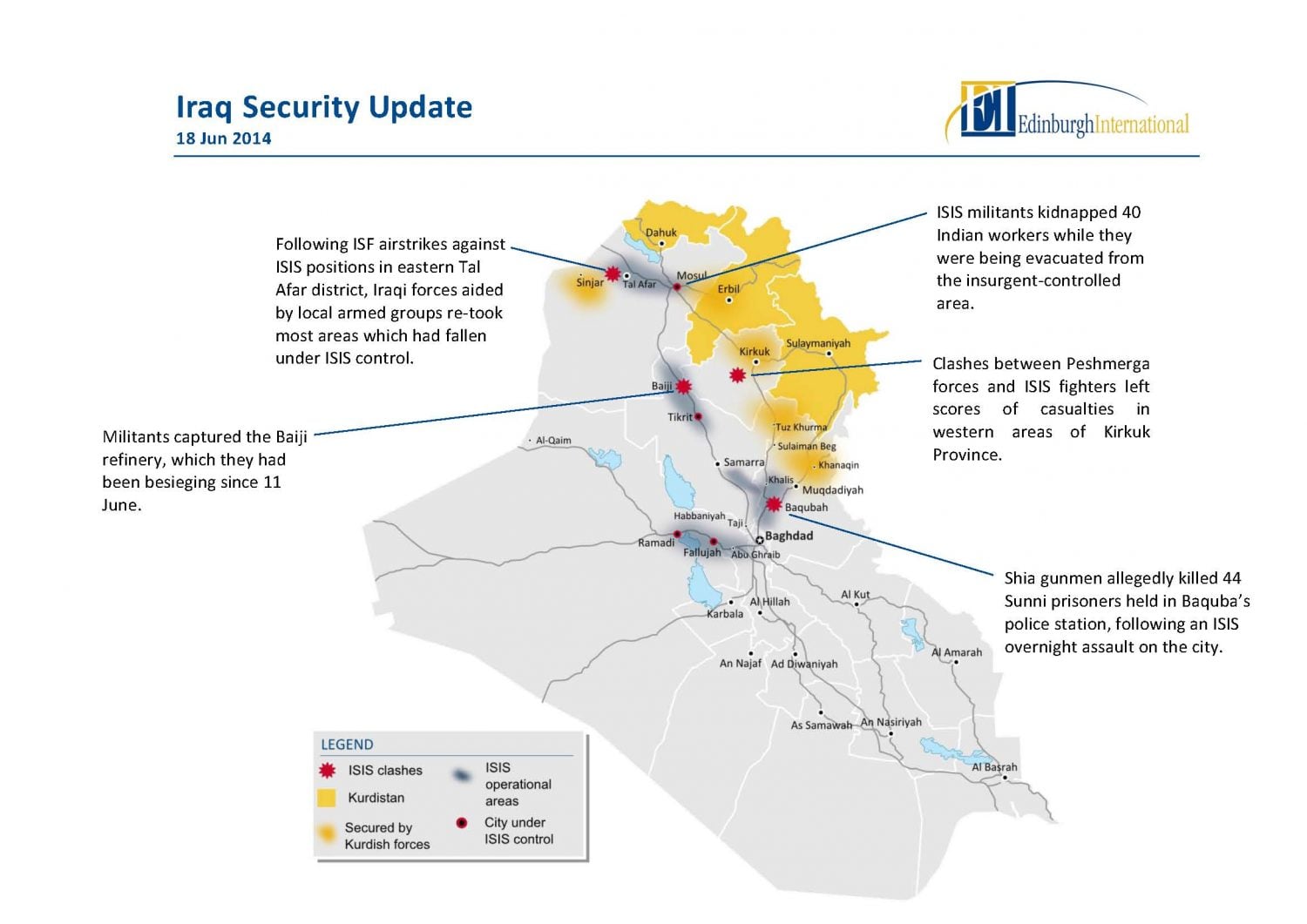
ISIS related violence in the last 48 hours
Tel Afar
The situation remains extremely fluid and reporting largely disrupted across the North. Iraqi forces backed by local police and Turkmen groups recaptured ISIS positions in the district of Tal Afar, which fell under ISIS control on Monday. These gains followed ISF airstrikes on eastern neighbourhoods of Tal Afar, which caused a number of militants to retreat from the area. Routes into Sinjar and towards Kurdistan are still under the protection of Kurdish Peshmerga forces who are conducting vehicle checks to prevent infiltration and suicide attacks.
Kirkuk
After clashes between Peshmerga soldiers and ISIS erupted in the village of Bashir, 34km south of Kirkuk, Sunni militants are now reportedly in control of the area. The fighting left at least three Peshmerga dead, and Kurdish forces were reportedly sending troops and vehicles to regain control of the town on Wednesday. This incident follows an ISIS statement offering a truce to Kurdish soldiers, who are also battling with ISIS in some disputed areas of Diyala. According to Kurdish sources, fighting is still ongoing in Hawija, Zab, Abasiya and Rashad districts of Kirkuk.
Diyala
Militant activity continued to be recorded between Baquba and Khanaqin, including in Kurdish-controlled areas such as the small city of Jalawla north to Muqdadiyah. Militants have been moving in and out of towns to disturb the organisation and allocation of Peshmerga forces across the province in order to seize unprotected areas.
Baquba
After the intense fighting on the outskirts of Samarra which saw the ISF reclaiming several positions between 11 – 16 June, ISIS has temporarily alleviated its pressure on the area to shift their focus on Baquba, the capital city of Diyala located only 50km to the northeast of Baghdad. As of latest reports, Baquba is still under ISF control, with ISIS briefly holding areas of Baquba on Tuesday night before being repelled by Iraqi soldiers and Shia militias. After a police station where dozens of Sunni prisoners were being held on terrorism charges came under ISIS attack, Shia gunmen (which some reports state were policemen) allegedly executed 44 of them.
Salahuddin
Despite the apparent tactical shift towards Baquba, the insurgency continues to be split across several fronts, with the northern part of Salahuddin still largely under ISIS control. Three more villages, Albu Hassan, Birwajli and Bastamli have reportedly been seized by ISIS after deadly clashes left 20 civilians dead. The situation is extremely fluid between Baiji and Samarra, with accounts of ISF troops leaving their remaining positions in the vicinity of Baiji to join up with soldiers stationed in Samarra. This movement follows an attack on the Baiji refinery late Tuesday with machine-gun fire and mortars, with fighting ongoing on the site throughout 18 June.
Baiji refinery
Militants now appear to control three-quarters of the facility, including the production units. The refinery was shut down on Tuesday and foreign staff evacuated. The Baiji refinery produces about 170,000 barrels a day and supplies northern Iraq. If permanent, its capture will certainly affect power supplies in the region, which may drive the ISF back to the northern front potentially re-tasking units currently operating in Diyala. Further south, skirmishes between ISF and ISIS were reported between Tikrit and Samarra, with militants setting several deserted ISF checkpoints on fire.
Posted in Weekly Security Update 5 Comments
Security Update 16 June 2014
Posted on 16 June 2014 .
By Anne-Laure Barbosa at Constellis Consulting www.constellis-consulting.com
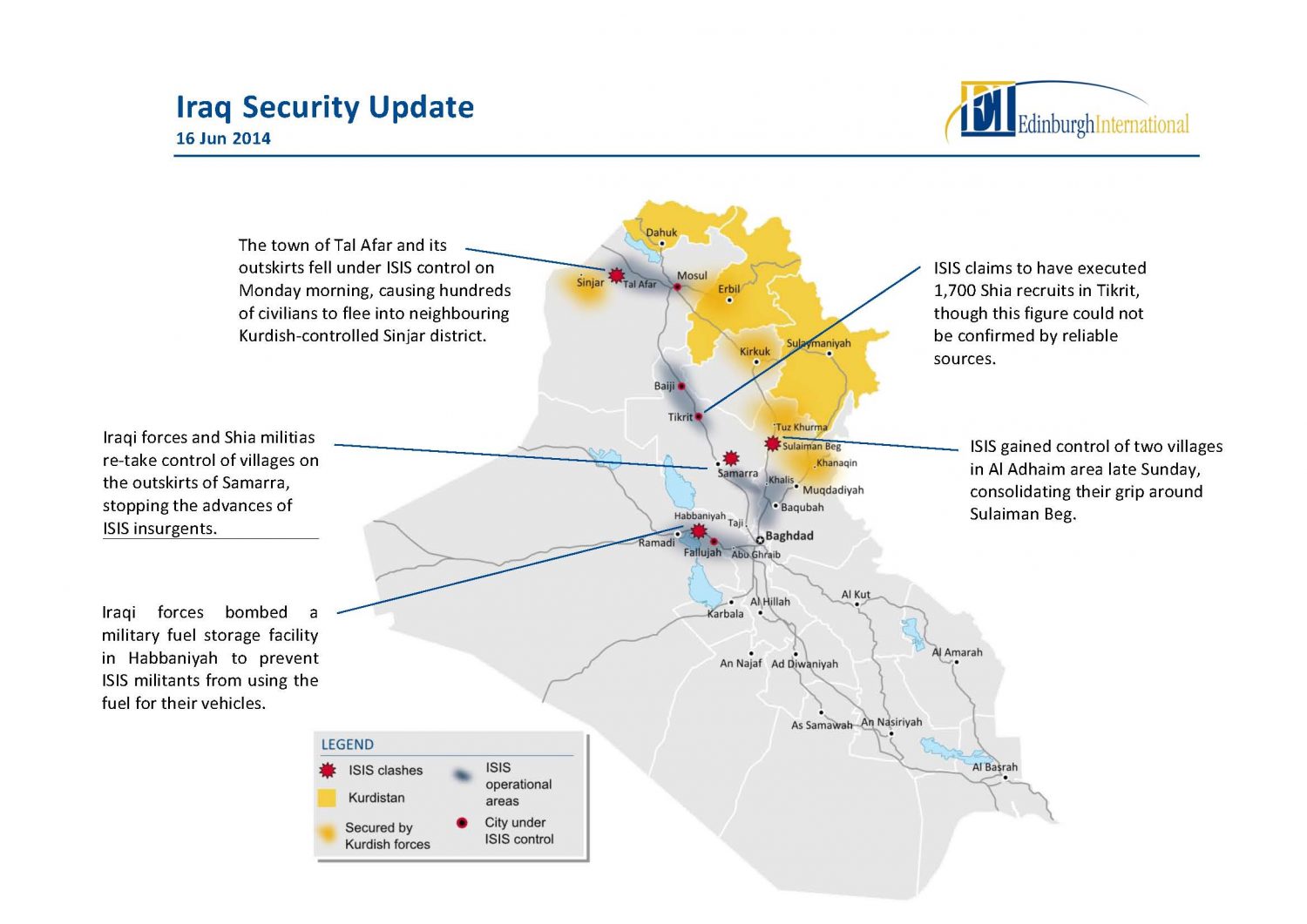
ISIS related violence in the last 48 hours
Tal Afar
The multi-ethnic and religiously-mixed town of Tal Afar, mostly populated with Sunni Turkmen, reportedly fell to ISIS insurgents early on Monday and is now being hit by Iraqi airstrikes. This development is neither surprising nor significant, as the majority of ISF ground troops have either fled, been captured or have found refuge in Kurdish-controlled districts of Nineveh. The ISIS takeover follows a refusal by Tal Afar leaders to allow Peshmerga forces to move into the city, from the Kurdish-controlled, neighbouring, disputed district of Sinjar. The capture of Tal Afar, a small town located 60 km west of Mosul and surrounded by rural areas, does not constitute a major breakthrough for ISIS forces seeking to push towards Baghdad.
Western Baghdad province and Anbar
The fall of Mosul and the lighting Sunni offensive advancing towards Baghdad from the North are currently determining the strategic movements of Iraqi troops, shifting their attention away from the Anbar frontline. This spectacular advance seems to have energised militant cells established in the West, with some attacks reported on targets close to the capital. On 11 June, five rockets hit Baghdad International Airport. Further IDF on BIAP has been reported in the last 24 hours. However, the increased motivation and mobility of ISIS troops within Anbar will not overcome the main challenges insurgents face in Fallujah and Ramadi, posed by Sunni tribal coalitions staunchly opposed to a permanent ISIS takeover in Anbar, despite sharing some of their grievances towards Maliki’s government. ISF counter-insurgency strategy has so far mainly consisted of shelling, curfews and reinforcement of checkpoints on roads towards western Baghdad. The northern offensive will have little to no impact on these actions and the situation is therefore expected to stagnate, with a western push towards the capital coordinated with the northern offensive unlikely. Instead, ISIS gains within Anbar are a stronger possibility, with militants advancing towards Haditha and Hit in western Anbar, and Habbaniya between Fallujah and Ramadi.
Diyala River Valley
Sporadic violence continued through the last 24 hours in the Diyala River valley although reports of continued ISIS advances are overplayed. Sunni militants, some of them ISIS cells, have failed to capitalise on the coordinated assaults of the last week and the town of Sulaiman Beg, north of Khalis towards Tuz Khurmatu remains the only significant settlement close to Diyala where militants have control. The Diyala Operations Command has identified that Sulaiman Beg will be the focus of a significant ISF operation in the coming week. The last 24 hours has seen ISIS claiming advances into Diyala around Al Adhaim suggesting an attempt to consolidate on their control of Sulaiman Beg. The seizure of these villages represent the only territorial gains in Diyala Province and do not threaten the major towns on the Diyala River. Following the ISF advance to re-take Muqdadiyah and Kurdish Peshmerga operations to secure Jalawla and Saadiyah, ISIS cells and other Sunni militants in the Diyala River Valley will continue to clash with these forces mainly on the outskirts of towns while established cells conduct bombings within them. ISF air and aviation operation continue to represent the greatest threat to Kurdish forces protecting towns with Kurdish communities such as Khanaqin and Jalawla. ISF air strikes and aviation assaults have killed and injured a number of Peshmerga fighters in the last 72 hours.
Samarra
As of 16 June, the main frontline between ISIS and ISF remained focused on Salahuddin province, north of Baghdad. After days of advances between 10-12 June which included the capture of Mosul, Tikrit and areas in the outskirts of Samarra, the ISIS push stalled near Samarra, where Iraqi troops regrouped and appear to be organising a counter-offensive to regain control of the north. The mobilisation of Shia militias helped contain the Sunni offensive, with the towns of al-Mutaim and Ishaqi, south-east of Samarra, retaken by the Iraqi army on 14 June. While unconfirmed, ISIS militants claimed to have executed 1700 Shia recruits in Tikrit, though this figure is most certainly exaggerated.
Posted in Weekly Security Update 8 Comments

Weekly Security Update, 03 - 09 June 2014
Posted on 10 June 2014 .
By Anne-Laure Barbosa at Constellis Consulting www.constellis-consulting.com
 Violent incidents sharply increased in their intensity over the reporting period with 453 fatalities recorded nationwide, doubling previous weekly figures. This significant uptick was prompted by a multi-front ISIS assault across the north, with militants attempting to seize cities in Salahuddin province, and succeeding in controlling parts of Mosul, Iraq’s second largest city, after days of fighting. These spectacular attacks demonstrate that ISIS is capable of launching mass-casualty assaults simultaneously and on several fronts, in the largest operation since insurgents seized Anbar’s Ramadi and Fallujah in December 2013. The wave of attacks, which took place on 05 – 07 June, occurred as the next government is still in the process of formation, with no sign of compromise among the deeply divided parties and blocs which emerged after the 30 April Elections.
On 08 June, Prime Minister Nouri Al-Maliki called for the parliament to declare a state of emergency in Mosul, after insurgents overran a military base and freed hundreds of prisoners. On 09 June, Kurdish Peshmerga forces were reportedly deployed to Mosul to protect their populations and prevent ISIS from seizing more terrain in areas bordering Kurdistan. As upcoming ISF operations attempting to retake control of Mosul are expected in the next days, the civilian death toll is set to increase. Aside from the humanitarian aspect of the crisis, rising violence will further compromise the chances of a rapid government formation, as Maliki’s rivals are unlikely to back policies which continue to antagonise Sunni populations and allow ISIS to extend their territorial reach. The capture of Mosul ensures that the majority of militant resources will continue to be concentrated in northern governorates, as ISIS strengthen their position and the ISF counterattacks.
North
Most of violence was concentrated in northern provinces, with several car bomb detonations recorded in Salahuddin, Diyala and Kirkuk. On 08 June, a coordinated assault on the PUK headquarters in Jalawla district killed 14 and injured 20. On 09 June, some 150 people were injured when a car bomb exploded in Tuz. Despite these mass-casualty attacks, the most significant event consisted of the multi-front ISIS assault on Mosul and towns of Salahuddin. On June 05, ISIS fighters stormed the town of Samarra, briefly taking control of several neighbourhoods before being expelled by Iraqi forces. Meanwhile, militants deployed throughout Suleiman Beg, a town overrun by ISIS earlier this year, and destroyed several houses. On 06 June, a violent assault on Mosul which resulted in days of fighting with ISF forces killed over 100 people in and around the city. Mortar shells falling on the al-Tink area, west of Mosul, killed 40 civilians and ISF elements. On 10 June, militants were reportedly in control of the Mosul airport, local TV stations and the governor's offices. Militants also freed nearly 1000 prisoners as they stormed a military base. The capture of large portions of Mosul means that ISF operations will militants will be hard to dislodge. It also ensures that the focus of ISIS will remain located in the north over the next weeks.
Central
 Despite a noticeable concentration of resources in the north, militants continued to hit Baghdad with series of car bomb attacks, coordinated with large-scale assaults conducted on 05 – 07 June elsewhere in the country. On 07 June, four VBIEDs detonated in sequence across the capital. The most significant incident occurred in the Shia-dominated district of Karadah, where a car bomb explosion killed ten civilians and injured 25 others. On 09 June, six civilians were killed and 22 others injured in two separate bombings in the capital. Meanwhile, intense fighting continued in Anbar province, with clashes erupting in the towns of Garma and Sichir, north of Fallujah and in the southern part of Ramadi, where gunmen stormed Anbar University and briefly took hostage some of the students and professors. Three guards were killed in the attack, with additional incidents consisting of VBIEDs and IEDs on bridges and checkpoints. As government resources are likely to become absorbed by the crisis in Mosul, insurgents could take advantage of the situation to seize terrain closer to Baghdad. Levels of violence are therefore expected to increase over the next weeks.
South
As previously assessed, and despite the car bomb detonations in Najaf and Dhi Qar last week on 02 June, the pattern of mass-casualty expeditionary attacks remains disrupted and violence levels across the south were consistent with previous averages. On 04 June, a VBIED killed seven civilians and injured 65 others in Hilla, while IEDs and small arms attacks caused additional casualties among ISF members and civilians. Outside Babil, Basra remained the most violent southern province, though reported incidents were mainly the product of intra-Shia violence. On 07 June, fighting between al-Gitran and Bani Saad clansmen resulted in one fatality, while other cases of tribal violence resulted from heightened tensions between Shia blocs in the aftermath of divisive elections. As militants remain focused on the north, with an intensification of efforts in Nineveh and Salahuddin, south-eastern provinces are expected to remain free from major attacks over the next weeks. Despite this trend however, the commemoration of the twelfth Imam’s birthday on 14 June could prompt attacks against Shia pilgrims on their way to Karbala, though violent incidents are likely to be concentrated in Baghdad and Babil.

Posted in Weekly Security Update 2 Comments

Weekly Security Update 27 May - 02 June 2014
Posted on 03 June 2014 .
By Anne-Laure Barbosa at Constellis Consulting www.constellis-consulting.com
 Casualty figures released in June indicated that nearly 800 people were killed in violence across Iraq in May, making it the deadliest month so far this year. This uptick in violence moved in parallel with an increase of tensions in the political sphere, as divisive and opaque parliamentary negotiations confirm that a next government is unlikely to materialise in the short term. Amid rumours that PM Maliki’s State of Law coalition has concluded an initial agreement with the Patriotic Union of Kurdistan (PUK), the increased appetite for militants to strike Shia interests has been reflected in a return of mass-casualty incursions in the south-eastern governorates. Despite these unconfirmed claims, other parties which include the Kurdistan Democratic Party (KDP), the Sadrist bloc and the Islamic Supreme Council of Iraq (ISCI) have voiced their opposition to a government orientated around Nouri al-Maliki. On May 27, Kurdish President Massoud Barzani threatened to organise a referendum on independence in the event that Maliki wins a third term. Protracted coalition-building will continue to impact on the government capacities to contain the insurgency, as resources remain absorbed by the political process. With unchanged circumstances in Anbar, continued militant appetite to strike ISF targets and a government formation process which widens divisions both along sectarian lines and within Shia tribal factions, levels of violence are expected to continue increasing over the next months.
North
Levels of violence across northern governorates remained elevated, amid a substantial increase in the number of incidents recorded in Nineveh, where seven car bombs caused dozens of casualties in Mosul district. In the most significant attack, two VBIEDs detonated in two areas of Mosul, killing two policemen and injuring 12 civilians. The governorates of Salahuddin, Kirkuk and Diyala displayed incident levels consistent with previous weekly averages, both in their intensity and frequency. Nineveh was the only northern province witnessing VBIED incidents, as militants temporarily shifted their efforts towards central and southern targets. While Kurdistan remained free from major incidents, the relatively large share of seats earned by Kurdish lists in the elections has allowed Erbil to translate their leverage against Baghdad into bold policies. Following the first independent oil sale to Turkey, and despite threats of legal actions from central authorities, Massoud Barzani reaffirmed the constitutional rights of Kurdistan to manage their own trade agreements. The presence of ISIS strongholds around Baghdad guarantee that militant resources will remain concentrated in northern governorates over the next weeks.
Central
 Violence in central provinces remained defined by security dynamics aligned with previous weekly reports. Baghdad continued to attract the majority of complex attacks, with five car bombs recorded in several districts of the capital. The most significant of these incidents occurred in Ameen district, as a VBIED killed five civilians and injured 20 others. On May 27, a militant wearing a suicide vest detonated himself in the Al-Shorja market area of central Baghdad, killing 13 civilians and injuring 25 others. Another suicide attack displaying similar tactics caused 17 fatalities and wounded an additional 30 people. As the situation in Anbar stagnates, the crisis has become a means for political leaders to raise their personal profile and gain legitimacy. On June 02, ISCI leader Ammar al-Hakim and Sheikh Ahmed Abu Risha, a prominent Sunni tribal leader in Anbar, met in Baghdad to discuss the political process and the insurgency in the country’s western desert. While discourses alone are unlikely to affect the situation in Anbar, the crisis is regularly manipulated by political parties to justify their opposition to Nouri al-Maliki, who currently seems in an advantageous position to remain Prime Minister. Security dynamics will continue to reflect political stagnation in Baghdad and levels of violence are therefore expected to be maintained across central governorates.
South
In contrast with previous weekly reports, southern provinces were marked by a return of expeditionary VBIED attacks. A car bomb detonated in Dhi Qar on June 02, as the first incident of this type in south-eastern provinces since April 20. The attack was coordinated with a second car bomb explosion in Najaf, which caused dozens of casualties. Despite this change in security dynamics, the pattern of regular mass-casualty attacks remains disrupted and has been replaced with limited and sporadic incursions into Shia-dominated governorates, where the violence remains largely concentrated in Babil and Basra provinces. On June 02, a VBIED detonated in the Asriyah Village north of Babil, killing two civilians and injuring four others. Other reported incidents continued to consist of IEDs against ISF targets, while heightened tribal tensions were responsible for a substantial increase in violence levels in Basra, with skirmishes and targeted shootings causing casualties. Considering the widening tensions between the various Shia coalitions as the political process fails to form a legitimate government, levels of violence are set to continue increasing over the following weeks.

Posted in Weekly Security Update Comments Off on Weekly Security Update 27 May - 02 June 2014

Weekly Security Update 20 - 26 May 2014
Posted on 27 May 2014 .
By Constellis Consulting www.constellis-consulting.com
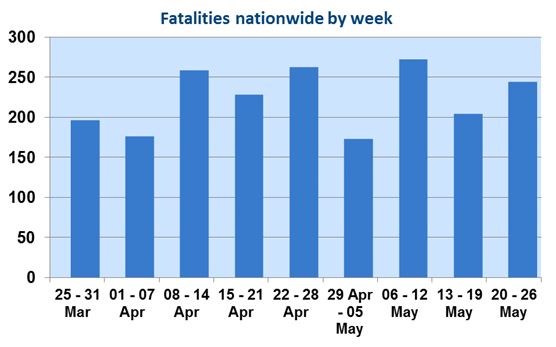
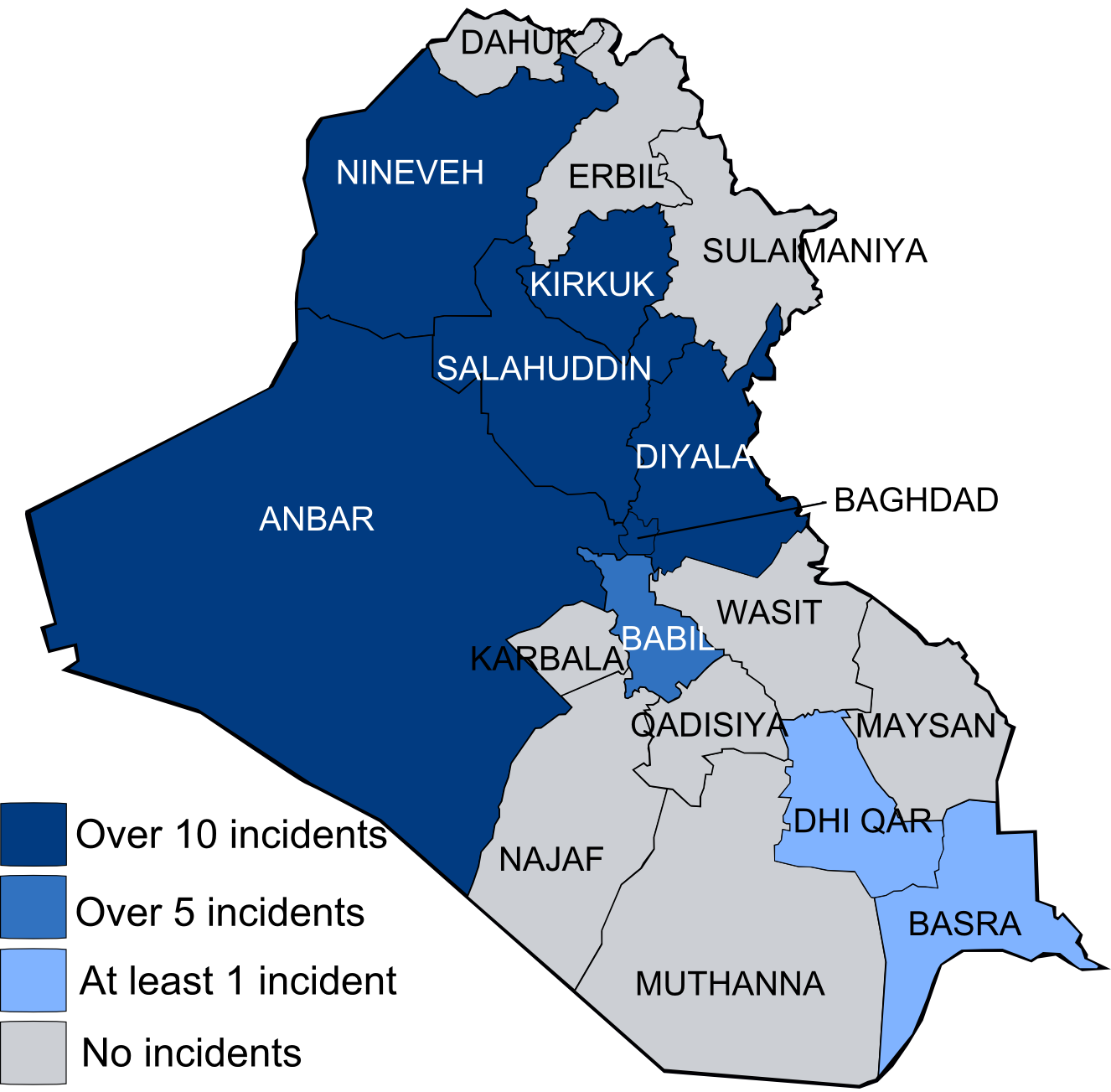 Following preliminary electoral results confirming current Prime Minister Nouri Al-Maliki as the frontrunner, allegations of fraud multiplied over the reporting period, putting in jeopardy the process of quickly forming a government. On 22 May, former Prime Minister and leader of the Iraqiyya coalition Iyad Allawi publicly questioned the fairness of the elections, formulating veiled accusations against Maliki and his perceived autocratic leadership aimed at surviving politically. Accusations emerged both from within and without the Shia community, meaning that a Shia coalition is unlikely to materialise in the short term. Aside from Allawi’s bloc, the Sadrist movement and Kurdish lists, which are likely to be necessary for Maliki to form a majority in parliament, remain staunchly opposed to an alliance with the State of Law coalition. The next few weeks are therefore expected to witness negotiations on sensitive issues such as the oil and budget disagreements between Erbil and Baghdad. In parallel with electoral disputes and general stagnation in the political sphere, levels of violence recorded this week substantially increased across Iraq. This uptick in complex assaults coincided with Shia celebrations honouring the death of Imam al-Kadhim, one of the twelve successors to Prophet Muhammad. Aside from this event, which drew a considerable amount of militant resources, the frequency and intensity of attacks remained aligned with previous weekly averages, due to unchanged circumstances in Anbar and continued ISIS operational capabilities in the north. As assessed in the previous reporting period, competition between the various Shia parties continued to fuel tensions in the south, with several accounts of tribal fighting. As such, security dynamics are expected to remain consistent with continued political stagnation, with incident levels unlikely to witness drastic changes over the next weeks.
North
Levels of violence across the north witnessed a substantial uptick, with several mass-casualty incidents targeting civilian populations in all provinces, excluding Kurdistan. In Diyala, four Iranian workers were killed when a roadside bomb struck a convoy of vehicles belonging to an Iranian company building a gas pipeline. In a separate incident, a car bomb which hit a residential area in Kirkuk killed ten civilians and injured dozens. In Salahuddin, a suicide bomber detonated a VBIED near the al-Rayash checkpoint on the Tikrit-Baji road in Hajjaj Village, killing two soldiers and injuring eight others. Meanwhile, Nineveh continued to attract the majority of attacks, with several VBIEDs detonating in the Mosul area and causing scores of casualties. Kurdish provinces remained free from major incidents, amid new developments regarding the oil and budget disputes. While Kurdistan’s Prime Minister Massoud Barzani affirmed that Kurdish parties had overcome their internal differences, this move is likely aimed at obtaining concessions from Baghdad on oil exports to Turkey. Expectations are that Kurdish lists will remain unified as long as their coalition is able to capitalise on electoral divisions to extract benefits from the central government. Elsewhere across the North, violence levels are expected to remain unchanged.
Central
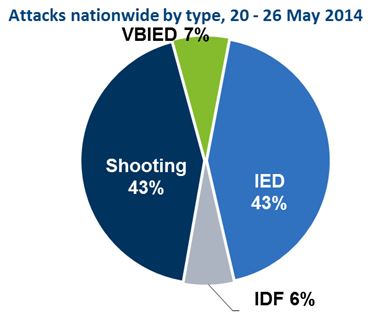 At least 35 pilgrims were killed in three suicide bombings across the capital, as they converged on the shrine of Imam Kadhim in western Baghdad, ahead of a religious festival commemorating the Shia martyr’s death. In eastern Baghdad, a mini-bus approached a crowd of pilgrims near Tayaran Square and caused 14 fatalities. In Mansour, the capital’s western neighbourhood, a parked car exploded, killing six. Another bomb detonated in a parked vehicle in the capital’s east, also hitting a group of pilgrims. The most significant incident occurred in the Al-Sha’ab area, as a car bomb detonated against a crowd and caused nearly 50 casualties. Pilgrimages are frequently targeted by Sunni militants due to the high likelihood of hitting large numbers of civilians. In Anbar, four people were killed and 19 others wounded by artillery shelling on several neighbourhoods of Fallujah, amid government claims that the army had succeeded in retaking key areas of Ramadi. A car bomb went off in in the vicinity of a government compound in Haditha, killing three policemen and injuring five civilians. Claims that government forces are retaking insurgent-controlled territories are more likely a reflection of current divisions, as parties tend to use the Anbar crisis as a political tool to undermine their rivals. As most government resources remain absorbed by the coalition-building process, any shift in the security dynamics is unlikely in the short to medium term.
South
Political tensions, particularly between Shia factions, have been the main driver behind the increase in tribal fighting observed in the south-eastern provinces in the past weeks. On 22 May, skirmishes between Bani Malik and Albu Bakhit tribesmen in Basra ended without any casualties. Drive-by shootings also killed two individuals in the province, while tribal fighting involving several clans in Dhi Qar resulted in one serious casualty. While this trend should be maintained as political divisions are not expected to show any signs of improvement in the short term, Babil remained the prime focus of insurgents. Between 20 and 24 May, three car bombs detonated in residential neighbourhoods, injuring scores of civilians. Though the threat level across south-eastern provinces remains elevated, major incidents occurring over the next weeks should remain the product of internal Shia divisions rather than a result of expeditionary attacks from the north.
Posted in Weekly Security Update Comments Off on Weekly Security Update 20 - 26 May 2014

Weekly Security Update 13 - 19 May 2014
Posted on 20 May 2014 .
By Constellis Consulting www.constellis-consulting.com
 Initial election results released by the Independent High Electoral Commission on May 19 showed that Prime Minister Nouri Al-Maliki’s State of Law coalition won the largest share of seats, with at least 94 elected MPs in the 328-member parliament. Though previous estimates predicted that Maliki’s party would lead the polls, proportions exceeded expectations as the Sadrist bloc and the Islamic Supreme Council of Iraq (ISCI), his two main Shia rivals, only picked up 28 and 29 seats. Kurdish lists gained a total of 62 seats, while the two main Sunni coalitions won at least 33 seats. The secular coalition headed by Iyad Allawi took 21 seats, reflecting the limited appetite for cross-sectarian platforms, a stark contrast to the 2010 parliamentary elections. While Iraq enters a difficult negotiation phase in which Maliki’s rivals will form alliances and attempt to extract concessions, increased tensions translated into a series of deadly incidents against civilians, with a noticeable return of VBIED sequences to the capital. The challenge of forming the next government will not only be solved with the co-optation of parties through government positions, but will also depend on the ability of leading blocs to reach some degree of consensus on divisive issues. The task of reaching out to rivals will be particularly difficult for Maliki, who has not only antagonised Sunnis and Kurds, but also Shia parties which oppose policies seen as sectarian and fuelling conflict. Although southern provinces continued to be insulated from major attacks, divisions between Shia parties grew in parallel with intra-Shia violence, which has witnessed an uptick in the past weeks. These initial election results are unlikely to satisfy Maliki’s rivals, and most coalitions are expected to appeal the results before the judiciary over the next weeks. These procedures will further hinder the political process, with government formation likely to take at least six months and translate into increased tension and violence.
North
The frequency and intensity of attacks reported across northern governorates remained consistent with previous weekly averages, with main incidents concentrated in Nineveh and Salahuddin. On 13 May, a VBIED explosion caused 13 casualties in Salahuddin. On 14 and 15 May, two car bombs detonated in the multi-ethnic province of Kirkuk, which witnessed competitive elections between various Kurdish and Arab lists. Series of IEDs and small arms attacks continued to mirror the worsening security situation in northern governorates, with claims of electoral frauds likely to fuel discontent and energise ISIS militants. Though Kurdistan remained free from major incidents, the position of Kurdish leaders will be determinant with regard to government formation. The preliminary results achieved by the Kurdish lists, which won more than 60 seats, are indeed likely to give leverage to Erbil in the post-election negotiations, with oil and budget disagreements with Baghdad expected to draw closer to consensus in the next months. Meanwhile, current levels of violence are likely to be maintained in all northern provinces, as government resources will continue to be absorbed by the electoral process.
Central
 In line with the trend identified last week, the number of VBIED incidents witnessed in Baghdad continued to increase over the reporting period. On 13 May, a series of car bombs hit the capital and killed at least 28 people. Two car bombs initially detonated in the neighbourhood of Sadr City, while a third one exploded in a commercial street of Jamila district, eastern Baghdad. A fourth VBIED subsequently detonated in the same area, killed four people. Electoral tensions were also mirrored in incidents targeting political figures. On May 18, a Shia politician was reportedly kidnapped by militants. In a bid to further destabilise the government, ISIL militants seem committed to concentrating the majority of their resources on the capital, which has been facilitated by the security vacuum prevailing in neighbouring Anbar. The majority of ISF operations continued to focus on Ramadi and Fallujah, which the government has been attempting to recapture for five months. On 14 May, three policemen were injured in the district of Hit, when a VBIED exploded near a police station. While the electoral campaign largely focused on the Anbar crisis and its perceived mishandling, any drastic movement on the issue is unlikely over the next weeks. In light of current political and security dynamics, violence across central governorates will remain elevated.
South
Divisions between the main Shia factions were reflected in an increase in tribal fighting across southern provinces, with tensions expected to increase in the next weeks. Despite an absence of car bombs which continues to demonstrate that ISIL militants remain focused on Sunni-dominated areas of the country, intra-Shia violence translated into drive-by shootings targeting individuals in the provinces of Basra, Maysan and Qadisiya. Despite this change of dynamics, most incidents remained concentrated in Babil governorates, with series of IEDs hitting ISF checkpoints. Preliminary election results, which gave a large advantage to Maliki’s coalition, are likely to inflame existing tensions, with incident levels expected to rise across south-eastern provinces.

Posted in Weekly Security Update 1 Comment

Weekly Security Update 06 - 12 May 2014
Posted on 13 May 2014 .
By Constellis Consulting www.constellis-consulting.com
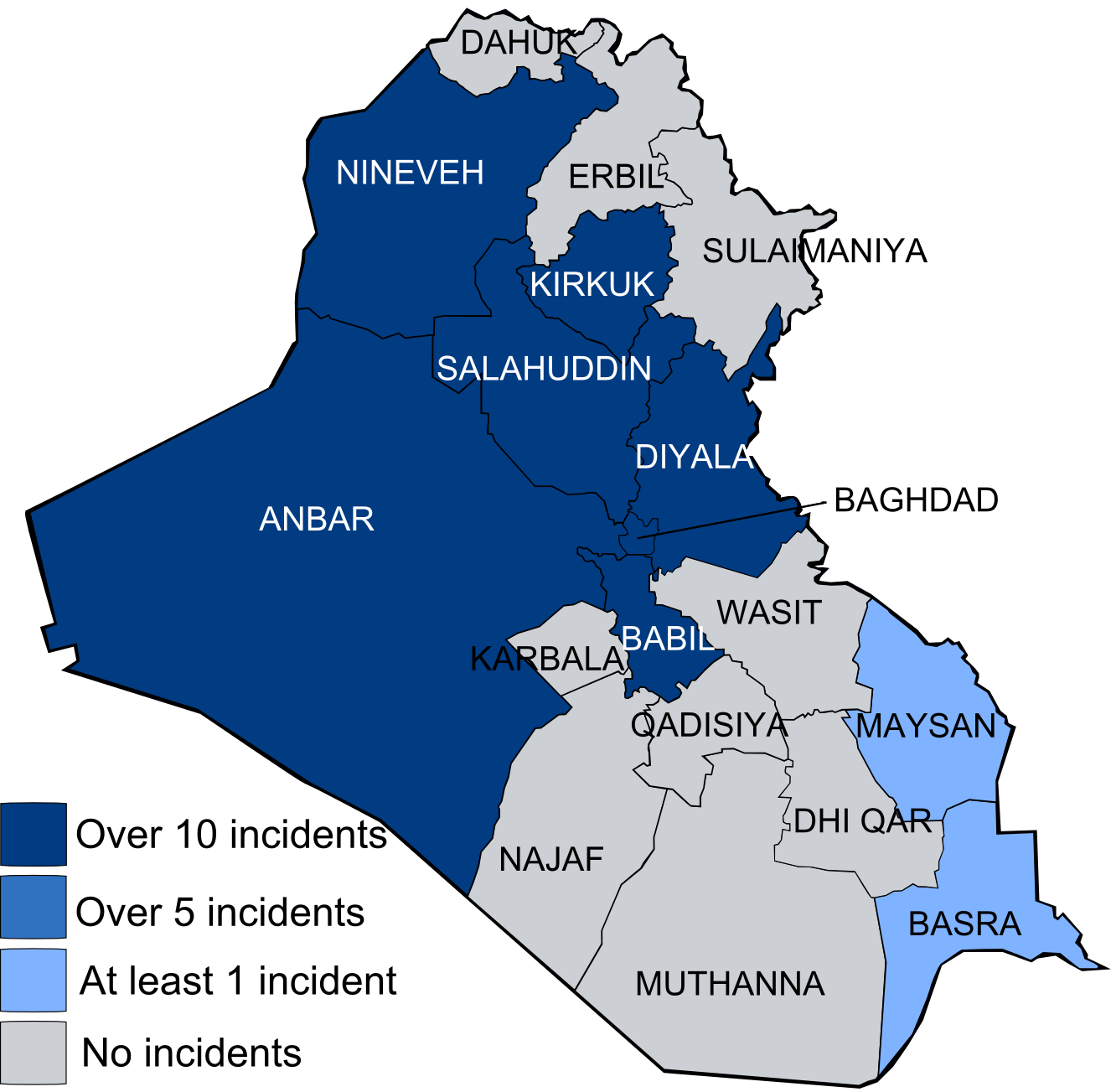
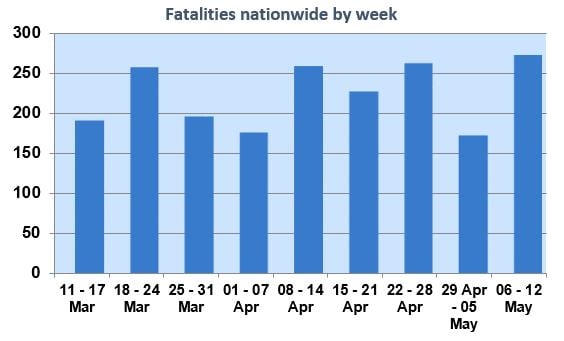
With official results due in the next few days, electoral manoeuvres defined Iraq’s political environment this week, with party leaders seeking to form alliances and build coalitions to advance their own interests. Ultimately, the ability of political figures to navigate this system, more than the poll results, will determine the shape of Iraq’s next ruling coalition and government. Ammar al-Hakim, leader of the Islamic Supreme Council of Iraq, has been multiplying calls to reinvigorate an alliance inclusive of the main Shia parties. These manoeuvres may result from a strategy to extract concessions from the State of Law coalition, which likely received the most votes, though certain groups such as the Sadrists seem to have invested too much in anti-government actions and rhetoric to side with Nouri al-Maliki in the aftermath of the elections. Fighting between government forces and Sunni insurgents in the northern and central provinces continued to reflect extreme polarisation in the political sphere, with coalition leaders increasingly appealing to their own sectarian bases. While Maliki poses as a Shia champion against the insurgency, Usama al-Nujaifi, leader of the largest Sunni bloc, described Maliki’s campaign as an all-out war against Sunni Arabs. The negotiation of alliances, and subsequent government formation, will indeed be complicated by a lack of unity stemming from personal disagreements and diverging views on the country’s political trajectory. Following relatively peaceful elections on 28 and 30 April, largely due to increased security measures and checkpoints around key polling stations, incident levels witnessed a considerable uptick over the reporting period, with a return of VBIED attacks in Baghdad and surrounding governorates. As upcoming results are unlikely to appease radical Sunni elements and government policies will most certainly continue to be driven by electoral interests, violence is likely increase across Sunni-dominated areas, with series of car bombs to be expected in restive districts over the next weeks.
North
As levels of violence increased across the north, Nineveh and Salahuddin continued to concentrate most of the complex attacks and incidents. On 10 May, at least 25 Iraqi police and army personnel were killed and 13 injured in the provinces of Nineveh and Diyala. On 11 May, militants ambushed a military convoy and killed 20 soldiers near Ain al-Jahash, Nineveh, in the deadliest execution-style attack against the ISF. On 12 May, seven civilians and two soldiers were killed when a car bomb detonated near a checkpoint in Tikrit. Series of IEDs and small arms attacks continued to mirror the worsening security situation in northern governorates, with poll results likely to fuel the insurgency. The increase of violence levels, both in frequency and intensity, largely results from the establishment and consolidation of militant bases in Nineveh, Salahuddin and Diyala, which have allowed insurgents to stage complex attacks against the ISF. While Kurdish provinces remained free from major security incidents, Erbil is likely to attract increasing political attention over the next weeks. While Kurdish authorities are still embattled with Baghdad over budget allocation and oil exports, the poll results due in the next days will measure the leverage earned by Kurdish parties against the leading coalition, impacting on the trajectory of bilateral disputes.
Central
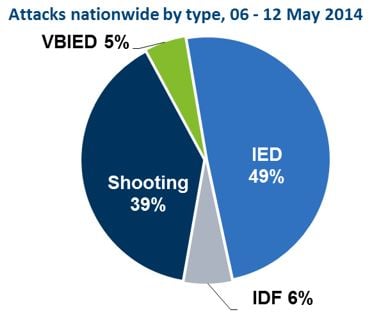
Following an unusual absence of car bomb attacks in Baghdad last week, VBIED incidents returned to the capital, with six detonations causing dozens of casualties across northern and eastern Shia-dominated districts. The timing of the attacks, on 10 and 12 May, could mean that additional VBIEDs are due this week in Baghdad, with the civilian death toll set to increase. After a relatively peaceful election period facilitated by the concentration of government resources on the capital, Sunni radicals will capitalise on the re-deployment of troops to neighbouring provinces to strike Baghdad with further assaults on civilians and ISF assets. Meanwhile, the situation in Anbar continues to be stagnant, with the fighting reportedly intensifying in Fallujah and key areas of Ramadi still under insurgent control. On 06 May, two car bombs targeted two army checkpoints, while renewed shelling on civilian neighbourhoods of Fallujah contributed to an uptick in civilian deaths across the province. On 11 May, Iyad Alawi, leader of the Wataniya Alliance, denounced the government’s treatment of the Anbar crisis, while Sunni tribal leaders met in Erbil to discuss options likely to promote dialogue. The absence of concrete measures undertaken by the government, which appears increasingly disengaged from the Anbar front despite the impact of the insurgency on the economy, will do little to improve the situation and levels of violence should be sustained over the next weeks.
South
Despite an elevated level of threat maintained across the southern provinces, the intensity and frequency of violent incidents remained consistent with previous weekly averages and the majority of attacks were confined to Babil. While ISIL militants mainly targeted ISF elements through the use of roadside bombs against army convoys, the nature of attacks recorded in Babil contrasted with the type of incidents occurring in the south-eastern governorates of Basra and Maysan, which witnessed drive-by shootings consistent with the methods used by Shia militias against their political rivals. Though VBIED expeditionary attacks cannot be ruled out as security measures are reduced, most incidents against south-eastern locations should rather involve actions against local political figures, with the situation likely to remain tense as lenghty post-election negotiations continue to reflect disagreements over unity amongst various Shia groups.
Posted in Weekly Security Update Comments Off on Weekly Security Update 06 - 12 May 2014